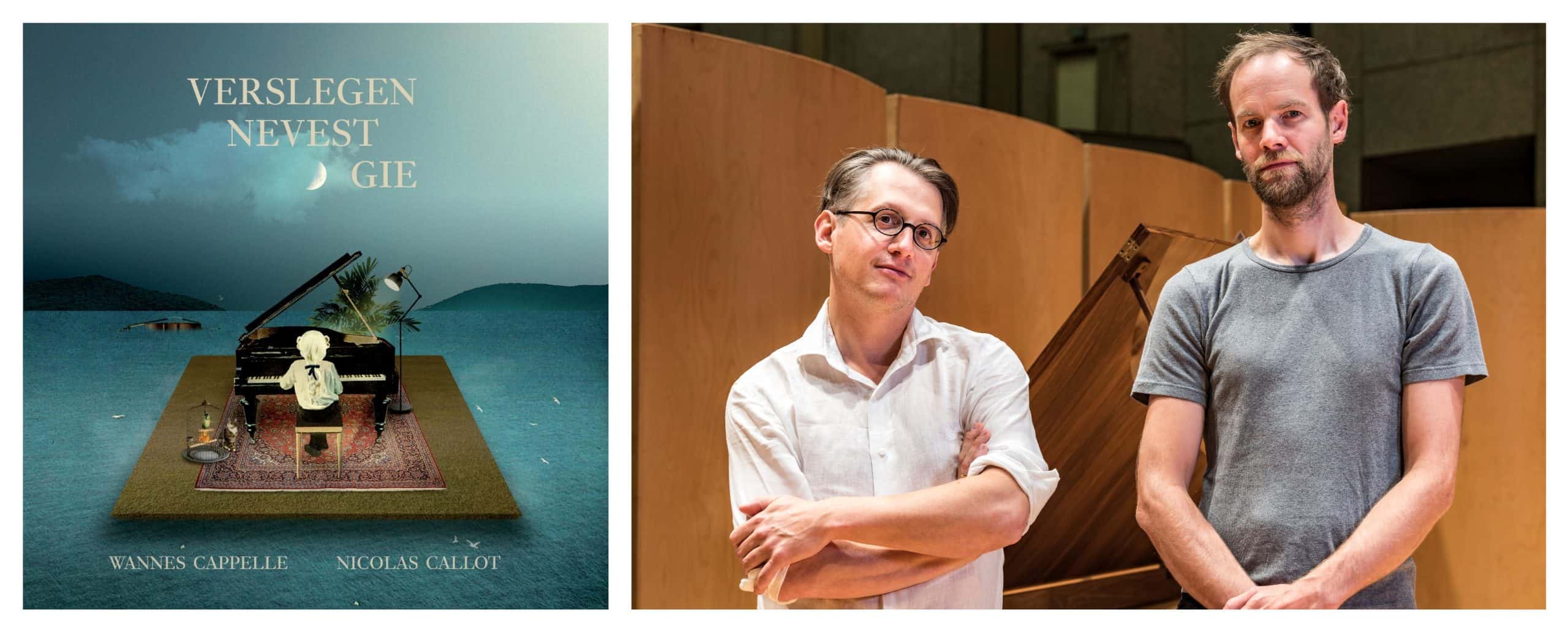
Mozart in West Flemish, that's what's written in capital letters on the back of their brand new CD. Two years after Come on, knock me over!, their remarkable collaboration on a selection of songs by Franz Schubert, pianist Nicolas Callot and Wannes Cappelle, frontman of Het Zesde Metaal, are joining forces again. "You can clearly see that we've taken a step forward in every way. The way we've delved into the material and worked with it was much freer this time."
At the closing concert of the Festival van Vlaanderen Kortrijk in February 2019, it was still a bold leap into the unknown: classical art song, but with a West Flemish accent—what would that yield? Today, pianist Nicolas Callot and singer Wannes Cappelle are already thinking about their next project. "It's simply too much fun. I don't see why we would stop," says the frontman of Het Zesde Metaal at the end of our interview. After Come on, knock me over!, a recording of works by the lieder composer par excellence Franz Schubert (1797-1828), both gentlemen have now delved into the oeuvre of Wolfgang Amadeus Mozart (1756-1791). Downright clever you yields another dozen reworked numbers and considerable linguistic virtuosity, as the audience discovered in late October during Everyone Classical in Bruges. It was the forerunner of a tour that kicks off on December 9 at Cultuurcentrum Everberg, and you'll find the performance dates listed at the bottom of this article. The conversation with Callot and Cappelle takes place on the top floor of the KBC Arteveldetoren, a twenty-five-story structure that no one passing Ghent along the E40 can miss. Here in the auditorium, the new Mozart songs will soon be presented to the bank's clientele. But before that happens, both musicians cheerfully answer a series of questions, and notably in Standard Dutch.
When you started this adventure together in 2019, you had to humbly admit, Wannes, that you knew nothing about classical music... What have you learned about this music since then; do you perhaps look at classical music differently now?
Wannes Cappelle: What I knew about classical music actually came from music school. I played piano until I was sixteen. So I knew, for example, Serenade by Schubert, but I didn't realize there was a text to go with it (chuckles). Classical music always seemed somewhat on a pedestal to me, but since working with Nicolas, that world has come much closer to my own background in pop music. Now I can take a Mozart song and figure out for myself which chords I can use to play that music on a guitar as well, which makes the genre more understandable and in a sense more human. And at the same time, you also see its genius better. It's also quite wonderful when a score, which is essentially a lifeless thing, is brought back to life. You're re-creating something, and what you do in that way is so personal and tied to the moment in which you're playing the music.
I had to work enormously hard to sing all those classical songs at an acceptable level. Some notes and tones are really high-pitched, and of course I have to make sure I can pull them off. I actually started realizing for the first time that repetition is the key, until the note comes out the way it should. I've become much more disciplined with voice exercises, even though I've already been singing for twenty years. It's as if I'm only learning things now, and that's a wonderful thought. So there's still room for improvement, at my forty-three.
After Schubert, you're now putting all the spotlight on Wolfgang Amadeus Mozart, undoubtedly an even more famous composer, though not primarily for his art songs, but rather for his wildly popular operas. How did you go about choosing the music this time; what considerations influenced this decision?
Nicolas Callot: For the music selection, I naturally made a suggestion, but ultimately we decided together what we would record. I made a selection from the limited number of Mozart songs that exist. The number of arias was also limited, because there aren't that many that fit Wannes's voice type. I started looking more for intimate moments, such as Come to the window for example, the love song from the opera Don Giovanni. So I was thinking more about the vocal and musical side, and then Wannes started working on the texts and indicated what he could really get his teeth into. That way we also let a few pieces drop. It's quite possible that the repertoire will be expanded again during the tour, like what also happened with Schubert.
With Mozart, the selection process was a bit more difficult because, unlike Schubert, he didn't work with those great poets. There is a text by Goethe included, but the other material is somewhat obscure and of lesser depth. And yet Mozart chose those texts for a specific reason. It's fun and enriching to figure out what those reasons actually were. It turns out that there's often a double meaning and something quite ironic in the texts. They don't always illustrate the music and vice versa, which is completely different with Schubert. It's precisely that duality in Mozart that's interesting and at the same time fascinating to discover. It also made it sometimes more challenging to get everything on a musical footing at first.
Is there a specific aria or song that absolutely had to be on the CD?
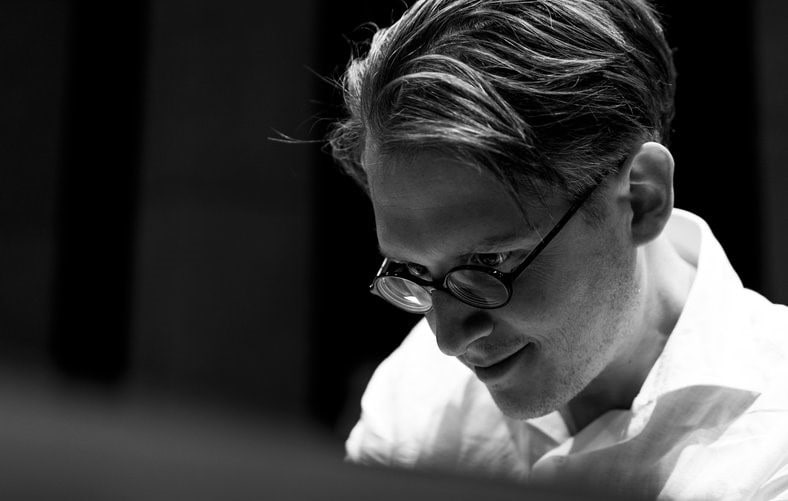
Nicolas Callot: "There's often a double meaning and something quite ironic in the texts that Mozart set to music. It's precisely that duality that's interesting and at the same time fascinating to discover."
Callot: I find this a difficult question. You see, if you look at the {{NOTRANSLATE_1}} numbers for the most-listened-to tracks, you notice that the first track on a CD is generally the most listened to and the last track the least. So you think carefully about what you'll put as the first track on the CD. In our case, that's {{NOTRANSLATE_2}}, which you hope will convince people to keep listening, even if it's not necessarily our best track. And I think that's important: that the CD is one whole and offers one listening experience. It's in that overall experience that the listener should immerse themselves, from beginning to end, even if perhaps one track takes on a life of its own because it's more popular than all the others. There are albums out there that you can only listen to straight through, from a to z, without shuffling or anything else. Only that way do you follow the arc of tension that the artist builds. Cappelle: Choosing a single for the radio was indeed a challenge. From a text perspective, I found {{NOTRANSLATE_3}} for example very close to what I myself would write as a text. And {{NOTRANSLATE_4}} was also a wonderful text to translate for me. But like Nicolas, I find it difficult to choose. Because {{NOTRANSLATE_5}} is also really beautiful ({{NOTRANSLATE_6}}). So let's ultimately stick with {{NOTRANSLATE_7}}, the last track on the CD. The concept of {{NOTRANSLATE_8}} is of course comparable to {{NOTRANSLATE_9}}, your successful Schubert lieder recording, even though the composer is indeed different. Apart from the composer, are there any other differences between the two recording projects in terms of content or form? Come, Sweet Zither, which you hope will convince people to keep listening, even if it's not necessarily our best track. And I think that's important: that the album is a cohesive whole and offers one complete listening experience. It's in that total experience that the listener should immerse themselves, from beginning to end, even if perhaps one track takes on a life of its own because it's more popular than all the others. There are albums that Cappelle: Choosing a single for the radio was indeed a challenge. From a text perspective, I found {{NOTRANSLATE_3}} for example very close to what I myself would write as a text. And {{NOTRANSLATE_4}} was also a wonderful text to translate for me. But like Nicolas, I find it difficult to choose. Because {{NOTRANSLATE_5}} is also really beautiful ({{NOTRANSLATE_6}}). So let's ultimately stick with {{NOTRANSLATE_7}}, the last track on the CD. you can only listen to straight through from start to finish, without shuffling or anything else. Only that way do you follow the dramatic arc the artist builds.
Cappelle: Choosing a single for the radio was indeed a challenge. From a lyrical perspective, I found Lullaby for example, very close to what I myself would write as lyrics. And also Evening Feeling I found a wonderful text to translate. But I find it just as difficult to choose as Nicolas does. Because Song for the Journey I also think is beautiful (""). So let's ultimately go withlaughsthe last track on the album. Evening Feeling The concept of
is of course comparable to Downright clever you , your successful recording of Schubert songs, although the composer is obviously different. Besides the composer, are there any other differences—in terms of content or form—between the two recording projects? Come on, knock me over!Sammy Slabbinck
Callot: I don't think so, no. There are actually many parallels to draw between both projects. First and foremost, it's a continuation. You can see that immediately in the cd design, because for the artwork we went back with Steve Dugardin to collaborate, who created a witty cover. At the same time, it's also an evolution: you can clearly see that we've taken a step forward on all fronts. The way we've delved into the material and handled it was freer this time. Not that we were completely loose with things, but by digging and exploring, you give yourself more room to play. Mozart is certainly a different spirit of the times than Schubert and also calls for a different approach, something Wannes has picked up brilliantly. By doing it, he found his footing again and made the music his own. Even if Schubert might be closer to him, he still knows how to bring Mozart very convincingly.
The recording location was different though. The first cd was in collaboration with DE SINGEL and because of that we recorded in the Blue Hall. That's such a sacred temple where you think everything sounds good. As a musician and recording director, I've worked there many times, yet for our Schubert it wasn't so obvious because we wanted to preserve that intimate quality. But in the Blue Hall that was simply very difficult. So this time we just went to a place where we had peace and could do what we wanted, and that was the Betty Braem Hall of the !Kunsthumaniora. That school occupies a small castle just outside Antwerp, in Berchem, and has built a modern, soundproof hall there. We looked for a middle ground between classical music, which lives from space and its natural acoustics, and the pop world, where you go into the studio and record everything separately and modify things if necessary. The hall was ideal for bringing those two worlds together. On the one hand to have the directness of Wannes' voice and make the texts as understandable as possible, and on the other hand to also make the piano sound good.
Which pianoforte do we actually hear on the new cd, Nicolas?
Callot: With the instrument we're in Vienna at a transition point. The pianoforte we recorded the Schubert songs on was very early for Schubert, and now very late for Mozart. It's a copy by Jan Van den Hemel, but originally built in South Germany by Jacob Pfister (1770-1838). He was a student of Anton Walter (1752-1826) for ten years, the great piano supplier to Mozart. The link with the composer is very pronounced. It's almost a copy of the pianoforte Mozart himself played.
The pianoforte is the same as on our Schubert recording, but the director was different: Song of Separation helped us with it, a talented countertenor who is also Wannes' vocal coach. I made and edited the recording myself. It's nice to have those aspects in your own hands, especially when you really know what you want and how something should sound.
"I made the texts my own, but I didn't make it my own story. I stayed true to the content and to the score. Even when there was something that didn't immediately fit my vocal range, I still took on the challenge," is what was said in the fall of 2020 in the press release about Come on, knock me over!. Have you stuck to this important principle again, Wannes, because an aria is quite different from a song of course, or how did you experience the translation of the texts into West Flemish this time?
Cappelle: I think I've perhaps been a bit freer with the source material in different ways. In Cappelle: In for example, with the original text I felt it stayed pretty much the same, and that for many verses. So you have to deliver that whole song, and it becomes a very sad affair, whereas I felt there was a really beautiful story and progression in the music. So I was a bit freer with it there. By first and foremost deciding which verses to use and which not to, and putting my own message and also some anger into it. The whole album was actually a search for how to deliver each song in such a way that it feels like something I want to tell. On the other hand, there were also small things, like adding or removing a little ornament, but that was also very customary back then. I also dared to sing a note a beat earlier or later because the translation called for it.
Musicologist Pieter Bergé, who hoped back then in The Standard that Cappelle would continue his search; but precisely with less attention to the correct notes, and more for his own interpretation of the songs. 'He shouldn't jeopardize his personal, narrative style by being too faithful to Schubert', is what he said then. How did you deal with this advice, Wannes?
Cappelle: I certainly understand what Pieter Bergé meant here. If you compare the Schubert recording with how we performed the music at the last concert of the tour, it was actually incomparable by then. When you make a classical recording for the very first time, it's perhaps normal that it all stays a bit obedient and within the lines, whereas I now really feel that I already dare to play with the material more. The playfulness that's in the music is right there for the taking. You can't perform these Mozart songs stiffly. Even what I tell between the different songs during a live performance is much more playful than with the Schubert repertoire. The spirit of Mozart calls for that, it kind of sets you up for it.
Callot: When you dive into the studio, it's normal that you deliver a finished product: the cd has to go with you on tour and people like to have a memento of something. But you always realize after you've performed something so many times, that's when it really becomes interesting and you want to go back into the studio to re-record the album. But capturing that evolution in what we do on a cd, how you stand in a hall and present something and so on, is actually impossible. Whether you do that at the beginning or at the end of a tour, that magical moment and that experience always remains something unique. We really should record live things much more and after the tour select the ten best songs, spread over roughly thirty concerts, and then release those. Something like that gives a completely different dynamic.

Wannes Cappelle: "I started doing much more disciplined vocal exercises, even though I've been singing for twenty years. It's like I'm only learning things now."
According to you, Nicolas, there's more depth in Wannes' translations this time, more layers, and he's made them more contemporary and narrative. Can you give one or more examples of that?
Callot: Would you like to do that, Wannes? You have a couple of good examples of that.
Cappelle: In Lullaby for example, it's told that father and son hear a sound in the empty castle, a moaning. In German the text goes "What kind of ache might this be?". If you don't dwell on that, it just passes by. But then I saw the maid in front of me being grabbed one more time in the kitchen, and so in West Flemish we get "a moanin' and groanin' 'och'". The rest of the text doesn't have that double layer. It's about a very classical lullaby, where you suddenly run into that passage. I'd almost think Mozart wrote that line himself. I find it really nice to come across things like that and interpret them.
Another example is Come to the windowThat's such a beautiful love song, but then it's put in the mouth of a scoundrel like Don Giovanni and sung at the window of his chambermaid. I find that quite striking. Meanwhile, he sends his servant, who is disguised as himself, to the kitchen to keep his wife occupied, while he's seducing the chambermaid. Right at that moment, Don Giovanni sings one of the most beautiful songs from Mozart's entire repertoire, something that moves you deeply. The beauty of it is that there's nothing of that irony to be found in the music. But it really clashes with the story behind it. A less gifted storyteller probably wouldn't have separated the story and the music from each other.
At the whistling passages The Bird Catcher am I I wondered: besides singing, Wannes now also has to whistle well and in tune. Did you use a specific sample for this sound or was this also completely recorded live?
Callot: During a live performance I try to bring that whistling myself, but on the CD it's vocal coach Steve Dugardin you hear. He can hit that high note perfectly. We recorded it a few times and then I started tinkering with it. So it's definitely not a sample. Originally that little tune is of course performed by a glockenspiel, but that doesn't work on my pianoforte.
Both rhyme beautifully with each other – Come on, knock me over! and Downright clever you – but what's the story behind the title of the CD? Where can we find this 'exhaustion' on the record?
Cappelle: For me the title of the CD has a double meaning. First and foremost, it comes literally from the song To ChloëThat song is about a man who lies exhausted next to his beloved after the deed: "and here I sit spent, but so blissfully beside you."But if you measure yourself against Mozart, then you also feel defeated yourself. I liked that undertone to it as well. If you dive into this work – tackle Mozart, as we read here and there (laughs) – then you feel extremely humbled.
Come on, knock me over! received a lot of acclaim, even in the Netherlands for example, where they don't immediately speak West Flemish. How do you explain that this language, this dialect, still manages to convince the audience beyond the provincial borders?
Cappelle: Music is primarily emotion. The text comes second. If people sense that something rings true and comes from the heart, you recognize that in any language. And in the Netherlands you still have some recognition somewhere, even if it's just one word. But with these classical songs, my guess is that people perk up their ears precisely because I don't sing the songs in a classical way, but stay closer to the speaking voice. People aren't used to that; it stands out for that reason. In my opinion, classical singers work so much on tone that the message suffers, while for me the storytelling comes first and therefore must come across.
Callot: It's a bit what you're used to. In classical music the vocal takes precedence and people still sing the way they did one hundred fifty years ago. You really have to be trained to listen to that. That's not so obvious. In that respect, the accessibility with Wannes is greater for the average person, but also for an audience that does listen to classical music more often, but not necessarily to the vocal repertoire. Because that's ultimately just a niche. After a classical concert, no one from the audience stumbles out over the fact that they didn't understand this or that phrase.
You get to choose just one piece from the new CD: which of the twelve tracks is ultimately the most successful for you, and of course why?
Callot: I'm so incredibly fond of Come to the window because on the one hand it's something very simple, originally written for mandolin and voice, and on the other hand I also find it sounds gorgeous on my instrument, even if it's a rearrangement. Especially because I can add the moderator. Through the piece of cloth that's pushed in front of the hammers at that moment, I sound as it were like a mandolin player who can accompany the story in all intimacy.
Cappelle: I would actually choose the same one. The accompaniment is indeed incredibly beautiful. But besides that, I would also like to mention Come to the window because of the Italian. I've stayed as close as possible to the original sounds and have the wonderful feeling that I'm singing Italian in West Flemish. I'm very pleased with this translation. The singability of the Italian has still crept in somewhat.
Halfway through the recording the instrumental {{NOTRANSLATE_2}} in B minor appears (KV 540). What function does this number serve in the whole of the recording; why the choice for precisely this solo piece?
Callot: With this {{NOTRANSLATE_2}} I wanted to create a kind of resting point in the recording. Beyond that, it's also meant to let the instrument be heard in all its facets, and this fragmented piece lends itself well to that purpose. B minor is an extremely rare key for Mozart, with a dramatic and dark character. But just as with Johann Sebastian Bach, where this key is much more prominent, it also conveys a form of acceptance. In this piece, you can beautifully feel the tension between the drama and the finitude of life on one hand, and resignation to faith on the other. I've left out the repetitions that are in the work because everything needs to fit neatly on an LP. In that way, you hear the piece a bit naked, without the opportunity to introduce variation.
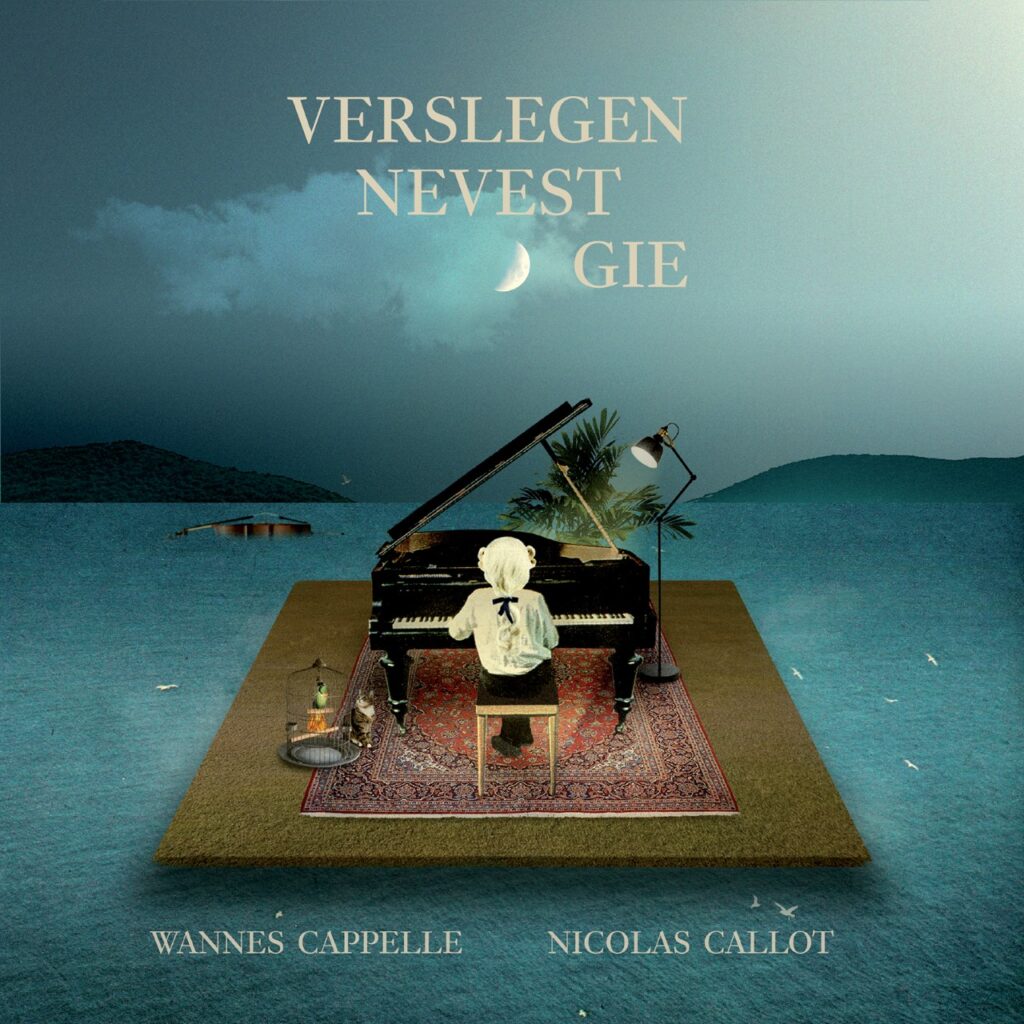
And another quick question: on the cover we see not only a pianist in a wig at his grand piano, but also a caged bird, a greedy cat, and even a floating cello. What connections are there between this image and the album's content?
Callot: The image on the cover is quite surrealist. There are many things that don't make sense, like the late 19thth-century piano, for example. It's up to the viewer to let their imagination run wild.
Cappelle: The bird and the cat together also illustrate "verslegand nevest gie" as the album title. The bird is there for the trouble, or perhaps the other way around: the cat swooning over the beautiful whistling tones of the bird. But I think mainly that Sammy wanted to put that playfulness of Mozart in it, and sometimes treat things disrespectfully. The cello drifting in the water—that's something you obviously don't do. If you take Mozart really seriously, you have to be able to play around with it too.
You stood with thanks to Klara together in the chamber music hall of Concertgebouw Brugge during Everyone Classical. How did the music reach the audience there; how was the response afterward?
Cappelle: The people from Klara told us that everyone left with a beaming smile. The audience was really engaged, we could feel that.
Callot: Klara also recorded the concert and they wanted to broadcast it again. Because people enjoyed it so much, the atmosphere was right, and Wannes' linking texts went over so well. There was also a lot of laughter, which is generally not the intention at a classical concert. But that ultimately came very spontaneously. We were also able to capture the silence and experience very intimate moments, which is not a given at such a well-attended festival.
Let us, without the slightest restrictions, take a look into the future. What comes after Schubert and Mozart? Which classical composer might still be considered for a West Flemish remake and refresh?
Callot: I think there will definitely be a follow-up, but the question is indeed what.
Cappelle: It's simply too much fun. I don't know why we would stop. I'm also convinced that you can bend everything to your will, but the question is how much you can tamper with the original without shortchanging the music.
Callot: Late Romantic orchestral songs, by Brahms for example, require a specifically trained voice with a very wide range and are often written with someone's vocal abilities in mind. We could make a leap in time, toward the early 20stth-century music of Kurt Weill or something like that. That cabaret-like quality could work fantastically, because it again offers the opportunity to combine singing and storytelling.
Cappelle: For me, the greatest pleasure lies in the fact that these projects already have a story in place, which I then work with formally. With Het Zesde Metaal, I have to come up with my own songs and texts every couple of years anyway. So this is a nice change of pace because I have to tell what's already there in my own way.
The new album was also coupled with an extensive tour in December 2022 and January 2023 through concert halls, churches, cultural and community centers. These are sometimes large venues that clash with the intimacy of this music. Which locations do you look forward to performing together at for that reason?
Cappelle: I don't necessarily have a location that stands out. We do play in a number of small churches, and that can be very pleasant, acoustically as well.
Callot: Last year we performed in the foyer of the Handelsbeurs, and I look forward to returning thereon Sunday, December 18 at 11 a.m., note."). That was quite a special and festive moment back then. But sometimes you're also surprised when you arrive at a place you've never been before and you still have the audience with you in an apparently less inspiring venue. In the end, it always comes down to the moment.
WHO": Wannes Cappelle [vocals & translations], Nicolas Callot [pianoforte]
WHAT": Interview following their new recording with Mozart songs titled Downright clever you
RELEASES": BBclassic
ORDER: Cypres CYP8614 or via the Nicolas Callot's webshop
PHOTOS": © Yoshie Kuwayama and Kattoo Hillewaere
09.12.22 CC Evergem
10.12.22 CC De Wissel, Wingande
11.12.22 Sint-Nasius Church Boekel, Zwalm
14.12.22 OC De Djoeland, Oud-Turnhout
16.12.22 Cultuurzaal De Balluchon, Koekelare
17.12.22 Sint-Columbakerk, Deerlijk
18.12.22 Ha's Concerts, Gent
12.01.23 St. Peter & Paul Church, Mechelen
13.01.23 Sint-Bavokerk, Lauwe
14.02.23 Sint-Machariuskerk, Laarne
15.01.23 De Kern, Wilrijk
18.01.23 Stadsschouwburg, Sint-Niklaas
20.01.23 CC De Woeker, Outhnaarth
21.01.23 Dranouter Music Center
22.01.23 Sint-Baaf Church, Sint-Baafs-Vijve
27.01.23 GC Spikkerelle, Avelgem SOLD OUT
28.01.23 Concert Studio, Kortrijk (5:00 PM) Extra concert!
28.01.23 Concert Studio, Kortrijk (8:15 PM) SOLD OUT