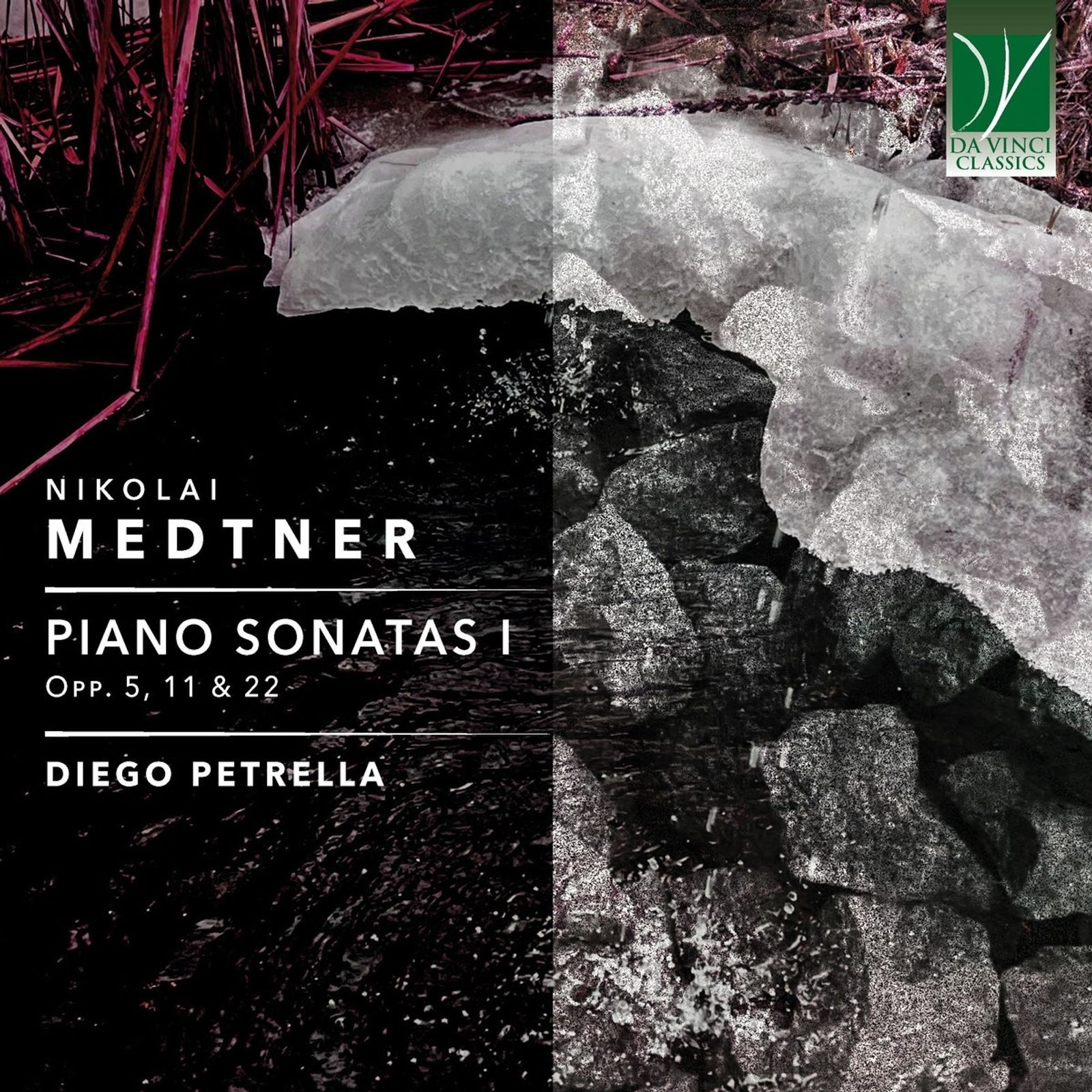
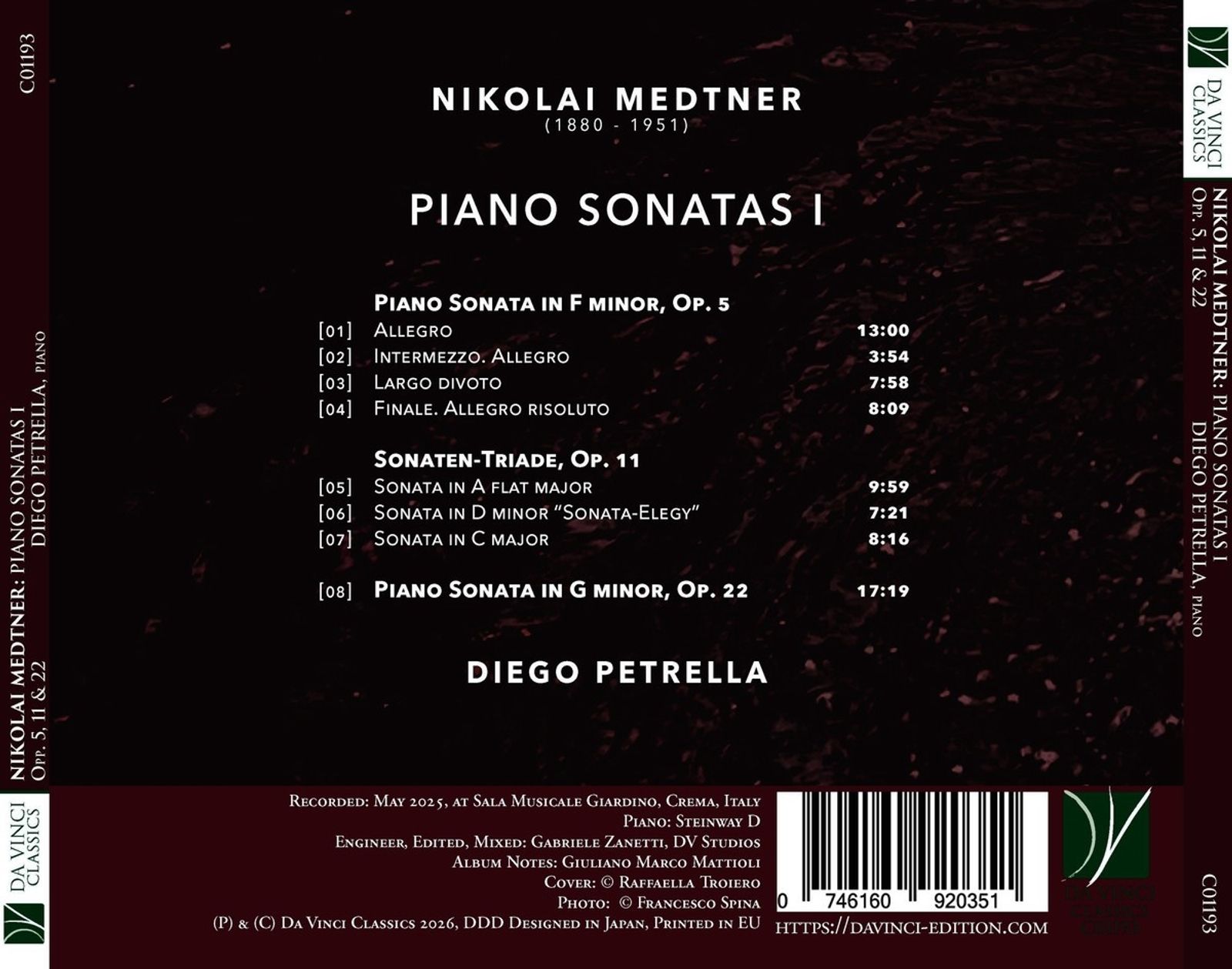
There are composers who only find themselves after years of wandering, and there are those who, like Nikolaj Medtner (1880-1951), already bring their voice almost fully mature when they first speak. Taneyev, his teacher at the Moscow Conservatory, once said that Medtner was "born with sonata form" – a remark that, after listening to this new recording by Diego Petrella, sounds anything but exaggerated. At a time when Russian musical life was dominated by the colorful orchestral imagination of Rimski-Korsakov, the dramatic worlds of Tchaikovsky, and later the revolutionary language of Scriabin, Medtner chose a different path: that of absolute music, rooted in classical forms but infused with a distinctly Russian emotional world. Da Vinci Classics presents with Piano Sonatas I the Sonata in F minor op. 5, the complete Sonata Triptych op. 11, and the Sonata in G minor op. 22 together: not a random selection, but the chronicle of a vocation that unfolds over several years.
The First Contours of a Master
Whoever hears Medtner's Sonata in F minor op. 5 for the first time immediately notices that this is no debut composer still searching for his voice. The four movements – unusual for a composer who would later celebrate the organic unity of the sonata – show a young Medtner still experimenting with classical polyphony, yet already possessing a remarkable gift for thematic development and inner coherence. The opening{{NOTRANSLATE_3}} writhes through restless questions that find no answer, peppered with those resonant bell figures so characteristic of Russian imagination. Petrella resists the temptation to force this immediately into climax; he lets the tension breathe, giving the silences between phrases as much weight as the notes themselves.
The subsequent Intermezzo: {{NOTRANSLATE_3}} reveals another side of Medtner's personality: lighter in touch, more mobile and almost playful, yet never without underlying nervousness. Petrella finds exactly the right balance here between elegance and inner tension; the virtuosity remains transparent and lively, while the dark undercurrents of the music are not smoothed away. In the Largo devoto, where the music then unfolds into a kind of sacred sarabande, the pianist manages to find that choir-like gravity without stiffening into devotion – a balance not every Medtner interpreter masters. Here Petrella sounds particularly convincing: where the music tends toward silence, he lets the sound fade without losing its tension; where the melody grabs at the throat, emotion arises not through emphasis, but through a deep understanding of the phrase's inner movement.
The Finale: {{NOTRANSLATE_3}} risoluto offers no simple triumphant resolution, but a final trial of strength in which the energy of the opening movement and the hushed solemnity of the Largo devoto converge. Petrella chooses a resolute but never superficial ending: the rhythmic force remains connected to the dramatic arc of the entire work. Where the music must become stormy, he lets it burst forth; where doubt and tension hide behind the virtuosity, he keeps them palpable. Thus emerges not a display of pianistic mastery, but a portrait of a young composer who, already in his first published sonata, knows how to unite a world of contrasts, and who has found in Petrella an interpreter who brings this early world back to life with fresh eyes and deep understanding.
An Altarpiece in Three Panels
The Sonata Triptych op. 11 is perhaps the heart of this disc, and not by chance. Inspired by Goethe's poem Reconciliation these three independent sonatas – heard in sequence – create the impression of three panels of the same altarpiece. Reconciliation – between conflict and rest, between darkness and light – forms the hidden dramaturgy of the cycle, both poetically and musically. Here Medtner continually probes the boundaries of pianistic capability, without virtuosity ever becoming detached from expressive necessity. The technical challenges – the complex polyphony, the layered rhythms, the constant interplay between voices that complement, contradict, and rediscover each other – are not obstacles to be overcome, but means by which an inner world is revealed.
Precisely in that continuous interplay between outward virtuosity and inner necessity lies the challenge of this cycle. Petrella demonstrates here not only stunning technical mastery, but above all the ability to subordinate every difficulty in the score to the musical idea behind it. His playing possesses the clarity to make audible the often densely woven contrapuntal architecture of Medtner, but also the freedom to let the music breathe and speak. Nowhere does one get the feeling that the pianist wants to display the technical obstacles of the score; on the contrary, precisely because everything seems so natural, it becomes clear how much control, insight, and imagination lie behind this interpretation. For Petrella, virtuosity is never an end in itself, but a means to unlock the many layers of Medtner's musical universe.
The first sonata of the triad, in A-flat major, opens with an almost childlike simplicity that Petrella never allows to sound naive – here joy is earned, not given. Beneath the apparent clarity, one constantly feels the memory of the struggle that preceded it; the pianist makes clear that Medtner's lyricism is never superficial, but always nourished by a deeper awareness of human vulnerability. In the Sonate-Elegy in D minor, the emotional center of the triad, Petrella colors the shadow of the so restrained that it becomes more of a memory than a quotation. The dark colors, the long arcs of tension, and the hushed moments acquire a natural intensity from him: the tragedy is never exaggerated, but precisely because of this it strikes all the more powerfully. And the third sonata, in C major, con passione innocente – an instruction that few pianists dare to take literally – sounds truly innocent in Petrella's hands, without ever becoming foolish. Here too, what convinces is not only the stunning fingering technique with which the pianist masters the most demanding passages, but above all the way he imparts an intention behind every note. The virtuosic movements take on something of a spontaneous joy, as if the music were discovering itself as it sounds. For Petrella, this closing sonata becomes no superficial liberation, but the natural endpoint of a musical journey in which struggle, reflection, and joy ultimately merge into a single whole. Turning to the organic sonata Sonate in G minor op. 22, Medtner chooses an uninterrupted musical arc in which darkness and light, doubt and conviction, stillness and outburst seem to flow organically from one another. That this very sonata would later become Medtner's most frequently performed work hardly needs to surprise us. From the dark Tenebroso opening, the entire sonata seems already contained in the opening gesture. Petrella lets that long arc of tension unfold almost organically, as if each new thought inevitably flows from what preceded it. He refuses to break the music into separate episodes, but constantly guards its grand architecture, so that the uninterrupted form retains its full convincing power. His playing remains strikingly clear: even in the most densely written passages, the different voices retain their own contours without the natural flow of the music ever being interrupted. Day of Wrath To that clarity Petrella pairs a flawless sense of proportion. Climaxes are never played prematurely or emphatically underlined, but grow naturally from the preceding material. The dark passages retain their threatening intensity without becoming heavy, while the lyrical moments shine all the brighter precisely because of this. Here too, Petrella's impressive technique never becomes an end in itself, but a natural means to make Medtner's great arc of tension audible. This sonata thus unfolds not as a succession of impressive pianistic moments, but as a single breathing musical thought that preserves its inner logic from the first to the last measure.
A Living Dialogue with Medtner. Diego Petrella is not the obvious name for this repertoire. Trained at the Milan Conservatory and artistically shaped by encounters with figures such as Sylvano Bussotti and the experimental traditions surrounding Fluxus, he brings a musical background that seems far removed from Medtner's late-Romantic world. Yet that apparent distance from Medtner's world ultimately proves to be the greatest strength of this recording. Petrella approaches this music not as a historical monument to be reverently reconstructed, but as a living score that gains new meaning with each performance. In doing so, his interpretation remains constantly in motion: analytical where the structure demands it, free where the music needs space, but always true to the organic development that makes Medtner's sonatas so unique. Whether this recording will dethrone established references – think of Hamelin or Demidenko – is less important than the question of what place it occupies within the growing Medtner discography. As the first installment of a planned complete edition, this is above all a promising calling card. Petrella treats these early sonatas not as youthful works in which the later master tentatively announces himself, but as fully realized musical worlds, each possessing its own character and dramaturgy. In doing so, Petrella convincingly demonstrates why these sonatas, and their composer, deserve a much more prominent place in the great piano repertoire. Those who listen to this disc hear not only a young Medtner already speaking his own language with surprising maturity, but also a pianist who brings that language to sound so naturally that it hardly sounds like a historical curiosity anymore, but like living music that still has something essential to tell us today. Nikolai Medtner, Sonata Triad op. 11 (Sonatas A-flat major, D minor "Sonata-Elegy", C major); Piano Sonatas F minor op. 5 & G minor op. 22, Da Vinci Classics, C01193, May 2025, Sala Musicale Giardino, Crema, Italy, Nikolai Medtner: Piano Sonatas I | Diego Petrella. There are composers who find themselves only after years of wandering, and there are those who, like Nikolai Medtner (1880-1951), bring an almost fully formed voice with them from the moment they first speak. Taneyev, his teacher at the Moscow Conservatory, would once have said that Medtner…
Toward the Organic Sonata
With the Sonata in G minor op. 22 opts for an unbroken musical arc in which darkness and light, doubt and conviction, stillness and eruption seem to flow organically from one another. That this very sonata would later become Medtner's most performed work should hardly come as a surprise. From the dark Tenebroso-opening, the entire sonata seems already contained in the opening gesture. Petrella allows that long arc of tension to unfold almost organically, as if each new idea inevitably flows from what preceded it. He refuses to divide the music into isolated episodes, but constantly guards its grand architecture, allowing the unbroken form to retain its full persuasive power. His playing remains notably clear: even in the most densely written passages, the different voices maintain their own contours, without the natural flow of the music ever being interrupted.
To this clarity, Petrella adds an infallible sense of proportion. Climaxes are never played prematurely or emphatically announced, but grow naturally from the preceding material. The dark passages retain their threatening intensity without becoming heavy, while the lyrical moments shine all the brighter for it. Here too, Petrella's impressive technique never becomes an end in itself, but an obvious means of making Medtner's grand arc of tension audible. This sonata thus unfolds not as a succession of impressive pianistic moments, but as a single breathing musical thought that preserves its inner logic from first note to last.
A Living Dialogue with Medtner
Diego Petrella is not the obvious choice for this repertoire. Trained at the Milan Conservatory and artistically shaped by encounters with, among others, Sylvano Bussotti and the experimental traditions surrounding Fluxus, he brings a musical background that seems far removed from Medtner's late-Romantic world. Yet this apparent distance from Medtner's world ultimately proves to be the greatest strength of this recording. Petrella approaches this music not as a historical monument to be reverently reconstructed, but as a living score that gains new meaning each time it is performed. This keeps his interpretation constantly in motion: analytical where the structure demands it, free where the music needs space, yet always faithful to the organic development that makes Medtner's sonatas so unique.
Whether this recording will dethrone the established references—think of Hamelin or Demidenko—matters less than the question of where it stands within the growing Medtner discography. As the first installment of a planned complete edition, this is above all a very promising calling card. Petrella treats these early sonatas not as youthful works in which the later master modestly announces himself, but as fully realized musical worlds, each possessing its own character and dramaturgy. In doing so, Petrella convincingly demonstrates why these sonatas, and their composer, deserve a far more prominent place in the great piano repertoire. Those who listen to this disc hear not only a young Medtner who already speaks his own language with surprising completeness, but also a pianist who brings that language to sound so naturally that it no longer sounds like a historical curiosity, but as living music that still has something essential to tell us today.