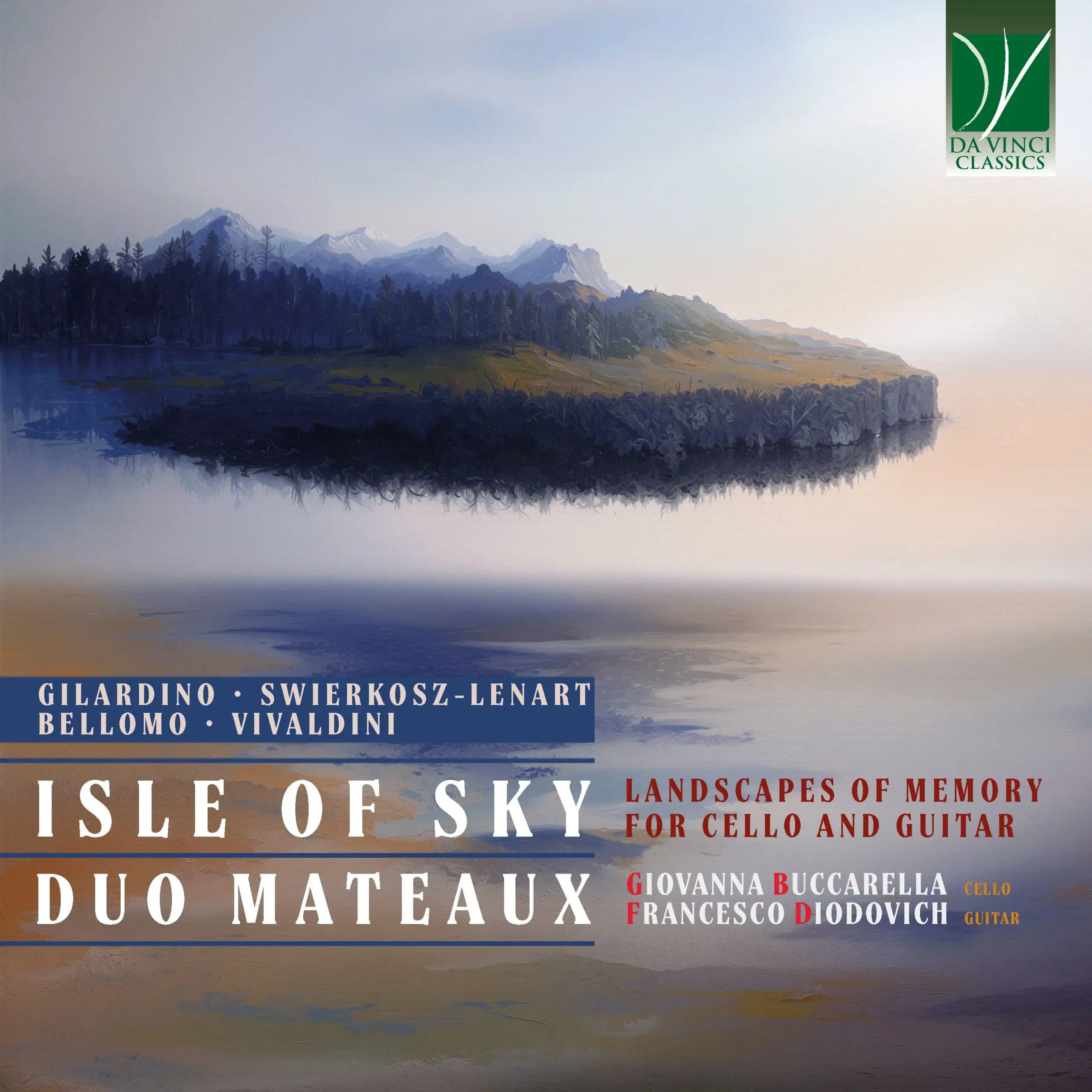
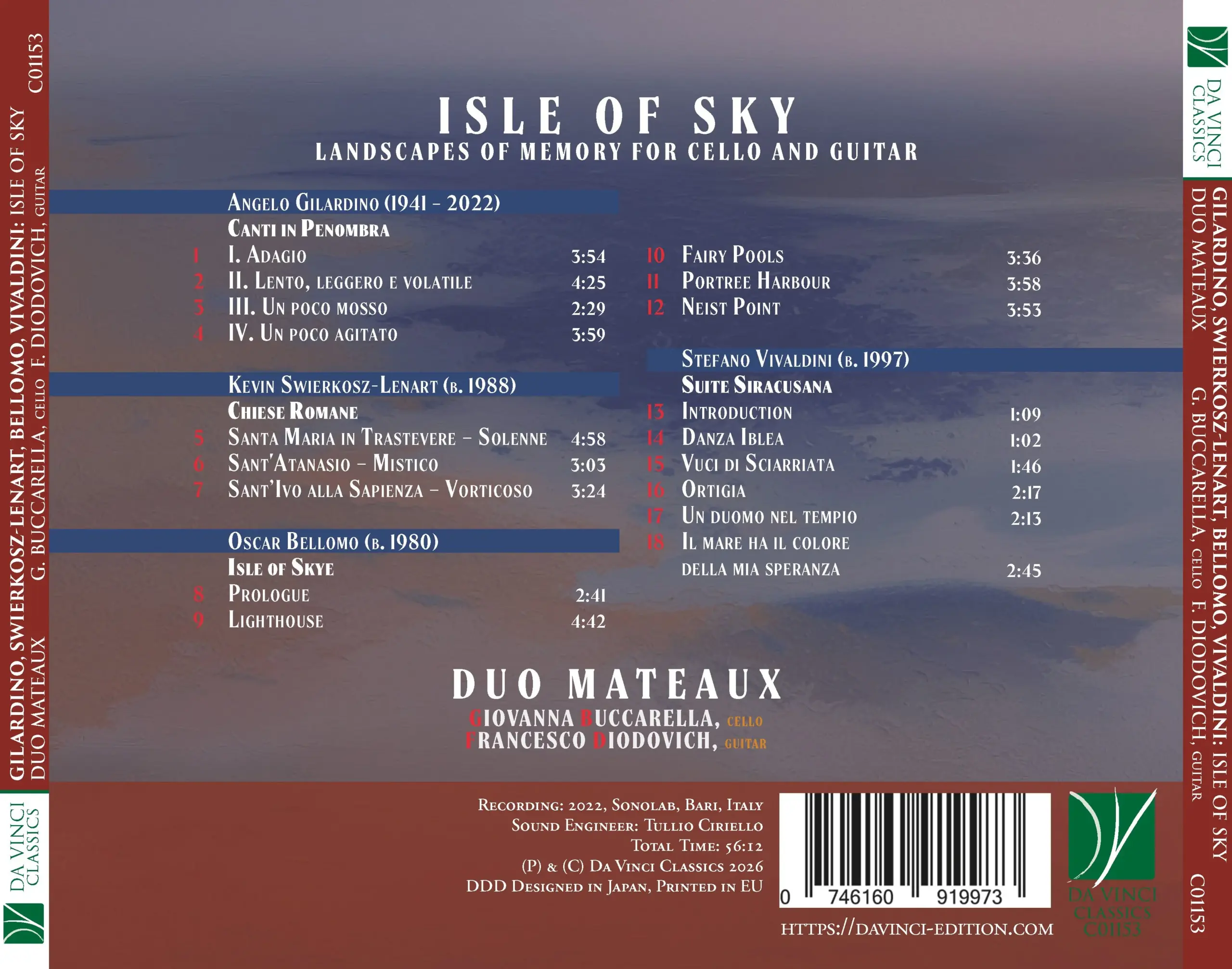
Some CDs show landscapes, while others let you hear how landscapes settle into a person's heart. Isle of Skye: Landscapes of Memory for Cello and Guitar, the fourth album by Duo Mateaux – cellist Giovanna Buccarella and guitarist Francesco Diodovich – clearly belongs to this second category. Four contemporary Italian composers, four different ways of making two instruments speak to each other, yet remarkably coherent throughout: each piece is about memory, about places that are relived rather than merely described.
When beauty doesn't reveal itself immediately
The album opens with Canti in Penumbra by Angelo Gilardino (1941–2022), one of the great guitar composers of the twentieth century and notably the teacher of two of the other three composers on this CD. It's a curious work within his output – Gilardino rarely wrote for cello and guitar, and the reason turns out to be biographical: cello was the only instrument he ever studied systematically alongside guitar. That immediately explains both the intimacy and the tension of the piece: the guitar remains shadowy and suggestive, while the cello constantly searches for a song that – in Gilardino's own words – must remain in the half-light.
The opening movement is admittedly a challenging introduction: the music grates, deliberately seeks discomfort, and doesn't immediately endear itself to the listener. Only in the subsequent sections does the work gradually open up and the dialogue between cello and guitar gain warmth and conviction. While Canti in Penumbra as a composition didn't completely convince me, it becomes clear how successful this unusual instrumental combination can be: the cello brings human depth and breath, while the guitar provides shadow, space, and transparency. Buccarella and Diodovich play this tension with admirable restraint – never is the temptation to let the cello sing out fully gratified too soon, making the eventual serenity of the fourth movement all the more powerful.
Rome as sound and memory
Kevin Swierkosz-Lenart (b. 1988), a psychiatrist by profession and devoted to Rome by temperament, builds in Romanesque Churches a musical portrait of the city to which he is deeply connected, centered on three churches. Where Canti in Penumbra Gilardino's work still demands a certain restraint and adjustment, Swierkosz-Lenart's music virtually sweeps the listener along immediately.
In the first movement, dedicated to Santa Maria in Trastevere, it is the guitar that opens the musical narrative and, as it were, leads the listener into the space. The cello responds as a thoughtful commentator: not as a virtuosic counter-voice, but as a voice that helps shape the architecture, history, and atmosphere. The solemn character of the music is struck particularly poignantly here; the movement unfolds slowly and eventually fades as if the sound itself dissolves into the silence of the church.
The second movement, inspired by the Greek-Catholic liturgy of Sant'Athanasius, is without doubt one of the most beautiful moments on this CD. The cello is given full room here for a melody in Byzantine mode that sounds both ancient and timeless. Buccarella plays this long melodic line with exceptional sensitivity: warm and intense, yet always with admirable restraint. The guitar remains in the background as a withdrawn partner that responds subtly, adds colors, and surrounds the cello without ever demanding attention. It is precisely this refined balance that makes this section so moving.
The third movement, too, dedicated to Sant'Ivo alla Sapienza, immediately convinces through the equality between both instruments. Here cello and guitar each have their own voice and together develop a musical dialogue in which neither dominates. The clarity of the structure, the melodic power, and the natural collaboration between Buccarella and Diodovich make Romanesque Churches one of the most convincing works on this recording. It is music that not only evokes a place, but also the experience of that place: the silence, the history, and the human presence contained within it.
A landscape without a viewer
The title work, Isle of Skyee, forms the heart of this CD and is at the same time its most evocative section. Oscar Bellomo (b. 1980) composes landscape music without ever resorting to literal imitation – no mimicry of bagpipes or waves, but what the composer himself, following Angelo Gilardino, calls "observation without observer." It is not about representing a place, but about evoking the experience of a landscape: the silence, the movement, and the memory contained within it.
That becomes immediately clear in Prologue. Bellomo doesn't open with a pronounced melodic gesture, but with a cautious, almost mysterious movement in which cello and guitar feel each other out. Something seems to be waiting for the listener, as if the journey to the island has yet to begin. The two instruments complement each other beautifully here: the guitar lays down the first sonic landscape, while the cello responds with a voice that sometimes grates and thereby adds tension. That slight roughness suits the image of a landscape that doesn't reveal itself immediately.
Of the subsequent movements, particularly Lighthouse and Fairy Pools stand out. In Lighthouse the guitar traces a fine tapestry of arpeggios above which the cello sends out short light signals like the rotating beam of a lighthouse. The strength of this movement lies in the natural interplay between the two instruments: not a soloist facing an accompanist, but two voices that continuously complement and strengthen each other.
In {{NOTRANSLATE_1}}, there is always a mix of reality and illusion that are intertwined. Hoffmann the poet (tenor Arturo Chacón-Cruz) is the central player. His object of affection? The soprano Stella (soprano Jessica Pratt) in all her forms: Olympia, Antonia and Giulietta. Her opponent? Art in living form: La Muse (mezzo-soprano Julie Bulianne), disguised as Nicklausse. The antagonist is Lindorf (bass-baritone Erwin Schrott), translated into various figures (Spalanzani/Miracle/Dapertutto), but always in the same role. These four form the core that sets the game in motion and ultimately concludes it. Fairy Pools Bellomo reveals a lighter and more playful side of his musical imagination. A sparkling, almost theatrical dance unfolds, which Buccarella and Diodovich play with obvious pleasure. Rhythmic impulses, subtle shifts in color, and continuous dialogue between cello and guitar give the movement an irresistible liveliness. The recording quality also shines here: the clear, natural sound without excessive reverb lets every nuance and every shift between the two instruments speak perfectly.
Portree Harbour on the other hand, convinced me less. The movement remains primarily an atmospheric sketch and lacks, for me, the inner development that makes the stronger moments of the suite so compelling. Neist Point then restores the balance and provides a convincing conclusion: Bellomo doesn't let the landscape fall silent here, but rather brings it to life. The music moves more freely and lightly, so the island appears not only as a memory but also as a living, almost tangible experience.
Isle of Skyee leaves a mixed feeling behind. The suite contains moments of great beauty and convincingly shows how rich the combination of cello and guitar can be, but not every atmospheric sketch has the same impact. It's precisely in the strongest movements that Bellomo proves his special talent: he doesn't paint a landscape, but lets it move and breathe.
Syracuse, between memory and hope
Stefano Vivaldini (b.1997) closes with the Suite Siracusana, a series of miniatures in which Syracuse is presented not as a tourist destination, but as a landscape where history, myth, and personal memory converge. From the opening sounds of In {{NOTRANSLATE_1}}, there is always a mix of reality and illusion that are intertwined. Hoffmann the poet (tenor Arturo Chacón-Cruz) is the central player. His object of affection? The soprano Stella (soprano Jessica Pratt) in all her forms: Olympia, Antonia and Giulietta. Her opponent? Art in living form: La Muse (mezzo-soprano Julie Bulianne), disguised as Nicklausse. The antagonist is Lindorf (bass-baritone Erwin Schrott), translated into various figures (Spalanzani/Miracle/Dapertutto), but always in the same role. These four form the core that sets the game in motion and ultimately concludes it.troduction a musical walk through a city unfolds in which different times exist side by side.
The energetic movement of Danza Iblea, the more pronounced character of Vuci di Sciarriata and the hushed atmosphere of Ortigia reveal different facets of Syracuse: not as a literally depicted place, but as a memory brought back to life through sound. Particularly striking is A Cathedral in Time, in which Vivaldini makes the historical layering of Syracuse palpable. The music seems less to describe a building than to trace the marks of centuries embedded within it. Stone becomes sound here, architecture becomes memory.
The Suite Siracusana also demonstrates how rich the combination of cello and guitar can be. Both instruments receive an equal voice: the cello brings warmth, breath and lyrical depth, while the guitar, with its transparent colors and rhythmic refinement, provides lightness and perspective. Buccarella and Diodovich find precisely the right balance between individual expression and ensemble playing.
The final section, The Sea Has the Color of My Hope, ultimately forms a radiant endpoint of this CD. With an intelligent reference to Homer's "wine-dark sea," Vivaldini opens, after the shadow of Gilardino and the sacred stillness of Swierkosz-Lenart, a world of light and hope.
When Memory Becomes Sound
What ultimately drives this CD is not so much virtuosity – though Duo Mateaux certainly possesses that – but rather a shared musical ethic: listening to each other, allowing space, and never convincing through force. Giovanna Buccarella and Francesco Diodovich play as if they understand precisely that these four composers are not asking for outward display, but for attention, nuance, and a fine sense of timbre.
Therein lies the strength of this unusual combination of cello and guitar. What appears on paper to be a fragile instrumentation proves in practice to open a particularly rich sonic landscape: the warm, human resonance of the cello and the transparent refinement of the guitar continually complement each other. The contemporary language of these four composers sometimes requires time and patience – especially Canti in Penumbra by Gilardino does not give in easily – but whoever crosses that initial threshold discovers a surprisingly accessible and colorful world.
Not all works moved me equally, but particularly the music of Kevin Swierkosz-Lenart and Stefano Vivaldini brought me considerable listening pleasure and made me curious for more of their work. Isle of Skye is therefore not a CD one puts on casually, but an album one makes time for and into which one slowly enters. When the last note has faded away, ultimately not a single melody lingers, but an atmosphere: the impression of having been somewhere without ever actually having traveled. Precisely therein lies the greatest strength of this release: it transforms landscapes into memories, and memories into music.