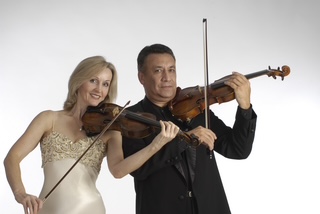
For many readers of Klassiek Centraal, Routa Kroumovitch and Alvaro Gomez may still be unfamiliar names. Yet they have been fixtures of the Orfeo Music Festival in South Tyrol, Italy, for years. As musicians and life partners, they share not only an impressive international career, but also a life in which music has always taken center stage. In a conversation with Werner De Smet for Klassiek Centraal, they talk about their shared story, which began in 1972 at the Moscow Conservatory.
Routa came from Latvia and had the opportunity to study there with the legendary David Oistrakh. Alvaro traveled from Chile to the Soviet Union for his musical education. "Opposites attract," Routa says. For her, music and life have always been inseparable. When they married, music naturally became the foundation of their shared life. Alvaro agrees and adds that traveling together for concerts is far more pleasant than spending long periods on the road alone.
Although both have built active solo careers—as soloists, chamber musicians, concertmasters, or conductors—they still find great fulfillment in making music together. In doing so, they each bring their own personality to the interpretation of a work. This sometimes leads to different perspectives, but when they ultimately share the same musical vision, Alvaro says it often produces the most beautiful results.
That they also influence each other artistically goes without saying. Routa experiences the encounter between two different cultures as a continuous enrichment, both personally and musically. When Alvaro offers a critical remark or suggestion, it's not always immediately easy to accept. Yet she often finds that, after some reflection, there are valuable ideas behind it. Alvaro, for his part, points to the particular challenges of repertoire for two stringed instruments. Purity and balance demand special attention. That's why they regularly try switching roles. They want to avoid one part always taking the lead while the other merely accompanies.
That ongoing dialogue is also part of their way of communicating while making music. According to Routa, that communication as a couple becomes richer, faster, and sometimes more complex, precisely because they can share together what brings them the greatest happiness: music. Yet alertness remains necessary. Alvaro describes finding a shared vision and the mutual support of ideas as something difficult to put into words.
Over the years, certain composers have become particularly dear to them. For Routa, Bach and Beethoven remain inexhaustible sources of inspiration. The music of Prokofiev and Shostakovich has also become increasingly important over time. When she prepares a concerto, sonata, or chamber music work, that piece becomes, as it were, part of herself. Alvaro calls himself a true 'Latin guy' and therefore feels naturally drawn to Romanticism and virtuosity, but has gradually discovered the wealth of more traditional repertoire and contemporary composers. According to him, there are particularly many talented composers active today.
Keeping freshness in their repertoire poses no problem. Both musicians continually perform new works and regularly collaborate with living composers who write especially for them. This keeps their duo vibrant and keeps their own curiosity alive. At the same time, they return with pleasure to works they have performed before. Routa notes that both the musicians and the music continue to evolve. As a result, their perspective on a work keeps changing. No performance ever feels quite the same.
They also find that openness to new experiences reflected in the Orfeo Music Festival. Both speak enthusiastically about the combination of high-quality concerts, masterclasses, students, and fellow musicians, set against the backdrop of the South Tyrolean mountains. For Routa, the festival creates a special collegiality between students and teachers. She calls it an almost magical period. Alvaro especially appreciates the relaxed atmosphere in which concerts, meetings, and joint excursions go hand in hand.
As teachers, they experience the festival differently from regular education. According to Routa, both students and teachers are more relaxed there. Students come not to earn grades, but to learn and discover new ideas. The environment, the walking opportunities, the food, and the atmosphere all contribute to that openness. Yet she also points to a problem many young musicians face today, especially from the United States: the high cost of international flights. Before the pandemic, some students returned faithfully to the festival year after year; today, many can no longer afford it. According to her, additional financial support for young musicians is therefore necessary.
What she notices first in young talents is not only musical ability. Routa especially looks for the willingness to work hard and continue developing. Talent alone is not enough, she believes. With perseverance, people can sometimes achieve remarkable things. Alvaro also emphasizes that passion and dedication are indispensable. Without those elements, even great talent remains unused.
Yet both look with confidence toward the new generation of musicians. Routa notes that each generation is shaped by different experiences and therefore looks at music differently. Alvaro sees especially the advantages of the current times. Young musicians can now easily listen to performers from all over the world. The combination of traditional musical values and modern possibilities leads, according to him, to a particularly high level.
They, in turn, try to pass on their own experience. Routa tells how throughout her career she has gained important technical and musical insights that she gladly shares with her students. For Alvaro, it is even a responsibility. Everything that music and life have given him, he wants to pass on to the next generation.
They remain pragmatic about the role of social media and self-promotion. Publicity is important, they both acknowledge, but ultimately every musician must prove on stage what they truly have to offer. Visibility alone is not sufficient.
The programming of the festival is not in their hands, but the choice of repertoire they themselves perform is. Festival director Dr. Larisa Jackson gives each concert its own theme—this year, for example, "Golden Evenings in Bressanone" and "Romantic Fire and Virtuosity"—and Routa and Alvaro, in turn, propose repertoire that can captivate both students and audience.
When it comes to reaching new listeners, Routa points to the many moments when she has met people after a concert who were visibly moved. Music can touch people deeply and encourage them to delve further into that world. She illustrates this with a small experiment at home: she once had her granddaughter watch a film with the sound off, after which she no longer reacted anxiously or emotionally to what she saw. For Routa, proof of how much music colors our perception of a story. Alvaro notes that reactions vary around the world and often remain unpredictable. It's precisely that which makes the audience so fascinating.
The future of classical music also comes up. For Routa, an important role is reserved for festivals like the Orfeo Music Festival, where education, inspiration, and encounter are central. Daily lessons, masterclasses, and concerts motivate young musicians and bring people together. She points out that many visitors return yearly and even tailor their vacation to the festival: last year, for example, 35 students from American Stetson University came from Innsbruck to one of the concerts. Alvaro sees it more simply: classical music must be presented in a natural and accessible way, so that people feel welcome and are not discouraged.
After more than fifty years of making music together, their mutual communication remains an essential part of every performance. Although they often intuitively sense where the music is heading, Routa emphasizes that concentration and communication always remain necessary. Music is always alive, after all, and no performance is ever the same. Alvaro puts it even more forcefully: the day he no longer needed communication while playing together would be the day he would stop making music.
When they take the stage together today, gratitude prevails above all. Routa feels blessed to have been making music with Alvaro for so many years and to have built memories together on virtually every continent. Alvaro sums it up in a few words: "I feel blessed and incredibly happy."
After more than fifty years of making music together, Routa Kroumovitch and Alvaro Gomez still share the same conviction: music remains the golden thread running through their shared life.
http://www.alvarogomezviolin.weebly.com/