Schubert without song? That doesn't exist. Schubert without piano? Unthinkable. For young Franz, the piano was essentially his orchestra. Had he been given the chance, he would have composed far more for orchestra and less for piano.
Schubert's untimely death – and what kind of age is 31 to die, really? – and the shadow cast over him by the great Beethoven, as well as Mozart and other circumstances, were the reason he wrote less for orchestra than he would have liked. And so he gave the world, for centuries to come, magnificent piano works including a series of four-hand compositions.
Yaara Tal & Andreas Groethuysen
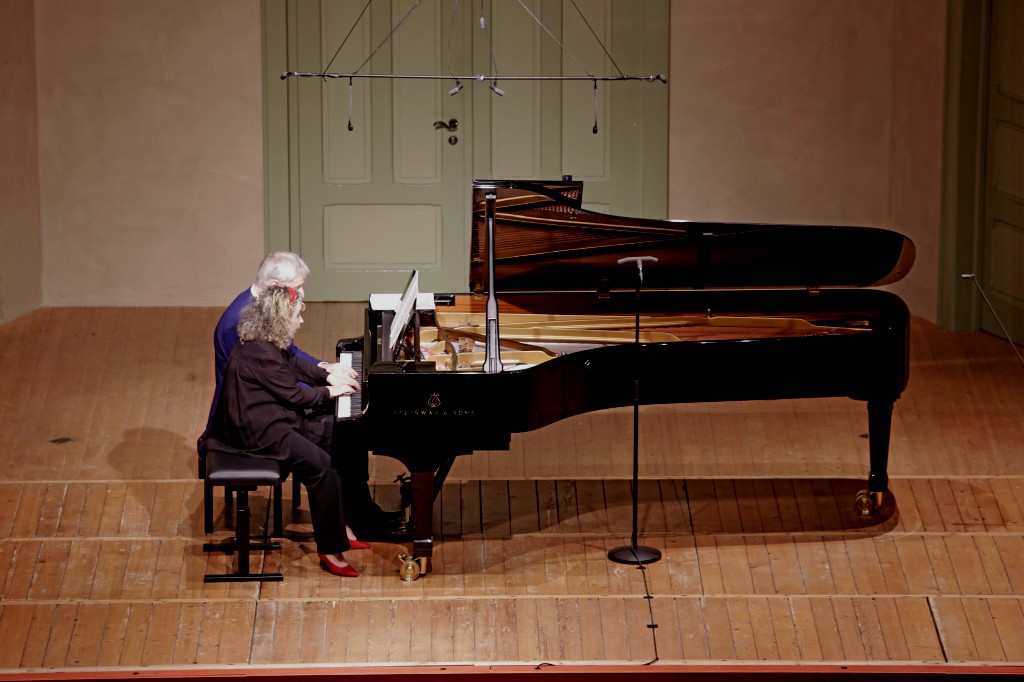
The first concert I was able to attend was a recital by the world-renowned piano duo Yaara Tal & Andreas Groethuysen in the Markus-Sittikus-Saal. Those two, their four hands on one piano and Schubert? They belong together, inseparably linked. To start backwards for a moment: when you know the audience won't leave the hall – making that clear with applause you rarely get – without an encore, and the duo would be held hostage by it (so to speak: such audiences don't resort to violence and it's actually impossible after Schubert, who caresses your soul) then you know the recital was thoroughly enjoyed in every way. Rightly so.
From the encore that wasn't played at that first Schubertiade – or perhaps it was, but there are no notes about it – to the four-hand program from 50 years ago and now. The duo opened with the Rondo D, D 608. What stood out immediately? The brilliant tones the duo coaxed from the piano, the exceptional acoustics of the hall – and this is no throwaway comment because far too many halls get labeled as having 'good acoustics' when that's not really the case – or the quality of Schubert's score that in any case provides enjoyment? It was a symbiosis of it all. The melodies and the foundation, the rich phrasings, the rhythm, a tempo that mercifully wasn't rushed. Here Schubert spoke, no, sang his countless most beautiful song without words. It was just the beginning of an afternoon that flew by.
The well-known and popular Grande Sonate (Sonata in B, D 617) couldn't have been played more beautifully. Pure enjoyment, enjoyment, and more enjoyment. Less caressing of the soul and more pleasure came with the cheerful, not overly militaristic 'Drei Militärmärsche' D 733. They give the impression that Schubert rather found the military something to laugh about and rather ridiculous.
With the Andantino varié from 'Divertissement sur des motifs originaux Français' D 823, the melancholy that is present in every Schubert work in some form resounded once more, whether emphasized or not.
The brilliant duo wrapped up (almost) with the deservedly well-known and ever-moving Fantasia in f, D 940. What more could you want and is an encore justified after that? Andreas Groethuysen posed the question aloud to the audience, but yes, well, the success, the atmosphere, that sustained well-deserved applause… This concert alone made the journey and the ordeal with Deutsche Bahn worthwhile.
Choral singing closes the evening
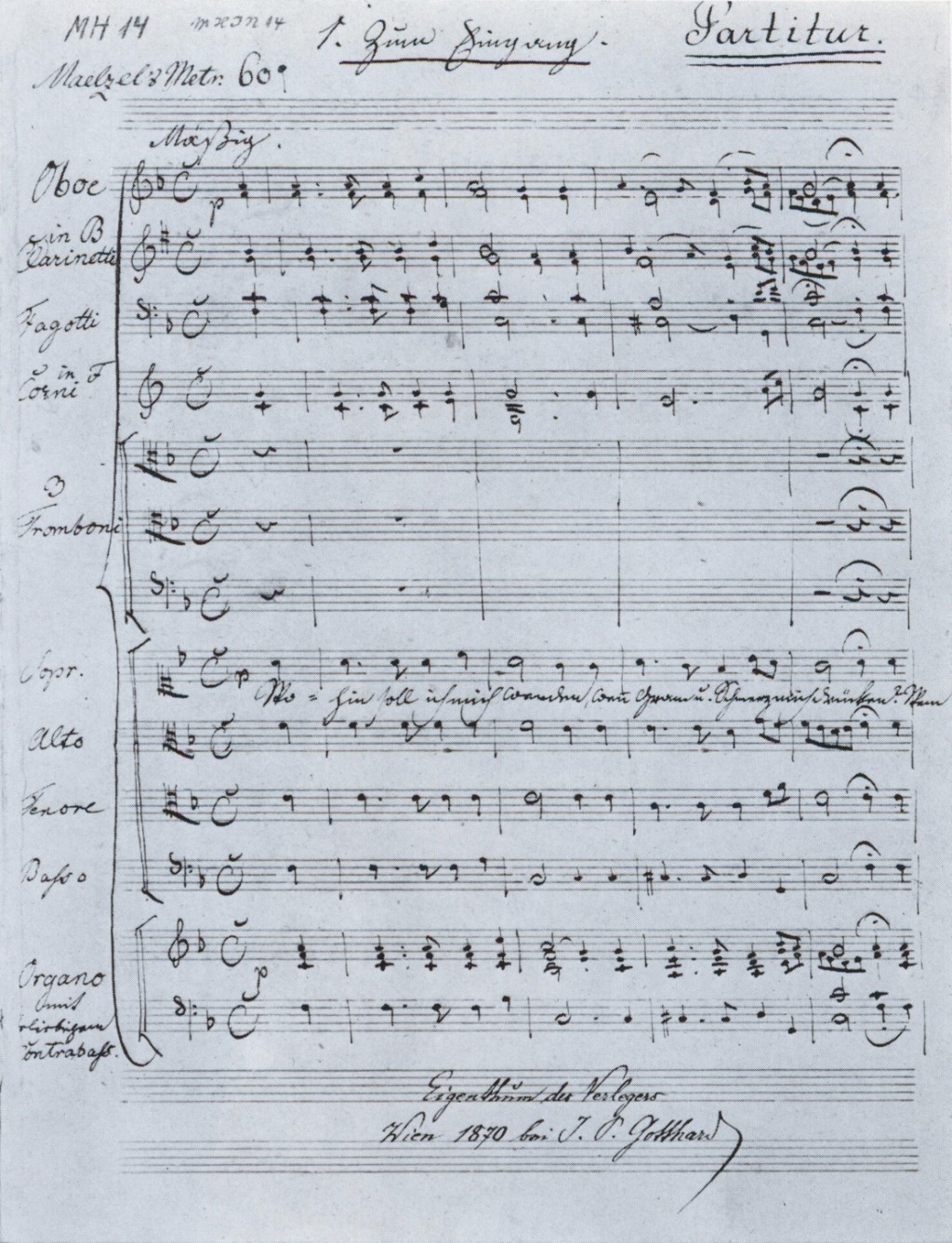
Handwritten transcription from 1870 (long after Schubert's death) of the first page of the section "Zum Eingang" (Introitus).
Do you know it? The Deutsche Messe? I have wonderful nostalgic memories of it, at least. I'd already heard it earlier in the day when, walking toward the various museums, I heard singing from a distance accompanied by wind instruments. I caught the wind direction with my ear and yes, that music was coming from the church. I walked up to the closed door because: 'Die ORF (Austrian radio) registriert'. So I stood at the door eavesdropping for a quarter hour or half hour or so – I completely lost track of time. Yes! Schubert's Deutsche Messe! I was as happy as a child, because as I said: nostalgic memories. It became quiet and I walked on to the various museums, where you elsewhere read about on this website.
At exactly 8 p.m., the Pfarrkirche is packed to the gills – virtually every concert of this Schubertiade is sold out – the regional choir performs sacred songs. 50 years earlier, it was the Regensburger Domspatzen (sadly lacking the necessary funds this time) who took the honors. Those boys from back then are all in their sixties now, ha, I'm in good company… The local voices don't have the rigorous training of the Domspatzen, but it must be said that very hard work has been done to deliver an almost flawless performance. Schubert's music is something other than simple folk songs and demands knowledge and commitment. The Kammerchor Feldkirch succeeds here and deserves more than praise. Organist Johannes Härmerle provides support and everything is expertly guided by conductor Benjamin Lack.
And so as a finale we get what I'm sitting on the edge of my seat for: the Deutsche Messe performed by the aforementioned choir and by the wind players of the Symphonieorchester Vorarlberg. An excellent ensemble that accompanies skillfully. The importance of the right balance, support, not drowning out the choir cannot be overstated. Here it's played exactly as it should be, especially when the choir doesn't consist entirely of seriously trained singers. And so I enjoyed that mass doubly, which moved me. Old memories, the work itself with its rich melodies that remain true to the text, true to the faith for which the mass was composed. That's what it should be. Thank you!