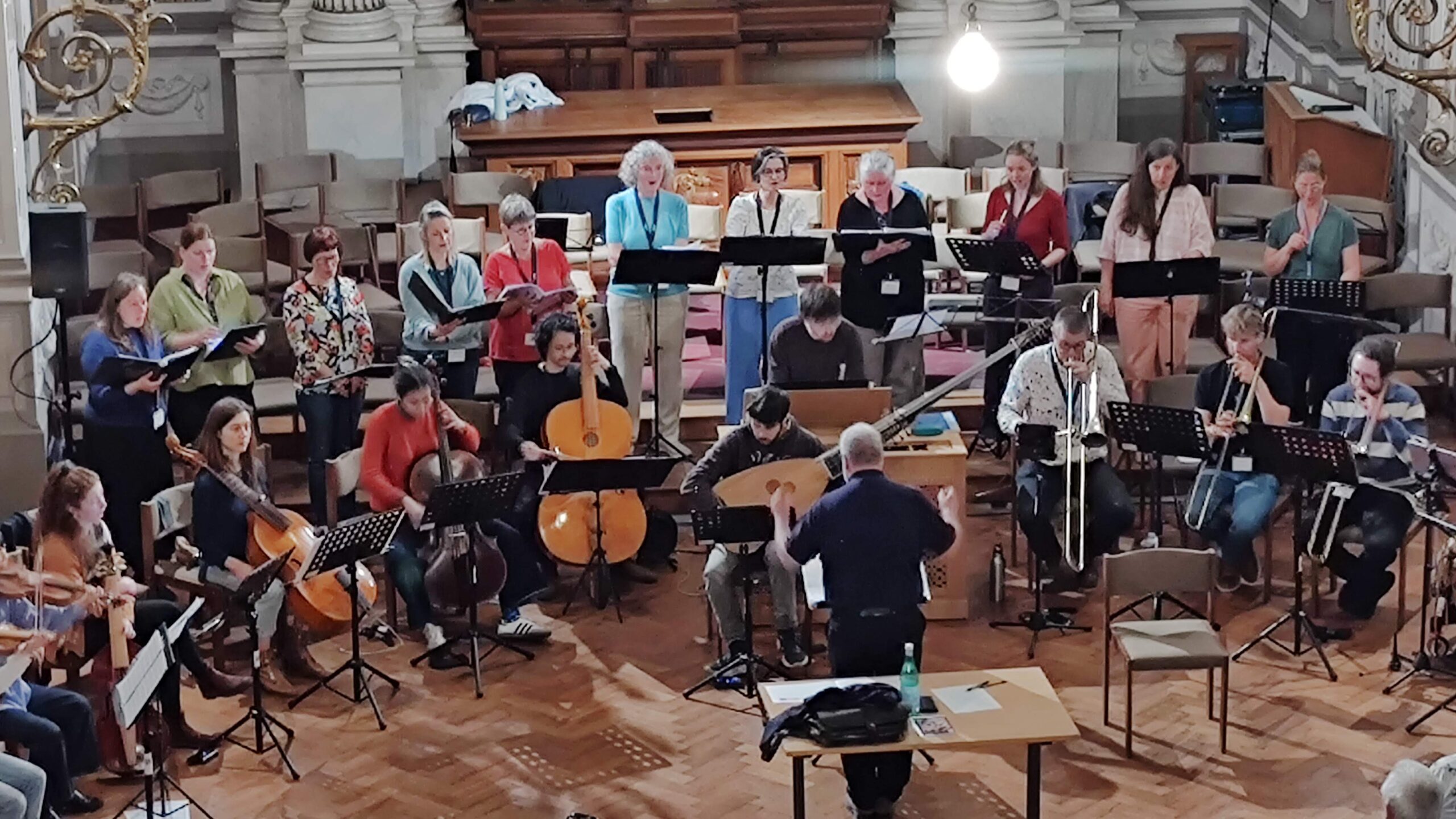
Over the weekend of April 25-26, Koor&Stem organized an intensive choral workshop centered on Claudio Monteverdi's (1567-1643) Vespers of Mary. About forty singers from across the country, with diverse musical backgrounds, and a select group of instrumentalists (strings and winds) gathered on Friday evening in the chapel of KULeuven's Carolus campus in Antwerp: a beautiful Baroque space that immediately set the right atmosphere.
The First Read-Through
Around 7 p.m., it was time for the first read-through. Particularly exciting because beforehand you really couldn't gauge how intensively you needed to prepare to hold your own right away. I didn't take any chances and prepared—for me, unusually thoroughly. I had sung the Vespers once before, but that was long ago, and I absolutely wanted to avoid falling behind at that first rehearsal.
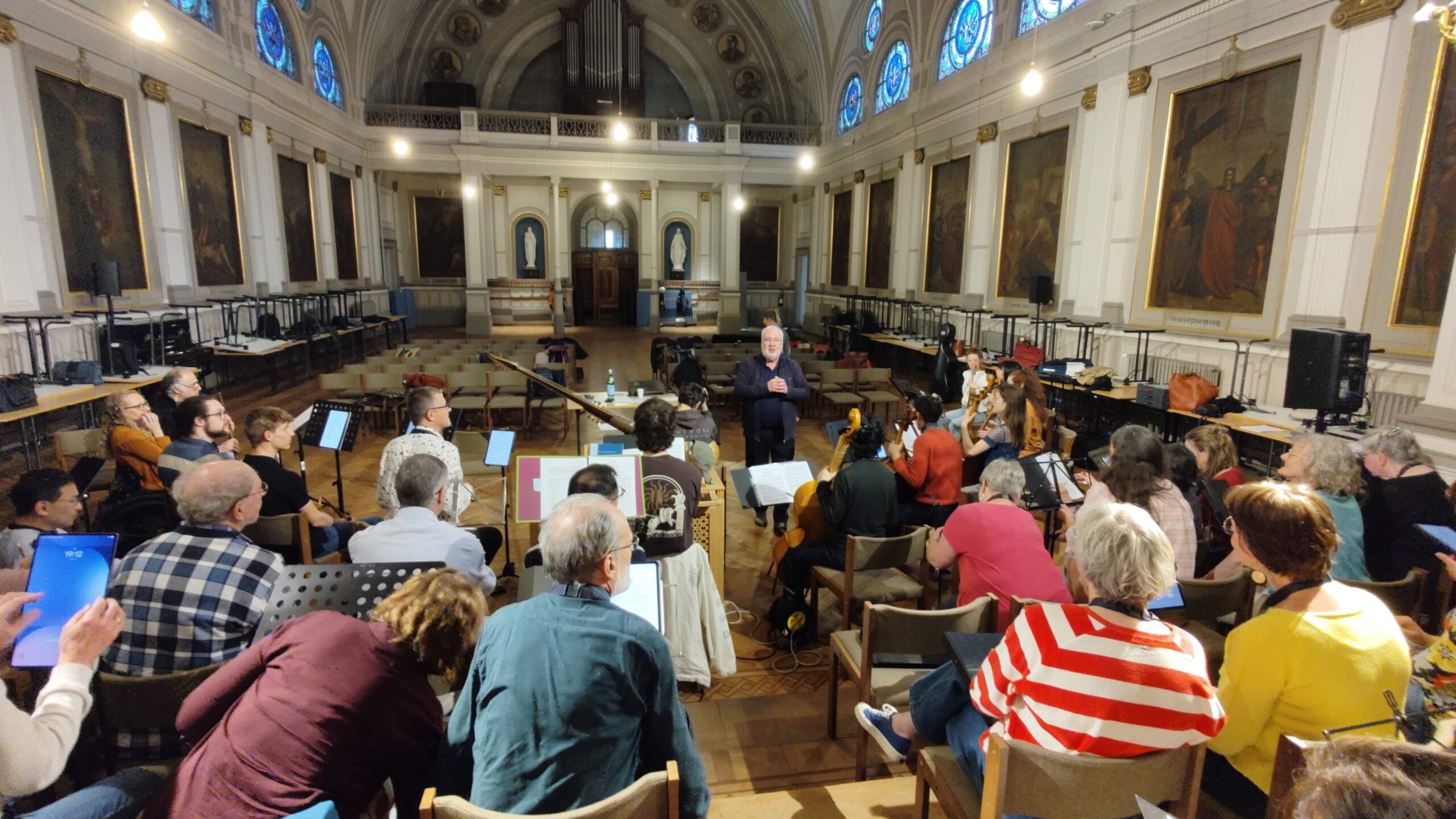 In retrospect, that preparation was no luxury. We were singing from a different score, with the usual alternative readings and alterations, which immediately demanded precision and focus. You couldn't call it 'polished,' but that first read-through was truly impressive. So impressive, in fact, that it was well past 10 p.m. when Wim Becu—the driving force behind the whole weekend—decided to call it a night.
After the customary singers' procession to the café, I got to bed a bit later, dreaming of more. The appointment was set for 10 a.m. the next morning.
Short Night, High Notes
Wim Becu chose to perform the Vespers at A = 466 Hz, in quarter-comma meantone—in other words, a full tone higher than what's usually standard in early music. I can assure you: after a short night, as a tenor you quickly feel like you're singing bass, let alone sailing toward 466.
Still, the enthusiasm and steady buildup got our voices warmed up quickly. We dug deeper into the score and worked deliberately on the most challenging passages. Between times, Wim spiced up the rehearsals with anecdotes, like the one about Jordi Savall, who reportedly recorded late into the night much to the irritation of a singer who had to sing 'Audi caelum' at three in the morning. In my mind, that 'caelum' had already closed the night before—at least, that's how I would have put it. It was precisely those stories that gave the weekend extra color.
Lunch and International Encounters
At noon, Koor&Stem provided a boxed lunch. Those moments—along with the short breaks—were ideal for networking with fellow singers and catching up with the cornetto player from Argentina, the theorbo player from Ferrara, and the trombonist from Spain. This group was truly international. What a pleasure to experience this together.
Afternoon Shift Change
In the afternoon there was a changing of the guard: Emilie De Voght, a renowned pedagogue, vocalist, and choral conductor, took over the baton and led us through the complex Lauda Jerusalem, while Wim worked intensively with the instrumentalists downstairs in the salon.
What stood out here was how strongly Emilie's extensive choral and vocal experience came through in her teaching approach. She knew how to articulate with particular clarity how certain passages are best sung and why, with concrete instructions that directly addressed what singers need. That was enlightening and enriching. Although this session was regrettably quite short, I still took away a number of particularly valuable tips. This part could certainly have been longer.
Dinner and Evening Rehearsal
Shortly after, the group dispersed to dine in the city. In retrospect, this was a missed opportunity to eat together—a small suggestion for an otherwise brilliant organization.
That evening we continued rehearsing earnestly, though fatigue was clearly taking its toll. We had been working since 10 that morning on this monumental composition, which sometimes calls for up to ten voices. It was therefore a particularly wise decision to wrap up around 9 p.m., so everyone could start the next day somewhat refreshed: the day of the performance.
The Final Day
"Fit" was perhaps a somewhat overly optimistic word. Personally, I could still feel the strain from the past few days weighing on me. As an amateur singer, you're just not used to that pace. Still, the spirit came back quickly enough, and gradually the realization began to grow that the weekend was coming to an end – and with it, farewell to this magnificent work. I caught myself counting down: two more times for Lauda Jerusalem, three more times for Dixit Dominus… each time with the word "unfortunately" attached.
The final details were polished and the rehearsal just before the performance was deliberately canceled. This choice was clearly driven by a desire to give everyone some mental peace and room to prepare themselves inwardly. After such an intense weekend, that turned out to be a particularly wise decision.
A large part of the group then headed to the nearby Notteböhm Hall, which was exceptionally open that day. There – presumably – the most legendary Koor&Stem promotional video ever was recorded. Curious? Be sure to check it out on Norbert Braun (photo Jonathan Ide), Marc Wellens (photo Opera project).
The Performance
Dressed neatly in black with a touch of spring – perfectly in line with the beautiful poster – everyone lined up. There was a nice turnout of the audience, with of course plenty of familiar faces. The performance itself went smoothly, though fatigue played tricks on us here and there. The same went for the little organ, which overheated and produced an annoying squeaking sound due to a broken valve. With no organ builders available on a Sunday, Arne Van Handenhoven – our excellent continuo player – had no choice but to constantly switch registers on and off.
The audience responded enthusiastically. They may have been "the fans," but I couldn't shake the impression that people were genuinely moved. Of course, this performance was far from professional or concert-quality – but that wasn't the intention at all.
What shouldn't go unmentioned is the unbridled energy of Wim Becu. From Friday evening through Sunday afternoon, his drive, sharpness, and enthusiasm remained remarkably constant. He too must have been tired by the end of the weekend, but you couldn't tell. His commitment, alertness, and musical fire were particularly contagious and gave the whole weekend extra momentum.
Music as a Bridge
I like to paraphrase Jan Van Elsacker – once my singing teacher and a particularly gifted Monteverdi interpreter – who summed it up beautifully: "Sometimes the most beautiful part of the day only announces itself at the very last moment. A fleeting Facebook message at three in the afternoon: an invitation to a musical performance, barely an hour later, just around the corner. But upon arrival, it turned out that the true music wasn't just in Monteverdi's scores, but especially in the faces of those present. A wave of emotion seeing so many familiar faces: former singers from the Antwerp Cathedral Choir, voices from days gone by, still the beating heart of the amateur music scene.
The most poignant moment came with a greeting from a dear lady. In the mist of time, I didn't recognize her at first, until one sentence fell: 'Dominique from Scarabee…'
Those words, forty years later, instantly turned back the clock. Under the inspiring and masterful direction of Wim Becu, the ensemble rose above itself. What he manages to realize in such a short time is truly remarkable.
They say music soothes the soul. But this afternoon was more than that. Music became a bridge to the past, a comfort in the present, and a reason to look deeply into each other's eyes again."
Finally
It couldn't be summed up better. What a weekend. What an organization. And what bonds were forged. I sincerely hope that Koor&Stem continues to organize many more such weekends, with the same dynamism and commitment. There will undoubtedly be some lessons learned that will emerge from the survey, but today admiration is what prevails. A heartfelt shout-out to Liesbeth Segers and the entire organizing team.
Koor&Stem is a Flemish organization dedicated to supporting and developing choirs and vocal culture. Choir weekends and singing courses play a key role in this. They bring singers, conductors, and accompanists together in a learning and meeting environment where both musical and social goals are central.
The aim of such initiatives is not only to improve vocal quality through coaching, workshops, and rehearsals, but also to inspire and connect singers. By working intensively together on voice training, repertoire, and ensemble singing, Koor&Stem stimulates artistic growth and singing pleasure. These weekends fit perfectly within their broader mission to strengthen choir life in Flanders and bring people together around music.