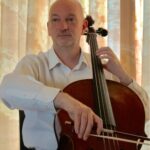
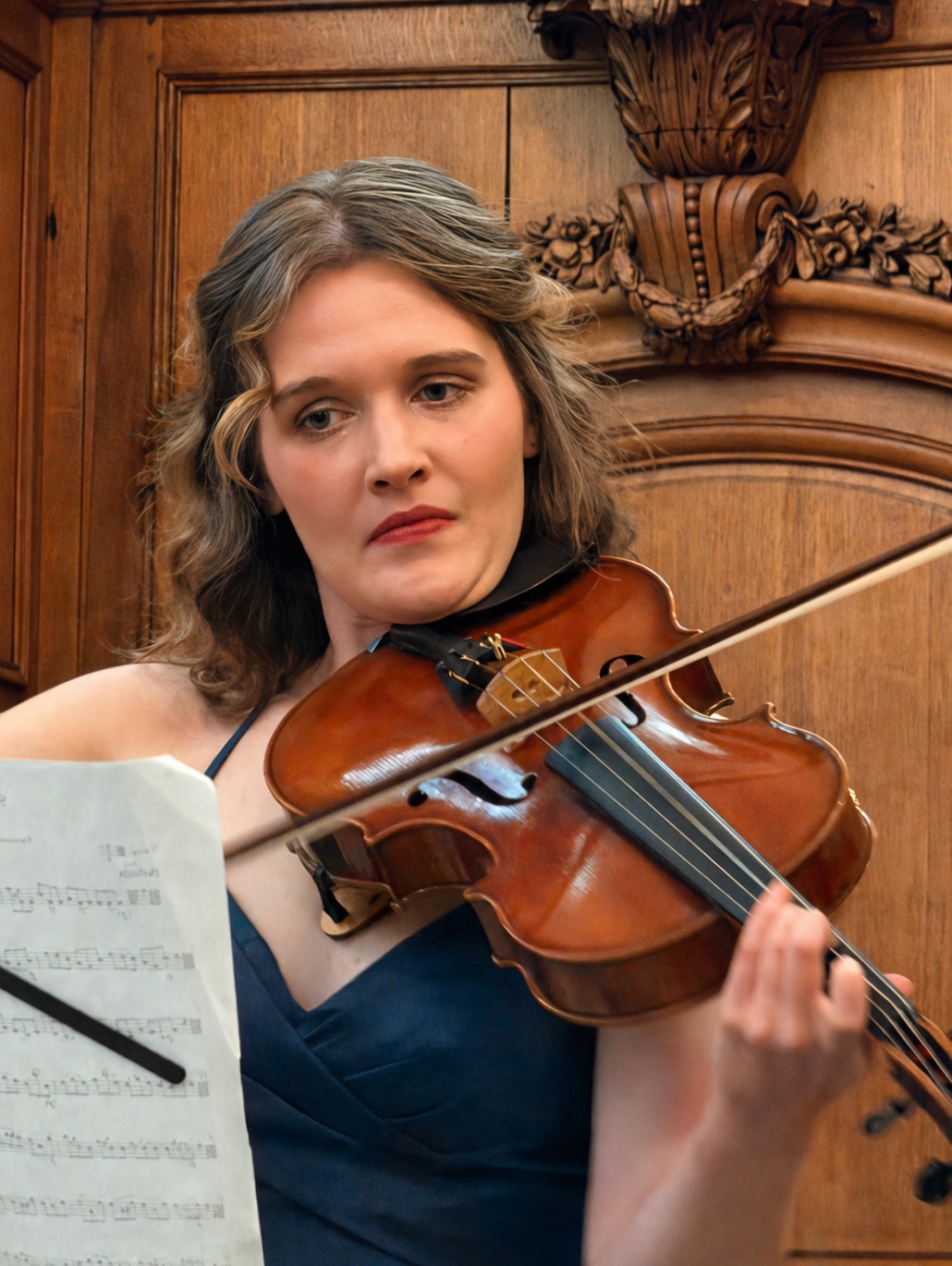
On Saturday, April 25, 2026, Belgian violist Kaat Schraepen at the Sint-Rochuskapel of Mariadal in Hoegaarden presented the program Back to Bach, a concert organized by Classical in the Chapel. In this program, she started from the music of Johann Sebastian Bach to demonstrate how his musical language continues to resonate in the work of later composers such as Paul Hindemith and Max Reger.
A carefully constructed program
The heart of the program lay in the alternation between movements from Bach's sixth cello suite and Hindemith's sonata for solo viola. This alternation was each time preceded by a brief narrative, delivered by Kathleen Poelaert. This gave the concert a clear dramaturgical arc from the very beginning. Rather than presenting separate works side by side, a cohesive whole emerged in which music and text complemented each other.
The choice to connect Bach and Hindemith so explicitly proved particularly effective. While Bach's music excels in clarity and structural logic, Hindemith often demands a more concentrated listening experience. By placing both composers in close proximity, underlying connections became audible. Motifs, rhythmic patterns, and dramatic arcs took on new meaning within the larger framework.
The narrative served as a subtle guiding thread. In the image of a train journey and a visit to a historic city, an atmosphere was created that guided the audience through the program. Without explicitly explaining or interpreting, that narrative layer provided support and direction, enriching the listening experience with coherence.
A clear and convincing interpretation
Kaat Schraepen presented this program with great concentration and a clear insight into its structure. Her playing was characterized by luminous tone production and natural phrasing, allowing the music to unfold organically.
In Bach, she laid bare the structure without burdening it, resulting in transparent and balanced sound. Phrases were given space and breath, and the underlying coherence became apparent in a natural way. In Hindemith, by contrast, she brought out the sharper contours and tensions of the music clearly, without the whole seeming fragmented. Through this approach, the continuity of the program was preserved and Hindemith's language also gained greater accessibility.
Following this alternating journey, Max Reger's suite formed the finale of the official program. Here the focus shifted toward a more introspective sound world. The music took on a more concentrated character, in which the previously established connections came together in a more compact form. Schraepen chose a restrained and controlled interpretation, with attention to the internal tensions and layering of the music. The audience followed this development until the end with rapt attention.
An intense audience response
The concert closed with enthusiastic applause, after which Kaat Schraepen thanked the audience with an encore that was received with particular warmth. The reactions afterward indicated strong engagement with the program and the performance, with the coherence of the whole and the way the different styles were connected to one another making a particular impression.