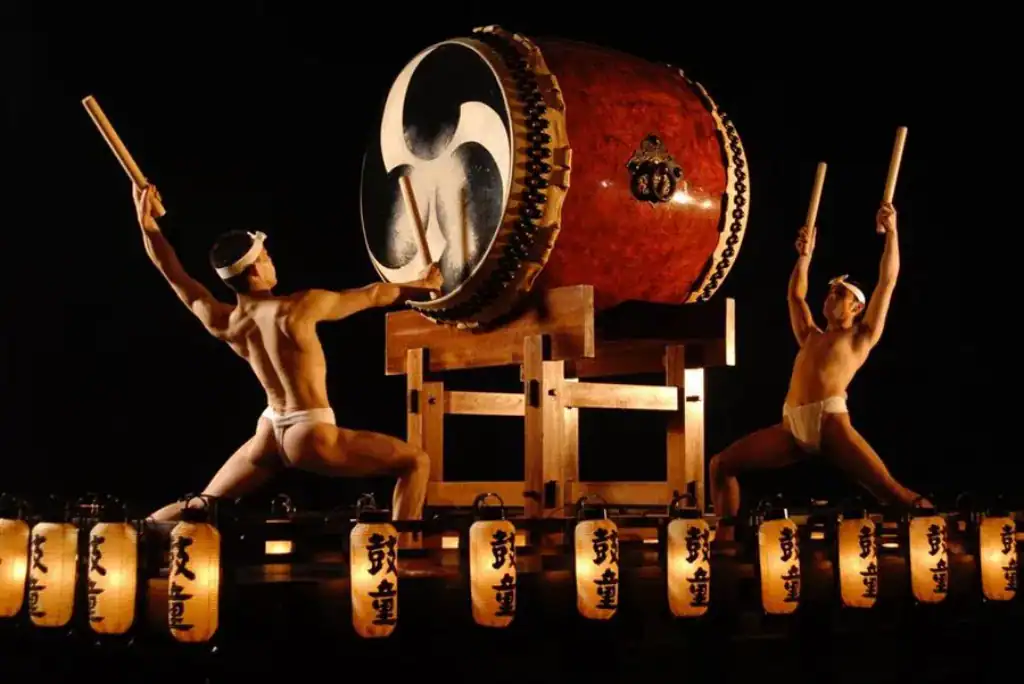
What exactly is taiko?
Taiko is a Japanese word that literally means "big drum." It refers to a traditional Japanese drum used in various contexts. In Buddhist temples, taiko accompanies ceremonies and sutra recitations, while in Shinto shrines the instrument plays a central role during festivals (matsuri) and rituals to invoke the kami, the gods or spirits.
Beyond religious contexts, taiko also served an important function. In village communities, it was used to gather people together, announce rituals, or warn of danger. Historically, taiko even functioned as a means of communication in military contexts, for example to indicate marching rhythms or signals for attack and retreat.
Is taiko considered music?
Not exclusively. Traditionally, taiko is not always primarily seen as "music" (ongaku), but rather as rhythm (hyōshi), bodily practice, and ritual sound. The emphasis is on timing, breathing, collective synchronization, and physical and mental discipline.
Taiko music therefore revolves not only around sound, but also around movement and collaboration. The musicians use their entire body to drum. This makes taiko an art form in which strength, energy, and a sense of community come together.
What does the name Kodo mean?
The name Kodo refers to two Japanese written forms that sound the same but have different meanings. On the one hand, Kodo means "heartbeat": ko stands for drum and dō for movement. In this sense, taiko is seen as the primal rhythmic heartbeat of life, connecting humanity, nature, and community. On the other hand, Kodo can also be read as "drum children." In this meaning, openness, learning, discipline, and respect for tradition are central, without rigidity. It's about an attitude of continuous curiosity.
Why is Kodo considered such an important group?
Kodo is widely regarded as the most renowned and influential taiko group in the world. The group is based on Sado Island and emerged in 1981 from an earlier group, Ondekoza. Since their international breakthrough, Kodo has played a key role in the global spread of ensemble taiko. In 2024, they received the Award for Japan's Cultural Ambassador.
Their performances combine musical precision with physical intensity and a powerful ritualistic presence, making them an international point of reference.
Konnichiwa, Chris Leon. A promoter of Kodo in the Benelux for 23 years now. How did you come into contact with them?
That connection came through Jo Van Driessche, the promoter of Kodo and my personal friend, who at the time organized the Bruges Festival, Belgium's oldest world music festival. We traveled together to Osaka, where I saw Kodo perform live for the first time. After the concert, we were invited backstage and introduced to the entire Kodo group.
A year later, I also attended the Earth Celebration Festival on Sado Island, where Kodo is based. This is a festival where Kodo invites international artists they've met during their One Earth Tour around the world.
How did you become their promoter?
When Jo Van Driessche stopped working as promoter, it created an opportunity. I applied to become Kodo's new Belgian promoter. Some time later, I was notified that my application had been approved. That's how I started organizing my first three concerts mid-week in Bruges. That mutual trust is why, more than thirty-five years later, we're still working together.
What does it mean to be a promoter?
The European tour is put together by the Kodo management. Each promoter receives their available dates. Then my work begins:
- Finding the perfect venue and halls.
- Booking hotels at the best rates
- Developing a marketing plan
- Graphic design of posters, flyers, banners, etc.
- Setting up social media campaigns: website/Facebook/Instagram, etc.
- Arranging transportation from arrival to departure
- Booking catering
- Planning technical visits
- Following the Rider specifications to the letter
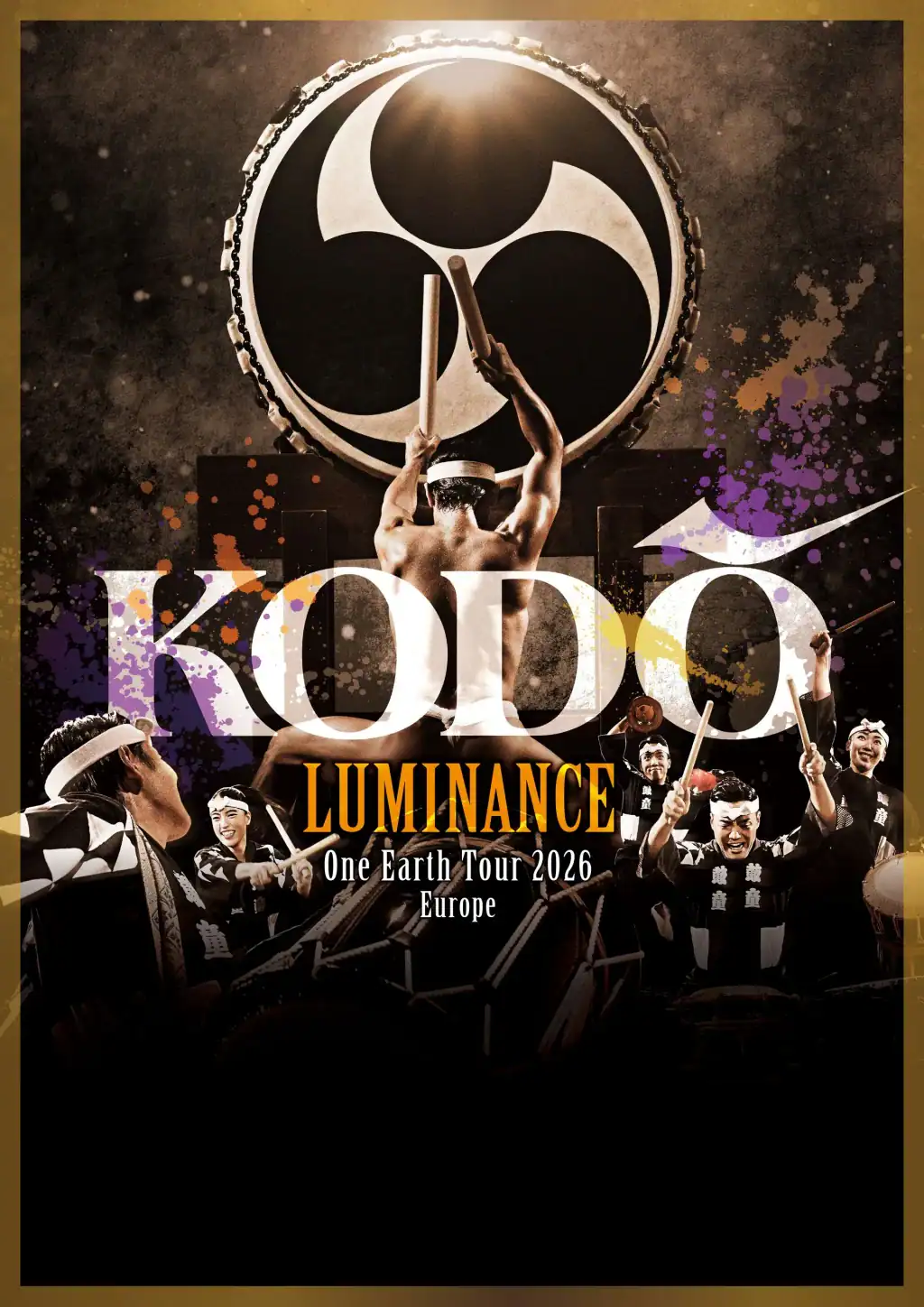 What should I understand about the Kodo group?
The group consists of fourteen percussionists and six staff members, including a tour manager, a lighting designer, two stage managers, an artistic director, and a tour driver. Kodo Village offers an apprenticeship program. After rigorous selection, about twenty students are admitted to a two-year training program to become Kodo drummers. Only a few make it. The training is physically and mentally extremely demanding: every day students run ten to fifteen kilometers before breakfast and are trained to become ambidextrous so they can play equally well with both hands. Without exaggeration, Kodo drummers are true elite athletes.
Does that kind of top sport also require a top diet?
Absolutely. Kodo members eat mainly Japanese food, though with some Western influences here and there. Kodo's regular caterer in Belgium, Mr. Lode Arnouts, knows perfectly what they want and always finds the perfect balance between the two.
Have you ever had the chance to play one of those drums yourself? And what can you tell me about Kodo's drums?
Yes, I did. During my stay on Sado Island in their rehearsal hall at Kodo Village, I had the privilege of trying it. It was a unique experience. Unlike classical theater, where ōtsuzumi and kotsuzumi are used, Kodo works exclusively with taiko drums. These include the hiradaiko (flat drum), shime-daiko (tightly stretched drum), nagadō-daiko (drum with a long body), and the monumental ōdaiko.
Kodo uses the hiradaiko (flat drum), shime-daiko (tightly stretched drum), nagado-daiko (drum with a long body), and odaiko (large drum). The Odaiko easily weighs three hundred fifty kilograms. The Kodo members carry this drum themselves to the stage. During concert preparation, much attention goes into properly tensioning the cords on the small drums used in the piece 'Monochrome'.
During setup, only production personnel are allowed in the hall. However, during rehearsals, no one else is permitted. Similarly, during preparation, markers are placed on the stage so the drums are positioned correctly during the concert. This also takes proper lighting into account.
After Kodo's performance, it's exclusively the members of the Kodo group who very carefully bring the drums back to the trucks. Quite a few trucks...
Have you ever been on a European tour?
Yes, in 2010 I was the second truck driver for the European Kodo tour. It was a unique experience. We left Belgium heading toward Lugano, then drove to Scotland where we arrived two hours before the show and all the Kodo members were waiting for us. Five days later we drove from Aberdeen to Munich. There's always something exciting happening.
How is that international collaboration progressing?
The former tour manager Mr. Takashi Akamine was very dear to my heart, but sadly he passed away two years ago. Our collaboration always ran very punctually according to Japanese standards. The collaboration with the current tour manager Mio Teycheney-Takashiro is also excellent.
I must say, I consider it an honor to serve as Kodo's promoter. 2026 is a very special year.
Why?
2026 is a special year because Japan and Belgium are celebrating their 160-year friendship bond, and Kodo's performance in Belgium is an integral part of the festivities organized by the Japanese Embassy in Belgium for this occasion.
In addition, Kodo is also celebrating fifty years of Monochrome, an iconic work that was first performed in 1976 and is still regarded as a milestone in their repertoire. The new Japanese ambassador Takeshi Osuga and his wife are also invited to the concert in Brussels.
One more thing about the name of the Kodo tour, perhaps?
The name of the tour has always been "One Earth Tour" since its inception, and it is a message of hope and peace that Kodo wishes to convey. In a world with relentless pandemics and wars, Kodo continues its tour, hoping that the sound of its resonating drums will uplift people and bring them together, create ripples of hope, and transform darkness into light.
The new production is called "Luminance." With their music, Kodo wishes, like light itself, to bring clarity—not just to see but also to feel. Based on the Japanese taiko tradition, they bring mostly their own compositions.
Going forward—what does that look like for you?
Until the end of March, Kodo is touring nine countries, including Belgium, and performing in twenty-one cities. Making sure it's a success in Belgium is therefore my first priority. I am Kodo's promoter in the Benelux and look forward to bringing Kodo back to the Netherlands and Luxembourg.
Arigato, Chris Leon: Kodo Concert Schedule Belgium
March 3, 2026 Bozar / Palace of Fine Arts in Brussels
March 4, 2026 Concert Hall in Bruges
March 13, 2026 Queen Elisabeth Hall in Antwerp