Edgar Tinel (1854-1912) is today a virtually forgotten Belgian composer whose work is rarely performed. Yet at the end of the nineteenth and beginning of the twentieth century, he was one of the most important figures in the musical life of our country.
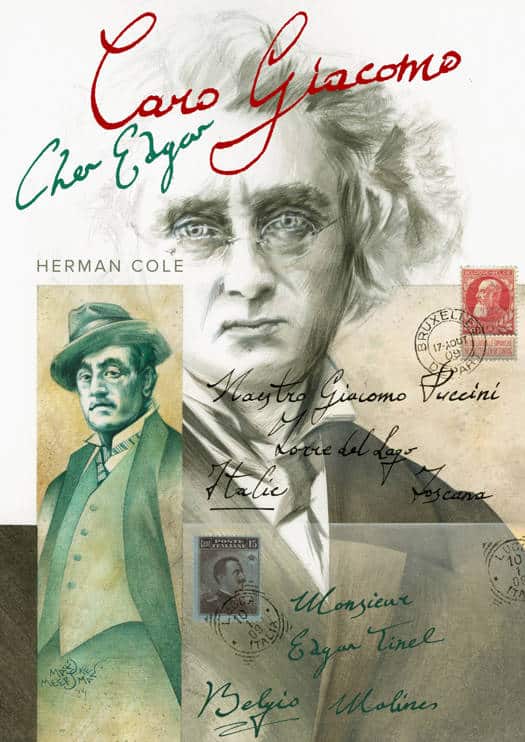
In the epistolary novel Dear Giacomo, dear Edgar author Herman Cole mirrors Tinel's life against that of Giacomo Puccini, whose centenary of death was commemorated in 2024.
It is a novel, admittedly based on Tinel's archives, but above all largely fictionalized. Cole writes very vividly so that the reader can fully immerse themselves in the comings and goings of the protagonist. The letters span the last twenty years of Tinel's life, who died in 1912 at the age of fifty-six. It consists of about sixty letters from Tinel to Puccini. In them, Tinel often reflects on what Puccini wrote in his responses and replies to him.
Prix de Rome
Like Tinel, author Herman Cole hails from the Waasland region. He couldn't simply let the year 2024 pass by, not only a hundred years after Puccini's death, but also 170 years after Edgar Tinel's birth in Sinaai near Sint-Niklaas. Throughout the epistolary novel, it is clear that the author admires both composers, different as they were. Cole is an Italy expert, retired Italian teacher, travel journalist, and also honorary citizen of Puccini's birthplace Lucca in Tuscany.
Born in 1854, Edgar Tinel was a typical product of the ultra-Catholic Flanders of the nineteenth century. He composed primarily religiously inspired music and was the driving force behind the Cecilian movement, the reform and purification of sacred music. In 1877 he won the Prix de Rome, which speaks volumes. He was primarily inspired by German Romantics such as Schumann and Brahms. Besides being a pianist, composer, and pedagogue, he was also inspector of music education, director of the Lemmens Institute and later of the Brussels Conservatory. His now-forgotten oratorio Francis was an international success with more than a thousand performances worldwide. His leading role in Belgian musical life also earned him the title of royal Kapellmeister. When Albert became king in 1909, Tinel had good contacts with the musical Queen Elisabeth.
Café music
As one of the great Italian opera composers, Puccini is still performed all over the world today. During his lifetime, Puccini experienced great triumphs in Europe and America. In Tinel's letters we hear the echo of Puccini's worldwide successes and his many travels. The epistolary novel is organized according to major works by both composers, three by Tinel and six operas by Puccini. Besides successes, it also concerns difficulties and obstacles in their life paths. Sometimes an opera received a poor reception at its premiere. La Bohème was criticized as an easy success, and in Milan the premiere of Madama Butterfly was met with ridicule. The composer Paul Dukas found Puccini's Tosca to be "café music".
In his imagination, Tinel travels alongside Puccini or enjoys the Italian sun and the peace by the lake near Lucca, where Puccini had his villa. The family life of both men is extensively covered. With his six sons, Tinel had better luck than Puccini in his married life. The end of the nineteenth and beginning of the twentieth century is also a period of great technological progress, which appears here and there in the correspondence. Puccini acquires an automobile, Tinel writes about the flight of the Wright brothers, the Simplon Tunnel is being dug, the first cinema of the Lumière brothers, Edison's gramophone, etc.
Spirit of the age
Although they made various attempts, Tinel and Puccini never met in person. There was always something in the way. With Tinel's death at fifty-six, the correspondence comes to an abrupt end in 1912. Twelve years later, Puccini dies of cancer in a Brussels hospital.
Unlike in a classical biography, the reader can step into the shoes of the protagonist Edgar Tinel through his letters. Herman Cole succeeds remarkably well in capturing Tinel's joys and sorrows, the musical life of the time, and the spirit of the age. Not only are the two lives, successes and setbacks woven together, but also the political, social, scientific and technological changes of the fin de siècle are vividly described. Contrary to what the title and cover suggest, this contains only letters from Edgar Tinel to Giacomo Puccini, not the other way around. It is therefore an alternative biography of Tinel, based on imagined letters.
You don't have to be a Puccini lover to enjoy this special book. This book is not distributed but can only be ordered at the bookstore 't Oneindige Verhaal in Sint-Niklaas, www.oneindigeverhaal.be