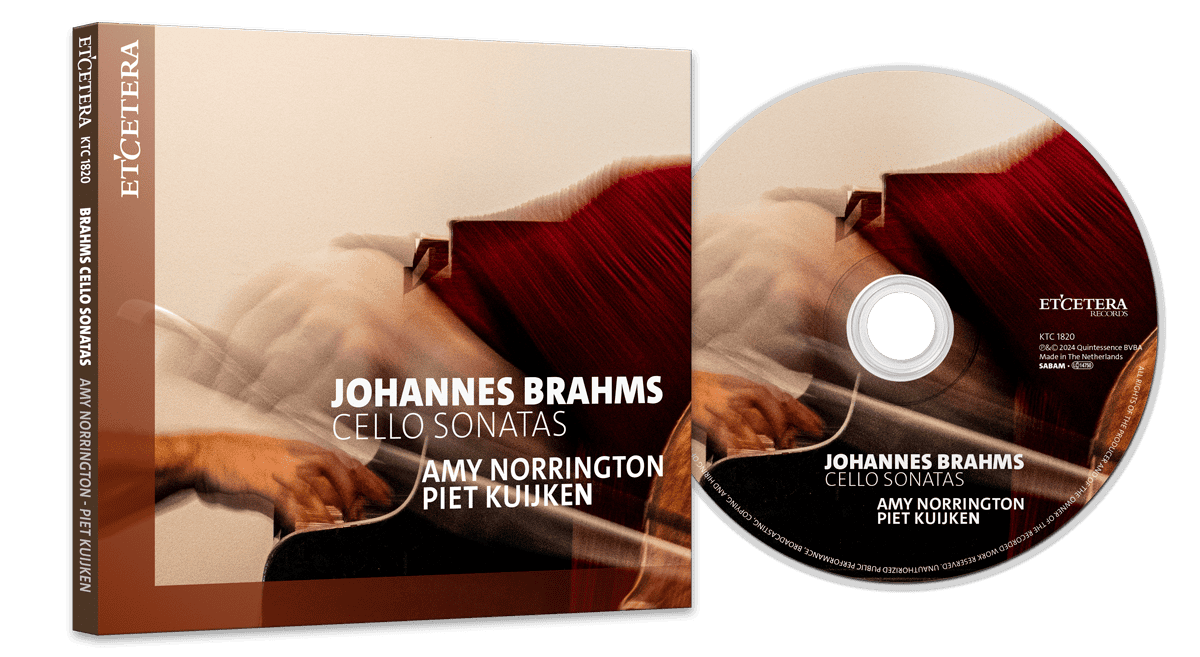
Johannes Brahms's (1833-1897) cello sonatas have been pressed onto CD countless times. So why yet another recording? Because the duo Amy Norrington and Piet Kuijken clearly carry this music deep in their hearts. And also, in no small part, because of the instruments being played here.
The real showstopper of this new Et ceterarecording is undoubtedly the Johann Baptist Streicher (1796-1871) pianoforte from Piet Kuijken's collection, a period instrument from 1868. "Brahms himself owned an identical instrument from the same year until his death, one he held very dear and used to compose even his very last opus numbers on," as we read in the trilingual CD booklet (EN, DE, NL). You couldn't get more historically informed than that, though of course that has a lot to do with the actual playing style as well. In any case, most musicians resort to modern(er) instruments when they tackle Brahms. There are a few exceptions on the market. For instance, his violin sonatas were recorded by the duo Johannes Leertouwer and Julian Reynolds on a Blüthner grand piano from 1857 ((Various composers) Alexander Robson, Choir of St John's College, Cambridge"), and Aylen Pritchin and Maxim Emelyanychev used a Steinway from 1875 for the same repertoire (Apartée). But this approach is rather unusual for the cello sonatas, and who knows—on record at least—possibly without precedent.
Brahms's two sonatas for piano(forte) and cello rank among the most important works written for this solo instrument in the second half of the 19th century. But despite the public success of particularly the first sonata, not everyone was thrilled with its quality. Take Simon Vestdijk, for instance, who was ruthlessly hard on the second sonata in an examination of Brahms's chamber music (th How Does One Write About Music?, 1963). "Messy and meaningless," was his verdict on the opening movement (Allegro vivace). "A rather dull piece," is how he dismissed the following, "tedious"Adagio affettuoso . As belonging to "Brahms's weakest chamber works," came his final, very harsh verdict. We hear a different tune from the musicians themselves. Take for example Steven Isserlis , who instead speaks of "two marvellous sonatas" and "" and "invaluable assets to the cello and piano repertoire". The opening section of the second sonata, which Vestdijk disparaged, is regarded by the British cellist as "extraordinarily bold", while the slow movement is praised for its "rich style". "A highpoint in late nineteenth-century chamber music", thus Isserlis concludes his encomium.
Relentless fierce exchange
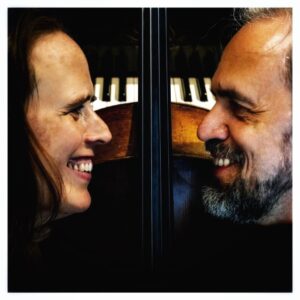
 Gorgeously winding gently in the evening light: this is how Brahms's first cello sonata (1862, 1865) begins. The exquisite way Amy Norrington phrases the opening theme immediately makes me suspect that she, too—just like Isserlis—carries these pieces deep in her heart. This is the cellist's very first solo album, which is surprising given her already lengthy track record. Chamber music clearly comes naturally to her, as evidenced by her long history with Oxalys and her current commitment to the Valo String Quartet. Norrington's dedication to the repertoire is substantial, particularly as founder and artistic director of the exceptionally fine " Festival Resonances " in the small Namur hamlet of Halloy. On this CD, she performs on a magnificent cello from 1695 by Francesco Ruggieri (ca. 1628-1698), equipped with gut strings and lent by her fellow cellist David Waterman of the Endellion String Quartet. She is accompanied by Piet Kuijken, one of her regular partners. With that surname, the Belgian pianist hardly needs much introduction. Since 2002, he has been, among other things, piano professor at the Royal Conservatoire of Brussels and guest professor at the conservatories in Antwerp and the Sorbonne University in Paris.
With the second theme from the " ), and yet the almost manic energy with which the quartet overwhelmed the listeners was a joy to hear. While Youn pushed through with particular vigor, Ibragimova and company made the strings sigh and screech. That struggle continued unabated in the subsequent scherzo ( ", the cello sonata in E (Op. 38) reaches its first genuine climax. Cello and pianoforte seem engaged in a tumultuous and relentless fierce exchange. The duo gives each other no quarter, only ratcheting up the tension. After a seemingly bucolic third theme has definitively silenced the mood, the relatively brief development remarkably offers little genuinely new material. What stands out is a new kind of stubborn fierce exchange that once again slowly subsides. In the closing coda, it seems as though both instrumentalists respectfully smoke the peace pipe. This both monumental and promising beginning receives a playful yet yearning continuation in the graceful " Allegretto quasi Menuetto". Norrington and Kuijken demonstrate not only a fine ear for dynamics, but also beautifully blend the timbres in the central trio. The third and final movement of Brahms's first cello sonata is a veritable stylistic hodgepodge in which fugue and sonata form are freely intermixed. This complex and sometimes calculated " {{NOTRANSLATE_3}} " is like a breathtaking roller coaster where both players must blindly trust each other. Their long-standing affinity is an extraordinary asset here. The whole remains in excellent balance from beginning to end, resulting in a tight and yet transparent sound. A worthy, intense, and occasionally even lyrical conclusion.
Songs as an encore
 To allow the listener to catch their breath, and yet add some pleasant extras to the album, the first cello sonata is not immediately followed by the second. Two Brahms songs first provide the necessary respite: " Es träumte mir " (Op. 57, no. 3) and " Ach, wenth diesen Blick " (Op. 57, no. 4). A choice that works out very well, as the contrast between these tender songs and the furious conclusion of the first sonata could hardly be greater. The arrangements are by the Norrington-Kuijken duo themselves, but essentially the original is being performed, with the cello as the voice. With the heroic opening of the first movement of the orchestral second cello sonata in F (Op. 99, 1886), another stylistic break follows ("). "A rather dull piece," is how he dismissed the following, "tedious""). At the piano, the tremolos flow effortlessly—the beginning of a notoriously difficult part that is taken on with considerable aplomb and sounds excellent on the Streicher. Norrington's spontaneous playing makes the whole a colorful and above all attractive overall experience. The following, usually serene movement is played with the necessary feeling, and especially laments that Brahms ultimately excluded, if not destroyed, the slow movement from his first cello sonata. The quality of musicianship remains top-notch in the final two movements as well. The extraordinarily witty scherzo (" . As belonging to "Brahms's weakest chamber works," came his final, very harsh verdict. We hear a different tune from the musicians themselves. Take for example is plucked and bowed with considerable feeling, and it's especially regrettable that Brahms ultimately rejected, if not destroyed, the slow movement from his first cello sonata. The quality of musicianship remains top-notch throughout the final two movements as well. The exceptionally sharp-edged scherzo ({{NOTRANSLATE_3}} passionato) – performed at a lively tempo – brimming with energy and distinguished by sheer force of will, while the remarkably carefree finale – "full of joyful contentment", as critic Bernhard Vogel put it (1887) – forms a sophisticated pedal point () certainly didn't deserve a beauty prize for its articulation, but that wasn't the point anyway. Everyone understood and felt the intensity that built to an unmistakable climax. In a word: stunning! The very last feat of this fantastic).
A recording that convinces across the board, thanks in part to a thoughtfully structured progression and a few well-chosen encores – the whole thing concludes with Die Mainacht (Op. 43, no. 2). If we were still handing out stars, this CD would rank very high in the firmament. About at the same level as Rostropovich and Serkin (by none other than Krystian Zimerman. It is therefore very tempting to compare this CD with those other, older recordings: an approach that reviewers apply time and again. But why always want to measure the value of something against something else? Why set performances in competition against each other instead of placing them brotherly side by side? In order to judge this disc on its own merits, it is therefore advisable to refrain from such comparative analyses. Ears wide open then for Valvekens, but closed to eminent colleagues such as Jozef De Beenhouwer, Mitsuko Uchida, Marc-André Hamelin, Piotr Anderszewski or Boris Giltburg., 1983), just to name those two greats. Because this is Brahms at his finest.