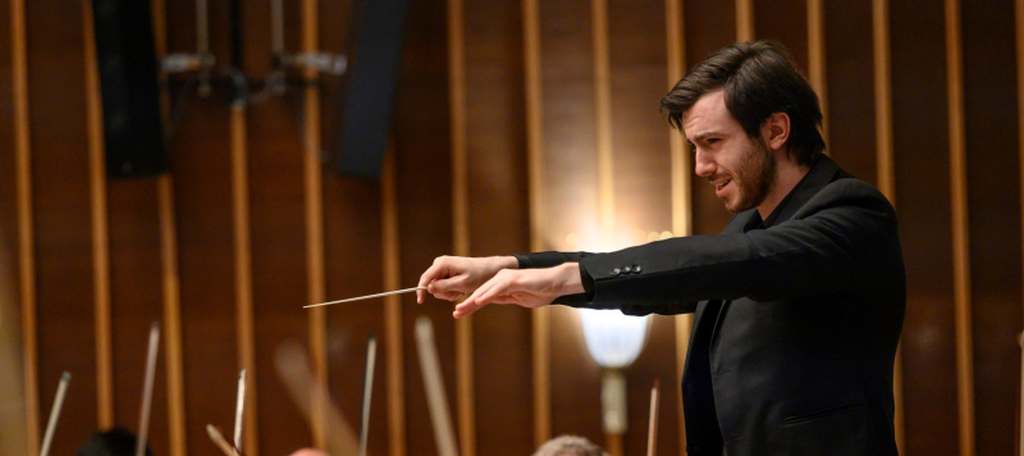
By Martijn Dendievel, assistant conductor at the Flanders Symphony Orchestra
I read the government agreement with great interest, and it contains good intentions and important decisions to improve the quality of our education. A strong focus on language skills, knowledge of history and current affairs, reducing workload for our teachers... These are all things I can only applaud.
Yet I missed one thing. It's something every child can develop. It's something that creates a sense of belonging and helps develop social skills. It's something that teaches children to discover their own feelings. It's something like a miracle elixir for improving academic performance, because among other things it enhances cognitive abilities.
Music has unfortunately almost disappeared from our education
Can you guess what I'm writing about? I'm talking about music. Singing, playing, humming, listening, just doing something with music! Unfortunately, it's (almost) completely absent from our education system. When I was in kindergarten, we still learned a couple of children's songs each month and sang them together with our teacher. Today, in an average school, you can count on one hand the 8-year-olds who know "Kortjakje." In primary school, there's no more singing, and regular contact with music within school walls is non-existent. Only children whose parents decide to enroll them in music school come into contact with the wonderful world of acoustic sounds and tones.
In recent times, however, there have been a number of studies and experiments proving how important music education is for everyone. In 2014, an American study found a clear difference in executive functions between children with and without music education. Important detail: the entire test group came from the same social background and had roughly the same IQ, which was a point of criticism in previous studies. During a memory and reaction test among other things, this remarkable difference in brain activity was observed between children with and without musical experience.
Problem schools in Bradford (England) and Roxbury (United States of America) made a complete U-turn by making music, art, and dance a cornerstone of education. As a result, not only did student performance improve in a short time, but so did the overall atmosphere and interpersonal relationships. Within five years, the school in Bradford was able to increase the percentage of students meeting expected English standards in reading, writing, and math from 53% to 74%. The American school, previously notorious for violence and dropout rates, replaced its security personnel with art teachers in 2010 and within just two years saw a dramatic improvement in the rate at which students absorbed knowledge. Bullying disappeared, students could concentrate better, and gained better prospects for further education.
In the German city of Bremen, a world-class orchestra, the Deutsche Kammerphilharmonie, is based in a secondary school, has lunch together with students in the school cafeteria, and turned the rehearsal space into an extra classroom. This way, the orchestra saves on infrastructure costs while simultaneously working on its social-artistic responsibility, which it has imposed on itself. They named their project "Zukunftslabor," the laboratory of the future. A few days ago, their eighth production went premiere, a music theater project that brings together students, teachers, orchestra musicians, and residents. Here too: twenty years ago, nobody wanted to go to this school; in 2018, it was included in a list of the twenty best schools in Germany. "Stadtteiloper" In our country, such initiatives are rare and usually organized by engaged cultural institutions or individuals. If we want Flanders to stand in the front row internationally when it comes to education quality and innovation, we need to anchor music in our school curriculum and reintroduce it for everyone, from kindergarten all the way through the sixth form of secondary school.
If we instill a love of music-making in children early enough, we lower the barrier that still feels elitist to many adults.
Some suggestions: in kindergarten, singing should return as a playful activity (of course with corresponding training for kindergarten educators). In primary education, professional musicians can, via the successful {{NOTRANSLATE_1}}
Kodaly method regularly bring large groups into contact with the basic principles of music. Music schools can also bring instrument presentations to the classroom and encourage children to take lessons. Secondary schools should be encouraged to organize school choirs and ensembles and regularly participate in rehearsals, concerts, and musical performances. In the Flemish conservatories, a program based on the German principle of "Musikvermittlung" can be started so that musicians can develop the right tools for the tasks mentioned above. We have so many creative minds in Flanders who would be more than happy to get started on this, and are just waiting for the green light.
If we instill a love of music-making in children early enough, we lower the barrier that still feels elitist to many adults. The beauty of music, and art in general, is that it has no negative side effects, brings people into dialogue and connects them with one another, encourages critical thinking, and can bring color back to life on both small and large scales.
Klassiek-Centraal.be » In our education system, music unfortunately hardly gets any attention anymore comments feed