New CD Jeroen Malaise – release concert May 23, 2026 MoMu Antwerp
Nomad – that's what the Grand Café on the Singel in Antwerp is called. Multi-awarded composer, self-proclaimed 'music archaeologist' and conservatory teacher Jeroen Malaise feels at home there. The name is practically symbolic of his musical life, he admits. Tradition and improvisation forms play an important role in his work. He has already performed at venues including the Wiener Konzerthaus, the Royal Opera House London, the Cage Festival Amsterdam, the Romaeuropa Festival, the National Arts Centre in Ottawa, Les Coups de Théâtre Montreal and the Beijing Music Festival. He also sits on the Steering Committee Metric and is an ambassador of the Pleyel 1884 at the Vleeshuis in Antwerp. Now his new CD has been released: 'West Bank Echoes – A Journey Through Palestine'.
How does someone end up on the West Bank?
Through a project for a conservatory in Italy, I ended up in Tunisia. There they asked me: would you be interested in visiting a Palestinian music academy? Being curious as I am, I jumped at the opportunity. It turned out to be a very special experience. Bittersweet, really. A place so laden with history: that's quite extraordinary. You can feel it. It's in the air. (Check out Michael Church's magnificent book 'The other classical music traditions' while you're at it.) And the fact that Palestinian culture was so completely overwritten fascinated me.
I wanted to bring something beautiful to the region – something of beauty – and I asked my record label Etcetera if I could dedicate a chapter to it on my new CD. Etcetera was enthusiastic and wanted nothing less than a full album on that theme.
That's why I went back to the West Bank last year. There are conflicts there, sure, but it's not a war zone. Places like Ramallah are relatively safe because many tourists visit them. Music is my language. The focus on this album is on the West Bank, not Gaza.
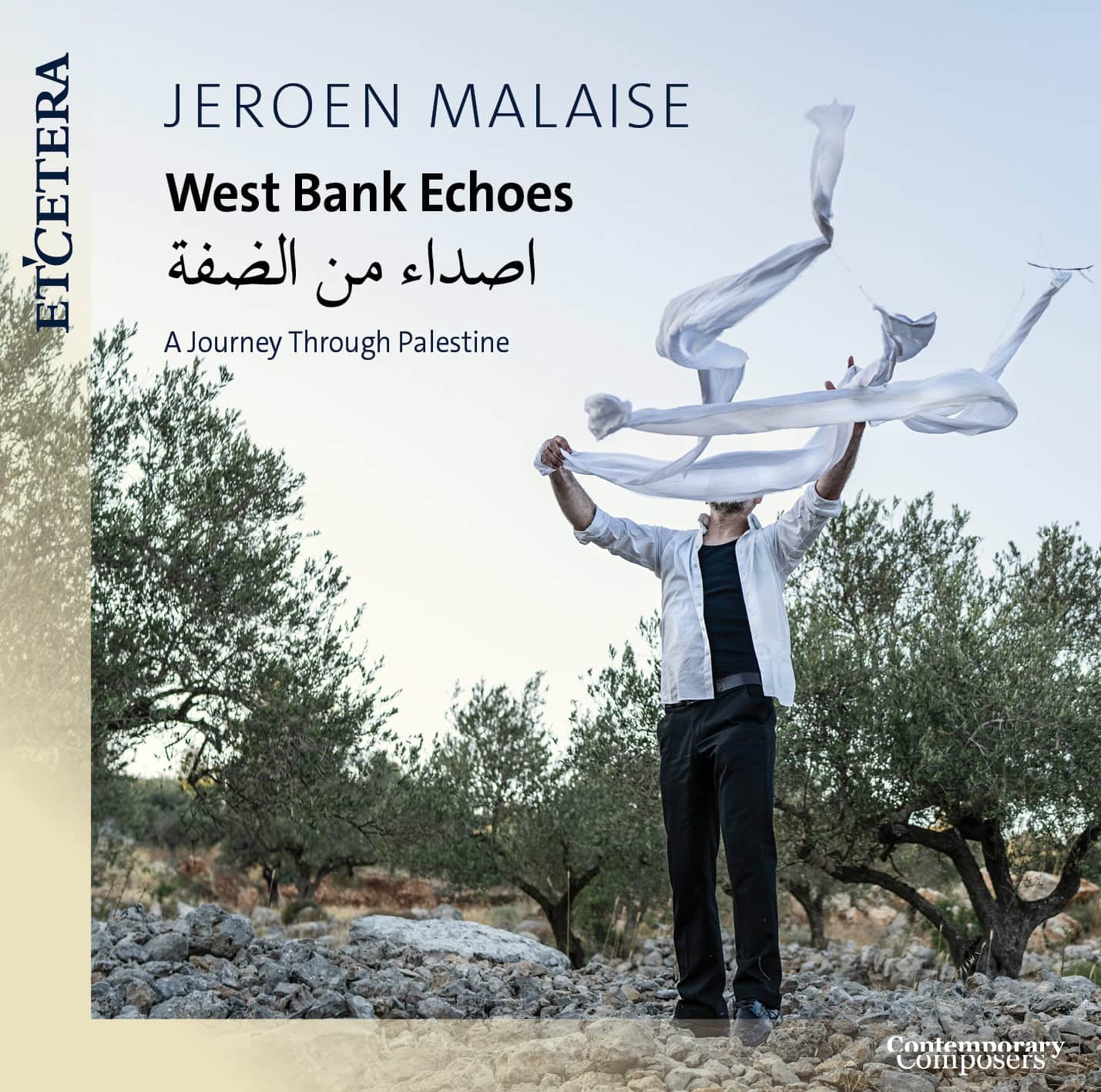
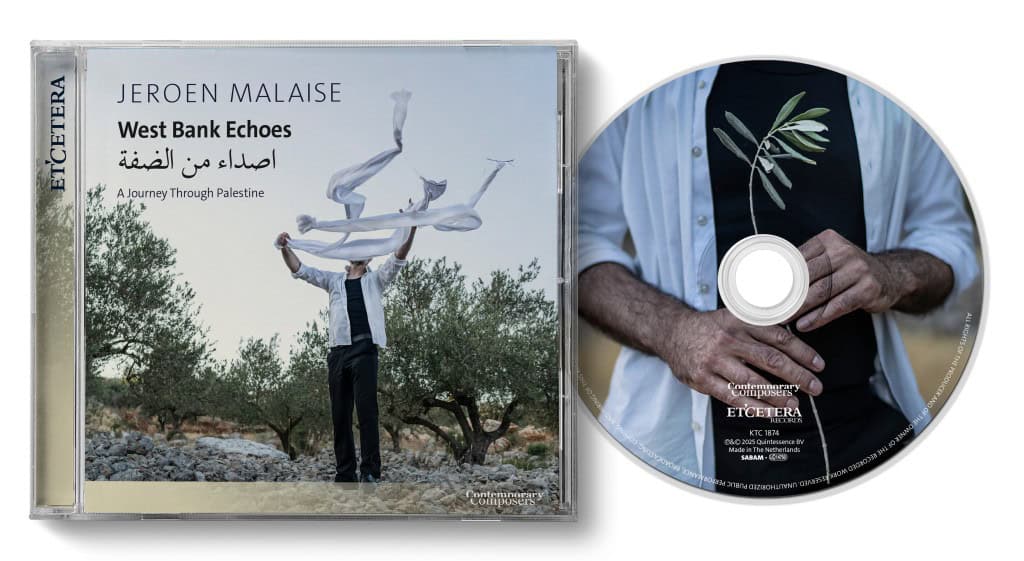
I've long been fascinated by the Arabic language and Arabic script. I even took evening classes for three years to deepen my knowledge of it. In the photo on the CD cover, I'm standing in an olive grove with white elegant cloths that evoke Arabic calligraphy. That was an idea from Samar Hazboun, the photographer who worked with Koen Broos on the shots. They are an integral part of this project, which is part of the Fantasia research project at Antwerp Conservatory. By the way, the title on the CD cover is also in Arabic – it simply had to be that way.
What does the Fantasia project stand for?
In the seventeenth and eighteenth centuries, you had those Grand Tours: composers would travel far and wide to gain new impressions and inspiration. Think of Franz Liszt's Pèlerinages or Robert Schumann's Waldszenen. That tradition has somewhat been lost. For me, the visit to the West Bank was a kind of Grand Tour. As you travel, you discover all sorts of things, and that was no different here. (To be honest, I find it rather odd that these cultural differences between East and West are so artificially separated.)
On my previous CDs, everything revolved around Preludes. Now it's Fantasia, with larger improvisation pieces. Often interactive. I see my own music as one great Fantasia.
I never play the pieces on my new album 'West Bank Echoes' the same way twice. Just like in the nineteenth century: the score was a finished product, but in fact they often played something different! Music is not a fixed work of art, after all. Music is constantly in motion. You bring your own expertise to the table, you process it, and in doing so you create your own musical language. I have no use for mindlessly repeating the standard repertoire. Give me a more dynamic picture: a landscape where you develop your own artistic and contemporary profile.
—For me, that's the standard: if you learn to play a musical instrument, you also learn to improvise. In the twentieth century, that usually didn't happen in Western European classical music. But in all other centuries it did: playing & creating as an intertwined duo. Look at Ludwig van Beethoven. Look at Franz Liszt.
Where does the title of your album come from: 'West Bank Echoes, A Journey Through Palestine'?
'Echoes' because it's not literally Arabic music. The rhythms from there have stuck in my head in a certain way. I use those rhythms in my own music, even though I may not have always understood them correctly. Arabs never say: that's wrong. They'll point out again and again: interesting!
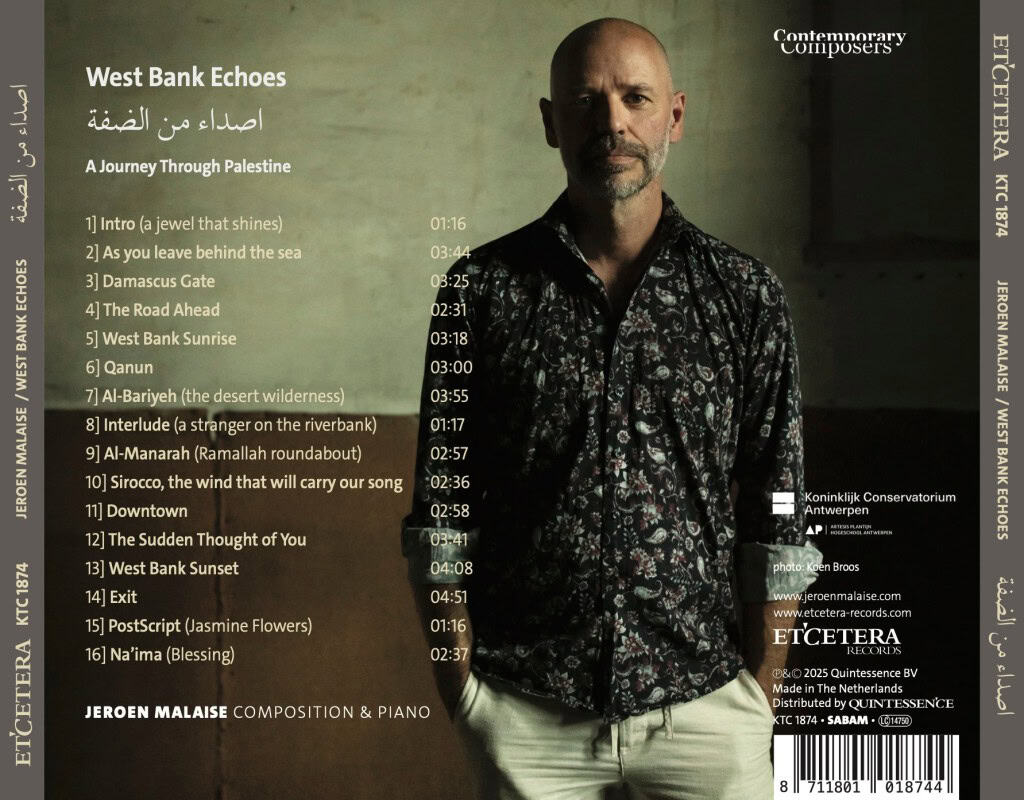
It was a journey in several senses: from Al-Bariyeh, the desert wilderness between Bethlehem and the Dead Sea, where you regularly encounter Bedouins. Where here and there Christian monasteries are scattered about. To specific instruments like the qanun, the kindred spirit of the piano—or the oud, cousin of our guitar. On that journey I also took rhythms from there with me, think of malfouf, an essential beat in Arabic music… that rhythm is very popular in the Middle East. And poets get to travel too. The opening track, for example, is based on a poem by Mahmoud Darwish, who compared Palestine to a brilliant jewel. And that's exactly how it felt to me!
Now I'm a bit confused. Is the music on your new album traditional or contemporary then?
What does that mean: contemporary? There are already many different definitions for that.
If you look at other traditions, you see that this distinction between 'contemporary' or not plays a much smaller role there.
For me, contemporary means: that you can really do what you want.
In Western Europe, we've gotten a bit stuck in that debate. A back-and-forth with hierarchical and compartmentalized thinking, rather than simply putting everything side by side.
Your new album is being launched festively on May 23rd with a concert at MoMu Antwerp. But first you're going to the Jasmine Music Festival in Palestine in May?
Yes, I want to translate that dialogue with the East into my concerts too. On May 23rd there's a concert at the Fashion Museum in Antwerp, together with the trio of a Palestinian oud player who lives in the Netherlands.
The Jasmine Music Festival takes place in Jerusalem, Bethlehem, and Ramallah. It's a drawn-out festival: one musician performs a concert at each of the three venues in turn. After two weeks, it's the next musician's turn to do all three venues.
Together with the Edward Said National Conservatory of Music, I've already visited those three halls. Beautiful spaces they are, with lovely grand pianos. Those instruments are often donations. Palestinians are incredibly strong at fundraising. I think that has a lot to do with their survival instinct.
What I do with my music, they don't find strange there at all. Here at the Conservatory in Antwerp you have the classical department and the jazz department. In the Middle East, conservatories divide things into Western classical and 'Oriental' music—which means: Arabic classical music.
And now?
Ha, releasing this CD means quite a lot to me.
Right now I'm without inspiration, I'm completely drained.
Wherever the wind takes me…
It'll all be fine, Jeroen Malaise. Congratulations again and thank you for your story!
‘West Bank Echoes, A Journey Through Palestineis out on Et cetera Records.
Release concert on May 23rd, 2026 at MoMu Antwerp
www.facebook.com/asifsherazi