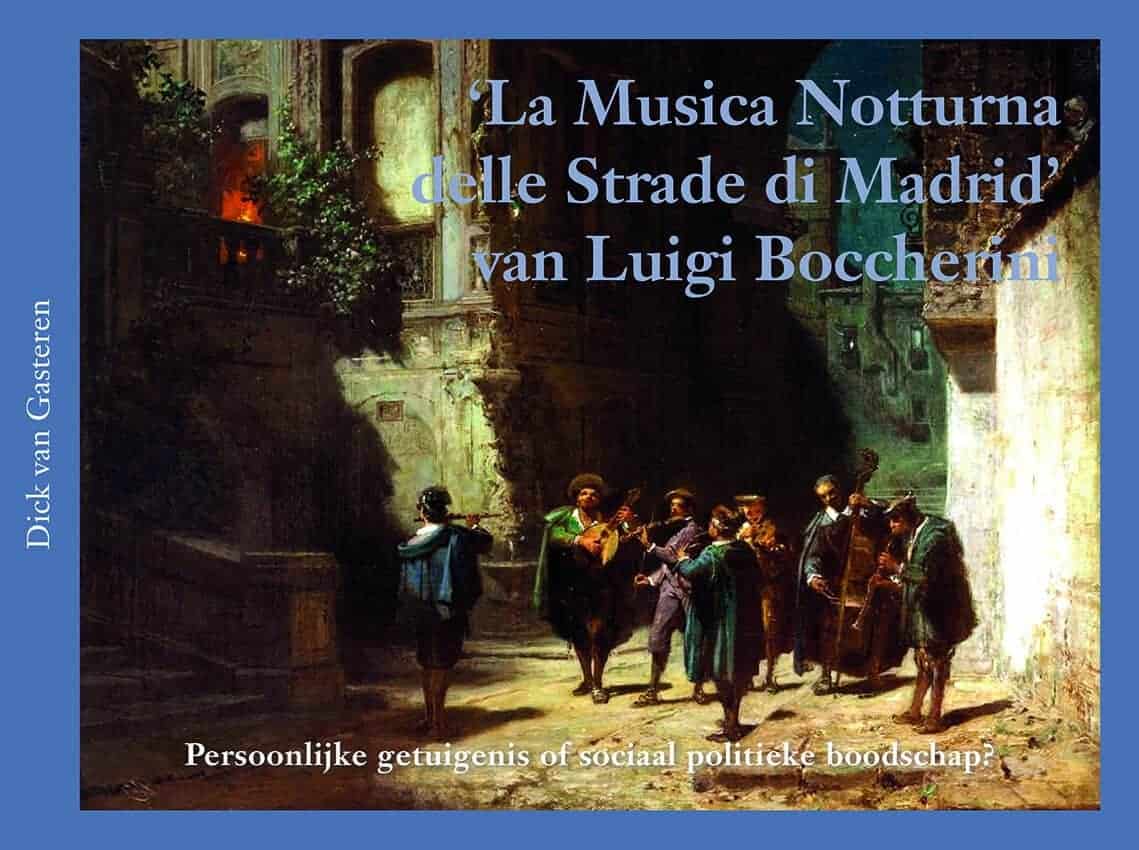
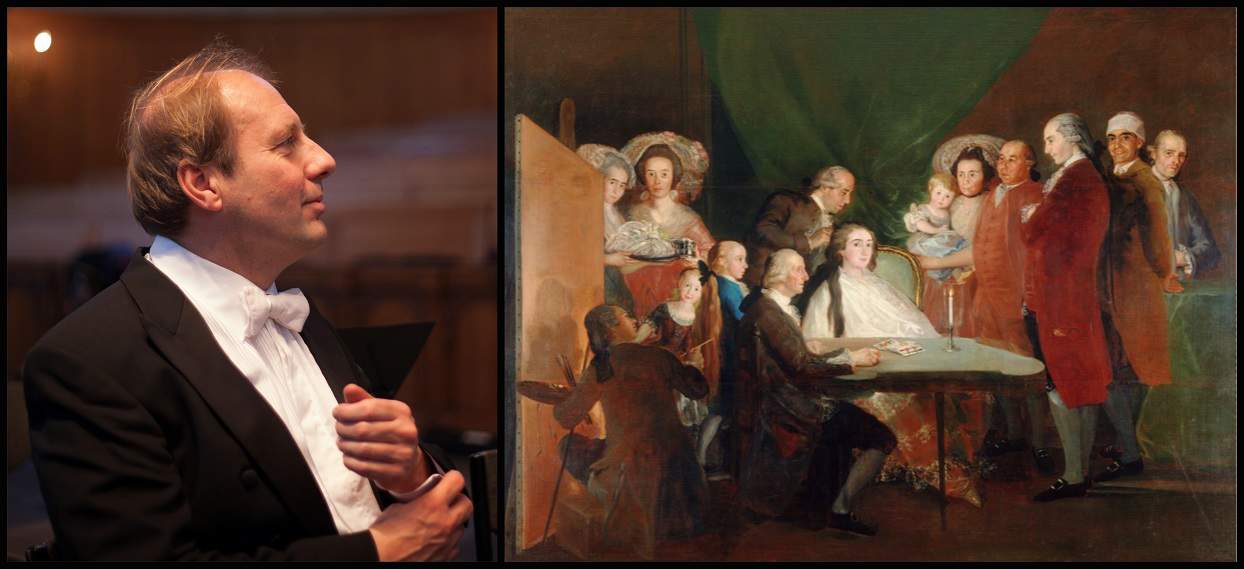
If clothes make the man, then in Boccherini's case they were above all, and repeatedly, his notes. But it can, thanks to this musical-iconographic investigation, be both. For an 18th-century composer and his wig are like 'Romeo and Juliet' or 'the man in the hat.' Or perhaps even like... María and Luigi? In any case, conductor Dick van Gasteren demonstrates it in this work in a manner that is both exemplary and particularly accessible. Through prints, then, such as a 'family portrait' in which Boccherini also appears properly dressed. And of course, above all, by thoroughly examining a series of images under the magnifying glass. For a facsimile of the autograph of the string quintet that Luigi titledthLa Musica Notturna delle Strade di Madrid really couldn't be missing as an appendix to this publication. © Lisanne Hoogerwerf
The by far most important source of this book is thus reproduced at the very end. It is the score of
'La Musica Notturna delle Strade di Madrid' by Luigi Boccherini (1743-1805), one of his rare string quintets for two violins, one viola, and a pair of cellos with a nickname. Although such an epithet is actually a good omen, it must have somewhat surprised Boccherini himself that his string quintet in C major was actually published in Berlin in 1822. For with an accompanying letter, our Italian composer had already urged the Paris publisher Pleyel in 1797 that 'La Musica Notturna' was a completely "useless" piece of music that outside Spain would only make a "ridiculous" and indeed meaningless impression. Meaningless to us, the listener, yet also truthful? On the title page of the score itself, Boccherini did indeed mention a "truth" that this very music would express. These are striking and even contradictory instructions that piqued the curiosity of Dick van Gasteren. The conductor of Ciconia Consort, a The Hague string orchestratherefore took a 126-page dive into Madrid's nightlife. In search of the 'truth' in, and especially about Boccherini's 'Notturna''Mortal beloved' Personal testimony or socio-political message?Such are both the subtitle and the research question of this veritable detective story. Spoiler alert: forget politics for now, everything is more than ever eroticism, love, and sexual attraction. Even in 1780, when Boccherini composed his seven-part 'Verità' in, and especially about Boccherini's 'Nocturne’.
'Mortal beloved'
Personal testimony or socio-political message? So goes both the subtitle and research question of this genuine detective story. Spoiler alert: forget about politics for a moment, it's all about eroticism, love and sexual attraction now more than ever. Also in 1780, when Boccherini composed his seven-part 'Notturna Music' wrote? Indeed, it's there in spades, and van Gasteren points it out convincingly. Thus the cello quintet begins with an explicit ode to María (parts 1 and 2), which is then courted in an equally confident and restrained manner (parts 3 and 4), only to finally be truly conquered (parts 5 through 7). The author even manages to give Boccherini's 'mortal beloved' a name: María del Rosario Fernández Ramos (1755-1803), "an 'Alma Mahler' of the 18e th century" (p. 91), and at the time a famous actress and singer in Madrid's theatrical world. It is therefore certainly no coincidence that the seduction game in part 4 takes place in a rose garden ('Il Rosario'). So the matter is thus somewhat settled, although van Gasteren does make a remarkable twist in the conclusion by still rebuking this hypothesis. Instead of assuming a serenade for Madrid, it sounds (p. 108): "[…] that the work should be understood as a personal testimony or serenade to María can hardly be reconciled with Boccherini's letter to Pleyel that 'the public outside Spain will never understand the meaning of the piece.' " If it really is a declaration of love, then "one should be able to understand that perfectly well outside Spain." Doesn't van Gasteren overestimate the general musical knowledge here, both in bygone centuries and nowadays? Far from everyone could or can read notes as well as he does, or understands with apparent ease the possible messages that might be hidden between them. And what's more: isn't María del Rosario's fame, especially outside Spain, presented in too rosy a light this way? Who would suspect such an intimate confession by the composer in this remarkable suite, let alone, on first—or second—hearing, understand Boccherini's cry from the heart to his muse María. For love is not only an eye disease, as the 'Minuetto dei Ciechi' (the 'Menuet of the Blind,' part 3) from 'therefore took a 126-page dive into Madrid's nightlife. In search of the 'truth' in, and especially about Boccherini's 'Notturna'Notturna
' testifies, but all too often also makes one deaf.
Red earstherefore took a 126-page dive into Madrid's nightlife. In search of the 'truth' in, and especially about Boccherini's 'Notturna'Music always stands in relation to society and can also serve a contemporary function in that sense. ' La Musica Notturna ' proves to be no exception in this regard, since the potential presence of such a socio-political message has been sufficiently demonstrated, contextualized, and deepened by van Gasteren. Central to this thesis is the conformist cultural policy of the Spanish king Carlos III (1716-1788) and his acolytes, the 'Junta de teatros Madrileñae '. With the staged tonadilla as its exponent, and whether it was theater, dance, or music: everything that deviated from the line in the royal theaters was increasingly viewed with suspicion in the second half of the 18th century. Purity of doctrine also ruled in church life and its associated processions, which in turn had repercussions on the carnivalesque atmosphere in which these processions usually took place. Add to that rising food prices and the French straitjacket into which the 'common Man(uel)' was forced, and the result is an explosive cocktail that led to a capital uprising in 1766. In 1770, Boccherini enters the service of Don Luis Antonio (1727-1785), the brother of Carlos, as 'cellist of his chamber and composer of musictherefore took a 126-page dive into Madrid's nightlife. In search of the 'truth' in, and especially about Boccherini's 'Notturna''. A privileged position in the entourage of the infante that could offer him both financial and the necessary artistic protection. Enough to take the cultural marching orders of the king and his retinue on a sneaky detour? Absolutely, artistic freedom was—and is to this day—a valuable commodity. Pamphleteer Boccherini thus protested with his 'La Musica Notturna' both for himself and for all of Madrid's colleagues who wanted to continue earning their bread on that basis. The work of María del Rosario belonged to that, but equally so that of Luis Misón (1727-1776)—composer and founder of the popular tonadilla—and painter Francisco Goya (1746-1828)—from the 1780s also in the service of the Spanish court.

© David Prins
Luigi Boccherini's sixtieth string quintet is a short, special, and far from "useless" piece of music: the occasion for the enthusiastic and remarkable detective work with which Dick van Gasteren has managed to satisfy his musical curiosity in an accessible and usually traceable manner. Not every one of the numerous informative inserts in the book equally reveals its source(s) (e.g., the inserts on pp. 18, 21, 72, 100, and 105), but the late Anner Bijlsma (1934-2019), the renowned Dutch cellist to whom this whodunit is dedicated, would likely have been less bothered by such nitpicking. For instead of wanting to search for such splitting of hairs, what remains especially striking is the mildly passionate manner in which van Gasteren has illuminated his subject. In G major, then: the same key in which the courting ('Il RosarioIl Rosario') and then the beginning of intercourse ('Passa calle ') from 'La Musica Notturna' are set. set to music.
"It is exceptionally difficult to determine how the abstract language of music relates to historical reality," concludes van Gasteren (p. 109), but he has succeeded brilliantly nonetheless. The more the author dares to dream within the confines of this symbolic score, the more it reveals its hidden secrets. Wonderful stuff. No one can listen to Boccherini's gem the same way after reading this—you'll be hanging on every note.
WHAT: 'La Musica Notturna delle Strade di Madrid' by Luigi Boccherini: Personal testimony or socio-political message?
WHO: Dick van Gasteren, conductor and artistic director of Ciconia Consort
PUBLISHED BY: PROMINENT publishers
: 9789026355059 | 416 pages | publication date: April 13, 2021: 978-94-92395-39-9 – 126 pages, supplemented with a facsimile of the score