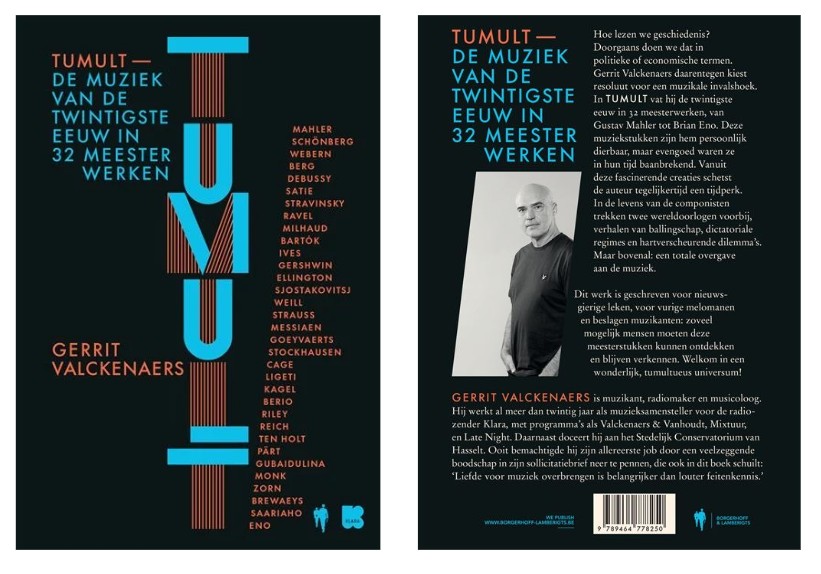
It's probably been a while since you last heard Darius Milhaud in a concert hall or on a radio station. La Création du Monde It's probably been a while since you last heard Darius Milhaud in a concert hall or on a radio station. Gerrit Valckenaers considers it one of the 32 masterpieces of 20th-century music. And he wrote a book about those 32. The author points out in his foreword that "programs featuring contemporary music were often relegated to late evening slots".e But now, I hear that music already around 8 p.m. in the evening! It is undoubtedly his merit—and that of his colleague Vanhoudt, with whom he produced those late-night broadcasts together for a long time—that there is now a sufficiently large audience without loss of listeners.Let's be honest, it was high time that in our 21st century more attention was paid to those often-forgotten composers from the 20th century. Always those 19th-century composers with their rigid repertoire and their classical predecessors, plus those enduringly popular Baroque composers. Nothing against them, mind you, but more good words about all those other and often lesser-known names—that not only may happen but must. Gerrit Valckenaers quotes the 18th-century British music historian Charles Burney, who believed that in his time "virtually all music was contemporary music, because every new composition had a life expectancy of at most two generations." But just as now, this did not mean that all new music was welcomed with open arms.
He presents us with 32 masterpieces in digestible chunks. And he does this not only with interesting anecdotes but also with thorough and original analyses. When you realize how difficult it is to express musical concepts in text without being able to play them for the reader, you must conclude that here we have quite a skilled teacher at work. And yes, sometimes it's about the more well-known pieces like Mahler'se Adagiettoalmost all music was contemporary music, because every new composition had a life expectancy of at most two generations. " But just like now, this did not mean that all new music was welcomed with open arms.
He serves up 32 masterpieces in digestible chunks. And he does this not only with interesting anecdotes but equally with thorough and original analyses. If you realize how difficult it is to express musical concepts in text, without being able to play them for the reader, then you must conclude that here is a truly excellent teacher at work. And yes, sometimes it's about the more well-known pieces like Mahler's Adagietto from his 5th Symphony or Le Sacre by Stravinsky, but have you already listened to Atmosphères by Ligeti or a miniature like Webern's opus 10, Five Pieces for Orchestra? That'll set you on a path to discover more and different masterworks by great names like, for instance, that gripping Telegraph for Germany by Alban Berg. And along the way you get insight into that tangled web of love affairs among all those Viennese artists. Or how Satie's music (Three Pieces in the Shape of a Pear) “went from café to concert hall”
Clever how he plucks the most compelling and interesting stories from his enormous consulted bibliography to place it all in its historical context. It speaks to tremendous erudition. And with each masterwork discussed you immediately learn a great deal, not only about that composer's other works but also about a whole bunch of colleagues or competitors, avant-gardists or simply contemporaries. He also characterizes beautifully Richard Strauss's balancing act with the Nazi regime in a chapter about a masterwork called "Four Last Songs". Nor are there missing discussions about businessman-composer Charles Ives (The Unanswered Question) and immigrant George Gershwin (Rhapsody in Blue).
You also learn, almost firsthand, the sad story of first the friendship and later the tensions between the assertive Karlheinz Stockhausen (Song of the Youths) and the introverted Karel Goeyvaerts (Sonata for Two Pianos). One of the most moving passages in the book is the extensive description of the creation story of Messiaen's "Quartet for the End of Time"."About the synesthete Messiaen it says: "Everything he sees, he hears". And about John Cage (4’33”") you read how his attention to ambient sounds made him a trendsetter for minimalism and the return of tonality. You meet the phase shifts of those minimalists like Steve Reich Music for 18 Musicians"), Terry Riley In C") , with the enchanting Dutchman Simeon Ten Holt from Canto Ostinato", and of course also with Arvo Pärt (Tabula Rasa") . More names? Too many to mention them all… Luc Brewaeys (Talisker)Meredith MonkBook of Days"), Brian Eno (Music for Airports") and many more, all virtuosically presented in "word and image", each accompanied by a beautiful graphic author portrait by Lotte Vanhamel.
Reading this book saves you from having to read at least 32 musical biographies from that period. In some of the more musicological sections you might get a bit lost if you haven't studied "music", but it's wonderfully easy to get swept away in this gripping book, even for the casual enthusiast. I thoroughly enjoyed reading it and learned an enormous amount from it. Now if only I could remember it all.