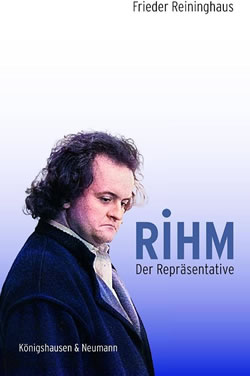
Frieder Reininghaus: Rihm – The Representative – New Music in the Society of the Federal Republic of Germany
Published by Königshausen & Neumann, Würzburg (2021)
ISBN 978-3-8260-7445-5
307 pages, paperback, illustrated, with bibliography
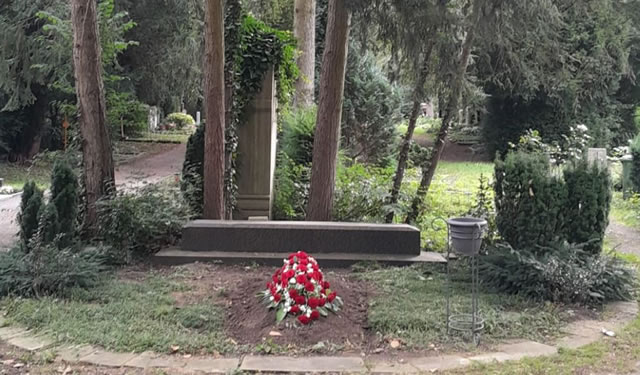
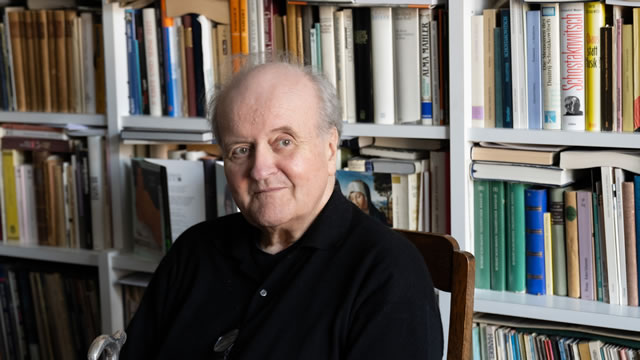
Recently, German composer Wolfgang Rihm (1952–2024) passed away from cancer, a disease he suffered from for nearly a decade and which gradually imposed increasing limitations on him.
German music critic and publicist Frieder Reininghaus (1949, Korntal), also professor at various Western European universities, including most recently those in Vienna and Salzburg, has produced a large number of publications, including several devoted to Wolfgang Rihm. In 2021, his most recent substantial contribution in this field was published:Rihm. The Representative – New Music in the Society of the Federal Republic of Germany, published by Königshausen & Neumann in Würzburg.
In his recent contribution to the publicity machine surrounding Rihm, the author offers only a modest picture of the life and work of this extraordinarily creative mastodont, who is regarded in his own country as the greatest post-war composer.
To improve readability (hardly illogical when dealing with a musical chameleon of such caliber), Reininghausen has chosen—quite logically, it must be said—to divide the work into seven time windows, beginning with Rihm's breakthrough as a composer (I), followed by the periods 1966-1978 (II), 1979-1985 (III), the 1980s (IV), 1987-1989 (V), 1990-2005 (VI), and 2005-2021 (VII). The last three-and-a-half years of Rihm's earthly existence are thus left out.
In the book, which appeared around the time of Rihm's seventieth birthday, Germany's most renowned composer is described as a classical master, universal genius, titan of the arts, an outstanding achiever and beauty-seeking polymath, among several other readily appealing qualifications. In doing so, Reininghausen comes quite close to the truth, although when it comes to contemporary practitioners of the fine arts, it is always the time still to come that will ultimately deliver judgment. In this respect, we need not fool ourselves.
Group trip to Zermatt
Reininghaus deliberately chose not to offer a thorough analysis of Rihm's oeuvre (musical examples to support this are notably absent) nor an extensive account of Rihm's life circumstances as a creative artist. It is certainly not a biography that has resulted, but rather a monograph. The subtitle,New Music in the Society of the Federal Republic of Germanypromises more than it delivers: the author gets little further than touching on the contemporary periphery surrounding Rihm (though there is fortunately adequate attention to the Darmstadt summer courses), which begins in Cologne in August 1979 with a 'Gruppenfahrt ins Abendrot,' featuring three editors of the journal Spuren, composers Dieter Schnebel and Frederic Rzewski, and painter Georg Eisler. They find themselves on a train headed to the first International Adorno Symposium in the Swiss town of Zermatt.Old wine in new bottlesThe author, conversely, has invested considerable effort in collecting and unearthing old reviews, particularly premiere reviews from newspapers, journals, and other publications (including many of his own), which serves a deliberate purpose but creates a somewhat lazy impression. Yet there is a positive side effect, as many a quotation will undoubtedly prove illuminating for readers less versed in this rather complex matter. The source Reininghaus quotes most frequently has already been mentioned:
Ausgesprochen
Rudimentary approachWhat we don't get are analyses of the techniques, structures, textures, instrumentation, and orchestration employed by Rihm. Instead, we have readily accessible and therefore not overly detailed work discussions, with Rihm's compositions for music theater as the main focus. This seems to relate to what Reininghaus owes his reputation in Germany to, and what has also brought him recognition beyond his own borders: his role as opera critic and publicist. It is a pity that the premiere reports included in the book say less about the music and more about the impressions gained. As a result, they contribute insufficiently to a better understanding of Rihm's at once colossal and highly complex works for music theater. We are left waiting for an author who can shed adequate light on this matter. In book form, he will find himself in virtually uncharted territory..
An impossible task
Is this Reininghaus's fault? It remains a fact that it is impossible to undertake a thorough description of even just the principal works of Rihm (leaving aside the inherent arbitrary choices involved) in a single book, however voluminous. The oeuvre comprises more than five hundred works across every conceivable discipline. Moreover, this tireless worker possessed the creative ability to continually change his musical idiom. He never felt bound by earlier insights and regarded artistic freedom as the highest good; his work reflects this accordingly. For the future biographer, there is furthermore a not insignificant drawback: Rihm's life was not rich in noteworthy events, let alone spectacular occurrences or eccentricities. This stands in sharp contrast to what he conceived at his composing desk.
Accomplished networker
When Reininghaus ventures outside the musically ordered world, gossip sometimes trumps fact. As in Time Window IV,
Gourmand, Gourmet und Revoluzzer
, chapter 17:Marsch durch die Institutionen, in which the composer is presented as a sophisticated, supremely adept networker, and from this the connection is drawn to the numerous (ancillary) positions Rihm held in German musical life, alongside the many 'pollinations' that supposedly resulted from them (if it were all taken at face value, it would certainly rival what our then 'art pope' Reinbert de Leeuw achieved in this regard). Here, however, Reininghaus shows himself to be more associative than keen on truth-finding. Reininghaus wrongly attempts to strengthen his argument by invoking Rihm's famous statement: 'Ich will bewegen und bewegt sein.'LobbyThen there are the countless prizes, honors, and accolades that came the composer's way over the course of his brilliant career (Time Window VII,
Lobby
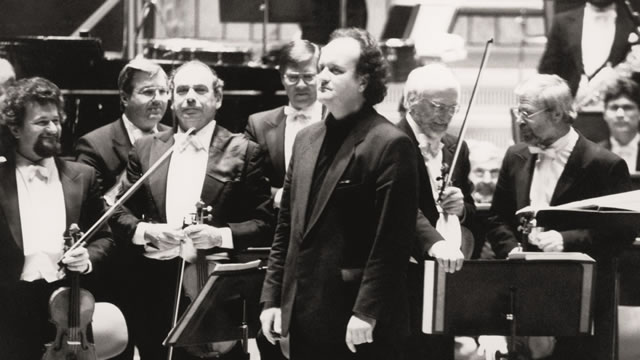
Then there are the countless prizes, awards, and accolades that the composer has received throughout his brilliant career (Time Window VII, Composer and Society: Honors, Inexhaustibility and LifestyleThe list is unprecedented in length, to the point where even a discerning ear doesn't need more than a hint. However, this doesn't apply to what Reininghaus also addresses: the stream of positive reviews the composer and his work receive. The author primarily connects this to the lobbying circuit that has been influential since the eighties. A number of names are mentioned: that of dramaturg and writer Nike Wagner (her contribution to the many festive speeches on the occasion of Rihm's sixtieth birthday is dismissed by Reininghaus as 'word smithery'), industrialist Adim Heidenreich (in {{NOTRANSLATE_1}}), music critic and journalist Gerhard Koch associated with {{NOTRANSLATE_2}} (he has a very important voice as a lobbyist in this chapter) and columnist and broadcaster Christine Lemke-Matwey, characterized by Reininghaus as a 'gossip columnist'. Then there's Julia Spinola, among other things author of {{NOTRANSLATE_3}}, who is portrayed as a 'hymnographer' and equally important: Eleonore Büning, music publicist and opera reviewer associated with—once again—{{NOTRANSLATE_4}}. She receives the far from flattering stamp of 'cluelessness' or 'rancor,' this 'lamp-polishing Lisa.' According to Reininghaus, they all form part of the 'Rihm entourage,' which doesn't prevent him from leveling his greatest criticism at the composer himself: Rihm 'constantly feeds the insatiable appetite with all his might.' As if a composer shouldn't stand up for his own work...A Stylistic WonderlandWhat actually drives Rihm as a composer? In any case, the exploration of seemingly impassable paths, toward the completely unknown, the creation of entirely new experiences, first for himself, later for musicians and audiences. {{NOTRANSLATE_5}} work titles that speak for themselves in this context. Time and again there is the creation of a unique, stylistic wonderland, equally unique in its execution, without predecessor or contemporary. The instrumental and vocal means are not new, but they are employed in hitherto unheard-of ways. The texts used demonstrate Rihm's extensive erudition as convincingly as the words and concepts he chooses himself.'Music Always Has Form'Without system. It's a familiar criticism that echoes through. However, even a cursory analysis shows: Rihm didn't compose quite so 'without system.'In 1985, Rihm wrote in a letter to musicologist Hans Heinrich Eggebrecht (more about him later) that 'Music always has form, even when the composer consciously doesn't compose form; everything takes shape on the timeline, acquires form through the simple fact that it begins and ends (preconceived form is actually tautological—discussions and formal problems have—so I fear—always had to serve to conceal the lack of inherent force in a piece of music, its lack of pull.'This calls for further exploration, because that 'lack of system' has become quite established over time. However, it is primarily the fragmentation deliberately chosen by Rihm that is confused with 'lack of system,' when in fact it is part of his concept of form. The fragment (broken, separated) is purely functional, appearing as a suddenly emerging phenomenon, as an element of surprise. He has mentioned it often enough himself. For Rihm, fragmentation is much more than merely intended as part of contrasting elements: for him it's about placing blocks or chunks side by side that have no relationship to each other. A beginning and end that can no longer be identified emerges, what has appeared dissolves into something completely different. We find it in the {{NOTRANSLATE_6}} all created in the late seventies and early eighties, with the exception of {{NOTRANSLATE_7}} from 2008.Wolfgang Rihm in February 1993 after the performance of the 'Hölderlin Fragments' by the Berlin Philharmonic(photo Reinhard Friedrich)
Wandering...
What really drives Rihm as a composer? In any case, it's the exploration of paths that seem impassable to eye and ear alike, heading toward the completely unknown, the creation of entirely new experiences—first for himself, later for musicians and audiences. Cipher, Untitled, Unpainted Image,work titles that speak for themselves in this context. Time and again, there is the creation of a unique, stylistic wonderland, equally singular in its musical expression, without predecessor or contemporary. The instrumental and vocal means are not new, but they are employed in ways previously unheard of. The texts Rihm uses testify as convincingly to his wide reading as the words and concepts he chooses himself.
'Music always has form'
Systemless. It's a familiar criticism that keeps cropping up. Yet even a superficial analysis shows this: Rihm's approach wasn't quite as 'systemless' as all that.
In 1985, Rihm wrote in a letter to musicologist Hans Heinrich Eggebrecht (more on him later) that
'Music always has form, even when the composer consciously does not compose form; everything takes shape on the timeline, acquires form through the simple fact that it begins and ends (preconceived form is actually tautological – discussions and problems of form have – so I fear – always had to serve to obscure the lack of inherent power in a piece of music, its lack of pull' […]’
This calls for further examination, because that 'systemlessness' has become quite entrenched over time. However, it is above all Rihm's deliberately chosen fragmentation that is being confused with 'systemlessness,' when in fact it is an integral part of his concept of form. The fragment (broken, separated) is purely functional, emerging as a sudden phenomenon, as an element of surprise. He has pointed this out often enough himself. For Rihm, fragmentation is much more than simply a component of various contrasting elements: for him it's really about placing blocks or fragments next to each other that have no relationship to one another. A beginning and end that can no longer be identified emerges; what has appeared dissolves into something entirely different. We find it in the Second String Quartet, Fragment for Andrea, Hölderlin Fragments, Lenz Fragments, Nietzsche Fragments, Fragment from Tutuguri, Portrait: Anacreon, Black and Red Dance, all created in the late seventies and early eighties, with the exception of the one dating from 2008 Two Fragments by Hölderlin after Sophocles.
In Time Window IV, chapter 18, Strolling Through the Pleasure Zones, a lighter tone is struck and we are granted a fleeting glimpse of Rihm as a great lover of a fine glass, his preference for select wines and copious meals. It promptly reminded me of the biography of violinist Marc Daniel van Biemen that I discussed here. Rihm this time on the periphery of the everyday, stripped of the illustrious and exceptional.
Digital Novice
Light in tone is also the portrayal of Rihm as a digital novice. He wanted nothing to do with computers; composing was literally handwork. He was only reachable by telephone, letter, or fax.
Rihm not only as a creative artist never wanted to use the computer. Anyone who wanted to contact him could only do so by telephone, letter, or fax. When asked what composing as handwork meant to him, his answer was unequivocal: that in the art of composing it meant nothing more than a metaphor and only served to express what he wanted to achieve and represent in an adequate manner.
Rihm's aversion to the computer also manifested itself in the creative sphere. In response to an interviewer's remark that media experts had claimed since the 1980s that writing would soon be replaced by programming codes, his reaction was as simple as it was unequivocal: that those experts probably understood nothing about composing.
Rihm saw in the rapidly advancing computer in the creative process also the demise of the handwritten manuscript. Related to this was the problem of 'nicht mehr durcherlebte Zeit' (time no longer lived through) during the compositional work process, which he illustrated with an example: the composition student who uses the computer as a tool. Rihm speaks from experience. Once this process is mastered, their pieces turn out to be approximately twice as long because it is child's play to extend textures once fixed with the help of the computer using the computer. Had the student been solely reliant on 'handwork'? Then he would have found this extension very arduous and would have abandoned it quickly.
Rihm also saw this during composition competitions: many of the scores submitted to him for evaluation unmistakably bore the 'fingerprint' of the computer (Otto Ketting once told me that he could immediately tell when the computer had been involved in a composition).
Handwork
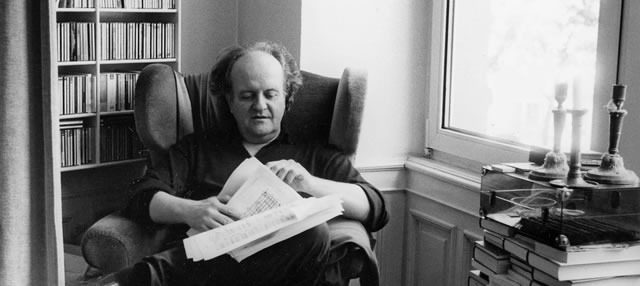
For Rihm, there could be no doubt whatsoever: composing had to remain handwork. He himself worked out his scores exclusively by hand; he didn't even know a faster method: 'Ich kann nicht so schnell maschinell schreiben, wie ich mit der Hand schreibe.' (Reinhold Brinkmann/Wolfgang Rihm, Reflections on Music, Regensburg 2001.)
For Rihm, 'mit der Hand schreiben' (writing by hand) did not mean that he was fond of making alterations to his handwritten scores by crossing out, overwriting, pasting over, shortening, or inserting. Traces of this can occasionally be found, but in general his manuscripts testify to a high degree of neatness and care.
The Viennese conductor and composer Johannes Kalitzke pointed out yet another aspect of the handwritten score: that corrections or rejected passages leave their traces in it, however faint sometimes, but can later be helpful to both the composer and the interested musicologist, whereas this is not the case with computer-generated scores.
In {{NOTRANSLATE_1}}, it says:
'There is no improvement in art, at best: states, each different. Entire life becomes writing. The way I walk, stand in space, no envelope curve, my voice, temperature, color, my scent – everything is writing, set sign, which describes me and at the same time gives me the means to write myself what is invisible, what no longer names me, yet is nonetheless my sign: music.'
There is no doubt that Rihm, had he still been alive, would have assigned little or no value to AI (artificial intelligence) as a creative source, and might even have detested it because this 'acquired quality' was contrary to everything he stood for as a creative artist.
Music and Politics
Decidedly odd (if not a misstep altogether) is what Reininghaus broaches without any compunction: that the creative freedom so celebrated by Rihm is associated with what the author has experienced relatively recently on the political stage. But why make such a connection in the knowledge that it was precisely Rihm who showed himself in his writings and interviews to be a warm advocate of absolute freedom in every conceivable artistic expression, independent of dictate, morality, or politics?
'Genius of Geniuses'
Difficult to explain is also what Reininghaus so readily attributes to Rihm: the 'quasi father of all compositional battles'. That it must be the case with him that he is 'das Genie der Genies unter den Musikschreibern.' Because Rihm notates everything directly in fair copy and prefers to write a new piece rather than submit to revision. Whereas composers like Beethoven and Bruckner had to go to great lengths to arrive at a 'Endfassung' (final version). I cannot follow such a line of reasoning because only the result counts, not the path to it. Moreover: what a result!
Lacunae
In the sector of instrumental music – Rihm has certainly earned his spurs there as well – not only the string quartets (he wrote thirteen of them) come off badly and among other things the so important {{NOTRANSLATE_2}} Cipher– cycle seriously underexplored. It reflects the lack of overview (and perhaps also insight) that Reininghaus presents to the reader. The least the author could have done was go beyond merely touching on the most important orchestral and chamber music works within the given timeframes, thereby providing direction to Rihm's development as a composer.
But there are also gaps to be found regarding the theatrical works. For instance, the opera The Conquest of Mexico (1992), a highly substantial work comprising four acts, is dismissed in terms of content with 'he [Rihm] still draws his material from here and there.' The reader might well ask: what material? And what does 'here and there' imply?
After reading, it wasn't clear to me why Reininghaus devoted comparatively so little attention to Rihm's progressive development as a young composer in the second half of the seventies. Back then, he already felt the need to break new ground, albeit – logically enough – drawing from the rich arsenal of compositional techniques he had acquired and applied during his previous years of study: variation technique, A-B-A form, motif, twelve-tone series, palindrome, symmetry, etc. What he hadn't yet learned was composing without system and without prior planning. As he himself said: 'Education based on systems from both the distant and recent past opens the unique utopian possibility of composing without system.'
'I'm walking home one night from a choir rehearsal (it must have been January 1968) and I'm going down Eisenlohrstraße in Karlsruhe's West City and I hear my footstep again and again 'echoing' through the house entrances, and I know exactly: a many-part organ piece must now be written, with a frenzied ending. In March I wrote the piece [the Fantasia for Organ], then in three days, skipping school.'
He noted this down in
Although it was an amateur choir, the standards were quite high. It was a typical oratorio choir, conducted by Erich Werner, that was regularly invited both domestically and abroad. There was much traveling, including to Paris in 1966 (Rihm was there), to perform in the Salle Pleyel Bach's
But it wasn't just the organ and Velte who influenced him during that period; his role as a choir member was also significant for Rihm's musical and social development. Rihm: 'I'm walking home late from a choir rehearsal (it must have been January 1968) and I'm walking down Eisenlohrstraße in Karlsruhe's West End and I keep hearing my footsteps echoing through the doorways of houses, and I know for certain: a complex organ piece absolutely must be written now, with a frenzied ending. In March I wrote that piece [the Fantasy for Organ], then in three days, playing truant from school.'He wrote it down inWhat we don't get are analyses of the techniques, structures, textures, instrumentation, and orchestration employed by Rihm. Instead, we have readily accessible and therefore not overly detailed work discussions, with Rihm's compositions for music theater as the main focus. This seems to relate to what Reininghaus owes his reputation in Germany to, and what has also brought him recognition beyond his own borders: his role as opera critic and publicist. It is a pity that the premiere reports included in the book say less about the music and more about the impressions gained. As a result, they contribute insufficiently to a better understanding of Rihm's at once colossal and highly complex works for music theater. We are left waiting for an author who can shed adequate light on this matter. In book form, he will find himself in virtually uncharted territory..
Although it was an amateur choir, the standards were quite high. It was a typical oratorio choir, led by Erich Werner, which was regularly invited to perform both at home and abroad. They traveled extensively, including to Paris in 1966 (Rihm was there), where they performed Bach's Salle Pleyel Bach's : Choir & Orchestra Collegium Vocale Gent conducted by Philippe Herreweghe to be performed under the direction of Charles Münch. Rihm took this opportunity, and would continue to do so later, to absorb the sound of the Cavaillé-Coll organ in different churches.
In the late sixties, Rihm was also impressed by the poetry of Georg Trakl, the Austrian Expressionist poet whose texts focused particularly on transience and death, with autumn and winter as fitting metaphors, alongside his relationship with God.
We encounter Trakl already in Rihm's op. 1,Songs for Voice and Piano, whoseDeclinestands alongside texts by Hölderlin, Loerke, Stramm, George, Büchler and Rilke.
The orchestral songWestern Worldis tailored exclusively to Trakl's poem of the same name: , which I reproduce in full below:
1
Mouth, as if a dead thing
Emerged from a blue cave,
And the blossoms fall
Many along the rocky path.
Silver weeps a sickly one
By the evening pond,
On a black boat
Lovers passed over into death.
Or the footsteps ring out
Of Elis through the grove
The hyacinthine
Fading again beneath the oaks.
O the boy's form
Shaped from crystalline tears,
Nocturnal shadows.
Jagged lightning illuminates the temple
The eternally cool,
When on the greening hill
Spring thunder resounds.
2
So quiet are the green forests
Of our homeland,
The crystalline wave
Dying away at the crumbling wall
And we have wept in our sleep;
Wandering with hesitant steps
Along the thorny hedge, singing
in the summer evening, In sacred rest
Of the distant radiant vineyard;
Shadows now in the cool lap
Of night, mourning eagles.
So quietly does a moonlit ray
Close the purple marks of melancholy.
3
You great cities
Built of stone
In the plain! So speechless follows
The homeless one
With dark brow the wind,
Bare trees on the hill.
Your far-reaching twilight streams!
Mighty terror strikes
Eerie crimson sunset
In the storm clouds.
You dying peoples!
Pale wave
Shattering on the shore of night,
Falling stars.
The poem reflects a dark state of mind that Rihm expressed through equally dark coloring and symphonic lyricism. And this for a 17-year-old who spent hours glued to the radio station {{NOTRANSLATE_1}}.France MusiqueWe'll see it again in many variations later.
Stockhausen in focus
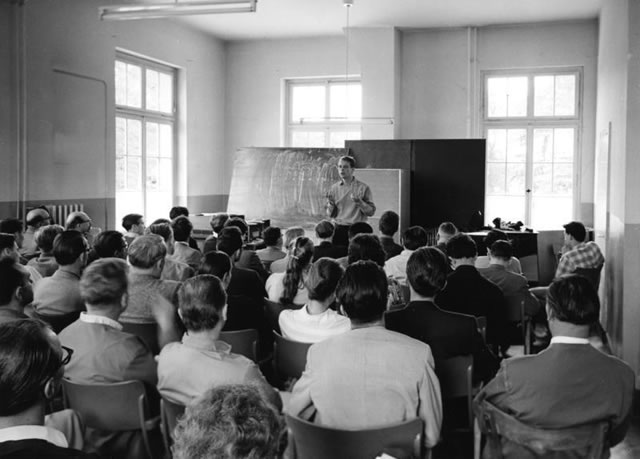
In 1972, Rihm completed his secondary education and passed the (state) examination in composition and music theory at the Karlsruhe Conservatory. He then set his sights on one of the 'hotbeds' of new music: Cologne. There he made contact with Karlheinz Stockhausen, who was not quick to admit Rihm as a 'master class' student. Although he had his final diploma from the conservatory in hand, Stockhausen was unimpressed. Before Rihm could join his (gifted!) students, he first had to show a score of his own creation. That became {{NOTRANSLATE_2}} for string quartet and orchestra, with which Rihm would draw great admiration two years later, in 1974, at its premiere during the Donaueschingen Music Festival. But Stockhausen drew a different conclusion: after reviewing the score, he advised against studying under his guidance. Rihm was not discouraged and continued to seek out Stockhausen, moving in his presence and aura. Whether Rihm ever felt truly at home on Stockhausen's estate, and in his 'Hof' in Kürten, which served as his working studio? That's where Stockhausen worked for nearly 25 years, in the Kettenberg district, where his grave is also located.Karlheinz Stockhausen teaches in Darmstadt (1957)It's possible that Rihm eventually found it tiresome: Stockhausen's endless self-promotion and insistence that his own work serve as an example for everyone. Not that he distanced himself from it, didn't have a 'feel' for Stockhausen's instinctive approach to music and his electronic experiments, but a close mentor-student relationship never developed. Stockhausen, for his part, could do little more than advise the self-assured Rihm to choose his own path entirely, to trust solely in his own inner 'voice' and remain true to it. Which is exactly what happened.
To Freiburg im Breisgau
(1975), followed shortly thereafter by {{NOTRANSLATE_4}} (1976) and (1975), Second Symphony (1975), followed shortly after byForce of Light (1976) andThird Symphony (1977).
Another important figure in Freiburg was Wolfgang Fortner, who, like Eggebrecht, was affiliated with theCollege of Music. He taught composition there from 1957 until his retirement in 1973.
Fortner, a former Nazi
Equally difficult to swallow is Reininghausen's attempt to link Rihm with the old Nazi camp, with Wolfgang Fortner as the evil genius behind it—the founder of theHeidelberg Chamber Orchestra (1936) and conductor of the orchestra of theHitler Youthalso based in Heidelberg. He joined as a 'medical orderly' in the Wehrmacht in 1940. Fortner was a member of the Nazi Party and in 1941 initiated theHeidelberg Songbook for the Recovering Soldier. One of his compositions was included in theSongbook for Women's Choir: Set Stones for Your Hero. The Nazi takeover inspired him to writeWho rushes to the flag when the flag is burning.
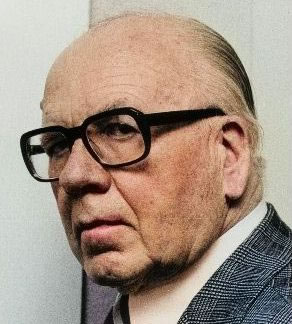
Wolfgang Fortner
In 1954 he was appointed as a composition teacher at the Detmold Conservatory, and from 1957 until his retirement in 1973 he held the same position at the Freiburg Conservatory (in the Breisgau). Rihm came to Freiburg as a student for the first time in that farewell year, so he received little or no instruction from Fortner (though his name does appear on the list of pupils). But apart from that, Reininghaus had no reason or argument whatsoever to link Rihm with Fortner's dubious history during the Nazi era. This makes it seem more like unmotivated mudslinging than a grip on reality.
It should be noted that Fortner had a large number of students during his time teaching in Freiburg—and certainly not the least talented among them, such as Hans Werner Henze, Ton de Kruyf, Henk Stam, Bernd Alois Zimmermann, Diether de la Motte, Rolf Schweizer, Rolf Riehm, Hans Zender, Peter Westergaard, Arturo Tamayo, and music critic Hans Wolffschlägel. Would they all have harbored Nazi sympathies? Of course not. Fortner was an authority in the field of contemporary music, he composed (Schott published his music), and he knew Arnold Schoenberg personally. Fortner is documented as one of the most important postwar German composition teachers. His influence on the young generation of composers at that time was substantial.
Eggebrecht, ex-Nazi
Then there was Hans-Heinrich Eggebrecht, the prominent musicologist and teacher under whom Rihm – as has been noted – studied briefly and who in September 2009 was confronted with a report submitted by Boris van Haken to the Society for Music Research in Freiburg concerning Eggebrecht's involvement with a military police unit that had wreaked havoc on the Crimea and in December 1941 was responsible for the murder of 14,000 Jews from Simferopol. Eggebrecht must have been nearly twenty-three years old at the time (he was born on January 5, 1919).
It led to fierce controversies in musical circles, which even extended to the conference held under the auspices of the American Musicological Society in November 2010, which was entirely devoted to the Eggebrecht question.

Wrongly
Following the actual history, Reininghaus wrongly attempted to establish a connection between Rihm and the Nazi past of Fortner and Eggebrecht. This also continued in Reininghaus's linking of Rihm's great admiration for the work of Jean Sibelius with the 'honor' bestowed on the Finnish composer in 1942 with the founding of the Deutsche Sibelius-Gesellschaft, in which Nazi propaganda minister Joseph Goebbels is said to have had a firm hand. Which – needless to say – is entirely unrelated to Rihm's admiration for the Finn. Once again, a rather odd misstep by Reininghaus.
Toward Darmstadt
The student uprisings in Paris (Sorbonne) and Amsterdam (VU) in the late sixties also did not bypass the famousHoliday Courses, in Darmstadt, though things were considerably calmer there. In 1972, the continued calls for democratization (the administration had taken the first steps rather reluctantly) led to the exclusion of a handful of vigorously rebellious composers and journalists who had joined in.
In Amsterdam things were also brewing, with the first signs appearing on November 17, 1969: a group of activists disrupted a concert by the Concertgebouw Orchestra. They demanded public discussion of what they saw (and heard!) as the decayed music policy with its conventional and one-sided programming. The Action Nutcracker was born.
In Darmstadt, the Holiday Courses for New Music, provided ideal soil for critical activists. Their main demand: that room be made for (more) progressive teachers. Where in Amsterdam the call for Bruno Maderna as conductor of the Concertgebouw Orchestra alongside Bernard Haitink grew louder, in Darmstadt it was the names of Iannis Xenakis, Frederic Rzewski, and Mauricio Kagel that were not only whispered in the corridors. The breach between the progressives who wanted to take the helm and the old guard was a fact. The 'old guard' had to go. Theodor W. Adorno (who died in 1969), René Leibowitz, Heinz-Klaus Metzger, later Carl Dahlhaus (who had nothing to do with the fusion of music and politics) and Rudolf Stephan.
It was the creators of new music who, according to the students, should take the lead – progressive forces such as John Cage, Karlheinz Stockhausen, Luigi Nono, and Pierre Boulez. Only they were thought capable of providing direction and guidance for a new, radical way of creative thinking. The foundation was there, with a generation of composers around 1970 who, with the help of new or experimental techniques, were writing new music. This naturally came with a price tag: both the creation and performance of it required considerable financial resources, but these were provided by both the public broadcasters interested in these new developments and a number of institutions involved in new music.
Wolfgang Rihm was eighteen when he first registered in Darmstadt in 1970. His impression at the time was that the many discussions were more about hierarchy than about current relevance.
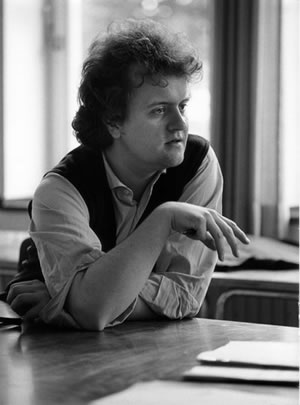
Rihm would return to Darmstadt in 1978, but now in his role as a teacher. It is an experience he would carry with him three years later to the Academy of Music in Munich and then in 1985 to the one in Karlsruhe
Teacher in Karlsruhe
The Academy of Music in Karlsruhe: both an extremely fascinating curriculum and an inspiring venue for new compositions. Students who grew into composers and teachers—it also speaks volumes about that fertile creative environment that has stood the test of time for half a century and whose end—thankfully!—seems nowhere in sight. Fertile also in the sense of preserving traditions alongside exploring and developing new musical role models, embedded in innovative language and aesthetics, but also the pursuit of the highest possible pedagogical standards to thus pave the way for new generations of composers. In which Rihm, as successor to Eugen Werner Velte, played a fundamental role. Idealistic, generous, open-minded: these were not only the core principles at the beginning of his adventure, but they are also upheld with full conviction to this day. For Velte as well as a composer his life's work, for Rihm a continuous source of inspiration but also cross-pollination. Teaching and composing, in what concerns Rihm a timeless vacuum.
Timeless
As a young composer himself, he once described the timeless nature of composing:
'Let's not fool ourselves: Art is ageless. Artistic production is too. When I'm composing, I even jump around in biological time. At one moment I'm eighty-nine, then four, then fifty-three, then twenty-six and a half, then seventy-three, then dead—that is, I'm fulfilling the clichés of old age at the moment. Of course I'll never grow up; that's part of it—so I can't accept it either.'
This offers, in passing, little or no room for a chronologically compiled biography or monograph. Nor for delving deeper into a creative process that encompasses (mostly presumed) life or stylistic periods. For in Rihm's vision there is no tangible ordering by creation and time, but rather an indefinable vacuum in which absolute freedom reigns.
Creative Periods
Josef Häusler (he passed away in 2010), artistic director of the Donaueschingen Music Days from 1976 to 1991 and head of the contemporary music department of the South West German Broadcasting, was the first to make an attempt to—it is certainly not new as a phenomenon in itself—divide Rihm's work into different creative periods. He did not do this in book form, but in a lecture during the international summer academy of the Mozarteum in Salzburg.
From the outset a rather risky undertaking because we know from, for example, Beethoven that the three creative periods accepted by musicology partially overlap each other, there is no question of seamlessly connecting. It should also be noted that a creative, artistic artist does not think or work this way either. Even with knowledge and experience in hindsight.
In Rihm's case, moreover, it holds true that he reworked many pieces multiple times, often so drastically that it led to something completely new. There is little or no cyclical process; rather, there is a high degree of continuity. Thus, in the nineteen-eighties Cipher (the seventh part was completed in 1985), and Rihm worked during the same period on Signs I – Doubles. The eighth part of Cipher was completed in March 1988 when he was already several rounds further with Signs , but now under the new title Sound Description'Work in progress' means something different to Rihm than it did to Boulez: Rihm used old material to design entirely new structures and textures.
Häusler's 'categorization' can thus be called arbitrary in a sense, especially since he completely overlooked Rihm's early period. The organ works alone that emerged in the second half of the sixties – roughly between Rihm's fifteenth and nineteenth year – would certainly have deserved critical examination. Even then, there were signs of the later overwhelming sound eruptions, the almost spontaneous expression and the magical 'sotto voce,' elements we hear echoed in Rihm's later work. Moreover, with the implication that Rihm never dismissed these 'youthful' organ works as 'unimportant.' Not long after (1975) came an important orchestral work as (1976) and , likewise early in his career as a composer.
Häusler defines Rihm's second creative period as follows:
'In the course of the 1980s, the narrative and proliferating features gradually recede and give way to a manner of speaking of increasing terseness; metaphorically speaking: substantiality is replaced by sign-like character. The individual sound, the sound object, moves to the foreground; in the context of the triad Sound Description, Rihm speaks of a departure from figuration, of the idea that every sound is the sculpture of itself. [...] Sound tactility in its purest expression.'
Artistry Modeled on Madness
Reininghaus rightly devotes more than passing attention to what has fascinated Rihm almost throughout his creative life: that of 'represented madness.' It exerted a particular attraction on him, the surrealist-absurdist texts, drawings, and paintings. Small wonder, then, that it casts long shadows in his work. In Rihm's own words: 'What else should a musical stage work be about?'
Early on, Rihm developed a taste for the 'poètes maudits,' the 'cursed poets.' This led him to the Artaud and Tardieu he so admired, but also to Hölderlin and Nietzsche. Then there were the texts of schizophrenic poets such as Ernst Herbeck and Adolf Wölfli that prompted Rihm to write song cycles, alongside the capricious concert arias for mezzo-soprano and large orchestra:Telepsychogram, (1975), set to text from a telegram by the eccentric and muddled King Ludwig II of Bavaria to Richard Wagner.
The central theme binding them all: the fragile line between genius and madness, but also mental decline, institutionalization, deterioration, death.
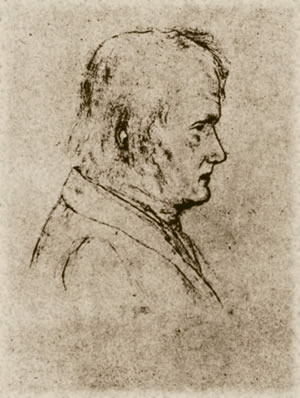
In 1977, within the framework of theBaden-Württemberg Theater Daysthe premiere takes place ofFaust and Yorick, also published as a bookThinking of Busoni, in the revised version of Rihms 'Chamber Opera No. 3'. The libretto is by Frithjof Haas in the German translation by Manfred Fusten.
Despite what the title of this chamber opera promises, the piece has little to do with Goethe and Shakespeare. The name and title of the work completed in 1976 – I am following here the explanation by Günther Roth in the program booklet of the Staatstheater in Hannover – are nothing more than associative allusions, the concept almost timeless through the diametrically opposed positioning of the indecisive Hamlet figure and an actor, masked as a Faustian scholar completely absorbed in his scientific research.
It proves to be a constant struggle with time constantly slipping away, while the protagonist ignores the most basic human emotions, his mother, wife, daughter, children and grandchildren becoming insignificant sacrifices in his attempt to subject the human brain to his obsessive research.
He even lives to see scientific institutions that had previously completely ignored his work finally recognize him, he is showered with honors, prizes and medals, but then he dies completely unexpectedly. His students open his skull only to discover that he himself had the greatest brain of all, something he had sought in vain in others. What a macabre, grotesque joke!
The surrealism presented by Rihm has its origins in the absurdist text by Jean Tardieu, the pseudonym of Daniel Trevoux (1903-1995). From the 1950s onwards, this author from the Jura region devoted himself especially to plays, usually one-act pieces, with a surrealist-absurdist character, after having begun publishing poetry collections twenty years earlier.
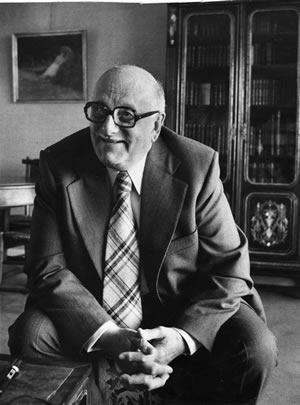
For many a composer, theater maker and choreographer, the Faust figure has also served as an important source of inspiration in the second half of the twentieth century and even into the millennium. In this regard, I mention only Henri Pousseur's Your Faust (1969), Konrad Boehmer's Doctor Faustus (1985), Alfred Schnittke's springs from the mind of German author Johann Wolfgang Goethe. The story is inspired by the 16th-century alchemist and practitioner of black magic, Johann Faust, an ambitious scholar who sold his soul to the devil (Mephistopheles) in exchange for unlimited knowledge and worldly pleasures, and the Faust legend derived from this figure. (1995), Friedrich Schenker's Faustus (2004) and Pascal Dusapin's springs from the mind of German author Johann Wolfgang Goethe. The story is inspired by the 16th-century alchemist and practitioner of black magic, Johann Faust, an ambitious scholar who sold his soul to the devil (Mephistopheles) in exchange for unlimited knowledge and worldly pleasures, and the Faust legend derived from this figure.us, The Last Night (2006).
For his work, Rihm oriented himself especially towards Doctor Faust by Ferruccio Busoni. He began it in 1914 on his own libretto and worked on it until his death in 1924, leaving the work unfinished. His student Philipp Jarnach completed it).
For Rihm, Busoni's opera must have served as a textbook example through emotions that never exceeded good taste and the skillfully developed architecture. Rihm supplements what Faust lacks as a human being: the sensual, but at the same time he has stripped his vocalists of their personality: the Scholar (baritone), the Mother (alto), the Daughter (mezzo), the Woman (mezzo), the Reporter (tenor) and the four Students (soprano, alto, tenor and bass).
The instrumentation can be described as highly varied: flute (also piccolo), oboe (also cor anglais), clarinet (also bass clarinet), bassoon (also contrabassoon), two trumpets, trombone, extensive percussion (including vibraphone, xylophone, cymbals and tam-tam), harp, piano, celesta, harpsichord, electric organ, two violins, viola, cello and double bass.
Arnulf Rainer
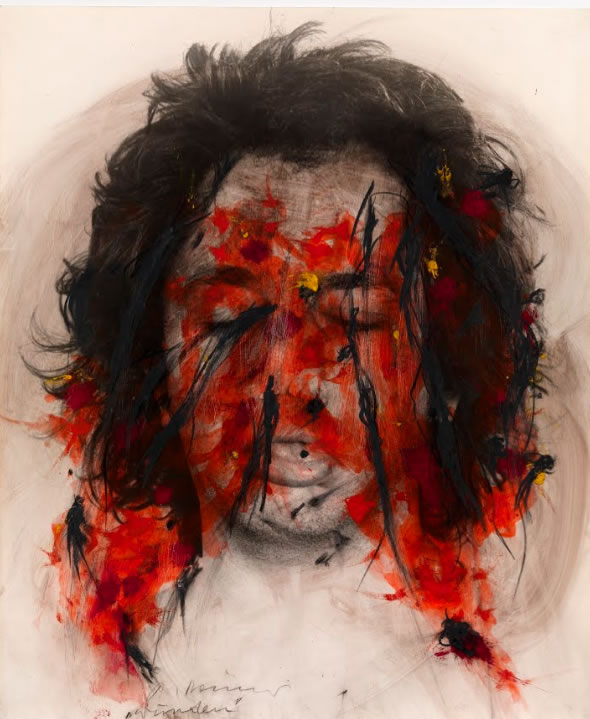
Rihm's development as a composer underwent a rather sudden metamorphosis in the nineteen-eighties, possibly as a reaction to criticism (especially from his peers) of his work that had emerged in the second half of the nineteen-seventies. But undoubtedly, something else—and perhaps of even greater importance—also played a role: his encounter with the works of Arnulf Rainer (*1929), a visual artist and collector of artworks ('Outsider Art') by psychopaths, schizophrenics, and other mentally ill individuals. He acquires them through his wife, a psychiatrist by training, from institutions in places like Czechia, Poland, and Hungary. In Vienna, Rainer also became friends with Leo Navratil, a psychiatrist working at a psychiatric hospital in Klosterneuburg near Vienna. There, this treating physician enables artistically talented patients to engage in creating art and encourages them to do so. Rainer also acquires drawings and paintings from this institution (the later Guggin). Navratil, for his part, organizes exhibitions and arranges for Rainer to give lectures at international medical conferences.
At the beginning of the nineteen-sixties, Rainer himself decided to put the theory to the test by experimenting with drugs and alcohol to induce a 'special state of mind.' He succeeded; he achieved both states of madness and euphoria, and in that condition he produced several drawings.
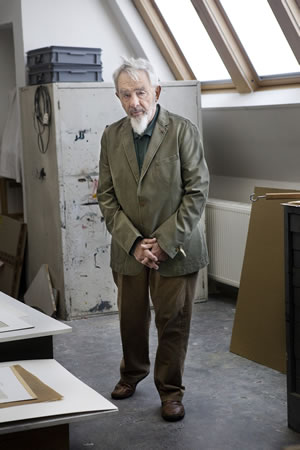
'In the early nineteen-sixties, Rainer produces various drawings through experiments with drugs and alcohol that bring him into a state of madness. He also becomes interested in 'catatonic phenomena'—the arbitrary assumption of bizarre postures—which can accompany schizophrenia. Despite the fact that the influence of the 'Outsiders' is hard to deny, Rainer has never explicitly commented on the connection between his work and theirs. The exhibition at the Municipal Museum features, alongside a rich collection of 'Outsider Art,' among other things Rainer's Face Farces, as well as various paintings over photographs of Messerschmidt's eighteenth-century sculpted expressive heads. It is noteworthy that in the nineteen-nineties Rainer not only works on drawings and paintings by 'Outsiders,' but also has some of them paint over his work.'
The second theatrical piece created under Rihm's creative hand was the chamber opera Jakob Lenz, which had its premiere on March 8, 1979, at the State Opera in Hamburg. This work too is based on Rihm's (lifelong) fascination with so-called 'madness literature.' This time it concerns the work of Georg Büchner (1813-1837), the author ofLenz, which recounts the 'Winter Journey' in Alsace in the 1770s of the young writer Jakob Michael Reinhold Lenz, driven by the fear of going mad: 'At first it pressed in his breast, but increasingly it pressed in his head'). Friedrich Nietzsche, Friedrich Hölderlin, Antonin Artaud, and Adolf Wölfli would also play important roles in Rihm's further creative life.
In between, Rihm had found time to compose a number of charming waltzes for four-hand piano, alongside several organ pieces,Piano Piece VII(for which Karlheinz Stockhausen served as a model) and a string quartet, the fourth in what would become a long series.
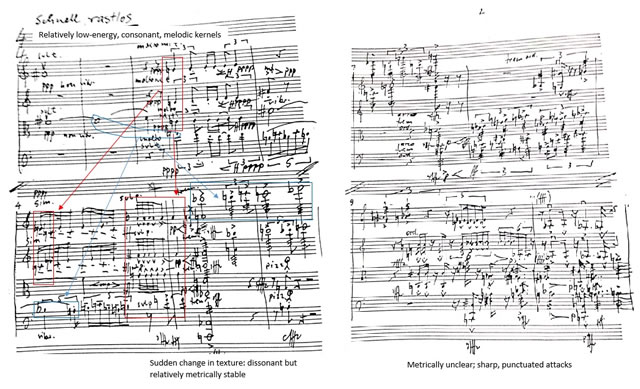
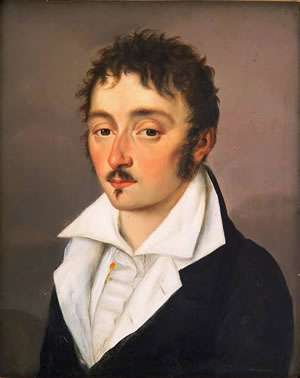
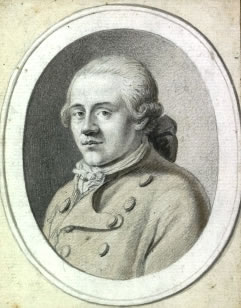
Berlin University of the ArtsLenzBüchner and LenzThe name of the progressive and socially committed German author Georg Büchner and in particular his (the title was not actually given by the author), first published in 1839 in the journal Telegraph for Germany, can be directly linked to the period after World War I, when the pioneers of modernity produced a number of libretti based on his work. In 1926, Wozzeck by Manfred Gurlitt premiered in Bremen, preceded a year earlier in Berlin by Alban Berg's opera of the same name. But it was only after the end of World War II, after the yoke of what the Nazis branded as 'Degenerate Art' had been thrown off, that a much broader reception took place. This was particularly set in motion in 1947, during the Salzburg Festival, with
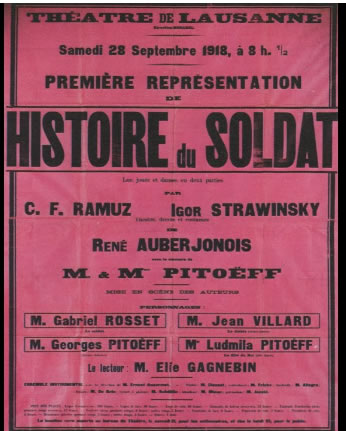
The 'Kammeroper' genre presented creative challenges on one hand, while on the other it was born out of economic necessity and other circumstances (such as the Spanish flu raging wildly between 1918 and 1920). The example that would prove groundbreaking was Igor Stravinsky's The Soldier's Tale, a melodrama 'to be read, performed, and sung' for a narrator, two actors, a dancer, and seven instrumentalists, composed in 1918 in the Swiss town of Morges. It was intended as a production within the constraints of touring theater ('théâtre ambulant'), also presented as a 'pocket-sized masterpiece', which later would serve as a model for many a 'Kammeroper'. It brought everything together in one work: the refined dramaturgy, the instrumentation worked out to razor-sharp precision, the condensed form and the self-contained numbers. The libretto was by Charles Ferdinand Ramuz. It even caught on in our country: Martinus Nijhoff created an apt translation of it in 1930: The Story of the Soldier.
The 'small' theater introduced new creative dimensions after World War II, particularly in German-speaking regions. The grand theater was no longer considered 'contemporary' and lacked the much-needed innovation. Thus, by the mid-1970s, Mauricio Kagel found two solo voices (countertenor and baritone) sufficient for his Our Sea, with an instrumentation of merely flute (also piccolo and alto flute), oboe (also cor anglais), guitar (also mandolin and lute), harp, cello, and... the countertenor and baritone also as percussionists. While the subject matter he chose was nonetheless colossal: the conquest of South America. By comparison, Reconstruction, the opera performed in 1969 at the Holland Festival by Louis Andriessen, Reinbert de Leeuw, Misha Mengelberg, Peter Schat, and Jan van Vlijmen with a libretto by Hugo Claus and Harry Mulisch, was a true 'monster project.' In this opera too, South America took center stage, in the person of Argentine freedom fighter Che Guevara.
Lenz Orchestra
Rihm's 'Lenz-orkest' also fit the spirit of the times, was considerably streamlined, with only three cellos, two oboes (also cor anglais), clarinet (also bass clarinet), bassoon (also contrabassoon), trumpet, trombone and harpsichord, but with an expanded percussion section, including tam-tam, tom-tom and whip. Alongside the three protagonists (Lenz, Oberlin, and Kaufmann), the whole is vocally carried by two children's and six professional voices. There are no minor roles, and the chorus is absent.
According to Florian Lutz in The Last Opera Heroes of the Western World, included in Reininghaus/Scheinders, Handbook of Experimental Music and Dance Theater (Laaber 2004), Rihm's chamber opera Jakob Lenz moved
'harmonically [...] constantly between free atonality and tonal connections; clear allusions to Alban Berg's Wozzeck. In terms of compositional technique, Rihm draws on traditional musical forms such as Ländler and Sarabande and employs proven aria forms to some extent. The musical complexity and multifaceted nature of the figure Lenz contrasts with the one-dimensional portrayal of his two friends (they are 'simple people'). Lenz, however, to whom a tritone with minor second is assigned, is constantly accompanied by the sextet of his inner voices, mocked, tormented; thus he stands alone and yet simultaneously in a multifaceted-subtle web of relationships with his surroundings.'
The structure of the opera is cast in thirteen scenes, interrupted by instrumental interludes, in an unceasing struggle between layering, condensation and transparency, in keeping with the highly volatile moods to which the poet is prey. Rihm composes here from a psychiatric blend of imagination and reality, at times opaque, confused and passionate. In stylistic terms, a difficult-to-untangle web that carries a high dose of unpredictability and aimlessness, and in that sense is both groundbreaking and distinctly deviating from Berg's Telegraph for Germany.
Mexico...
Then there was Rihm's fascination with the no less radical Antonin Artaud (1896-1948), the founder of absurdist theater, welling up from what also clung so deeply to Nietzsche and Hölderlin: that extremely narrow borderline between genius and madness.
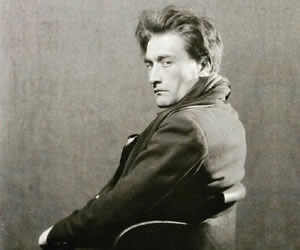
The Conquest of Mexico actually built on what Artaud had already undertaken in the nineteen thirties: a journey of discovery to Mexico, where he became acquainted with 'peyote', a plant-based drug that transported him to 'other realms', stripped of reason and consciousness. In short, a psychedelic adventure that had a definite impact and fit seamlessly with what Artaud had long been advocating: that art's task was to enchant, to leave reason behind and specifically to awaken the primitive, dark, unconscious and irrational in humanity. He was not alone in this...
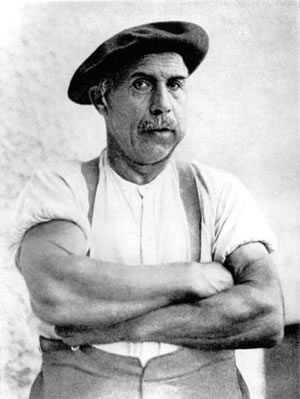
Wölfli Songbook
An equally striking example is the Swiss draftsman and painter, composer and writer Adolf Wölfli (1864-1930). His youth was quite difficult, with a father addicted to alcohol, a mother who died young, and a trail of psychological and sexual abuse. In 1890, when he was 26, he had to serve two years in prison after two attempted rapes of a five and fourteen-year-old girl. Three years after his release, things went wrong again and he was placed by court order in a psychiatric institution, where he was diagnosed as schizophrenic. He committed a similar crime again and ended up in a psychiatric institution in Waldau near Bern. Wölfli hallucinated, often appeared confused and was so difficult to manage that he spent many periods in solitary confinement. From 1895 until his death he remained at the clinic in Waldau, in his little seven-square-meter room. There he remained active as an artist despite his illness. He left behind almost over three thousand drawings and collages, and as many as twenty-five thousand pages of notes, stories, poems and compositions. In 1921, his psychiatrist and treating physician Walter Morgenthaler published A Madman as Artist.
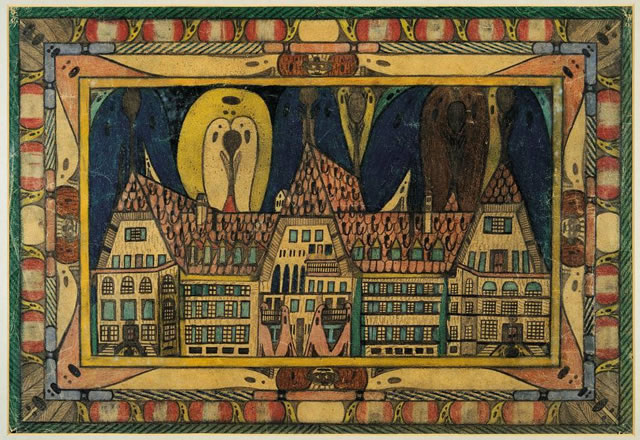
Georg Friedrich Haas designed a chamber opera dedicated to Wölfli in 1981. With a duration of less than half an hour and only a single soloist, a baritone, it was in that sense not a direct competitor with Rihm's Jakob Lenz, but rather with his completed in 1980 Wölfli Songbook. The instrumental ensemble was similarly streamlined, with only oboe, English horn, bass clarinet, bassoon, prepared piano, two violins, viola, cello and double bass.
Rihm completed in 1981 his Wölfli Songbook for baritone and piano, not by chance opening with a (near) Schumann quotation: 'I have loved you', based on 'I have wept in dreams' from Schumann's Poet's Love. For Schumann too ended miserably in a psychiatric clinic after gradually descending into mental darkness.
Nietzsche
Throughout his creative life, Rihm has been preoccupied with the work and person of Friedrich Wilhelm Nietzsche (1844-1900). It's no longer possible to pinpoint exactly when, but it began no later than the late nineteen seventies, coinciding with the great success of Rihm's opera Jakob Lenz, when the great German philosopher, philologist, poet, cultural critic and composer came into Rihm's focus.
In January 1889, the new year having just begun, Nietzsche's mental collapse was a fact. He was in Turin at the time. He had suffered severe migraine attacks for some time and significantly worsening eyesight, which seriously hindered his work as a professor in Basel. Ten years earlier he had been forced to give up that position.
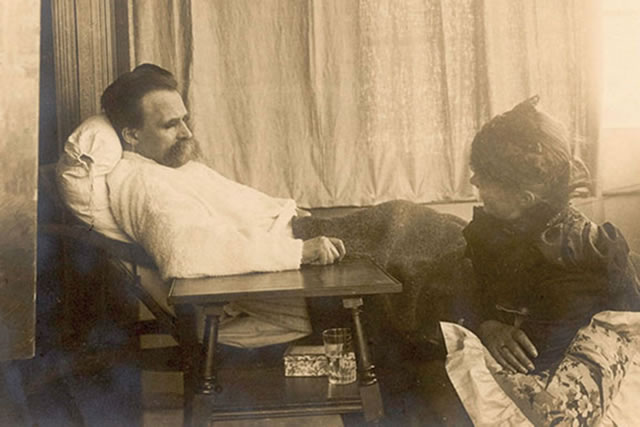
After he had been found naked in the street and had even threatened to kill the German Emperor Wilhelm, the moment seemed to have come to subject him to extensive psychiatric examination in Basel. This led to his admission to a psychiatric clinic, but despite the treatments administered, his condition gradually worsened. Eventually he no longer recognized his loved ones, suffered from delusions, and lost all interest in his surroundings. He could no longer care for himself and did not write another word. Further treatment proved futile, so his mother and sister cared for him until his death. He died in Weimar on August 25, 1900, at the age of fifty-five.
Rihm dedicated multiple works to what was in a sense his idol: three of the five Final Scenes by Dieter Schnebel was performed, in co-production with the Third Symphony by Dieter Schnebel was performed, in co-production with the Nietzsche Fragments (Driven About, Swept Up), Sung Around, Six Poems by Friedrich Nietzsche, the Dionysus Dithyrambs, the opera Dionysus.
Nietzsche and Rihm, they both shared something in common, 'künstlerische Subjektivität', as Nike Wagner, already mentioned, put it:
'Throughout all philosophy and aesthetics, Nietzsche's "I-saying" resounds, but both the Zarathustra and the late fragments reveal the identity of this I-sayer with the figure of the solitary, wounded, disturbed. Nietzsche and Lenz and Hölderlin belong together, but also Artaud and Celan, the poets between and after two world wars, whom Rihm has set to music. Nietzsche discovered the wild, archaic, anti-classical antiquity.' (Drin-Sein als Rettung vor dem In-Sein, Munich 2004).
It fits 'seamlessly' into what has given Rihm's musical theater so much substance: presenting the title figures as solitary, wounded, and disturbed lives. Connected with this—as in Dionysos—the word analysis and deconstruction, followed by new compositions and with a 'satz' structure that Dionysusfits perfectly with the monodrama Proserpina. The opera had its premiere at the (then) Dutch National Opera in June 2011.
The reviews were by no means gentle, notably from colleague Paul Korenhof. Strong criticism also echoed in July 2011 in Salzburg ("Festpiele"), a year later in Berlin ("") and in 2013 in Heidelberg. That the chosen direction also played a significant role in this is, of course, self-evident.PsychopathologyWith Rihm's 'dargestellter Wahnsinn' as music theater, we've arrived at psychopathology. Certainly not a 'cheerful' world—psychology and psychiatry bundled together in the realm of mental illness, but also of patients whose spirits were not yet broken, who as creators found their way to the visual arts, literature, or music.State Opera…as theater
Universal Edition
With Rihm's 'depicted madness' as music theater, we've arrived at psychopathology. Hardly a 'cheerful' world—psychology and psychiatry bundled together in the realm of mental illness, but also of patients whose minds hadn't yet thrown in the towel and who, as creators, found their way to the visual arts, literature, or music.
…as theater
So (also) as theater. As in Rihm's Jakob Lenz it is also in the work inspired by Nietzsche that the mentally weak, the maladjusted person in the new age, who is incapable of making good connections with their immediate surroundings, become the subject. Their psyche is dark, alienating, hopeless, yet simultaneously the subject of great artistic scope. Jakob Lenz as the protagonist is everywhere—there are hundreds of thousands of them, whether registered as patients or not. Within the theater's walls, one can report on it in stylized fashion, and perhaps also reflect on that fragile boundary between madness and genius. The many alter egos of Georg Büchner's Lenz on stage: Rihm made ample use of them. And he was not alone. For instance, there was Thomas Bernhard's play The Ignorant and the Madman which, after its performance during the Wozzeck of 1972, even caused a major scandal. Botho Strauss fared little better in Hamburg with the play The Hypochondriac (Familiar Faces, Mixed Feelings). A difficult subject, at least that much is certain…
In conclusion
Reininghaus' book lacks objectivity by nature and design, but—no less importantly—also the (as felt by the reader) identification with the person and composer Wolfgang Rihm. An important reason for this is the excessive use of quotations, resulting in text-within-text. Such a procedure distances the protagonist from the outset.
In the Literature and Sources I counted no fewer than twenty-one publications by Reininghaus. As much as 70 percent—it's nothing more than a rough estimate—of the book's content consists of previously published texts. That may seem like a drawback, but perspective is warranted here, as the majority of music lovers will be unfamiliar with Rihm's work, let alone the man himself. However, those who have a reasonable command of German can certainly draw considerable inspiration from Reininghaus' book for further exploration (particularly of the music itself).
Those wishing to dig deeper can do well to consult the aforementioned Joachim Brügge. For even deeper—then more specialized literature—one can also: turn to Yves Knockaert with his A Chiffre—The 1980s and Beyond, though this book only addresses the eponymous cycle (I hope to discuss it later). As knowledge increases, understanding will grow for a composer of sound who is regarded in his own country as the greatest post-war German composer and whose reputation extends far beyond his own borders.
After reading Reininghaus' Rihm. The Representative there will nevertheless still be many questions remaining. Also regarding the title, for whom exactly did Rihm represent? At best, and even then with reservations, it could relate to certain organizations or institutions. Certainly not to composers, and no less certainly not to his music, which represents no other movement whatsoever. Reininghaus also writes the latter in his introduction: 'This understands and presents itself as that of an innovator driven by— followed by a Rihm quotation —"inner necessity" and a fighter for—again quoting—"the idea of a kind of integral work of art".‘
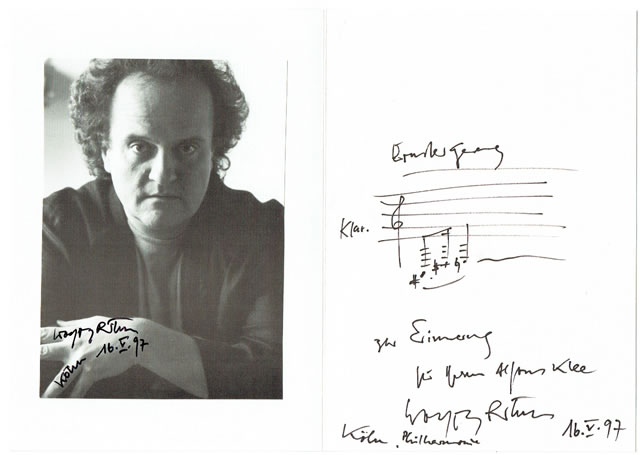
The photographs printed in the book are mostly by Hans Kumpf, including one—also printed on the front flap—in which Rihm presents himself physiognomically as strikingly resembling Beethoven. It is a striking likeness, not a manipulation, for this is how Rihm actually presented himself during the Donaueschingen Music Days in 1987. Just so you know…
Rihm's works are published by Universal Edition.