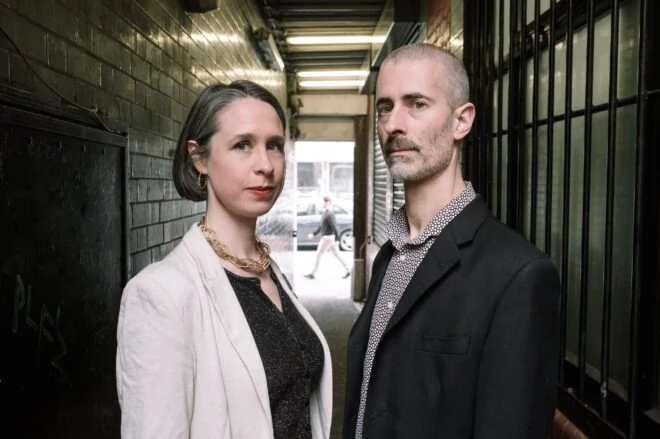
The third day of Transit Festival brought a moment for reflection. What if we gave space to impossible ideas for opera productions? What if we performed them anyway, in some form? Øyvind Torvund's Plans for Future Operas plays with the idea of what could have been, and what might still be. The performance by pianist Mark Knoop and soprano Juliet Fraser takes us beyond the boundaries of the practical. Now let's also consider the challenging.
Imitation Versus Reality
Initially, when you hear a title like "Talking with the Dead, Singing with the Birds," you probably think 'well, these are concepts already used in opera compositions and productions.' The answer to that is yes, and no. Although in one section of the composition – the part where sopranos sang together with the birds in the forest – something reminded me at a certain moment of a fragment from "The Bell Song" by Léo Delibes' Lakné (1883), I quickly realized that was normal. The love for imitating bells and birds – high, pure sounds – were simply standard values in nineteenth-century Bel Canto. But, imitation is the right word. Many concepts we see recurring in Torvund's composition have been imitated, but have never – for logical reasons – become complete reality – try telling wild birds to cooperate. And that is precisely the point of this production.
(Un)realistic Future Music?
Plans for Future Operas brought a range of options with it, each one perhaps more ambitious than the last. According to the Munich Biennale, it is ultimately "a presentation of countless idea fragments that all defy the laws of physics and acoustics."* Sopranos who seem to ride along on cars in Mad Max-style fashion, while car horns are part of the orchestra? Check. A ghost manipulating a guitar? Telepathically determining what music gets made? Singing with monsters? Singing in foreign languages, only to spontaneously burst into flames? If we could make Torvund's suggestions reality, the audience would even be floating in the air. Plans for Future Operas is not only a performance, but also a thought experiment. I can only think of one concept from the entire selection that has somewhat been realized: the famous American mezzo-soprano Marilyn Horne has indeed sung with a bunch of Muppet monsters. "C is for Cookie," anyone?
And Now: Performing(?)
Mark Knoop and Juliet Fraser had the challenge of performing the unperformable. Part of it was brought to life through video projection, which was a nice visual addition – as if you were watching over their shoulder at the sketch table. But, it ultimately remains a concert. And a concert sounds (mostly). It plays with sound and space.
What was interesting was that they made it seem simple. One moment projecting sounds, the next repeating a melody on three words, chirping with the birds in between, or repeating Norwegian words that a ghost whispers to you like some sort of scrambled Duolingo lesson… Fraser seemed seemingly unperturbed in her transformations. With some acting talent, she also showed what feeling was evoked throughout the whole thing. A little facial expression can go a long way, especially when your concept is "unperformable, but let's bring it to life anyway." There was just as much variety in the impossible. It wasn't so much a performance as a musical exposé. Something you don't just listen to, but that also inspires you and gets you thinking. Listening to it felt like solving a puzzle in my head. Can this really not be done, or can it? This actually sounds quite beautiful, wouldn't there be some variation possible? I've never typed so many questions in a review before, but this is exactly what Torvund's Plans for Future Operas what you do as a listener.
The performance was a pleasantly sounding mind game. It was something that placed the listener, if they wished, in a mentally less passive role. It gave me, at least, a hopeful feeling. Who knows, maybe we haven't reached the end of all our operatic possibilities. It would certainly breathe new life into classical music, and that, in my opinion, is always welcome!
* Quote from Münicher Biennale, "Øyvind Torvund, Plans for Future Opera's (2002)," Transit programme (2024): p.32.