
This past concert season, the programs of 111 orchestras across 30 countries consisted of works composed 92.5% by male composers, primarily white, deceased composers. Only 7.5% of the repertoire came from women. This is even slightly less than the results recorded by the English organization Donne, Women in Music in the 2021-2022 season. Despite growing calls for diversification, nothing has changed. The five orchestras studied in Belgium are even slower to adapt, with only 5 to even 0% of works by women. Action is needed.
Yes, these days you hear much more work by female composers on Klara, thanks to a new generation of programmers and curators. And yes, hardly a week goes by without a new CD of rediscovered or newly discovered works by women. And yes, for serious music lovers, Fanny Mendelssohn, Clara Schumann, Lili Boulanger, or Florence Price are no longer completely unknown names. But what about the major orchestras, on the concert stages of the big halls?
When you really do the math like Donne, Women in Music the conclusion is sobering: of the 16,327 works programmed by 111 orchestras across 30 countries in the 2023-2024 season, 92.5% were by male composers. If any evolution is noticeable in the global orchestra repertoire, it's actually a slight decline for female composers: their representation fell from 7.7% to 7.5% since the 2021-2022 season, according to the London organization.
This involves programming by the world's leading orchestras, from America across Europe and Russia to China, Japan, and Australia. These are the performers of so-called 'great works' on the 'great stages.' Chamber music concerts were included in the analysis only when performed by orchestra members.
Dead white men
Donne, Women in Music looked even more closely at the 16,327 works. The vast majority of that 92.5% of 'male' pieces were composed by deceased white men. Here too there's an increase compared to the previous report: 78.4% versus 76.4%.
The top 10 most performed composers remained virtually unchanged compared to the 2021-2022 analysis: Beethoven, Mozart, Tchaikovsky, Brahms, Dvořák, Ravel, Richard Strauss, Rachmaninoff, Mahler, and Sibelius. Together these ten 'historical' men account for 30.6% of all performed works. In other words, they were played more than four times as often as all works by women combined. The top 25 (which includes other predictable names like Bach, Shostakovich, Prokofiev, Stravinsky, Felix Mendelssohn, and Robert Schumann) represents 50.6% of programming. In that top 25, only one living composer: John Williams. 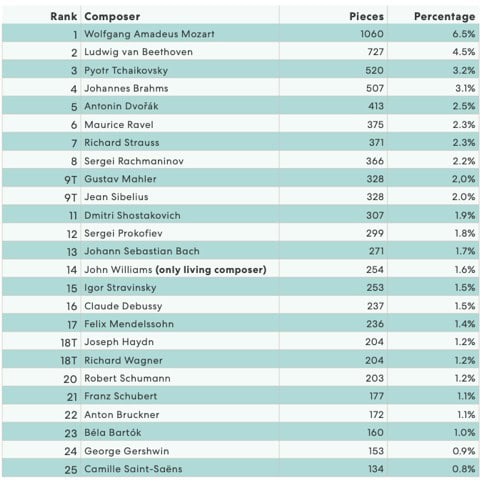
Living composers account for only 11.5% of programmed works – with just 1.4% of the repertoire written by a living woman.
Global majority in the minority
Barely 7.5% of works on programs this season were written by a woman. In 5.8% of pieces, it concerns white women.
Donne, Women in Music broke down the figures even further: only 1.6% was written by female composers from the 'global majority'. The organization categorizes the 'global majority' as people who are Black, Asian or Brown, have mixed heritage, are indigenous to the Global South and/or are called 'ethnic minorities'. In the previous count, the share of that global majority among women was 2.1%. Among men it was 3.2%, also a decline compared to 4.5% in 2021-22.
'Worldwide, this group currently represents approximately 80% of the world population,' the organization states. 'Despite years of discussion about the importance of inclusivity, the representation of women and composers from the global majority in the 2023-2024 season has actually decreased further.'
Finally also listed Donne, Women in Music the share of works written by non-binary composers. That is negligible at less than 0.1%.
From Lili Boulanger to Clara Schumann
The female composer with the most checkmarks next to her name was the French composer, in position 52. In the previous count it was Florence Price, who is now sixth in the top 10 of women and 83rd in the overall ranking. This American gained considerable attention through the – literal – rediscovery of her work and the recording of her symphonies by the prestigious Philadelphia Orchestra, as well as through the acclaimed Chineke! Orchestra.
The top 10 of most performed – which is therefore highly relative – female composers is completed by Anna Clyne, Sofia Gubaidulina, Gabriela Ortiz, Kaija Saariaho, Unsuk Chin, Grażyna Bacewicz, Anna Thorvaldsdottir, Jessie Montgomery and Clara Schumann. 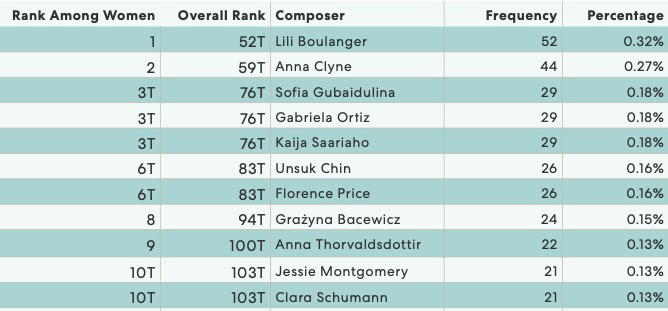
Five Belgian orchestras
Just as in the previous analysis, this season {{NOTRANSLATE_1}} examined the programming of five Belgian orchestras. They don't even reach the worldwide average of 7.5% female composers: Antwerp Symphony Orchestra (5.9%), National Orchestra of Belgium (5.3%), Brussels Philharmonic (2.4%), Orchestre Philharmonic Royal de Liège (0.5%) and Symfonieorkest Vlaanderen (0%). Donne, Women in Music That latter orchestra seems to be completely undoing her so promising achievement from 2020 for the second count in a row. It had brought Louise Farrenc's third symphony out of obscurity, a fantastic work that hadn't been heard in over 150 years, but was performed a dozen times in that pandemic year.
{{NOTRANSLATE_2}} however overlooked that a new composition by Murielle Lemay was performed last season. She followed a trajectory as a conservatory student in the SOV Composers' Academy. Donne, Women in Music 'The opportunity and power lie in giving a voice to today's female composers,' responds Frederik Styns, former director of SOV, when asked. He also points out that the number of programmed works at SOV is smaller than at other orchestras and that conductors often opt for the repertoire of more well-known composers. Conductor Kristiina Poska did perform Florence Price's violin concerto, albeit not with SOV, but with London Philharmonic.
Consolidation of the canon
The analysis illustrates, according to {{NOTRANSLATE_3}}, nonetheless 'a growing trend toward the consolidation of a classical canon, which consists mainly of historical white men, at the expense of broader diversity'.
The overwhelming dominance of historical white male composers in programming is not only a reflection of past prejudices, but a continuous confirmation of them, despite all discussions about equality and diversity. 'The future of classical music must not, however, remain limited to the echoes of the past, but must resonate with the diverse voices of today,' states Gabriella Di Laccio, soprano and founder of the organization. 'Why do the cultural expressions and voices of millions of people remain absent from our global stages? Why do we miss the opportunity to open our doors and welcome a new audience that still feels excluded in our concert halls?' Donne, Women in Music Call to action
{{NOTRANSLATE_4}}
should therefore be a call to action according to Di Laccio. The
The Donne Foundation which she founded, has a worldwide network of specialists ready to advise programming teams in developing more diverse and inclusive programs, and Donne Foundation already has a global network of specialists ready to advise programming teams on developing more diverse and inclusive programs, and The Big List her website lists more than 5,000 female composers.
'There is still a clear need for collective action to address this imbalance in the classical music sector,' concludes Gabriella Di Laccio. After all, 'by embracing diversity we enrich the musical landscape, not just for today's enthusiasts, but also for future generations who will come to see classical music as a vibrant, dynamic and inclusive art form. Hesitation or inaction simply perpetuates a status quo that is exclusive and discriminatory.'