The Komponistinnenfestival her:voice in the German city of Essen, which took place for the third time last week, is not only attractive for its concerts featuring rediscovered works. The lectures and debates are also well worth attending. And on the sidelines of the festival, we even ran into an 'old acquaintance' from Antwerp at the Essen Philharmonic. This is the perfect moment to compare how things were ten years ago with today, and to look at the differences between Flanders and Germany: is there now more interest in female composers?
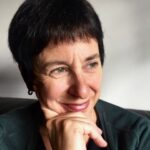
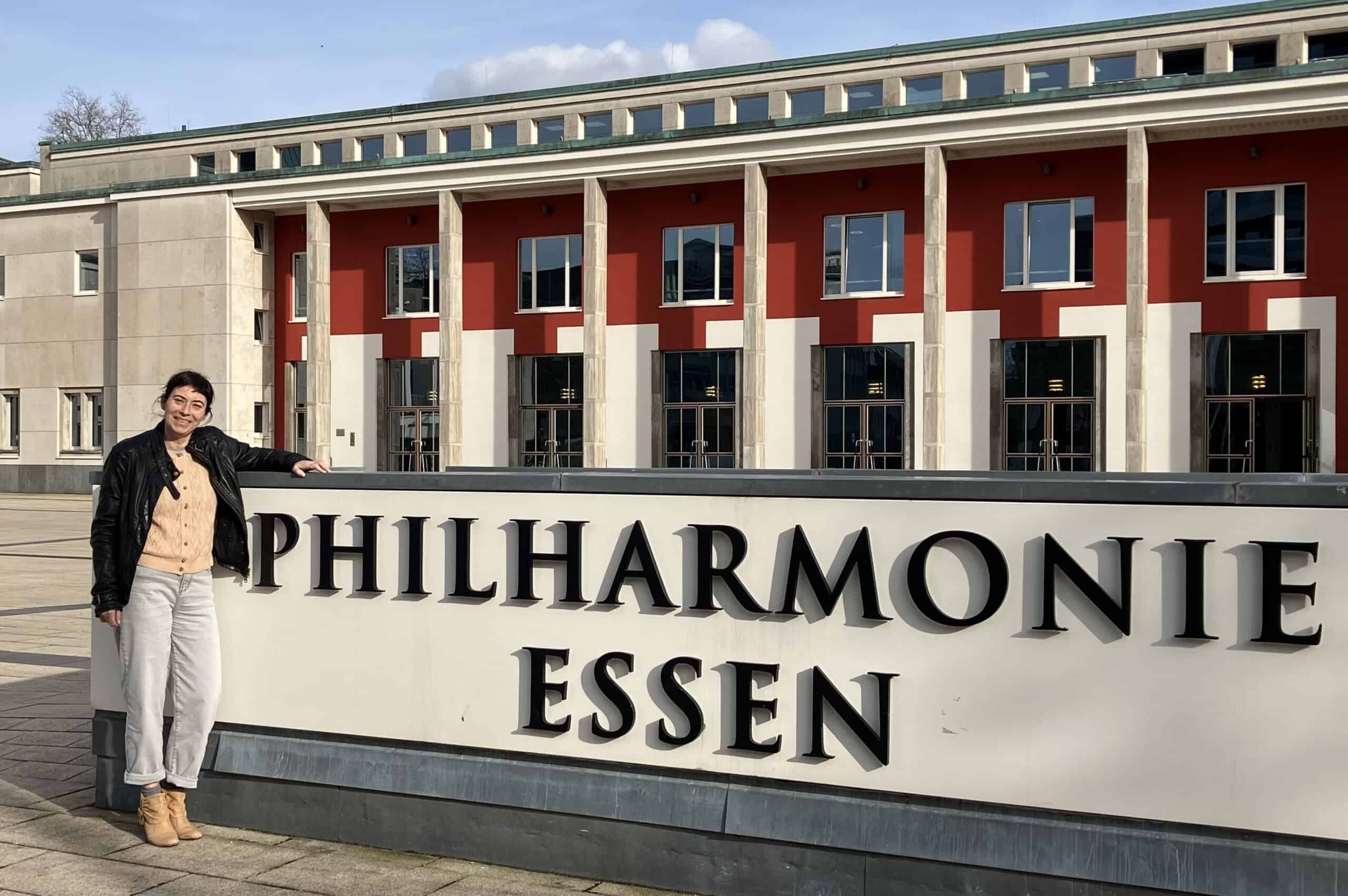
Chloë Herteleer (photo) was responsible for years for programming classical concerts at deSingel in Antwerp. I interviewed her back then for my book Woman at the Piano. Nearly a decade later, I wanted to ask the current Head of Programming at Theater und Philharmonie Essen (TuP) how she now views the place of female composers in the musical landscape and whether she experiences a difference between Flanders and Germany.
Concert organizers, as she explained to me back at deSingel, depend on what the major, highly sought-after names and orchestras themselves have to offer. 'Musicians travel around with two or three programs per season. At best, you can choose from those. They won't easily offer unfamiliar work themselves, because they know that venues play it safe. Programmers put together concerts with works the audience already knows', she told me. And: 'The audience wants recognition and repetition. People who are curious are an absolute minority.' (Woman at the Piano, p. 247-248)
Budget cuts
Over a cup of coffee at a café opposite her new workplace, she quickly dashes my hope that things have improved in the meantime. Yet when we look at the audience and the programmers (the elegant German way of writing to refer to both men and women – in spoken language you can even hear a subtle pause before *innen).
'The programmers are still playing it safe, or even more than before', Chloë Herteleer now observes. It's all about budget cuts in keeping with the spirit of the times. 'In many places in Germany, there's less investment in culture because living standards have fallen. More money needs to go to healthcare, infrastructure, and defense. And even where cultural budgets are still healthy – thanks also to the business sector, which in Germany still sponsors remarkably well – people rarely do anything extravagant with it anymore because they fear the audience won't follow. Box office revenues are becoming increasingly important, and this leads venues to program less adventurously.'
'Here and there there are still bright spots, like the Emilie Mayer Festival by the Akademie für Alte Musik, last fall in Berlin. Or our own Componist Women Festival her:voice, which took place for the first time three years ago. But I wonder if such events will still have a chance in the coming years. I even suspect there's more appetite for initiatives these days in Flanders, the Netherlands, or the United Kingdom.'
Pro bono
However, when it comes to individual musicians, she does notice more openness and willingness to explore unfamiliar paths compared to ten years ago, and thus to seek out female composers. 'But they have a hard time selling their proposals to concert halls for the reasons mentioned. That's why they often organize small-scale, local concerts or festivals with musician friends who are often willing to contribute pro bono. That way they have more freedom in their choice of program, even if they don't earn anything from it.'
We can also see musicians' interest in unknown works in the CD recordings of recent years, I note. Hardly a week goes by without another disc of 'forgotten' or lesser-known works by female composers coming out. But Chloë also tempers my enthusiasm somewhat on this score. 'CD recordings or streams don't generate much income for musicians. The major record labels only offer opportunities to musicians with large social media followings. I read an interview with someone from Deutsche Grammophon who was even open about that.'
In line
There are exceptions for those whose marketing machine still turns, like someone like Olafur Arnalds or the sisters and brothers from the English musical family Kanneh-Mason. As for recordings of composers, the German cellist Raphaela Gromes can count herself lucky to have a record contract.
She opened the Komponistinnenfestival with a cello concerto by Maria Herz (1878-1950), a work she got to know thanks to the granddaughter of the completely forgotten composer. Last year she was also the first to record it for her double CD Fortissima, which also features a beautiful cello concerto by Marie Jaëll (1846-1925). Furthermore, she also published a book under the title Fortissima together with musicologist Susanne Wosnitzka. It's about Suppressed Female Composers and How They Changed My View of the World, as the subtitle reads. Three years earlier, she had released the equally highly acclaimed double CD Women with no fewer than 33 works by women. During the intermission and after the concert at the Philharmonie in Essen, people were standing in line for it. Her supply of books and CDs she had brought along proved far too small.
By the way
By the way: in terms of structure, Gromes' book shows many similarities to Woman at the Piano (2018). Just as I reported on my journey of discovery as an (amateur) pianist, she does so as a professional cellist. We both marveled that we had never heard about female composers earlier in our studies and wanted to right that injustice in a way accessible to a broad audience.
When I was asked whether a translation of my book was planned, I responded that there probably wouldn't be any interest for it in Germany (or France or the UK) because they were already much further advanced in research and many monographs on female composers had already been published there. But now that I observe how well Gromes does with a similar book – 'Number 1 on the Classical Charts' is emblazoned on the cover – I'm beginning to have my doubts…
Not sold out
There was certainly interest among the audience present. Although it could also be noted that the (admittedly quite large) Alfried Krupp Hall of the Philharmonie was by no means sold out. The festival director Merle Fahrholz was also surprised by this, as she told me, because Gromes had drawn larger crowds at earlier concerts. 'It may well be down to the program. In any case, it's much harder to gauge public interest than before the pandemic. People also book much later' (an observation also heard in Flanders, fyi). But the same applies to, say, Mozart. Programming becomes much more difficult as a result. Although it does offer opportunities. Because if even the classics don't appeal anymore, maybe there's more willingness to present unfamiliar names.'
Fritjof Saga
For the unknown Fritjof Saga The Aalto Theater was already packed to the rafters. More than 120 years after its creation in Essen, this opera by Swedish composer Elfrida Andrée (1841-1921) with a libretto by Nobel Prize winner Selma Lagerlöf (1858-1940) received its stage premiere World premiere and garnered rave reviews. What's particularly striking and quite unique about this opera about vikings is that the creative duo behind it focuses on the perspective of the female protagonists. Excellent direction as well by Anika Rutkofsky. Look forward to the announced CD release of this gripping performance.
Networking opportunity
What surprised me, however, was that despite the speakers, relatively few people showed up this year for the admittedly fascinating and free symposium of the Komponistinnenfestival. Nevertheless, Fahrholz seemed very satisfied. 'With our festival, we manage to bring forgotten composers and their works to light. Though we're not a museum. Each time we ask what a work can still mean in our era. Beyond that, this festival is an important networking opportunity for academics working on the subject – ideas are exchanged back and forth. For the supporting program we collaborate with the University of Vienna. We also reach young people: students from the University of Zurich researched the life and work of Maria Herz and presented her with an exhibition and a Conversation concert. For the performance of Elfrida Andrée's (1841-1921) second symphony we received, just as two years ago for the opera Fausto by Louise Bertin (1805-1877), sponsorship from the Palazzetto Bru Zane in Venice. And the Fritjof Saga is also supported by the Swedish embassy.'
The intendant has her festival collaborations and financial support well organized, and already locked in for four years. This guarantees the fourth edition, from March 4-7, 2027. But afterwards, in the summer of 2027, Merle Fahrholz's contract with the Aalto Theater will not be renewed.
Education
The question of why female composers, despite increasing research and growing interest, still remain an exception on the stage came up during a panel discussion at the symposium. 'Ignorance,' answered Mary Ellen Kitchens without hesitation. That's why she uses the Archive Women & Music to focus on educational projects. This AFM in Frankfurt am Main is not only the world's most comprehensive archive with scores, recordings and literature about female composers, musicians and conductors from the 9th to the 21st century. According to Kitchens, it also contributes to adapting curricula – 'but that takes time' – and has for instance already ensured that works by women are naturally included in a new music book for beginning pianists. As a conductor, Kitchens also finds that conversation concerts work very well. These are concerts where you tell the audience about the works being performed. Something the concert series Poems of Love by the ensemble Triotique with myself as narrator has indeed received much acclaim for.
Repertoire
Once a work is rediscovered, it remains a challenge to get it into the active repertoire. For world premieres sponsors are still relatively easy to find, Merle Fahrholz observes. 'Because they can make a splash with that – which also applies to unknown works by men. They like it even better when there's no recording of it yet.' Mary Ellen Kitchens also notices among musicians that second performances are less desired. When they search for works by female composers in the Archive, they explicitly ask for something that has never been performed before.
Baby concerts
Back to Chloé Herteleer for a moment, as education came up not by chance in our conversation the day before the festival. She watched with dismay how at deSingel the programming of, among other things, chamber music was scaled back, leaving a loyal audience out in the cold. 'Now everything is being done to attract young people, but they don't have the time or financial means to attend concerts. Whereas you should cherish and serve that core audience, who do have time and money, and then try to involve young people in that. The key to that is education. Around Emilie Mayer (1812-1883) for instance, I'd be happy to Discovery Day (a full day with lectures and concerts centered around one composer) they wanted to organize. But that educational program was also discontinued in Antwerp.
"Here in Germany, that education is really excellent," she says. "There are projects for schools. Or concerts where children get a separate introduction before the intermission, after which they attend the second part of the concert in the hall. There are even baby concerts!"
Finally, Chloë Herteleer pointed out the unprecedented increase in the number of female conductors. Just about all orchestras are actively seeking women on the podium, to such an extent that the pendulum might be swinging too far. And although according to Chloë it hasn't been proven that female conductors attract extra audiences, it was a pleasure to see Turkish-Italian conductor Nil Vendetti at work in the concert with Raphaela Gromes. Her enthusiasm was contagious and brought cheer, not only to the audience but reportedly to the orchestra as well.
• The Fritjof Saga is still to be seen on April 9 at the Aalto-Theater in Essen.
• This review also appeared on the blog notities.vrouwaandepiano.be.