***** Antonio Vivaldi's Four Seasons (1678-1741) have something in common with Bach's Goldberg Variations. All musicians want to perform them on their instrument, whether it's a violin, saxophone, marimba, or in this case an accordion. Can you just do that? Not always, but sometimes definitely...
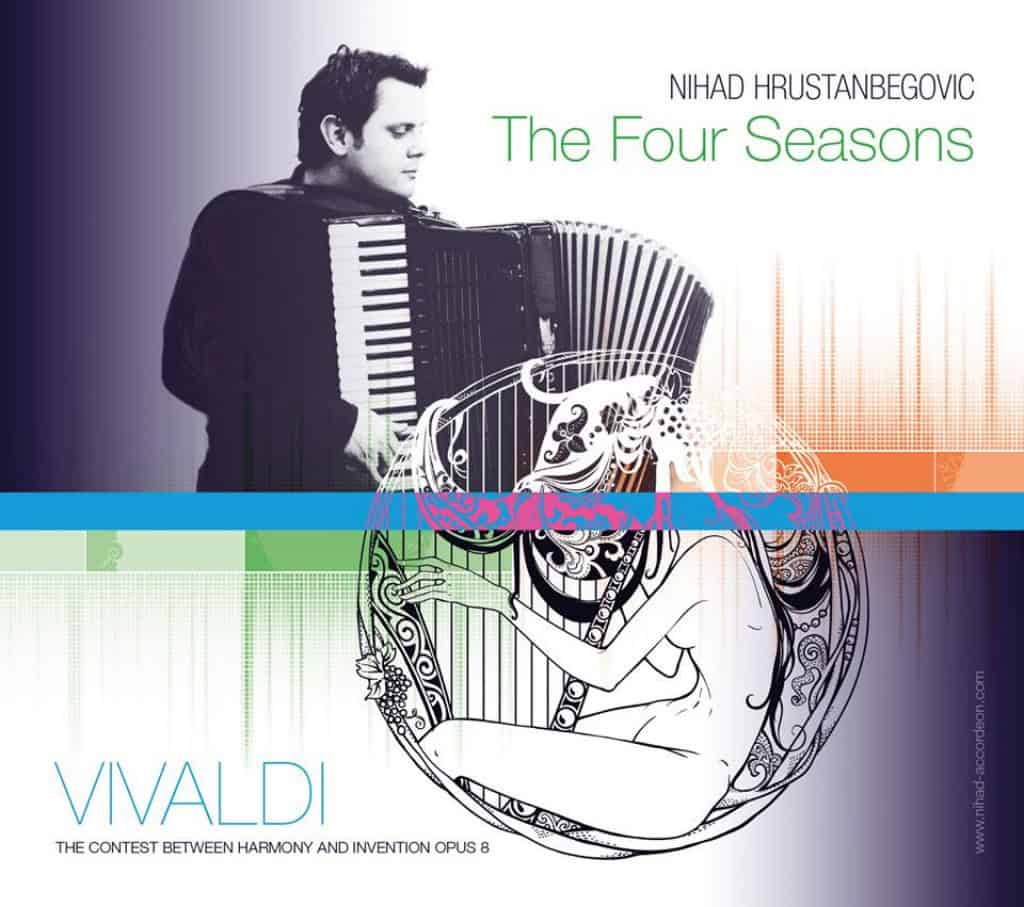
Through our Facebook fan page, we got in touch with Nihad Hrustanbegovic, an accordionist from Bosnia living in the Netherlands. He recorded the Four Seasons and presented the CD at a well-attended and enthusiastically applauded concert in Amsterdam's Concertgebouw. Just like the CD with the Goldberg Variations on accordion, we need to let our ears adjust to this performance. There is a fundamental difference in performing the aforementioned Bach or Vivaldi. Both works are extremely challenging and are sometimes underestimated and performed too hastily, but Vivaldi's seasons flow more easily on the ear than Bach's variations. Furthermore, you can assume that performing an orchestral work on accordion (or other wind instrument) is in any case more demanding than performing Bach's well-known variations on a different keyboard instrument than, for example, a harpsichord, precisely because they were written for a keyboard and not for an orchestra like the Four Seasons.
Hrustanbegovic opted for as faithful a rendering of the original score as possible. A task that deserves a hat tip, because transcribing an orchestral work to play solo on accordion without doing violence to the score is a task that no one had ever undertaken before. It must be said that the accordionist's extensive study of the score and literature on these Four Seasons has borne fruit. The Baroque character doesn't suffer at all. Moreover, Hrustanbegovic makes use of the registers and limits the drone, allowing the many details that give the work its unique character to come fully into their own. het werk zijn unieke karakter geven, ten volle tot hun recht komen.
The accordionist skillfully conveys throughout the entire piece what Vivaldi packed into his Four Seasons. That's more than just cheerful or dark melodies and chords. We won't go into all the details here, but anyone wanting to read more about the content of Vivaldi's work will find quite a bit of information, in Dutch, (good point!) in the CD booklet. Anyone who thinks the accordion is only good for accompanying folk music is mistaken, and we've known this for a while. However, it bears repeating that there exists a vast repertoire of original music, sometimes of surprisingly high caliber. In Eastern Europe, the accordion has developed into a concert instrument, especially after the end of World War II. The many new compositions are proof of this, but the exceptionally well-trained accordionists also want something other than contemporary work and for that reason among others, Nihad Hrustanbegovic turned to Vivaldi's Four Seasons. Bold? Absolutely! Successful? Absolutely! Every musical demand of the genius Vivaldi is met. Sure, you hear the occasional 'odd sound,'
but that's just the register change (you can sometimes hear it like with organs). The reason the accordionist chose this well-known work is to prove that the accordion deserves more attention from us. He wants to prove that his instrument deserves a rightful place among recognized concert instruments. Well then, he delivers that proof, and we can only hope his efforts will be vindicated for him, his colleagues, and that future generations will continue successfully down this path. Antonio Vivaldi: the Four Seasons