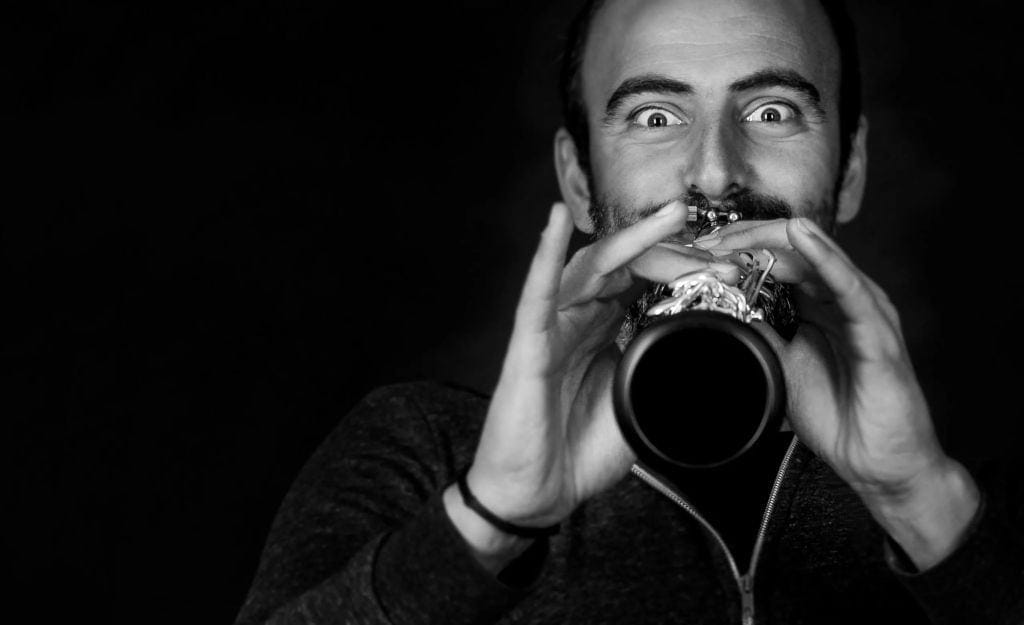
On Saturday, May 18, Syrian-American clarinetist and composer Kinan Azmeh will perform at DE SINGEL. He will do so together with the American string quartet Brooklyn Rider and Swiss percussionist Mathias Kunzli. A conversation with Azmeh about his compositional style, the challenges of composing, and the works that will be performed at DE SINGEL. "I would like to be a musician in the broadest sense of the word, where everything I do influences each other."
Your compositions include various works for solo, chamber and orchestral music, but also music for film, live illustration and electronics. Is there a particular genre or a particular combination of instruments that you prefer to compose for?
Kinan Azmeh: Not really. When I write music, I try to think beyond genres. I grew up in a particularly multicultural family: we had a great hunger for other cultures. I think my music is in line with that philosophy. And I try to remain true to myself. I write what I like to hear, it's that simple really. For me, instruments are merely tools in the hands of individuals. Especially when I know the musicians, I want to write for them and not for a specific combination of instruments. When I compose, I love this personal approach to the performers: to have that direct connection with them, not just through the instrument they play. It's also important to mention that I like it when performers take initiative. People who see a score of mine and try particularly hard to bring my music to life. Musicians, in other words, who don't just do what they're told. I also trust people with good taste: musicians who know what works and what doesn't. I love this flexibility in making music, not only in the jazz and world music scene but also in classical music. To be able to give a truly meaningful performance, I almost have to believe that I composed the music myself. So I can feel free while playing, without necessarily having to change the notes.
How would you describe your own compositional style?
KA: Honestly, I'm too close to it to describe my compositional style myself. It would be easier to have someone else find the similarities between the pieces I write. Perhaps it's music inspired by a multitude of traditions, without being limited by them. In many of my works, flexibility is built in. But that's really more of a philosophy than a compositional style. In my work, I try not to be put in a box. Perhaps my style will change over the years too, who knows.
The program features three of your pieces for string quartet, clarinet, string quartet and percussion, and clarinet and cello. What are the challenges of composing for these specific combinations of instruments?
KA: When you write for another instrument, the challenge of composing in general is to write something that is meaningful and playable. You want to write something that works well in the register of the instrument in question. You also want to write something that the performer enjoys playing, including challenges and difficulties. But ultimately I'm not a violist or cellist, so for many of the available options research is needed. In that respect, I'm lucky to be married to a violinist, so I have access to string techniques. Although I've also spent time learning about other instruments. The challenge when writing for clarinet is different, because that's an instrument I know very well. You don't want to write something that your fingers automatically know how to do. You want to write music that's challenging for you. Works for clarinet and string quartet have been composed before. We know what that sound world sounds like, whether it's Brahms' clarinet quintet or Mozart's. The challenge is to write something that is at least as meaningful as these iconic repertoire works.
How does your work as a performing musician carry through into your work as a composer and vice versa?
KA: I've always been fascinated by the idea of the 'complete musician'. To take Mozart as an example: we see him now as a composer, but in the past he and many of his colleagues were not only composers, but also conductors and improvisers who played different instruments. I would also like to be such a musician in the broadest sense of the word, where everything I do influences each other. My life as a composer and improviser is virtually the same. My life as a performer certainly influences how I compose, because I've learned so many compositions by playing them. I've also commissioned many composers to write new pieces for me, so I've learned a lot from that. When I perform, it helps me enormously to be a composer to understand the choices the composer has made. Simply put, composing a piece is about filling a page with ideas and notes. You realize that you have all the options in the world; you can write anything you want. So when you look at a piece written by someone else, you have a completely different respect for it, because someone has carefully made choices to arrive at their selection of notes. Composing helps you appreciate the music of other composers. When I play, many compositional ideas come to me. I think composition and improvisation are two sides of the same coin, and I enjoy moving along that thin line between them. Some of the best compositions I've heard in my life sounded very spontaneous. As if they had a natural flow. As if they were improvised. And some of the best improvisations I've heard in my life sounded structured and thoughtful as if they were composed.

You will be performing, among other things, the following pieces of your work: Dabke on Martandse Street, In {{NOTRANSLATE_1}}, there is always a mix of reality and illusion that are intertwined. Hoffmann the poet (tenor Arturo Chacón-Cruz) is the central player. His object of affection? The soprano Stella (soprano Jessica Pratt) in all her forms: Olympia, Antonia and Giulietta. Her opponent? Art in living form: La Muse (mezzo-soprano Julie Bulianne), disguised as Nicklausse. The antagonist is Lindorf (bass-baritone Erwin Schrott), translated into various figures (Spalanzani/Miracle/Dapertutto), but always in the same role. These four form the core that sets the game in motion and ultimately concludes it. the Elemandt and The Fandce, the Rooftop and the Distant Sea. Where do these titles come from and in what way(s) are they related to the music?
Azmeh: Brooklyn Rider commissioned me to Dabke on Martandse Street to write during the pandemic. A dabke is a circle dance performed across much of the Arab world, but particularly popular in Syria, Lebanon, Jordan, and the Palestinian territories. It's a particularly festive dance where people hold each other's hands. Martense Street is where I live in Brooklyn, New York. Dabke on Martandse Street is a kind of imaginary dance: the music itself has nothing to do with the music you'd typically hear with this kind of dance form. During the coronavirus and lockdown period, your immediate surroundings shrank to just two city blocks. Brooklyn is also known for throwing block parties, where they close off a residential block on both ends and have music, dancing, and food. Of course, that wasn't possible then either. So with Dabke on Martandse Street I tried to daydream about a situation where people could hold each other's hands again and dance to music that's foreign to Brooklyn, but part of the 'block party'. The layers in the title have a lot to do with slightly expanding your concept of home, and sharing something of home with your neighbors who also come from other countries.
In {{NOTRANSLATE_1}}, there is always a mix of reality and illusion that are intertwined. Hoffmann the poet (tenor Arturo Chacón-Cruz) is the central player. His object of affection? The soprano Stella (soprano Jessica Pratt) in all her forms: Olympia, Antonia and Giulietta. Her opponent? Art in living form: La Muse (mezzo-soprano Julie Bulianne), disguised as Nicklausse. The antagonist is Lindorf (bass-baritone Erwin Schrott), translated into various figures (Spalanzani/Miracle/Dapertutto), but always in the same role. These four form the core that sets the game in motion and ultimately concludes it. the Elemandt is a piece connected to my studies during a summer camp at Apple Hill Center in New Hampshire. This summer camp means a great deal to me because it witnessed my first steps in chamber music and improvisation. I went there one summer, and then returned to Syria afterwards. A few years later I was invited back, but this time to teach. Well, when I'm there, I like to go running in the forest. Once I got caught in a heavy downpour. I was soaked through and sat on one of the benches. I looked up and enjoyed the rain coming down. Since I was a small child, I've always loved rain. And then someone looked out from inside, saw me and said: 'there's someone in his element.' So that's what the piece is about. The first part is titled Run and the second is titled Rain. Originally it was a work in two parts, but a year later I went back to Damascus for the first time in six years and was invited by Quatuor Voce to write a movement. So I wrote Grounthd, which was added to the first two parts. In {{NOTRANSLATE_1}}, there is always a mix of reality and illusion that are intertwined. Hoffmann the poet (tenor Arturo Chacón-Cruz) is the central player. His object of affection? The soprano Stella (soprano Jessica Pratt) in all her forms: Olympia, Antonia and Giulietta. Her opponent? Art in living form: La Muse (mezzo-soprano Julie Bulianne), disguised as Nicklausse. The antagonist is Lindorf (bass-baritone Erwin Schrott), translated into various figures (Spalanzani/Miracle/Dapertutto), but always in the same role. These four form the core that sets the game in motion and ultimately concludes it. the Elemandt is a piece about home. Not home in the geographical sense, but as a kind of connection you feel with something and what that connection means. When you say someone is 'in their element,' it usually means that person is at their best. And being at home, I think, is such a situation.
The Fandce, the Rooftop and the Distant Sea also has something to do with home. The piece was written in 2017. It was during that period of six years when I hadn't gone to Syria. I was commissioned by the Elbphilharmonie and Yo-Yo Ma to write a work for clarinet and cello—to be performed during the Elbphilharmonie's opening season. Because it was a period when I wasn't going home, I started worrying about forgetting that home. During that time I took these imaginary trips through Damascus to remember how the streets ran, which turn I needed to make, and where to park my car. All sorts of personal mental exercises so as not to forget what Damascus looked like. The Fandce, the Rooftop and the Distant Sea is about this kind of reconstruction of an image of home, a reconstruction I made both alone and together with others. It's an exercise where both instruments deliver monologues, sometimes discuss things, and sometimes agree with each other. Toward the end of the piece they realize that the most important memories of home were the simplest ones. I wrote the piece when I was in Beirut and we rented an apartment with a fence around it. And there was also a roof from which you could almost see the Syrian coastline. Home was simultaneously very close and very far away.
What mood do you want to evoke with these three works?
KA: I think my answer for all three pieces will be the same. Because if I could tell you which emotions I want to evoke by putting them into words, I would just do that and we wouldn't need the music anymore. I think that's what's most exciting about making art: it allows us to evoke emotions we don't know; emotions we don't have the luxury of experiencing in real life. That's why we turn to art: because we suddenly, on an emotional level, are touched by something we don't know. It's a very complex combination of sadness, happiness, optimism, pessimism—you name it. It's all contained in a single piece of music. So I can't tell you what mood these three works will evoke. People will have to hear them and see what emotions they stir in them.
What guidelines would you give the audience to better understand this music?
KA: In all music, and especially in chamber music, the interaction between the musicians is very important. But the audience will also notice that in many of my pieces I try to approach a chamber music ensemble as a 'band.' The main difference between a chamber music group and a band, in the traditional sense of the word, is the rhythm section. In Dabke on Martandse Street but also in In {{NOTRANSLATE_1}}, there is always a mix of reality and illusion that are intertwined. Hoffmann the poet (tenor Arturo Chacón-Cruz) is the central player. His object of affection? The soprano Stella (soprano Jessica Pratt) in all her forms: Olympia, Antonia and Giulietta. Her opponent? Art in living form: La Muse (mezzo-soprano Julie Bulianne), disguised as Nicklausse. The antagonist is Lindorf (bass-baritone Erwin Schrott), translated into various figures (Spalanzani/Miracle/Dapertutto), but always in the same role. These four form the core that sets the game in motion and ultimately concludes it. the Elemandt the audience will hear a real presence of the rhythm section, which is usually the bass and drums. Dabke on Martandse Street has no bass and drums, and yet you hear a bass line accompanying the piece. The main pulse comes from the cello and all the other instruments play around it. The main advice I have is: open your ears and enjoy what's happening.
In {{NOTRANSLATE_1}}, there is always a mix of reality and illusion that are intertwined. Hoffmann the poet (tenor Arturo Chacón-Cruz) is the central player. His object of affection? The soprano Stella (soprano Jessica Pratt) in all her forms: Olympia, Antonia and Giulietta. Her opponent? Art in living form: La Muse (mezzo-soprano Julie Bulianne), disguised as Nicklausse. The antagonist is Lindorf (bass-baritone Erwin Schrott), translated into various figures (Spalanzani/Miracle/Dapertutto), but always in the same role. These four form the core that sets the game in motion and ultimately concludes it. In {{NOTRANSLATE_1}}, there is always a mix of reality and illusion that are intertwined. Hoffmann the poet (tenor Arturo Chacón-Cruz) is the central player. His object of affection? The soprano Stella (soprano Jessica Pratt) in all her forms: Olympia, Antonia and Giulietta. Her opponent? Art in living form: La Muse (mezzo-soprano Julie Bulianne), disguised as Nicklausse. The antagonist is Lindorf (bass-baritone Erwin Schrott), translated into various figures (Spalanzani/Miracle/Dapertutto), but always in the same role. These four form the core that sets the game in motion and ultimately concludes it. the Elemandt there's an exciting drive in the first movement, Run. You could say the piece is inspired by electronic music, which I'm also a fan of. The second movement, Rain, is actually a chorale with improvisations. The third movement is the most 'earthly' part. It's about what happens when you arrive somewhere and feel that you have both feet firmly on the ground. Perhaps these are the impressions I want people to experience when they hear the piece.
As context for The Fandce, the Rooftop and the Distant Sea I hope that what I said earlier is enough to spark the audience's imagination. It is a dialogue between two individuals who share a common love for something. But they also share common questions about it. I can only share general thoughts about this piece and no musical guidance, because the emotional context in which the piece was created is ultimately what matters most.
You also perform two compositions by Colin Jacobsen, one of the violinists of Brooklyn Rider: A Mirror for a Prince and Starlighter. What makes this music so special?
KA: I love the way Colin writes music, because like me he has roots in different musical genres. Starlighter was written especially for our collaboration. It's a piece about photosynthesis: the way plants convert light into energy or food. There's also a lot of real light in this bright piece. It's a short work, but it's incredibly moving to play and to listen to. You can hear a direct connection between what Colin writes and a number of ideas from Brahms' clarinet quintet. The compositional language is also very 'dense.' It's very different from my pieces, because there's no room for improvisation whatsoever. Everything is as written, even though Colin is also an improviser. In this work we can barely look away from the score, because it's so demanding in terms of performance.
Colin Jacobsen about A Mirror for a Prince:
A Mirror for a Prince refers to behavioral handbooks for rulers in which models of kings are described to follow or to avoid. With Il Principe Machiavelli perhaps wrote the most famous Western version of such a handbook. The first two pieces in this three-part suite are based on a collection of reconstructed music from the 16th– and 17th-century Ottoman court. An interesting feature of this music is that it was often composed in long rhythmic cycles – in the case of the first piece, for example, 48 measures. This is because this music emerged from refined poetic forms, and it's beautiful to hear how the rhyme scheme plays out both melodically and rhythmically. The third piece in the suite, A Walking Fire, is a piece from a suite of pieces with the same name that I originally wrote for Brooklyn Rider. The title comes from a line of verse by 13th-century Sufi mystic Rumi, in which he praises his friend and mentor Shams-i-Tabrizi and says that he is a living embodiment of love, literally 'a walking fire.' The piece was originally written for kamancheh, quartet and percussion, but I adapted it for clarinet.
The last piece on the program is by Lev Lyova Zhurbin: Everywhere Is Falling Everywhere. What appeals to you in this composition?
KA: I think Lev and I also lead similar musical lives. Lev is someone who does many different things: touring with a band or an orchestra, arranging or composing music, and so on. He's a very versatile musician. This piece was originally commissioned by the Silk Road Ensemble, but afterwards Brooklyn Rider and I commissioned the arrangement for our formation, together with Mathias Kunzli. It's a very flexible piece that passes through many different moods. It's actually like an incredible journey. There are parts where we improvise wildly, especially in the big finale. At its core you also hear music inspired by a multitude of traditions, without being limited by them, which actually characterizes our entire program. Everywhere Is Falling Everywhere is a seamless journey through the Arab world, across the Balkans toward the late-European Romantic style. It's also truly a piece that sounds exactly like its composer. And because it's a very personal piece of his, it has also become a very personal piece of ours.
- WHO: Kinan Azmeh, clarinetist and composer
- WHAT: Interview following a concert in Antwerp
- WHERE & WHEN: DE SINGEL, Saturday May 18, 2024
- PHOTOS: © Shervin Lainez and Liudmila Jeremies