It's and remains a remarkable phenomenon: that humans are by definition driven to progress, to strive for advancement, yet in much of classical music we actually look backward: toward historically informed performance practice, in which musicians try to come as close as possible to their ideal: that is, to perform music exactly as it was considered proper centuries ago. This can be debated at great length, with plenty of pros and cons, but there's no denying this practice anymore. It has even become a dominant force, especially where the performance of music from the (early) Baroque and (Viennese) Classical periods is concerned. This process certainly wasn't smooth sailing, but we've now reached a point where both the instruments (mostly replicas) have been improved, musicians have become (much) better at handling them, and especially thanks to musicological research, with new knowledge and insights, we have a far more reliable picture of that distant past (including the so-called 'Urtext' editions). We know our 'classics' in this field, so to speak—or at least we think we do...
For the music lover, historically informed performance practice certainly adds genuine value. That doesn't make performances from the "old school" any less interesting, but this practice has made it possible to experience the music from even more fascinating angles. As for Mozart's piano concertos, the interpretations of, say, Clara Haskil, Annie Fischer, Murray Perahia, or Mitsuko Uchida remain as compelling and relevant today—despite (or perhaps because of?) this historical approach—as ever, but the noticeable shift from 'traditional' to 'authentic' playing is unmistakable.
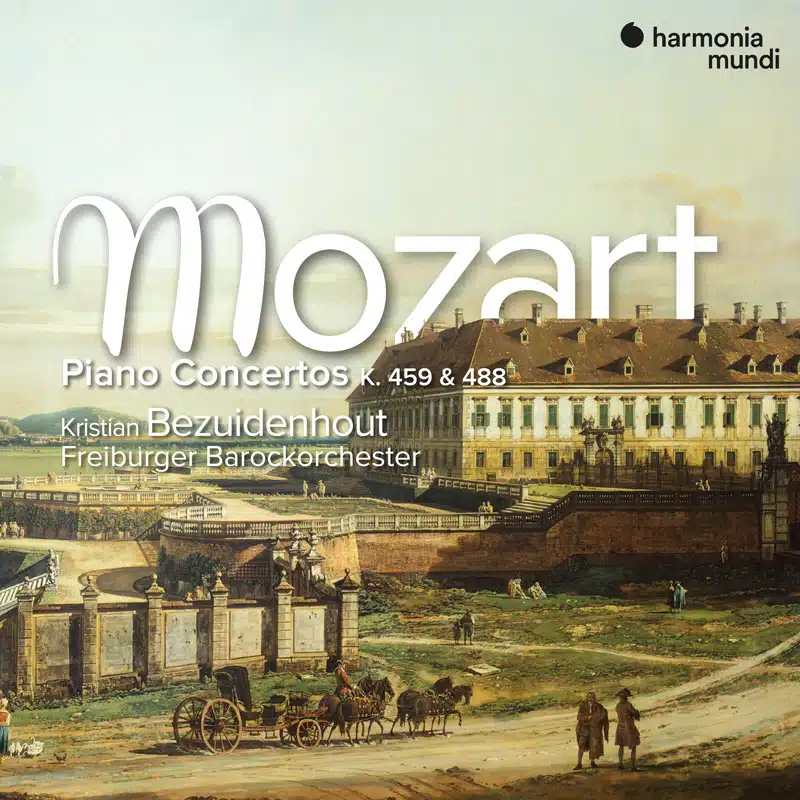
South African fortepianist Kristian Bezuidenhout and the Freiburg Baroque Orchestra (they've been collaborating for a long time, and you can hear it in this new album) have distinguished themselves admirably in the 'authentic' camp. Their Mozart series has now grown to five albums, and they're already halfway through their project to record all 27 piano concertos (which also includes the two concert rondos K. 382 and 386).
Unlike with Beethoven, the (forte)piano wasn't Mozart's primary instrument, though you certainly can't tell that from the quality of his output in this genre. Beethoven is even said to have exclaimed to pianist Cramer that he himself, Beethoven, could never be capable of composing anything like 'that' (Mozart's K. 491). It was Mozart who freed the piano concerto from its previously conventional constraints. And it was Mozart who, in his later concertos, finally gave the woodwinds a truly independent and often even prominent role, rather than merely a supporting one. He didn't even shy away from giving the wind section a part in the expressive discourse that rivals the operatic. It could hardly have been otherwise: for Beethoven, these piano concertos—especially from K. 453 onward—must have been an important point of reference for his own artistic explorations in this field.
However much Beethoven admired Mozart, he wasn't entirely enthusiastic about Mozart's piano playing. He found it rather fragmented and redolent of the harpsichord. Beethoven himself liked to play with curved fingers, his thumb often underneath. A striking feature of his piano technique was moreover his use of the pedal, which according to his student and admirer Carl Czerny was even more lavish than what appeared in the score or manuscript. In the cantabile passages especially, this created a more resonant sound, though it's worth noting that excessive pedal work on a fortepiano produces a cleaner sonic picture than on our modern piano or grand piano.
An interesting aspect is certainly the cadenza, which many pianists rattle off like a dutiful lesson or get around easily by choosing an existing one, either by the composer himself or from elsewhere. But not Bezuidenhout, who often presents the piano concertos with his own cadenzas, which is also somewhat in line with the performance practice of the time, in which improvisation was held in high regard—and Mozart was no exception to this (though he sometimes did write out a cadenza completely). In his cadenzas, Bezuidenhout naturally remains true to the 'spirit of the age,' captured in the prevailing eighteenth-century rhetoric, which reveals deep knowledge of the stylistic aspects of Mozart's piano concertos. Yet there isn't a single word about this in the CD booklet.
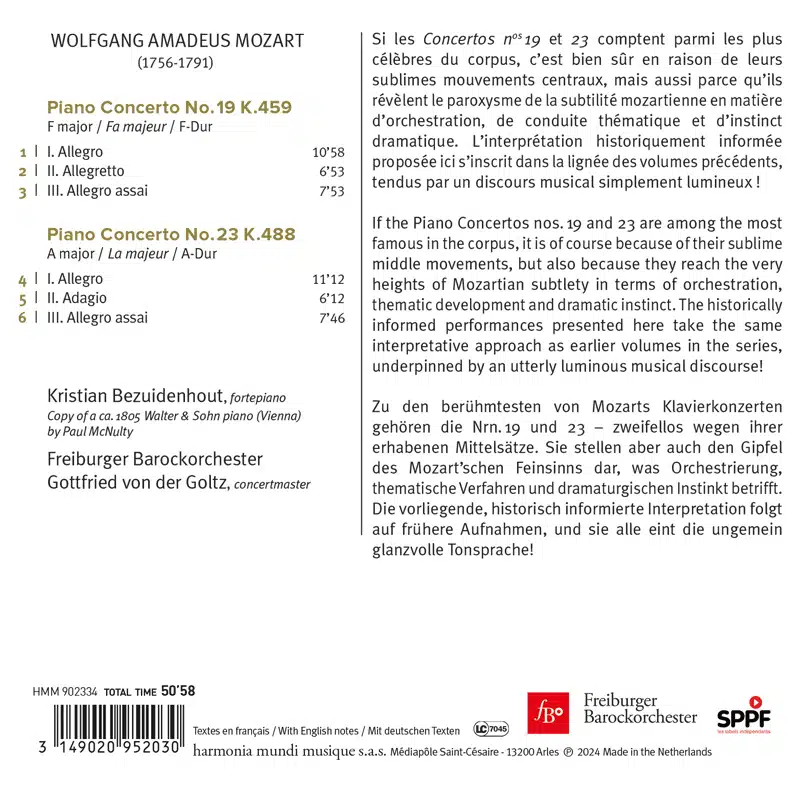
In both of these piano concertos, K. 459 and K. 488 (the independent woodwind parts are evident in both), the Freiburgers and Bezuidenhout are once again firing on all cylinders: it's nothing but sparkle, and the joy of playing shines through. The playful character that so typifies this music is further supported in this excellent recording by very infectious enterprise and a real sense of adventure. What's more, the whole thing radiates such concentrated vitality that it's a real pleasure for both ear and soul. The intimacy in the slow movements is equally warming, with vibrato used exclusively as a carefully calibrated expressive device that doesn't compromise the desired clarity of the music: refined, unassuming, and above all aesthetically justified.
The solo instrument used is a copy made in 2008 by Paul McNulty, based on a Viennese Walter from around 1805.