In the German city of Essen, HER:VOICE, a four-day festival celebrating women composers, took place from May 9-12. The diverse program featured around ten female composers, with particular anticipation for the orchestral works by Missy Mazzoli, Lera Auerbach, and Florence Price, as well as the recently rediscovered opera Fausto by Louise Bertin. If there was any doubt before, these works definitively demolished the myth that women compose 'more delicately' or 'more lyrically'.
If music lovers are familiar with works by women composers at all, they tend to be smaller-scale pieces such as songs and chamber music. These were certainly represented on the program of Essen's inaugural Composer Women's Festival, with gems from Clara Schumann, Pauline Viardot-García, Augusta Holmès, Lili Boulanger, and Germaine Tailleferre, though deliberately not placed as opening pieces or highlights. The Essener Philharmoniker, conducted by Estonian conductor Anu Tali, kicked off the festival with grand and powerful energy. The tone was set with River Rouge Transfiguration, a short work in which New York-based Missy Mazzoli (1980) drew inspiration from... industry in Detroit. The River Rouge complex is Ford's massive, now-deteriorated automobile assembly plant along the eponymous river. Plenty of concrete and gray factories then, with towering smokestacks—which the composer loves to imagine as organ pipes. In the timpani strikes and the repetitive/minimalist character of the music, you can easily hear the industrial bustle. Equally, you hear the river flowing. The harp, by the way, features prominently. Mazzoli even incorporated some techno elements, since that's Detroit too. In short, a captivating sonic tapestry. Mazzoli has already received two commissions from the Metropolitan Opera and was named 2022 Musical America Composer of the Year. Which speaks volumes about her renown—even though she remains barely known in our region.
Dream
The background of Lera Auerbach's piano concerto, the next work on the Philharmoniker's program, is different, though not entirely. It begins and ends softly and cautiously, but you occasionally hear sirens wailing in it, and often things get quite fierce. For Auerbach (1973), who also lives in New York but hails from the Urals, the work began with a special melody she heard in a dream at age fourteen. From then on, she searched for the right form for it. The work grew from a flute sonata into a piano concerto, which she later reworked. For 25 years she considered it a work in progress, but now it should finally be finished, she explained in an interview during the festival. The piano concerto is her reflection on time and change, on humanity's post-apocalyptic ruins as well. Auerbach, who is also a conductor and visual artist and writes (Russian) poetry and (English) children's books, presented herself in Essen as a virtuoso pianist. Had this been the Queen Elisabeth Competition, audiences would have sat with their mouths agape. And did we hear a touch of Prokofiev or Rachmaninoff? In any case, she didn't disown the Russian school. Impressive!
Alain Altinoglu (conductor), Pierre Audi (director), Klaus Bertisch (dramaturg), Bryan Register, Andrew Foster-Williams, Scott Hendricks, Ain Anger, Ingela Brimberg, Anett Fritsch, Nora Gubisch, Marvic Monreal, Iris Van Wijnen, Katie Lowe, Tamara Banješević, Jelena Kordić, Christel Loetzsch, Symphony Orchestra and Choir of the Munt. The Munt/La Monnaie, Brussels.
The first
With the third orchestral work, we returned to Detroit. That's where Florence Price's (1887-1953) Third Symphony premiered in 1939. This composer is considered 'the first African American woman whose work was performed by a renowned American orchestra' (namely her First Symphony by the Chicago Symphony Orchestra in 1933). Despite this success, she was acutely aware of her 'shortcomings' and the prejudices with which she was viewed. She had 'two handicaps—those of gender and race,' she wrote to a conductor she was trying to convince to perform her work (probably this Third Symphony). 'I am a woman and I have some Negro blood (sic) in my veins.' After her death, Florence Price fell into complete obscurity. That has only changed recently, perhaps also helped by the Black Lives Matter movement and a literal rediscovery of her works. In 2009, around thirty boxes full of her musical scores were found in an abandoned vacation home. Since then, she has enjoyed—quite deservedly—a revival—read more about it here. In Yannick Nézet-Séguin, she found a passionate advocate. The Canadian conductor signed on with the Philadelphia Orchestra in 2018 for the very first and Grammy Award-winning recording of the first and third symphonies. It was a pleasure to finally hear that third one live as well in an excellent performance by the Essen Philharmonic. Juba Dance also performed superbly by the Essen Philharmoniker.
A Pact with the Devil
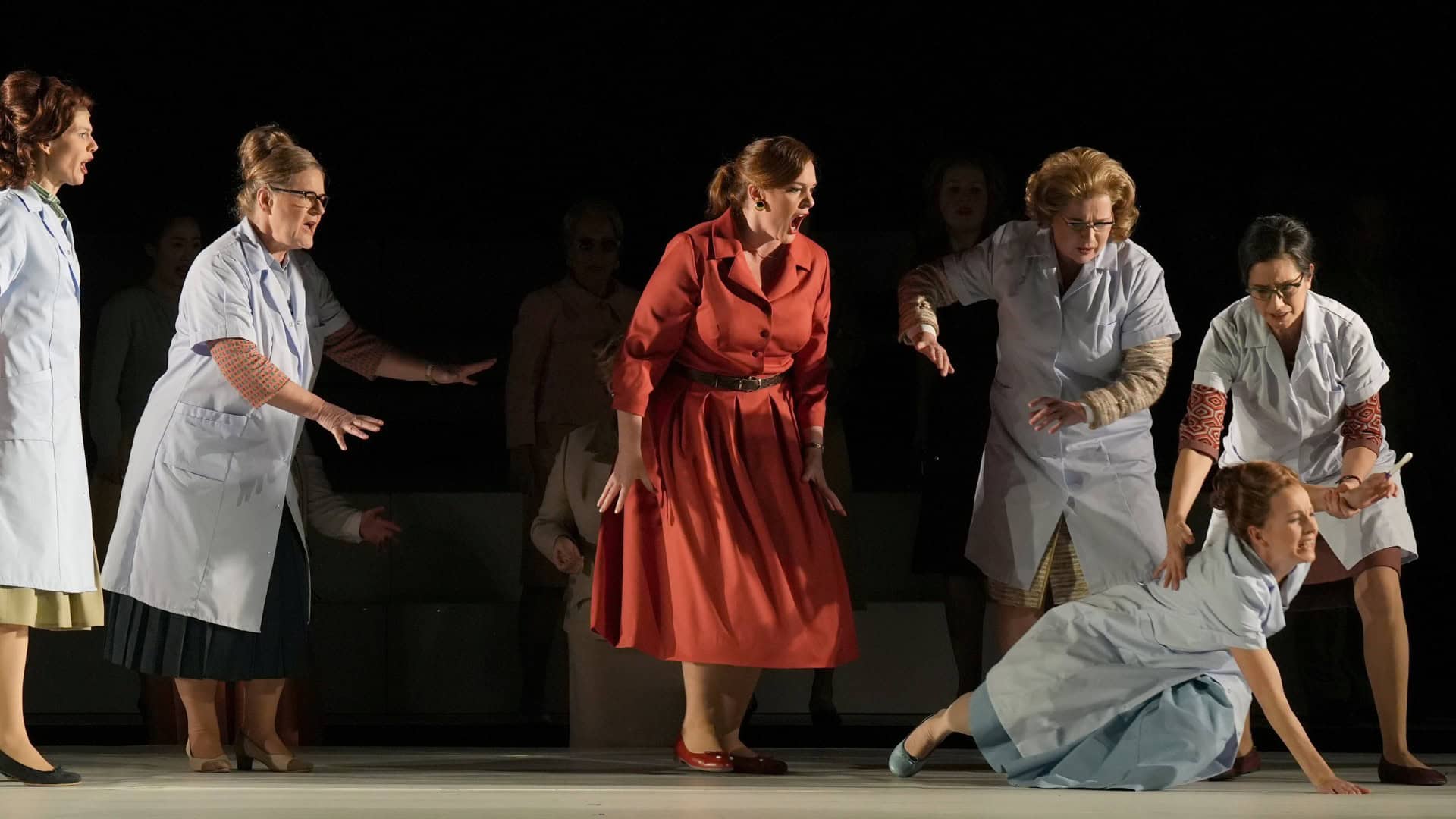
For another, more recent rediscovery, the festival moved from the Philharmonie to the adjacent Aalto Musiktheater. There I enjoyed, for the second time in two months, Fausto by French composer Louise Bertin (1805-1877). An opera that premiered in Paris in 1831 with three triumphant performances, but was then considered lost for nearly 200 years. Until it was rediscovered just a few years ago in the Bibliothèque Nationale de France. Thank goodness! What's remarkable about this work is that the then 26-year-old Bertin was the first to turn the Faust story—about the scholar who makes a pact with the devil—into an opera, before the better-known versions by Hector Berlioz and Charles Gounod. Moreover, for the libretto she wrote herself, she gave her own twist to Goethe's hugely popular tale. Elsewhere I've already explained why Bertin and Fausto are so exceptional for several reasons. This exceptionally powerful opera certainly deserves to be included in the 'repertoire'—there was complete agreement on this in the debates at the Komponistinnenfestival. Presumably, the Aalto Theater Fausto will feature it again next season. But let's hope Louise Bertin also gets every opportunity elsewhere. Tatjana Gürbaca, who directed the production in Essen, was named 'Director of the Year' in 2013 by the prestigious magazine Opernwelt, no less for her staging of Parsifal in Antwerp. So Opera Ballet Vlaanderen, what are you waiting for to bring her back to us for Fausto?
Written Out of Music History
In one of the very interesting lectures framing the festival, Vienna-based professor Melanie Unseld clearly explained how it came about that women were erased from music history, while their work in their time—contrary to what we might think—was actually regularly performed. First, the scores had to be available and archived. But how to prevent them from being forgotten in those archives? This requires the cooperation of many actors: music education, musicians, programmers, (radio) presenters, publishers, and the public. There also needs to be 'shared collective interest.' That curiosity does seem to be gradually emerging in recent years. Thanks in part to initiatives like HER:VOICE in Essen. In the countries surrounding us, such events are taking place with increasing frequency, also because musicology there has long paid attention to the female voice. The Komponistinnenfestival is even announcing a second edition (March 20-23, 2025) with even more discoveries. Interest in forgotten female composers is also growing here, but it remains largely limited to small-scale initiatives. Let our major cultural institutions take an example from this welcome and successful initiative by the Essen Philharmonic and the Aalto Musiktheater. The concert by the Essen Philharmoniker (Mazzoli, Auerbach, and Price) can still be heard on {{NOTRANSLATE_1}}. Louise Bertin's opera can be discovered on a recently released double CD in a beautiful edition with libretto by {{NOTRANSLATE_2}} (also available in full on Spotify and excerpts on YouTube).