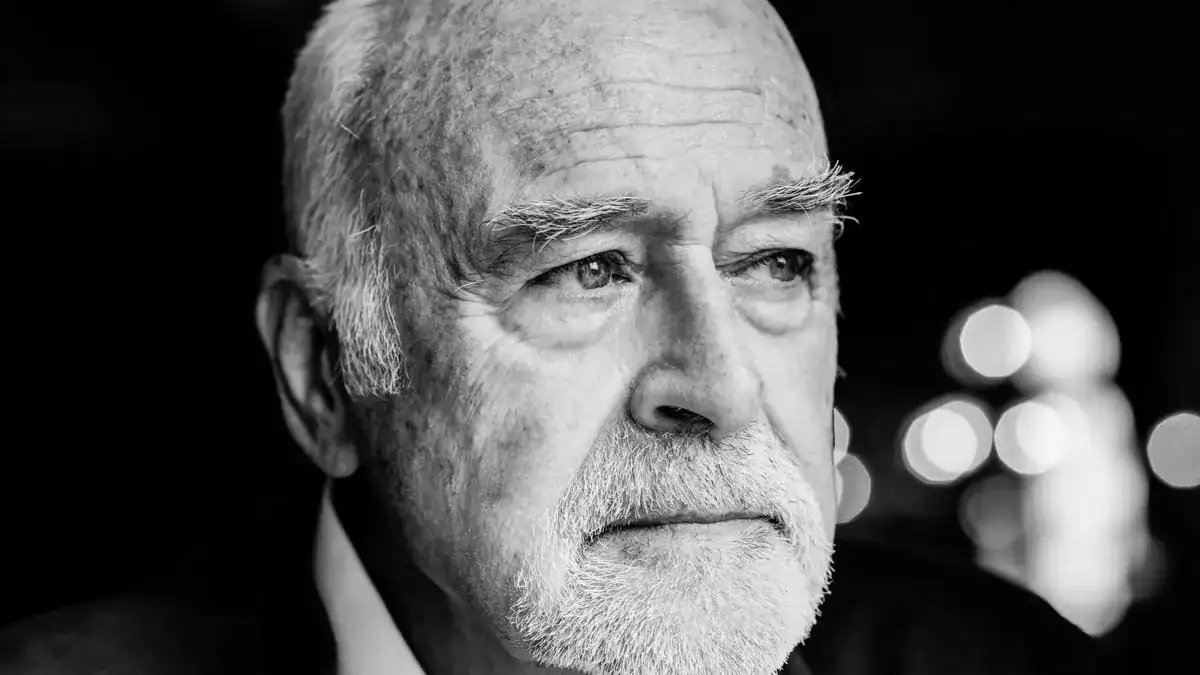
José van Dam is undoubtedly one of the most important baritones of the last half century. His career is long, but above all impressive. His repertoire ranges from Mozart through Verdi, Wagner, Beethoven, Berlioz and Debussy to Olivier Messiaen. Of his only opera Saint-François d'Assise, José van Dam sang the world premiere in Paris in 1983 under Seiji Ozawa with Christiane-Eda Pierre as the Angel.
In 2010 he retired from the opera stage, after a career that began in Paris and took him via Geneva and the Deutsche Oper Berlin to virtually every corner of the world. The origins of his singing talent go back to singing in the church choir in Brussels. He was born in Ixelles, in a family without any musical tradition. Regarding his choice to become a singer, van Dam liked to joke that he didn't choose the profession—the profession of singer chose him.
Perhaps therein lies the essence of the devotion and immense commitment the singer brought to every role he performed. He built deliberately, heeding his teacher Frédéric Anspach's advice: "go slowly." When, as a young singer, he sang Kothner in Die Meistersinger von Nürnberg, he trusted that one day he would reach Hans Sachs, a role he indeed performed masterfully and with great presence, also in Brussels (1993, 2000). Equally iconic is Golaud in Debussy's Pelléas et Mélisande, a role he recorded twice in still reference-standard recordings, once with Herbert von Karajan in 1978 with the Berliner Philharmoniker and once with Claudio Abbado in 1991 with the Wiener Philharmoniker (incidentally, two recordings van Dam himself considered among his best). A memorable production is undoubtedly his interpretation of Massenet's Don Quixote in the exceptional production by Laurent Pelly at La Monnaie under Marc Minkowski (2010). Indelibly etched in memory is his Falstaff in the stylish production by Willy Decker with the elegant Alice Ford of the late Susan Chilcott (1963-2003), under Antonio Pappano.
His baritone voice was not only lean but utterly distinctive. He had a timbre that you recognized immediately, and combined with this was a natural gift for bringing a character to life. He himself believed: "you must not only sing a role, you must live it." That requires utmost concentration, but then the presence comes naturally. He didn't want to be an intellectual singer; rather, humanity came first for him, which is why he felt at home with characters like Amfortas, the Dutchman or Hans Sachs, Figaro or Don Giovanni, Simon Boccanegra, Germont in La Traviata and Falstaff. "On stage you must always maintain control; you're essentially split into two personalities: one sings Golaud, the other stands beside and warns: careful, a difficult passage is coming."
Of course, it would be impossible to list all the great artists van Dam has worked with. Jean-Pierre Ponnelle (1932-1988) and Giorgio Strehler (1921-1997) were among his favorite directors. Later came Willy Decker and Laurent Pelly. If a director's vision didn't sit well with him, he declined the role—as was the case, for example, with Peter Konwitschny's Don Carlos. "A director must never impose on a singer; if he feels it's wrong for him, he shouldn't accept it," van Dam told me in an interview. "A performance is only successful if discussion is possible."
José van Dam also appeared in films: Joseph Losey's film version of Don Giovanni, and an earlier portrait film by Gérard Corbiau, Le Maître de musique. He also contributed to a film by André Delvaux, Babel Opéra, a kind of homage to Belgium.
The prospect of one day having to stop singing didn't frighten van Dam. He devoted himself heart and soul to training young singers. He was indeed one of the founders of the "Singing" discipline at the Queen Elisabeth Competition and led vocal training at the Kapel until Stéphane Degout and Sophie Koch took up the torch in 2023.
Despite an admirable and remarkable career, José van Dam remained a likeable man, dignified and at the same time warm in his dealings with others. He built his career with "feet on the ground and head in the clouds." He chose the role of Don Quixote (Massenet) as his farewell performance at La Monnaie (May 2010). That suited him well, he felt: "Quixote is an idealist and a dreamer. Every artist is naive when he tries to enchant two thousand people in a hall. Without idealism, one should not become a singer."
With the passing of José van Dam, the world loses yet another man of class and culture.