Three hundred years after Johann Sebastian Bach composed his passions, the questions embedded within them prove surprisingly relevant today. Who bears the blame? Who is sacrificed? Who gets to speak and who is silenced? With Your Flesh and Blood writer Jeroen Olyslaegers and composer Jef Neve transform that age-old subject matter into a contemporary story about climate anxiety, social media, populism, and the strained relationship between generations. The creation, which premieres on June 18 during STROOM in Dendermonde, presents itself as a human passion: no longer a religious narrative, but an exploration of humanity in a fractured society.
The fact that the passion form can still be relevant today is itself a remarkable thought. The genre seems firmly rooted in a Christian tradition that feels increasingly distant for many. Yet it was precisely the human drama underlying the passion narrative that Patrick Windmolders, artistic director of Vocaal Ensemble Reflection, wanted to re-examine. Beneath the theological layer of Bach's passions, he sees a story about exclusion, peer pressure, power, and responsibility. Phenomena that are no less present today than in the time the gospel stories were first told.
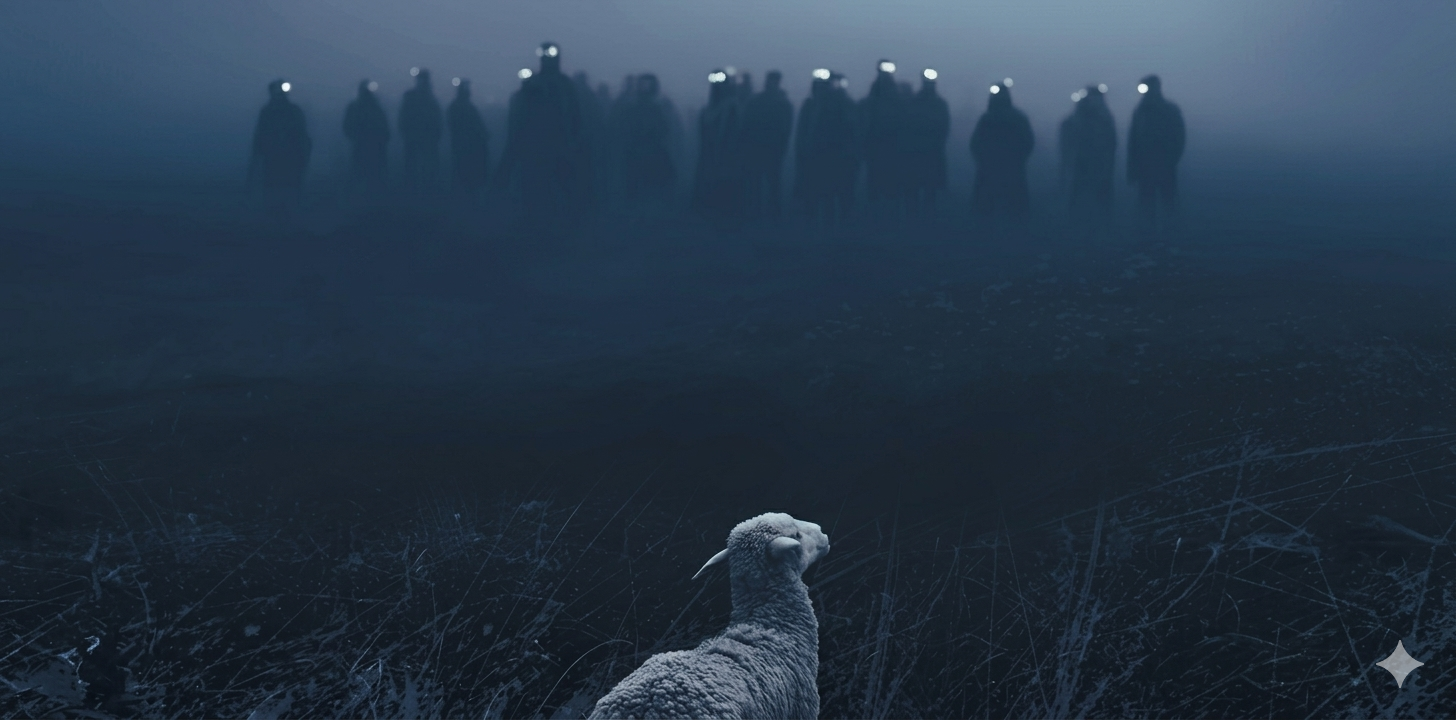
For the libretto, Windmolders turned to Jeroen Olyslaegers, a writer who in recent years has repeatedly confronted societal fractures and questions of historical guilt. Olyslaegers found an unexpected entry point in the restoration of the Ghent Altarpiece. When the upper panels of this famous artwork were unveiled again, it was especially the lamb's gaze that caught people's attention. Unlike in later overpaintings, the animal looks directly at the viewer. Not submissively or distantly, but with an almost human directness. For Olyslaegers, that became a powerful image for our time.
In {{NOTRANSLATE_1}}, there is always a mix of reality and illusion that are intertwined. Hoffmann the poet (tenor Arturo Chacón-Cruz) is the central player. His object of affection? The soprano Stella (soprano Jessica Pratt) in all her forms: Olympia, Antonia and Giulietta. Her opponent? Art in living form: La Muse (mezzo-soprano Julie Bulianne), disguised as Nicklausse. The antagonist is Lindorf (bass-baritone Erwin Schrott), translated into various figures (Spalanzani/Miracle/Dapertutto), but always in the same role. These four form the core that sets the game in motion and ultimately concludes it. Your Flesh and Blood the lamb stands at the center, not as a religious symbol but as a young person trying to find their place in a world that constantly judges them. Around them grows a chorus of voices reminiscent of social media: an endless stream of commentary, outrage, and condemnation. The individual is watched, weighed, and condemned before they even get a chance to speak. It's a mechanism Olyslaegers makes recognizable without becoming explicitly moralistic. His text moves between satire, rage, and compassion, as if trying to capture the noise of contemporary society without getting completely swept up in it.
One of the strongest interventions is perhaps the choice to replace the evangelist with a mother figure, played by An Pierié. She tries to tell a story, but is constantly interrupted by her child, by expectations, by the chaos of everyday life. It's a recognizable image of a generation trying to keep all the balls in the air at once. While young people blame their parents for causing today's problems, those same parents struggle with a sense of helplessness in the face of developments that threaten to overwhelm them as well. The gap between the two generations forms one of the emotional motors of the production.
Musically too, Jef Neve seeks a dialogue between past and present. The composer has repeatedly expressed his admiration for Bach and deliberately retains elements from the classical passion tradition. Arias, chorales, and choral passages remain recognizable building blocks. At the same time, he wants to avoid the music becoming a historicizing exercise. Just as the text draws from contemporary experiences, Neve seeks a musical language that makes the emotional urgency of today palpable without losing sight of tradition.
This experiment fits the artistic direction of Reflection, which since its founding has consistently coupled music with social questions. For this production, the ensemble collaborates with B.O.X., the ensemble of lutenist Pieter Theuns that has created new music with historical instruments for fifteen years. This combination of historical timbres and contemporary perspectives has already yielded remarkable collaborations with artists from very different musical worlds. Also in Your Flesh and Blood the past seems not to be reconstructed, but used as material to tell something new.
It's striking that despite the dark subject matter, the creators don't arrive at a message of despair. Climate crisis, alienation, toxic leadership, and polarization all pass in review, but nowhere does the story become a culture-pessimistic lament. As in every classical passion, suffering stands at the center here too, but ultimately it's about the question of how people can continue to relate to each other when old certainties disappear. The lamb looks the world straight in the eye, but at the same time asks whether the world is willing to look back.
That makes Your Flesh and Blood more than an updating of an ancient genre. The production seems above all an attempt to find new words for a society that increasingly struggles to understand itself. Perhaps that's precisely what a passion can still be today: not a religious witness, but a collective exercise in attention.
PERFORMANCE DATES
June 18, 8:30 PM (Premiere)
As part ofRob Walbers
Location: Hangar 43, Dendermonde
June 21, 3 PM
Location: Athena Hall Antwerp
In collaboration with Humanist Association
and House of Humanity Antwerp