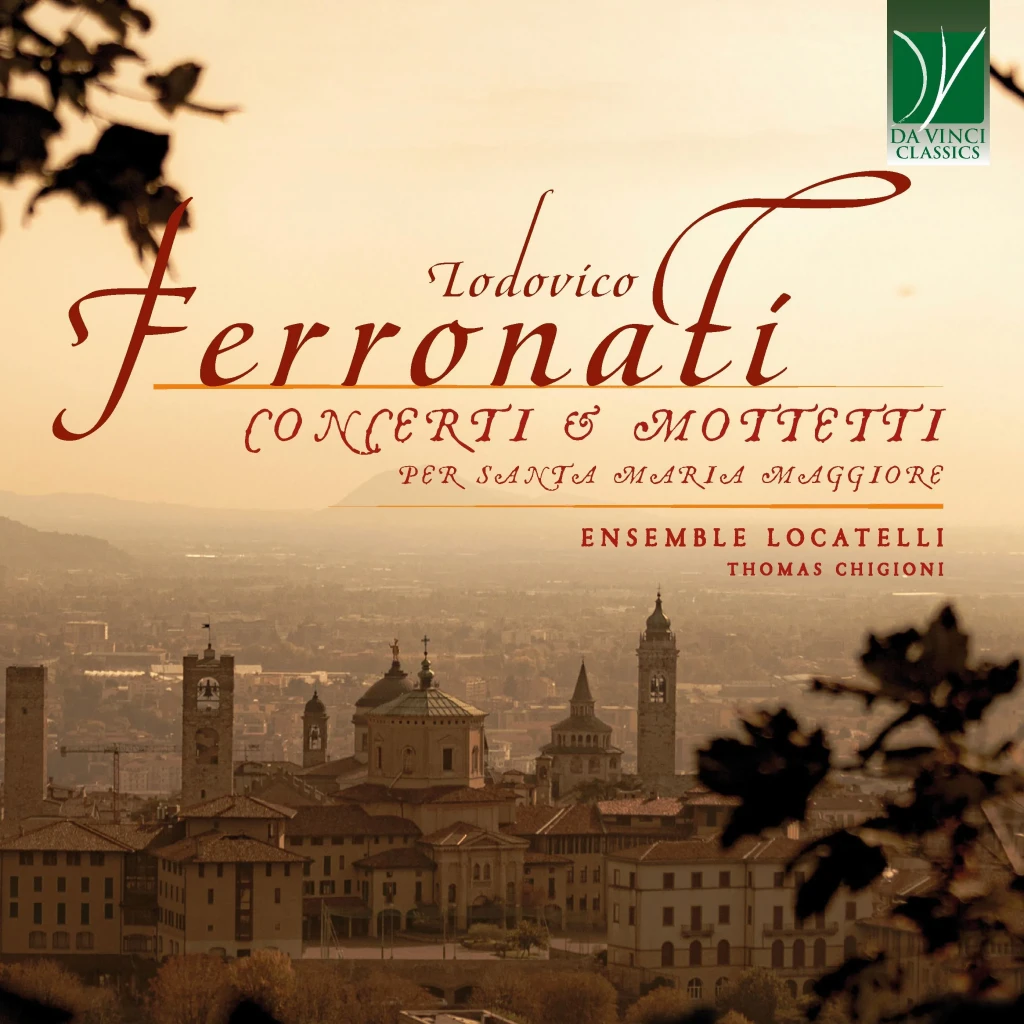
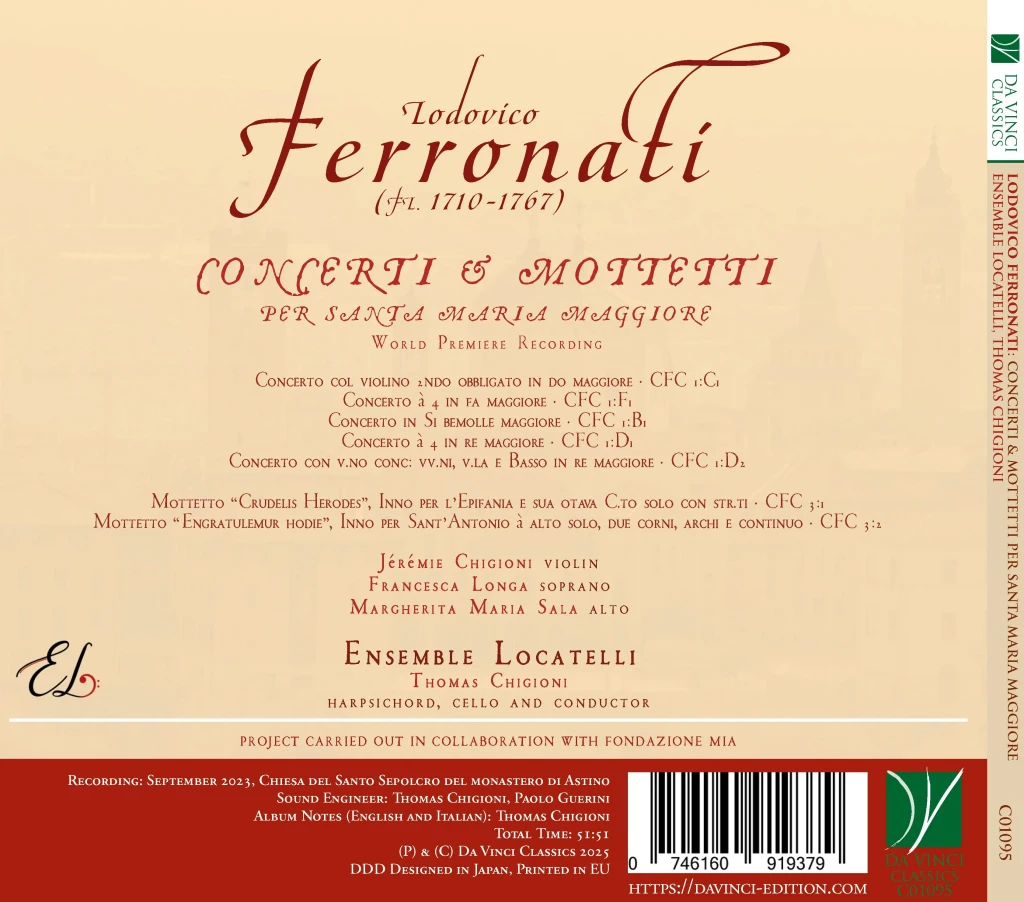
Ferronati di Bergamo! The name alone conjures up visions of rolling hills, mountains, and vast Italian lakes, the sun warming you like a benediction, and la dolce vita enjoyed with an original Aperol Spritz on the terrace of a historic villa. On my turntable sits the CD Concerti & Mottetti per Santa Maria Maggiore performed by Ensemble Locatelli under the direction of Thomas Chigioni.
Ferronati himself may not be a name that springs to mind, but in eighteenth-century Bergamo he was a key figure. For more than sixty years he was connected to the Cappella Musicale of the basilica Santa Maria Maggiore, first as a violinist and later as maestro di cappella. What's remarkable is that a large part of his music was lost and remained barely known until recently. This recording—a genuine world premiere—changes that, bringing recently rediscovered concerti and motets back to life.
The music clearly aligns with the Venetian baroque tradition: echoes of Vivaldi resound in the ritornelli, the contrasting tempi, and the prominent role for the solo violin. Yet there's a distinctive voice of its own, with a powerful blend of virtuosity and lyricism. The CD is also beautifully structured: instrumental concerti alternate with vocal motets, providing variety in color and character, and a natural balance between exuberance and quietude.
That image of a drink on the terrace, however, could mislead you. Ensemble Locatelli plays with a caliber that makes the Aperol taste even better: what richness of sound! Both in the tutti and in the solo passages, you're overcome by a delightful warmth and an almost physical sense of how beautiful music can be. Music that tingles right down to your toes. Those Italians: they had—and have—savoir-vivre.
The two motets are absolutely first-rate and showcase that quintessentially Italian baroque virtuosity at its finest. The fantastic Francesca Longa (herself connected to Santa Maria Maggiore) sings the Crudelis Herodes with radiant joy (vespers for Epiphany). The equally impressive alto Margherita Maria Sala delivers a spirited and virtuosic En gratulemur hodie (vespers for St. Anthony). What stands out most is the sound of both voices: full, warm, and rounded, never harsh or intrusive. They move with an effortless breath, as if following the rhythm of a calm heartbeat—broad, generous, and unmistakably Italian. The vocal showpieces don't sit heavily on top, but grow organically from the music itself.
And just when you think you've heard it all, something happens that catches your attention afresh. Subtle details make the difference: the Gregorian chant, sung with delightful Italian warmth, weaving its way through the first motet, or the refined interplay between alto and violin in the second. It's precisely these small touches that give this performance its voice.
Ensemble Locatelli plays with sharp definition and utmost precision, with great finesse in articulation and phrasing. Everything is in its place, without ever slipping into academic stiffness or dryness. On the contrary: the music continues to breathe and move, with a lightness and ease through which the Italian—almost Venetian—atmosphere shines through uninhibitedly.
At the end of listening to each CD I review, I ask myself: why would I listen to it a second time? Here the answer is clear. Not only because of the rare repertoire, but especially because of the conviction in the performance. In the final number, Ensemble Locatelli sharpens its knives once more and reaches again that impressive combination of virtuosity and musicality.
The CD was recorded in 2023, so some time has passed, but we should be especially grateful that this world premiere exists. I'm already curious to discover more works from the man from Bergamo and—especially—I can only strongly recommend that everyone follow Ensemble Locatelli and, with any luck, hear them perform live!
Or, to sum it up in one final sentence: after this CD, you'll crave the real thing: Bergamo, that Aperol and Ensemble Locatelli live. La Dolce Vita!
Released April 17, 2026