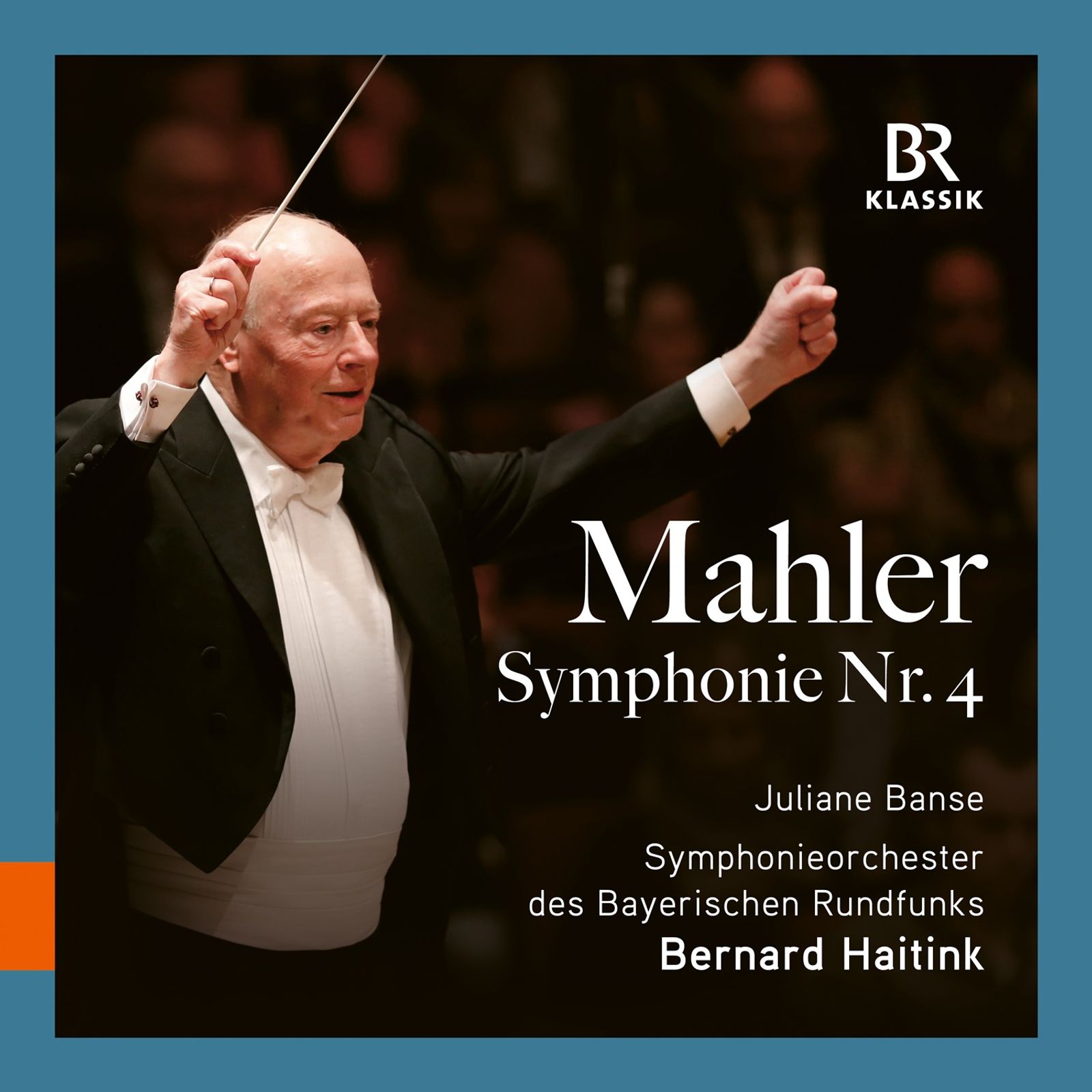
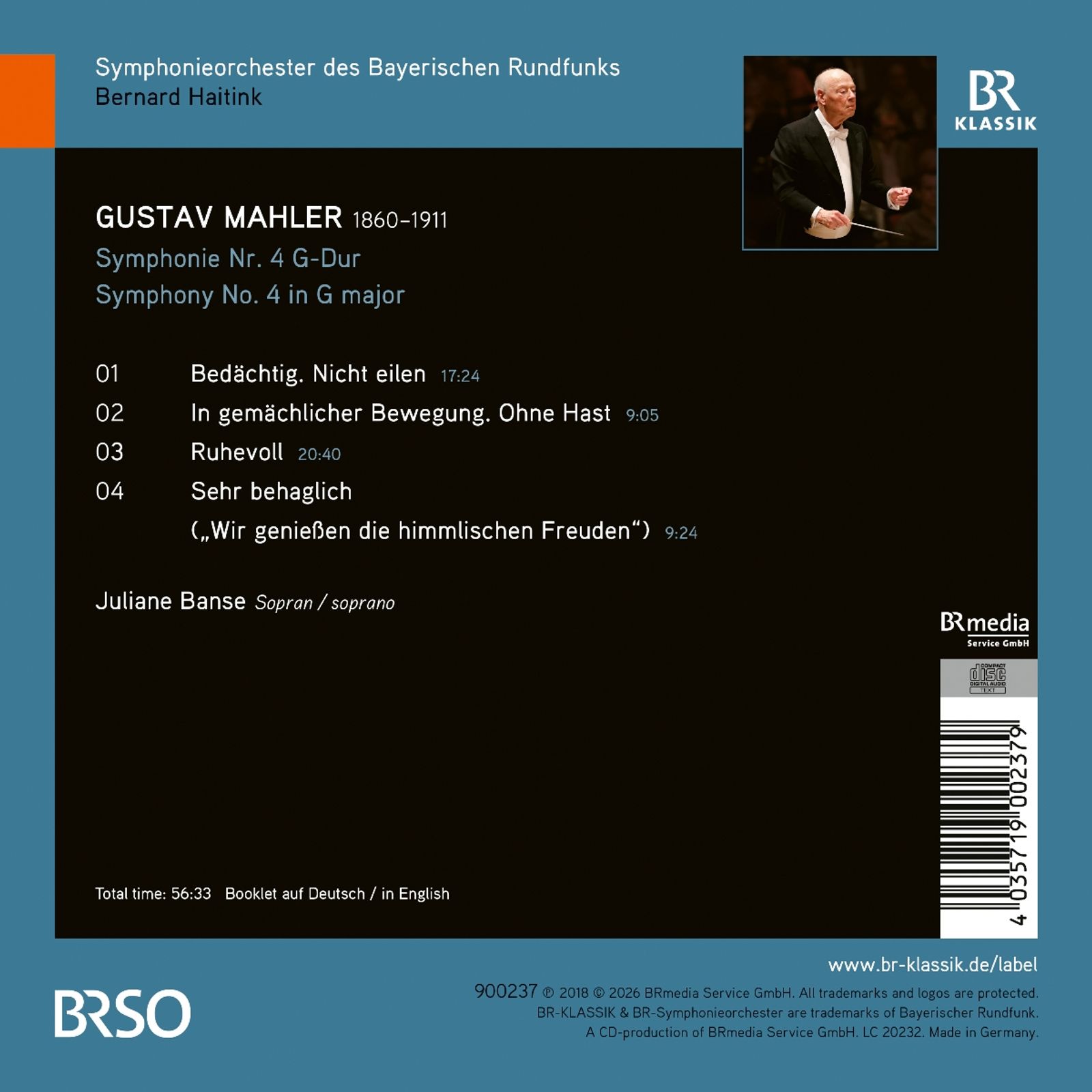
There are performances that impress, and there are performances that leave an indelible mark on memory. This live recording of Gustav Mahler's Fourth Symphony (1860-1911) with Bernard Haitink, the Bavarian Radio Symphony Orchestra, and Juliane Banse undoubtedly belongs to the latter category. What was captured in November 2005 at the Philharmonie im Gasteig and is now being released separately on CD by BR-Klassik is an inimitable, deeply moving, and incomparable interpretation that holds the listener in its grip from the first to the last note. The recording was previously part of an eleven-CD box set Bernard Haitink Portrait Vol. 1 that BR-Klassik released in 2019 on the occasion of Haitink's ninetieth birthday – a tribute to a collaboration with the BRSO that goes back to 1958. Now that Haitink is no longer with us, this separate release takes on added emotional weight: it not only documents a brilliant performance, but also a unique artistic collaboration that has passed into history forever.
Haitink once again confirms why he is rightfully considered one of the greatest Mahler conductors in music history. His approach breathes an effortless wisdom and a rare natural authority. No grandstanding, no excessive sentimentality, but a flawless grasp of the work's architecture. Precisely because Haitink refrains from emphasizing anything and lets the music speak entirely for itself, the emotional impact becomes all the greater. Every tempo is perfectly chosen, every transition sounds organic and inevitable. With a total duration of almost 57 minutes, and an Adagio that takes up well over twenty minutes, Haitink deliberately opts for a spacious, contemplative tempo – without ever losing momentum. He takes the time the music needs, demonstrating that slowness and tension need not be mutually exclusive. In this way, Haitink lays bare all layers of this symphony. At first hearing it sounds transparent and idyllic, but in reality – as Mahler himself knew all too well – it is suffused with irony and a humor that not everyone immediately recognizes. Already in the opening section, Haitink infallibly senses how Mahler plays with an old classical procedure that Haydn and Beethoven also loved to employ. Just before the end of the first movement, the famous slowing of the main theme receives exactly the right touch: subtly ironic, but never forced or caricatured. The playful irony, the underlying threat, the childlike innocence, and the existential melancholy all find their rightful place in an interpretation that cuts to the heart. The listener is never guided; everything seems to unfold with an almost inevitable logic. That is where Haitink's true mastery lies.
The Bavarian Radio Symphony Orchestra proves itself a more than congenial partner. The transparency of the woodwinds in the opening bars, the phenomenal solo violin in the grotesque scherzo – where Death, as Mahler himself described it, plays "crying and raw" as on a detuned fiddle – the velvety warmth of the strings in the heavenly Adagio, and the exemplary balance between all orchestral sections bear witness to an orchestra performing at the absolute highest world level. The dynamic buildup is exemplary: from the most delicate pianissimi to the majestic climaxes, the orchestra maintains admirable control, never losing emotional intensity. The conclusion of the third movement, in particular, ranks among the most impressive ever recorded on CD: a moment of almost supernatural beauty where time and space seem to stand still, and where the gateway to heaven sung of in the finale seems to open. Rarely does the hushed ecstasy of this Adagio sound so natural and yet so deeply moving.
In the finale too, the orchestra demonstrates its exceptional caliber. The accompaniment breathes, colors, and continuously supports the vocal line without ever imposing itself. Every instrumental contribution seems to fall into exactly the right place, allowing Mahler's wondrous soundworld – that idiosyncratic blend of heavenly innocence and earthly transience from The Heavenly Life – to unfold in all its richness.
Juliane Banse completes this dream team with a moving rendition of this finale. Her bright soprano possesses exactly the right blend of innocence, warmth, and expressivity. Her diction is exemplary, ensuring every textual nuance remains intelligible, but above all she lives her text. She narrates, paints, and moves, without ever overacting – and thus captures precisely that dual perspective inherent in this "child in heaven": naïve on the surface, deeply felt at the core. Banse doesn't merely sing of heavenly life; she makes the listener truly believe it. Her natural musicality transforms this finale into a moving culmination of an extraordinary performance.
That this masterful live performance is now available separately on CD can without exaggeration be called a gift to every music lover. This is Mahler of the highest order: deeply felt, technically unsurpassed, and musically perfectly balanced. A performance that not only commands admiration but also leaves the listener in contemplative silence long afterward. Essential for every Mahler enthusiast, and undoubtedly a performance that easily ranks among the greatest interpretations of Mahler's Fourth on CD.