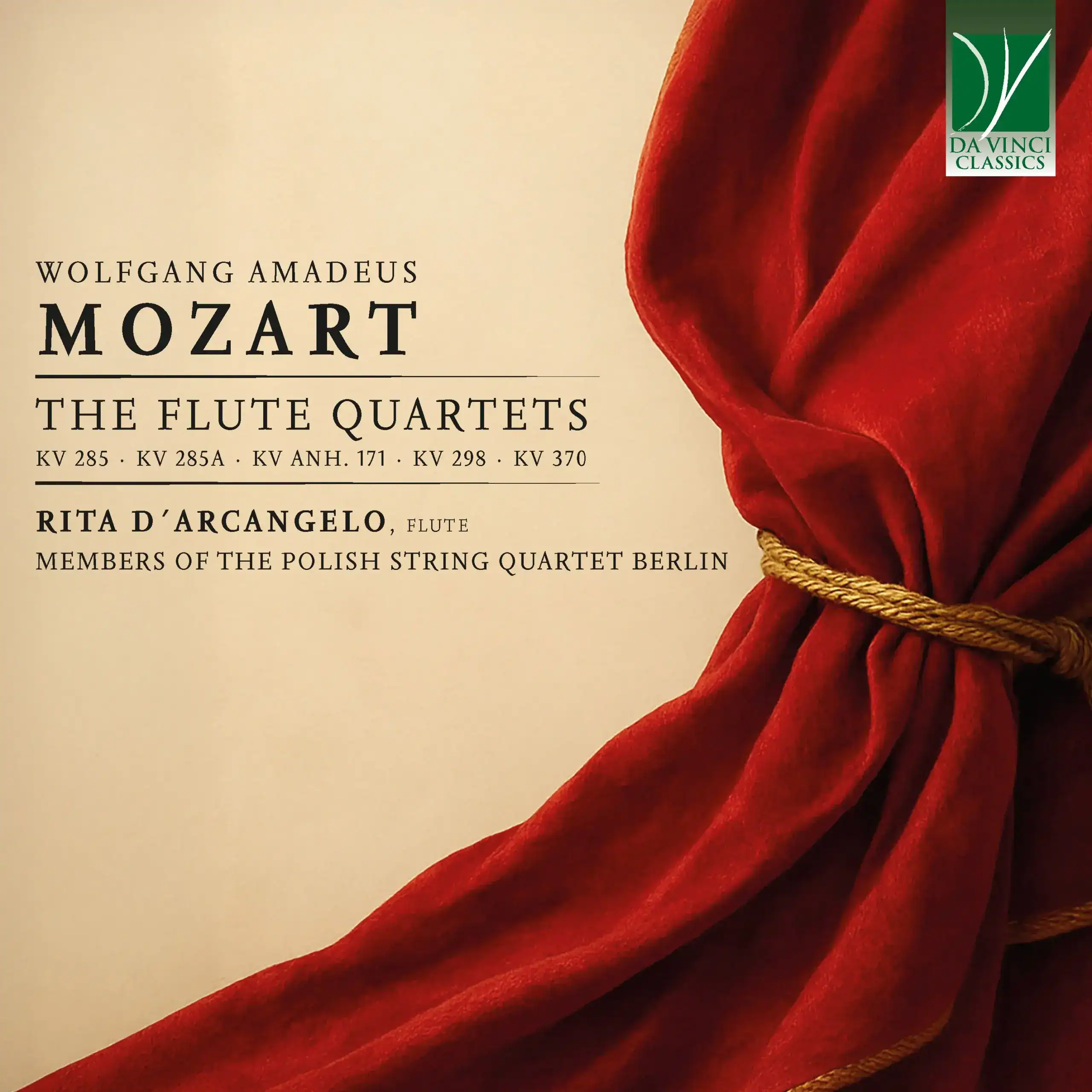
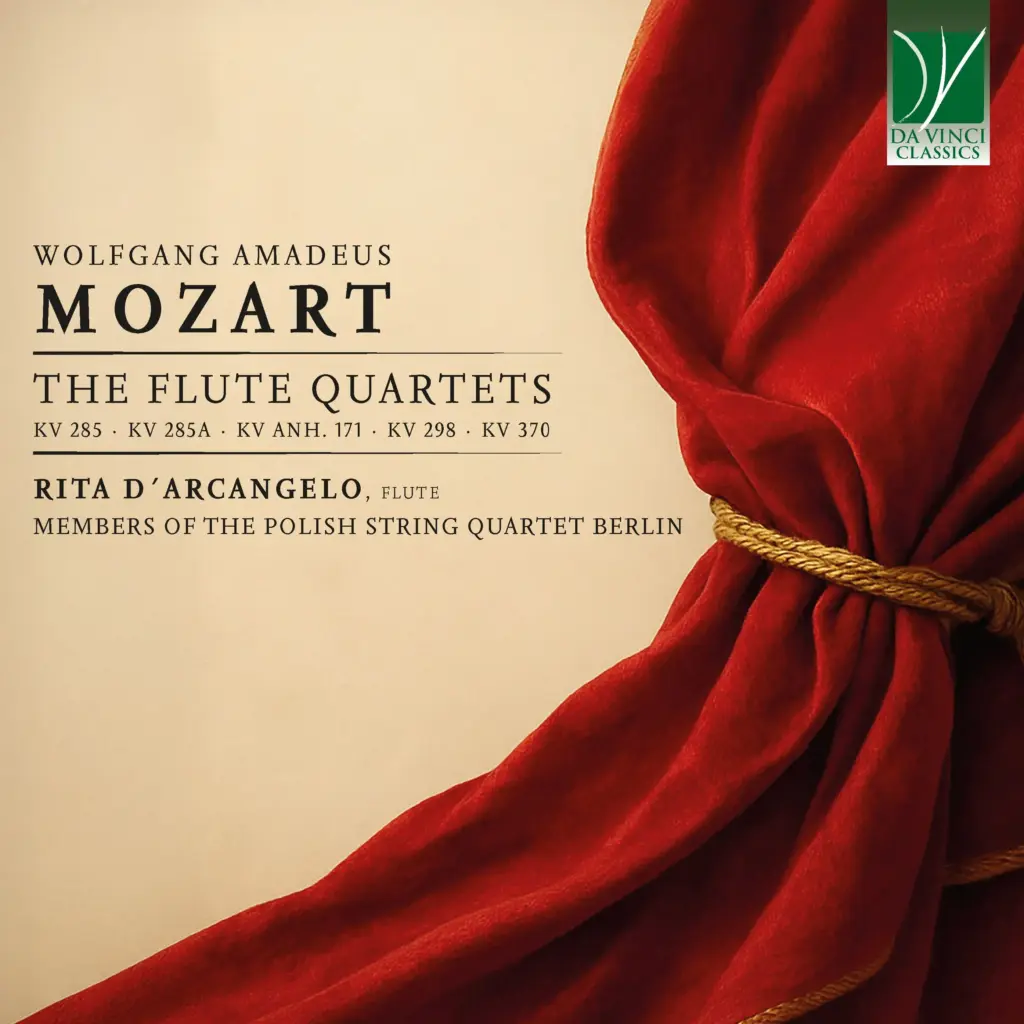
In 1777-78, during his arduous journey from Salzburg toward independence via Mannheim and Paris, Mozart accepted a commission from Ferdinand Dejean and discovered how naturally the flute could sing. These quartets for flute and string trio are conversations dressed in elegance, balanced between salon refinement and theater, chamber music rather than concert hall music, yet with the sparkle of a miniature stage. The city of Mannheim—famous for its disciplined orchestra, sweeping crescendos, and expressive wind players—offered a laboratory for color and balance; Paris suggested fashionable combinations and a taste for variety; Munich brought operatic grace; Vienna added the social intelligence of the salon. From these environments Mozart created works in which the flute is no exotic bird hovering above the texture, but a citizen among equals.
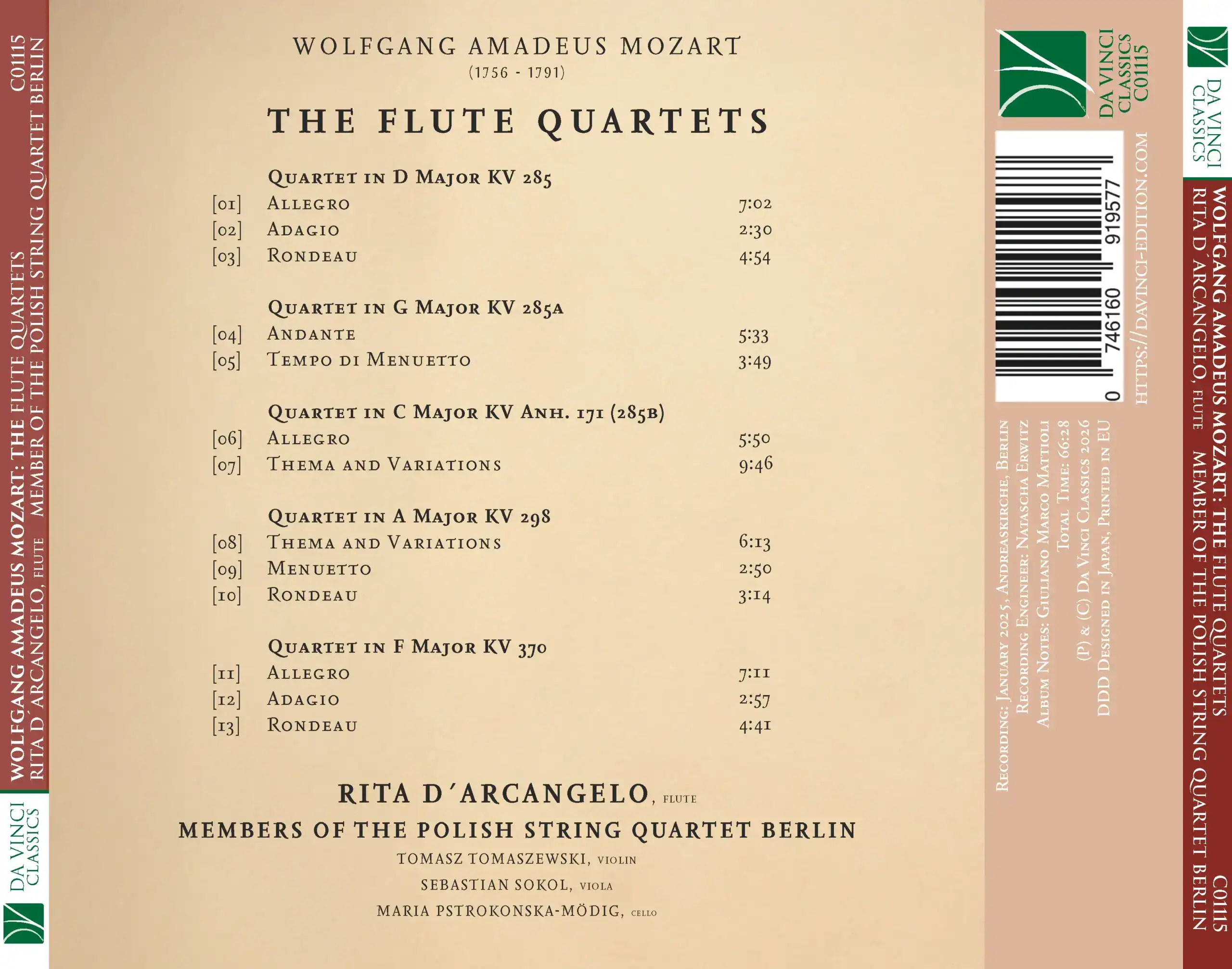
The Mannheim pieces set the tone. The quartet in D major K.V. 285 feels almost like a miniature concerto: an opening Allegro where the flute plays a radiant line above a lively string figure, confident yet collegial, with the strings answering in rapid scales and arpeggios, so that grandeur never becomes overwhelming. The Adagio shifts into B minor and breathes a nocturne-like atmosphere. With the strings pizzicato—a soft cushion upon which the melody rests—the flute sings an aria that seems both intimate and eloquent, a confidential voice hovering between melancholy and solace. You feel how the young composer, enchanted by Mannheim's musicians and by opera in his blood, could make an instrumental line sound vocal without words. The Rondeau returns to daylight, elegant and whimsical, each episode revealing a new facet of the conversation. The D major quartet is youthful but never childish; its virtuosity is tempered by tact, much as in Haydn's quartets the sharpest wit is anchored by courtesy.
If K.V. 285 is ardent, then the Quartet in G major K.V. 285a glows. With only two movements and an opening Andante, it begins not with bravura but with balance. The flute and violin exchange phrases reminiscent of Johann Christian Bach's suppleness—whose chamber music Mozart cherished and from whom he learned so much about balance and melodic line. The music listens as much as it speaks; viola and cello whisper with a discreet, Haydn-like humor, and nothing is forced. An elegant Tempo di menuetto bows without stiffness to courtly tradition, the trio colored by a subtle shift in the inner voices. This is a conversation in the spirit of the Enlightenment: measured, convivial, meant equally for the pleasure of exchange and the presentation of ideas. In such compositions one hears the seed of the equality that would mark later quartets: the conviction that eloquence in chamber music is collective.
The quartet in C major K.V. Anh. 171 (285b) is marked by history, yet possesses an irresistible charm nonetheless. Probably left incomplete and later filled in, it unfolds with a convincing naturalness. The opening movement, Allegro, is a sparkling game, a display of scales and syncopations that keeps the texture transparent. The second movement, Theme and Variations, becomes a salon of characters: first the flute draws in filigree, then the violin embellishes, and the lower strings claim eloquent passages. A variation turns toward the minor as if thoughts have slipped from the garden indoors; another restores a smiling grace. The close adds a subtly comic twist, a wink that lies somewhere between minuet and country dance. Mozart's mezzo carattere—that fusion of the serious and the playful—is everywhere present. Listeners will hear affinities throughout his oeuvre: the elegant, breathing lines anticipate the wind serenades, and the idea of a variation theater finds grand echo in the Gran Partita K.V. 361, where public splendor still makes room for personal confessions.
During his stay in Mannheim and Paris he also explored fashionable combinations, sketched the Concerto for Flute and Harp K.V. 299/297c, and discovered that fashion could serve content. After the setbacks in Paris and a hesitant return to Salzburg, he entered Munich with Idomeneo and the Quartet in F major K.V. 370. The F major work is chamber music that behaves like a miniature concerto. The opening Allegro sets a noble pace, but within it the solo part must unfold and dance, testing the newly expanded range of the instrument. The development is peppered with friendly skirmishes between soloist and violin, the harmony lively and refined as Mannheim does it. The Adagio switches to D minor and becomes an operatic scene without words: the strings speak in half-shadows, the flute answers with tender ornaments, and the silences feel like breaths between phrases on stage. The finale, a Rondeau in F major, contains playful rhythmic interplay—binary gestures against a sweeping 6/8 beat—before all ends with a smile. Brilliance and warmth go hand in hand here, just as in Idomeneo grandeur and intimacy hover together in the air.
At the other end of the journey stands the String Quartet in A major K. 298, probably written a few years later for friends and for fun. Mozart calls it, with a wink, a quatuor dialogué. The first movement, Theme and Variations, borrows from a dashing song by his friend and publisher Franz Anton Hoffmeister, first presented simply and then dressed in increasingly playful disguises. One need not recognize the original to enjoy the wit, for the counterpoint is crystal clear and the camaraderie effortless: the flute ornaments, yields, and returns; the strings imitate, tease, and applaud. The Menuetto proceeds with restrained grace, but in the trio the flute lets slip a naughty French tune—Il a des bottes, des bottes, Bastien—as if we had briefly landed in a Parisian salon before gathering ourselves again. The Rondeau crowns the joke. The quasi-Italian marking—Allegretto grazioso, ma non troppo presto, però non troppo adagio. Così-così—con molto garbo ed espressione—is a tempo indication that is simultaneously a smile, and the main theme alludes to Paisiello's Chi mi mostra tant'amor. The homage turns impish when Mozart plays with timing and accent, a display of playful invention that never breaks the spell of elegance. It is the last of the flute quartets and the most genial—a benediction rather than a farewell.
Through these quartets run lines that extend outward. The brilliance of Mannheim points toward Haydn's developing quartet world, where equality in conversation is the norm; Mozart adapts that principle for a group with a nominal soloist, ensuring the flute never silences its partners. The aria-like slow movements not only anticipate Le nozze di Figaro and Don Giovanni, but also the instrumental singing of the Sinfonia concertante and the wind serenades, with their gift for public elegance and personal candor. The skillful finales, whether rondo or variation, reflect the civilized wit of J.C. Bach and look forward to the refinement of Viennese piano variations; the playful borrowings in K.V. 298 align with a European habit of quotation that extends from Parisian quatuors d'airs to the salon fantasias of later generations. These quartets carry the atmosphere of rooms: rooms in Mannheim palaces, apartments in Munich, Viennese houses where music and conversation sat at the same table. The flute here is no pastoral cliché, but a full member of the ensemble, able to sing with natural suppleness and listen with tact. The strings, freed from mere accompaniment, offer their own commentary—the velvet murmur of the viola, the warm anchor of the cello, the quick assent and occasional swerving of the violin. Mozart draws eloquence from concision: repeated notes that breathe; canonic glimpses that are never didactic; cadences that hold their breath a heartbeat longer than courtesy requires. In the Adagio in D major pizzicato creates a frame of air, inviting the flute to paint sorrow without rhetoric. In the Andante in G major phrases open like shutters to twilight. In the variations in C major character studies unfold with the finesse of a miniature theater. In the slow movement in F major opera crosses the threshold silently, and in the finale in A major wit dances on tiptoe, never raising her voice. The five works together invite a listening experience that moves not only from piece to piece, but from light to shadow and back again. The journey ends where it should, with a smile. But along the way we have traveled quite a distance—from a winter in Mannheim to a Viennese evening, from apprenticeship to friendships, from the fashion of the world to the measure of the heart. Now as we hear these quartets, they still sound like the art of conversation at its best: fluid, candid, elegant, and human. They remind us that Mozart, even when the subject seems trifling, knows how to find depth; and when the surface gleams, he never forgets the warmth that hides beneath.
Giuliano Marco Mattioli © 2025