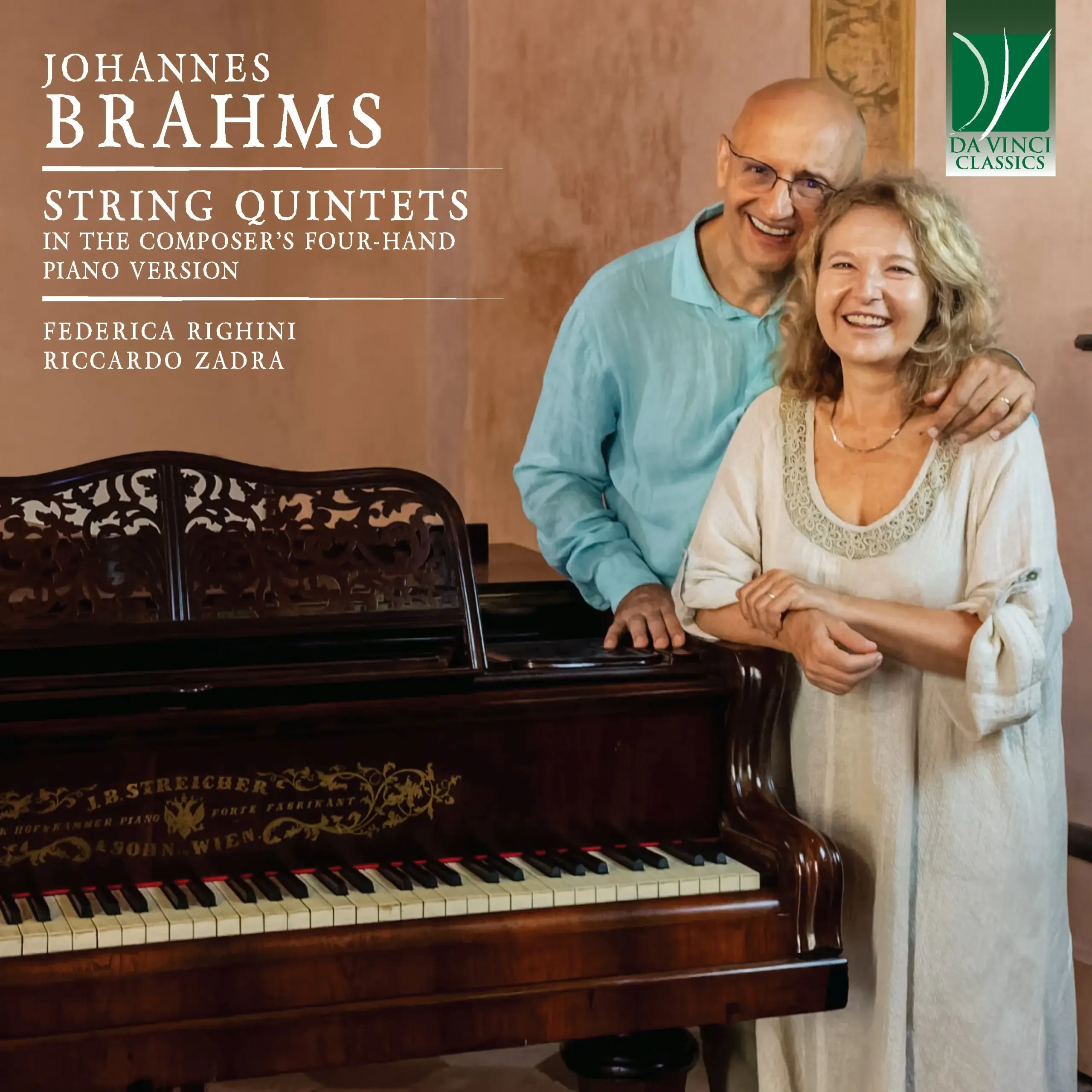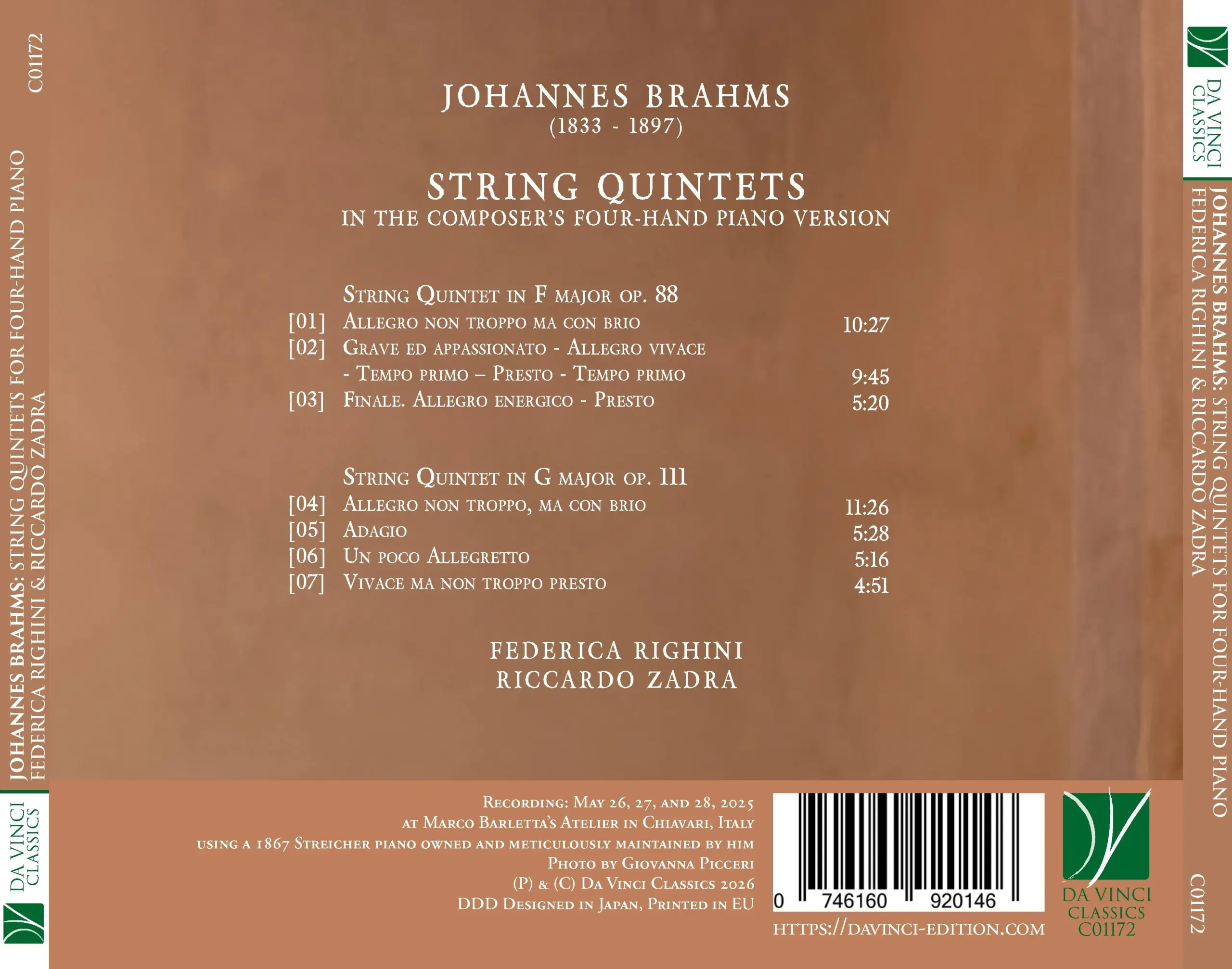
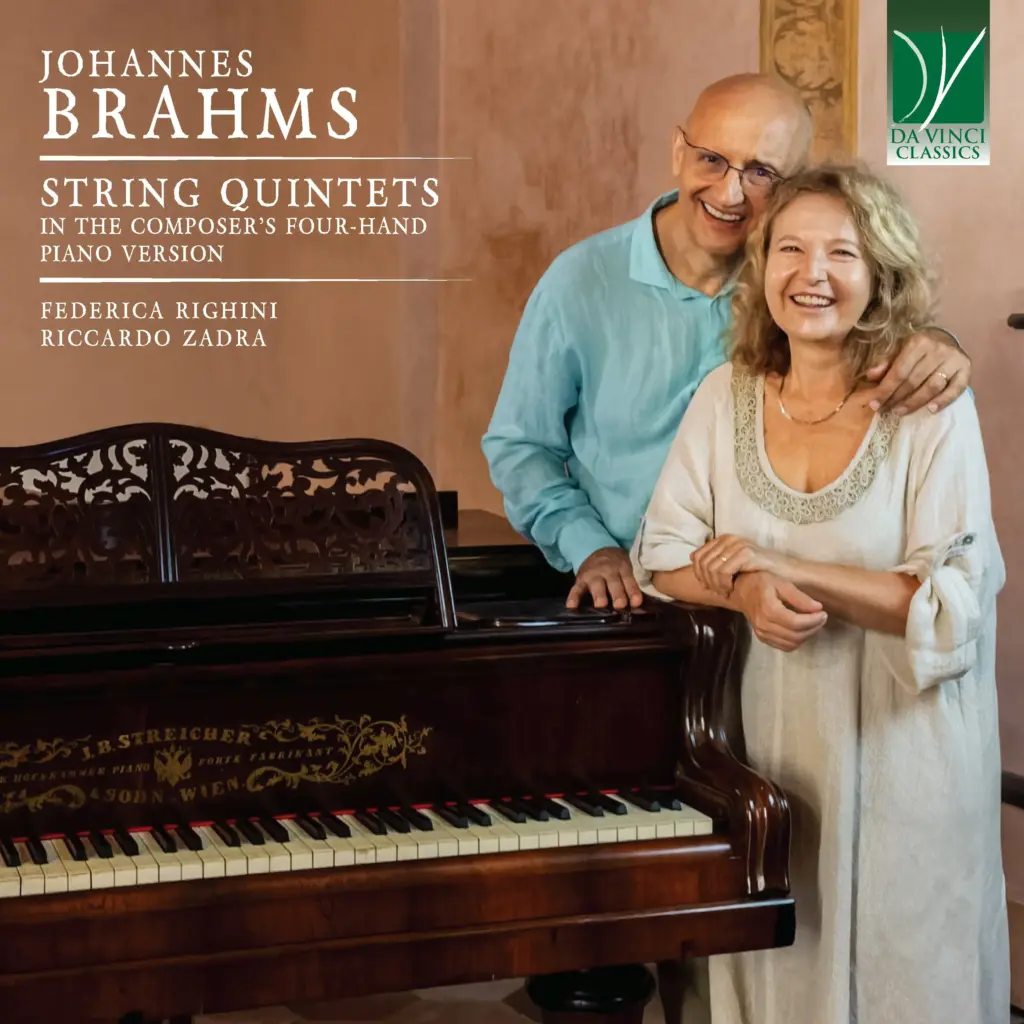
It's certainly a cliché to claim that Johannes Brahms's chamber music ranks among the finest ever written. But if this isn't stated, the level at which this Da Vinci Classics album is performed might not be fully appreciated. Here we hear two original transcriptions, made by the composer himself, of two extraordinarily beautiful string quintets by Johannes Brahms. Eight years separate the two works, and those eight years are particularly significant for Brahms's transition from his mature to his late style. On the one hand, this pair of quintets represents once again an example of Brahms's typical habit of composing works within the same genre in pairs (which was his way of ordering his musical thinking and continually exploring new perspectives). On the other hand, the time span and stylistic gap between the two works prompts us to reconsider their simple equation.
It may seem odd that Brahms, that giant of chamber music, approached the string quintet only relatively late in his career. He had indeed attempted this form once before, but the result had been both satisfying and unsatisfying. Satisfying, because the piece had enthusiastically delighted many of his early listeners; unsatisfying, because some of them (and eventually Brahms himself) agreed that the musical ideas and their structure were perfect, but that the instrumentation perhaps was not. That's why he first arranged it for two pianos, and later for piano and strings (and in this form it gained its immortal, and well-deserved, fame).
After this relative setback, Brahms let some time pass before returning to string quintets; and in the meantime, he worked intensively on other string ensembles, such as the string sextet, of course aside from the quartet.
It can therefore seem somewhat puzzling to hear these two absolute masterpieces of string repertoire performed on a piano. By the way, as a pianist, I still remember practicing Brahms's own transcription of Bach's Chaconne, exclusively for the left hand, when my brother, a violinist, passing by, exclaimed: "My kingdom for a bow!" Indeed, the piano has, compared to string instruments, two major shortcomings. The first is the absence of "a bow," that is, the ability to sustain the sound throughout its duration and to change its intensity, expressiveness, and dynamics. When a piano key is pressed, there is little that can be done to the produced sound. The second shortcoming is related to this and concerns the left-hand technique of the string player, namely vibrato. Skillful use of vibrato allows the performer to, so to speak, drastically change the tone color, the timbre, and, consequently, the overall "atmosphere."
Why then sacrifice the sound of a string quintet for a piano version? There are good reasons for it. The first and most important reason is that Brahms himself made these piano arrangements. They are not merely approved, but deliberately and intentionally created by the artist who wrote the original work. It therefore seems clear that Brahms was convinced that the piano version was equal to the original, or at least could withstand the comparison.
Second, by reducing the number of players from five to two, the work could be performed more often and thus gain wider circulation. Of course, the resulting piano pieces are far from easy, but in practice it was much simpler to find a performance opportunity for a piano duet than for a string quintet. String quintets are usually assembled for a specific purpose, for a particular work or event: while string quartets lead a life of their own, it is very unusual to encounter a "permanent" string quintet. (This also depends on the fact that there are at least two main types of string quintets, namely those with two violas and those with two cellos).