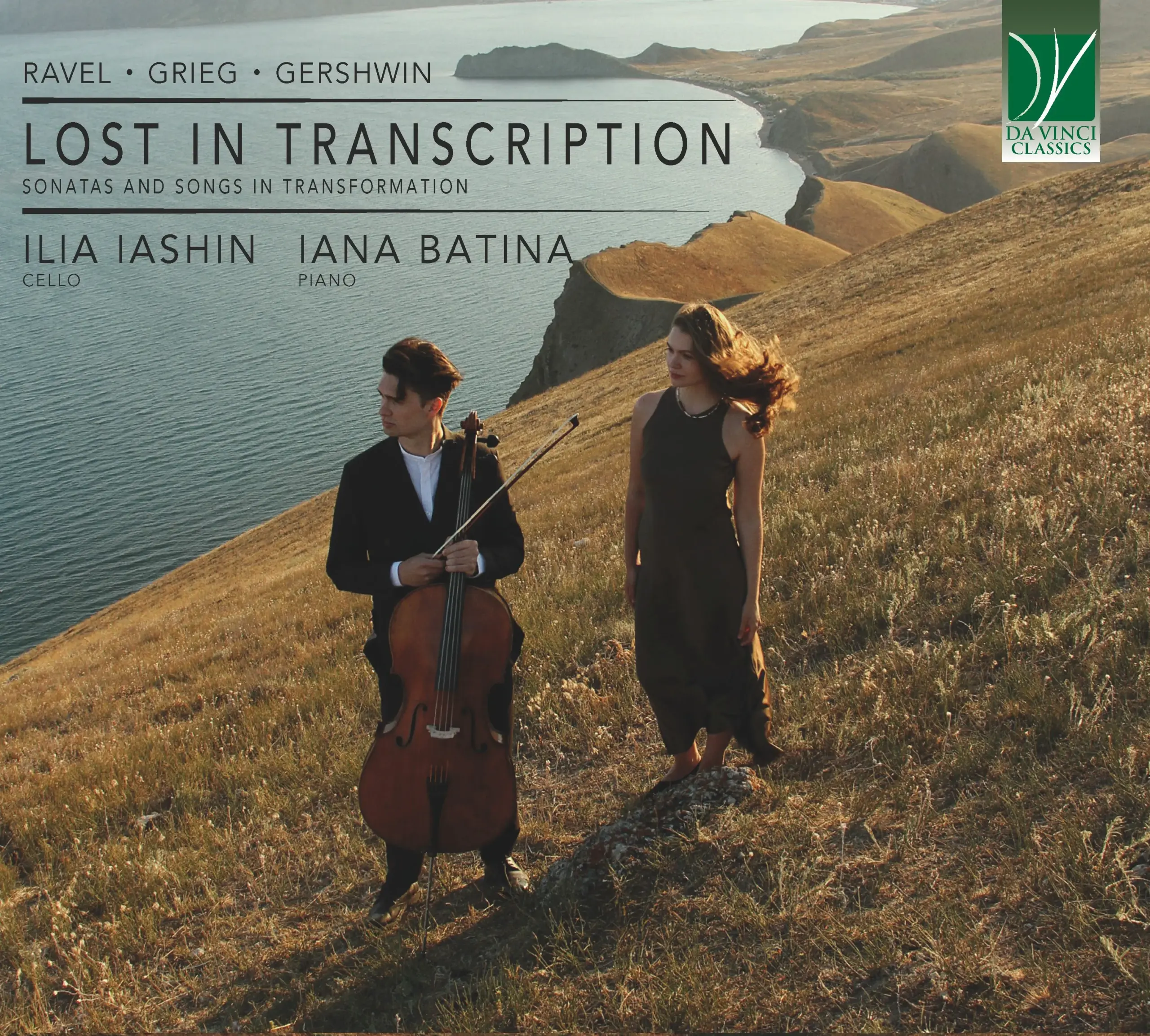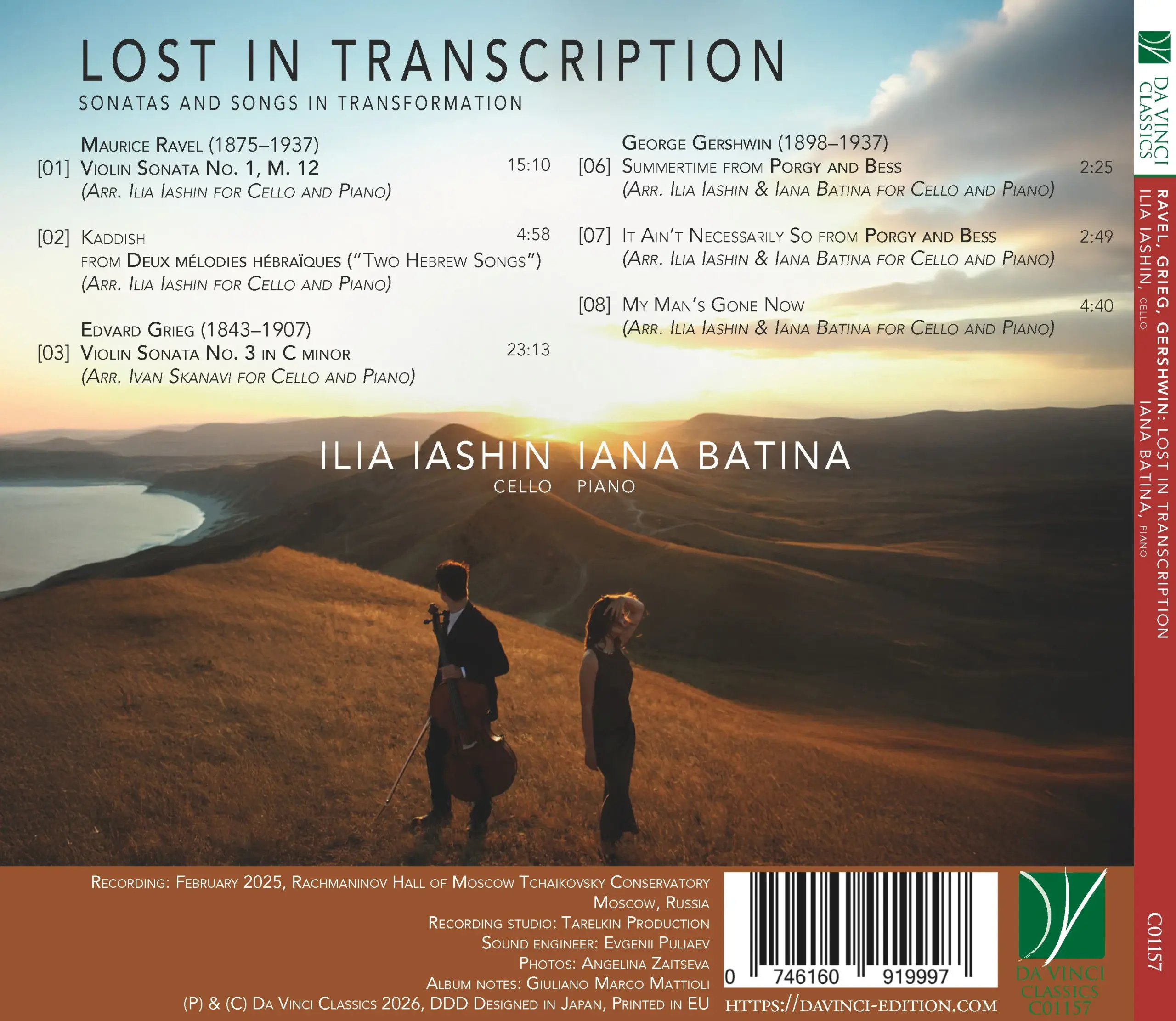
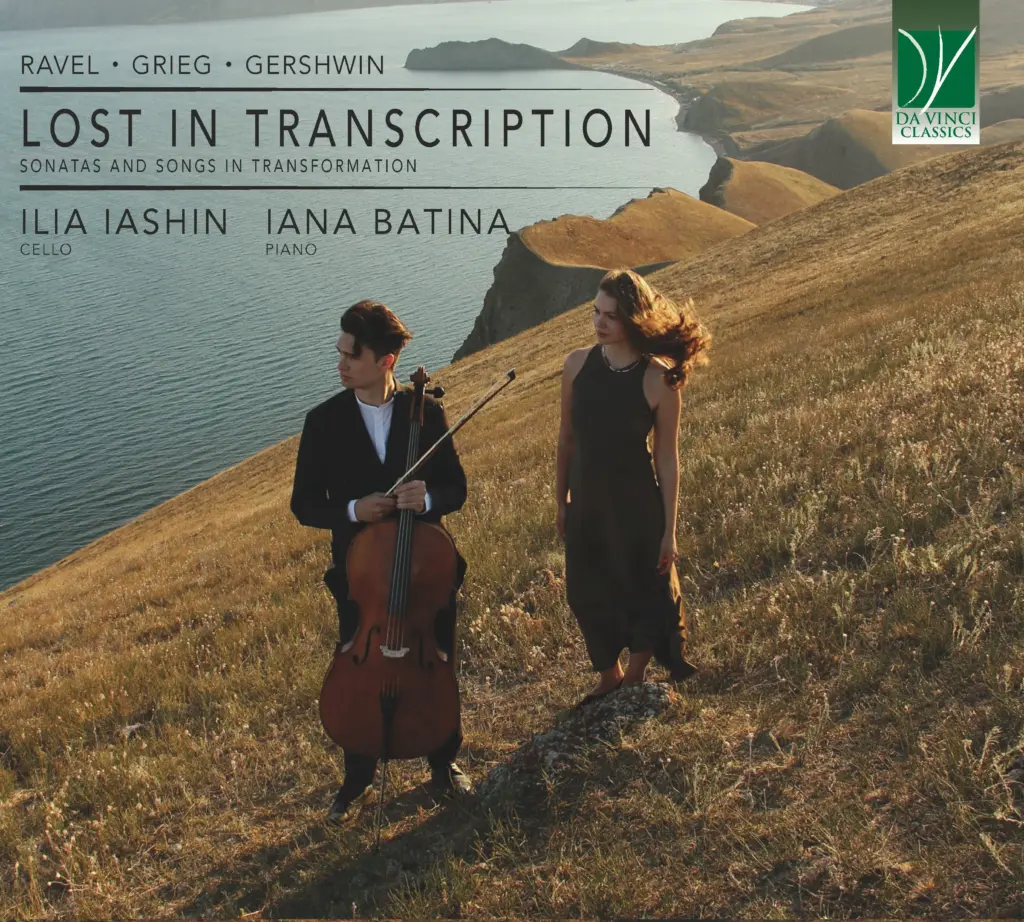
The title of this recording project already suggests that something is irretrievably lost in the transition from one instrument to another. In reality, the journey from Ravel through Grieg to Gershwin shows how transcription is not only an enriching pursuit, but also an act of knowledge acquisition: a lens that brings the object closer, breaks it apart and magnifies it, and lays bare hidden veins in the structure of the scores. The cello, taking over passages originally intended for the violin or the voice – Ravel's Sonate posthume and Kaddish, Grieg's Violin Sonata No. 3, three numbers from Porgy and Bess – is by no means a mere substitute, but a true protagonist that vies with the violin for the priority of brilliance and with the voice for the privilege of words, never denying its own timbre.
The Sonate posthume for violin and piano is Ravel's first venture into sonata form within chamber music. Composed during his student years at the Paris Conservatory, while Fauré and Gedalge's student absorbed the lessons of the French school, the piece remained a largely forgotten memory of conservatory life for decades. Various accounts, also adopted by Italian critics, suggest that the piece was performed in an academic context with Ravel at the piano and Georges Enesco on the violin, only to disappear from concert programs until its publication in the seventies. A recently discovered autograph refers not to a posthumous sonata, but to an unfinished sonata: what we today hear as an autonomous piece is essentially the first part of a sonata that remained in fragment form, and whose score is preserved in the Austrian National Library. Stylistically, the work follows the classical three-part structure of exposition, development and recapitulation, with a first theme that is sweet and cantabile and has often been compared by critics, in its general form, to the opening theme of the later Trio op. 67 for piano, violin and cello; the harmonic writing reveals a clear debt to Fauré's lyricism, filtered through a taste for timbral details and modal ambiguity that was already characteristic of Ravel. It is precisely this experimental, almost exploratory character that makes the transcription for cello particularly eloquent: while the piano part remains unchanged, the line originally intended for the violin is rewritten within a texture that emphasizes the continuity of the cantilena and the depth of the middle-low register. One does not get the impression of a simple lowering of the upper part, but rather of a shift in perspective: the same discourse is entrusted to a more inward-turned voice, less dazzling in appearance, but all the richer in content.
A similar interplay of distance and proximity characterizes Kaddish, the first of the Deux mélodies hébraïques. Ravel approaches this material not as a mere harmonizer of a traditional chant, but as a composer who reinvents it, inspired by the intonations of synagogue songs without literally reproducing the ritual chant of the Kaddish: the vocal line assimilates interval formulas and declamatory accents of the prayer and translates these into a stream of melismas, supported by bell-like chords in the piano. In Mario Bortolotto's well-known formulation, this passage is an "invaluable counterfeit" of the nasal synagogue style; it is therefore no coincidence that it was precisely the Deux mélodies hébraïques that in the thirties were cited as evidence of the composer's alleged "non-Aryan" origin, to which he ironically responded with the wish to share the same fate as Mendelssohn. The Kaddish, transposed to the cello, escapes the literal textual dimension, but at the same time gains a kind of inner deepening of the ritual. The low register of the instrument takes on the weight of a silent recitative, while the upward movements toward the high register, which in the sung version mimicked the nuances of a cantor, become ascending thrusts in which the melodic line almost seems to break under the weight of the invocation. Ravel's composition, which in the relationship between voice and piano already played with an unstable balance between improvisatory freedom and formal control, finds in the cello an ideal interpreter of the ambiguity between liturgical text and secular meditation on the value of memory.
With Edvard Grieg's Violin Sonata No. 3, the program's center of gravity shifts northward, but the underlying tension between rootedness and transfiguration remains unchanged. Grieg himself regarded this sonata, compared to the two earlier ones, as more 'international' in language and at the same time imbued with Norwegian elements, as if references to folklore had by now become a natural and inseparable part of his compositions. In the opening Allegro molto ed appassionato, the impetuosity of the first theme is combined with a second theme of warm cantability; the middle section, Allegretto espressivo alla romanza, achieves an almost domestic simplicity, with a melody that subtly hovers above a sober and restrained piano accompaniment; the finale, Allegro animato, reworks popular dance idioms and transforms them into an impetuous, almost breathless, rush. The history of transcriptions of this sonata sheds particular light on Grieg's relationship with the cello. There is documented evidence of a version of the Allegretto espressivo alla romanza for cello and piano, based on autograph material, in which the solo part is entirely from the hand of the composer, while the keyboard, with only minimal adjustments, retains its original form. Recent editions have expanded this perspective to the sonata as a whole, with versions for cello that implicitly enter into dialogue with the Cello Sonata in A minor and with other chamber works by the composer; the transcription discussed here also introduces a short cadenza between the first and second parts and an added modulation in the heart of the Allegretto, which creates a moment of harmonic tension absent in the violin score. The result is a particularly flowing journey in three stages, in which the cello assumes the role of sole narrator of a story that alternates between storm, self-confidence and dance.
The final part of the CD is devoted to three numbers from George Gershwin's Porgy and Bess: Summertime, It ain't necessarily so and My man's gone now. This work, conceived as a "folk opera" and also the result of a stay of several weeks on Folly Island to experience firsthand the language and music of the Gullah community, weaves together spirituals, blues, work songs and compositional techniques that derive both from European symphonic music and from the Broadway musical. Summertime, a lullaby sung by Clara at the beginning of the first act, is often described as a new spiritual: an almost entirely pentatonic melodic line unfolds over slow harmonies with a pronounced blues flavor, in an underground dialogue with the spiritual Sometimes I feel like a motherless child, while at the same time respecting Gershwin's explicit intention not to quote existing songs literally.
Even more complex is the cultural layering of 'It ain't necessarily so', which on stage is entrusted to the ambiguous and seductive figure of 'Sportin' Life'. Beneath the brilliant, jazzy sound layer, the melody takes on the profile of a synagogue blessing that introduces the reading of the Torah, including the congregation's choral response; various studies have recognized in the piece the presence of the liturgical mode 'Adonai malakh', emphasizing the major third and minor seventh that also characterize certain traditional cantorial intonations. Gershwin, the son of Jewish immigrants and yet deeply rooted in the African-American culture of Catfish Row, thus weaves together two sound memories: that of the synagogue and that of the black community in the American South, transforming what appears to be a lighthearted song into a field of tension between faith, skepticism and irony.
"My man's gone now," Serena's lament, brings this dialectic between different roots to a climax: around the verses of DuBose Heyward, among the most sublime verses in twentieth-century musical theater, Gershwin constructs an aria in which blues lament, spiritual and tragic opera aria converge in one great, unbroken whole. It is therefore hardly surprising that these passages have spawned a broad and enduring tradition of instrumental transcriptions: think, for example, of the suite and paraphrases for violin and piano by Jascha Heifetz, or Igor Frolov's concert fantasy on themes from Porgy and Bess. Following this tradition, but with a different sound balance, the arrangement for cello and piano used here takes the orchestral score as its starting point and entrusts the cello with both the main vocal parts and certain original instrumental interventions.
What unites these seemingly disparate experiences is the idea that transcription can be understood as a form of creative criticism. In Ravel, the cello brings the inner dimension of the Sonate posthume and of Kaddish sharply into focus; in Grieg, the transformation of Violin Sonata No. 3 into a story for cello and piano illuminates the dialogue between Nordic cantability and formal construction; and in Gershwin, the chamber arrangement of Summertime, It ain't necessarily so and My man's gone now allows us to listen closely to the interweaving of spirituals, blues, cantillation and opera style that forms the deep structure of Porgy and Bess. Far from being "lost" in transcriptions, these musical pieces rediscover in the warm and moving voice of the cello a new center of gravity, in which historical memory, cultural geographies and sonic innovation maintain a fragile and precisely for that reason intensely vital balance.