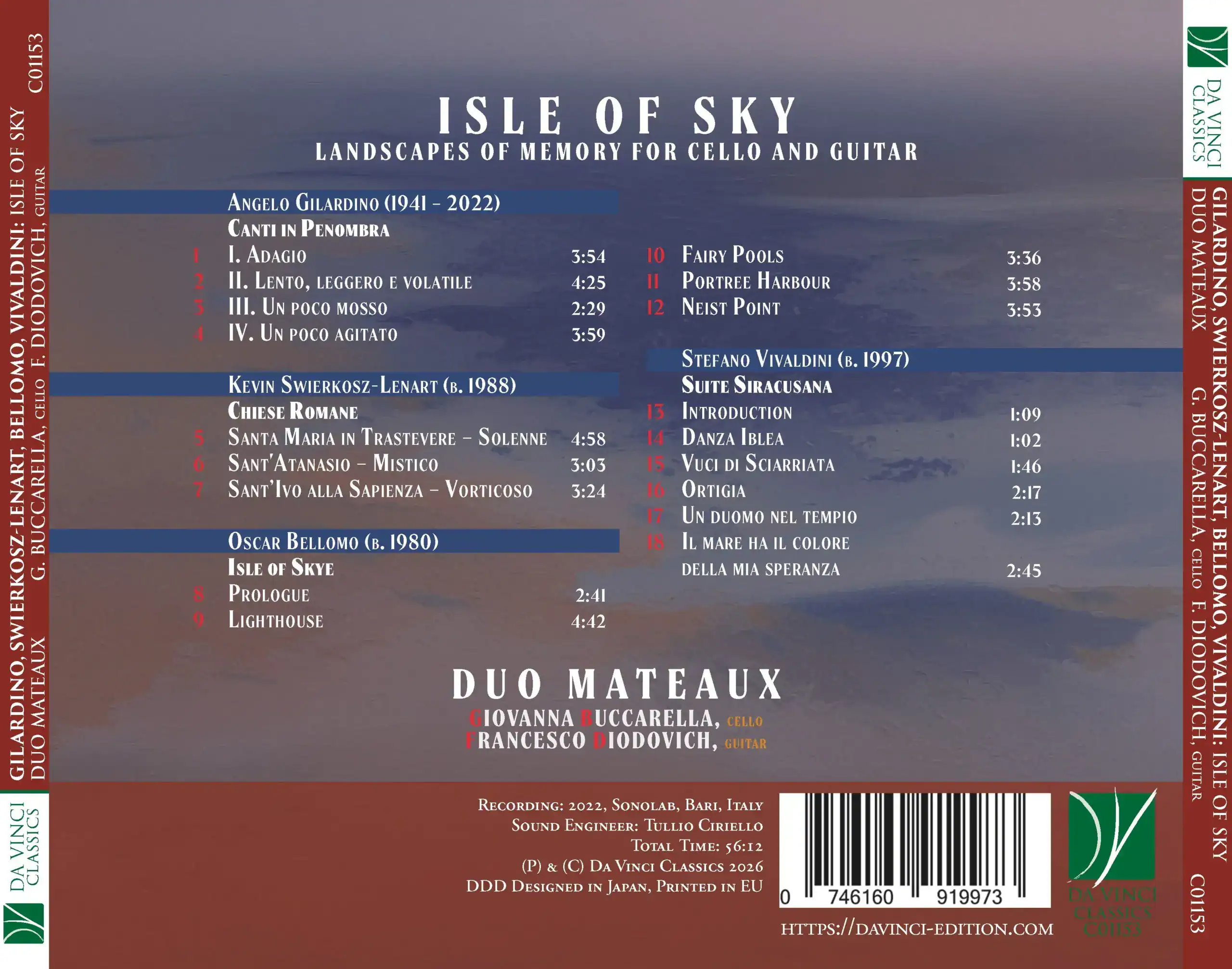
Angelo Gilardino (1941-2022) is widely regarded as one of the most important composers for guitar.
Despite an extensive body of work for solo instruments, chamber ensembles, and orchestras, this duo for cello and guitar is truly unique within his catalog. Attributing this uniqueness to mere coincidence seems superficial to me (after all, Gilardino could hardly have lacked contact with accomplished cellists throughout his career), just as it would be misleading to explain it as a kind of reluctance born from the inherent difficulty of the combination, or from a supposed distance from the poetic world of the cello. The opposite is proven by the fact that the cello appears in two other works: the Double Concerto from 2004, Star of the Morning, and the Quartet for flute, clarinet, cello and guitar (2010).
I therefore believe that the reasons for this late reduction of dialogue to the most essential elements should be sought in biographical circumstances. It is certainly no accident that the only instrument Gilardino systematically studied alongside the guitar was the cello itself. Through this, he developed a special affinity with the idiom and tonal color of the instrument; and the combination of the two instruments can hardly be interpreted otherwise than as a conflict within his own poetic sensibility. From this emerges a work that he himself described as "two-sided" and that carries the theme of division even in its title: Songs in the Twilight.
Here the guitar fulfills its role as a suggestive, enigmatic, shadowy instrument. The cello forms the complementary pole: a voice that yearns to come to the foreground, that would like to sound loud and dramatic, but which within this specific combination – in the composer's own words – must remain in the twilight.
The two-part character of the work is also reflected in the musical language: we find ourselves between the chromaticism of early Gilardino and the more recent dominance of modal and diatonic compositions.
The first section is entirely built around a four-note cell, played by the guitar within an elusive, disorienting counterpoint. From this theme, the cello repeatedly draws impulses for melodic development that remains incomplete, reaching new areas of consonance where the guitar drifts away, arpeggios and offers fragments. These do not form a true second theme, but rather an expectation of a renewed reconsideration of the original motif.
The second section is lyrical in nature and has an A-B-A form. The opening reinforces the ambiguous, suggestive quality of the guitar by presenting a motif fragment, formed by a rising triplet without an endpoint, floating in its stirring climax. The cello then enters with greater assertiveness, takes over this enigmatic cell and repositions it within the measure, so that each time a stabilizing endpoint is created – until the cello gradually erases it and its own natural inclination toward song takes over.
The B section follows – "light and fleeting" – of clearly different character. Introduced by the cello, it is entirely built from repeated notes, with the melodic element formed as figures that emerge like mosaic tiles. The guitar quickly joins in an imitative dialogue and again emphatically presents an unresolved rising movement at the end of the measure. After reaching the climax, a gradual deceleration leads back to the first episode, "slowly".
The third section has a nested structure. On the surface, it again takes the form of an A-B-A, but the B section is in turn articulated in three parts, B'-C-B', where C represents a development of A. It is a skillful formal variation on the two cores that have animated the work so far: on one hand, the fragmented guitar part that permeates the opening section, against which the cello oscillates between pizzicato and staccato; on the other hand, the eloquence of song, which here – albeit briefly – reaches its greatest expansion in the two B' sections.
The fourth section, in which the diatonic element predominates, can be associated with Gilardino's rich vein of "aquatic" music, and more specifically with a rain of Manzonian character that comes to heal the conflicts that have marked the discourse so far. The central lyrical element also offers a form of resolution, by picking up the triplet from the second section: here it is inverted into a descending line and firmly anchored on the first beat of the following measure. Cello and guitar bid farewell to the listener with an unhurried song, unfolding over a landscape touched by a fine, cleansing rain.