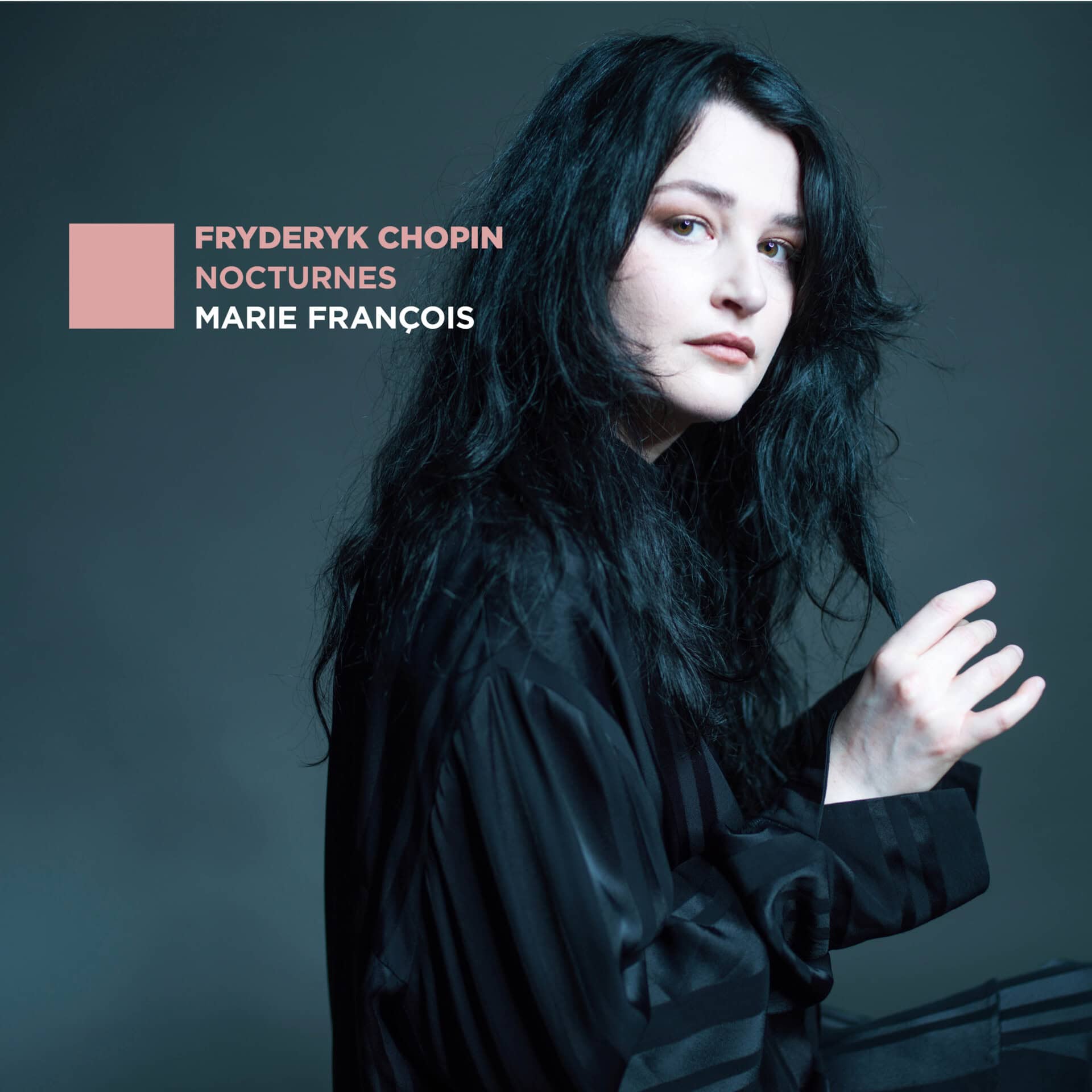

One of the challenges a pianist faces with this Chopin masterwork is choosing the right instrument. A Steinway, a Hoffmann, Kawai, or a vintage Erard? Which piano can do justice to Chopin? Belgian pianist Marie François has found an answer.
Chopin (1810-1849) worked on his 21 Nocturnes from his teenage years until three years before his death, and during that time the piano underwent rapid technical development. The range expanded to seven octaves, felt replaced the leather on the hammers, two pedals were added, and it became possible to play fast note repetitions. All developments that Chopin eagerly incorporated into his compositions. And every piano maker has a preference for a certain compositional style. That's why countless pianists performing these Nocturnes split their choice dilemma in two and opted for a (French) Pleyel or Erard from the mid-19th century.
Belgian pianist Marie François has chosen the Yamaha CFX—perhaps not the obvious choice, but tuned in such a way that the bass doesn't dominate and the high registers sound clear yet full. This is necessary to give the melodic lines of the right hand space and prevent them from being overshadowed by an overly assertive left hand. John Field, who developed the nocturne genre, had an ear for Bellini's bel canto repertoire, and when there's singing involved, it should be robust—ideally deep into the night. Lyrical and sparkling is apparently also the leitmotif of this double album. These qualities really shine in Nocturne no. 8 (Op. 27, no. 2), where François manages to control the dynamics and phrasing so well that finesse and lyricism remain in perfect balance. The same applies to Nocturne No. 18 (Op. 62, no. 2), François's favorite piece—darker in color and moving slowly toward the dead of night. Marie François plays these Nocturnes with both sultry warmth and playfulness, both expressively and sensitively, yet never sentimentally. In her hands, it's a clear night under a glittering starry sky.