

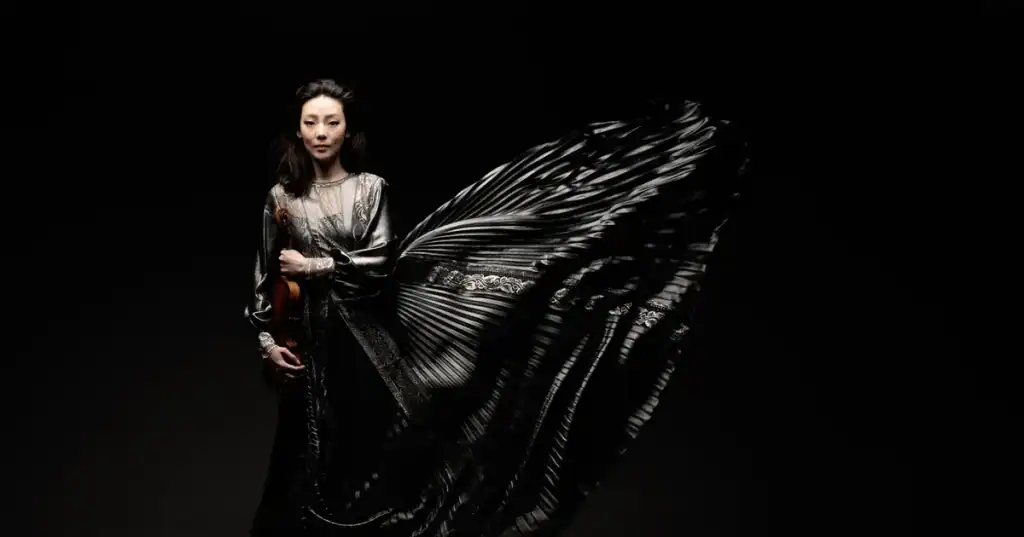
Andrew Manze and the Antwerp Symphony Orchestra explore the poetry of resilience
Sometimes it happens that a concert lifts time for a moment. That a hall breathes together, as if everyone recognizes themselves in one beating heart. Such an evening was granted to us by the Antwerp Symphony Orchestra, led by Andrew Manze, on Saturday, October 25 in the Koningin Elisabethzaal with a program that unfolded as a journey through a landscape of human experiences: Hillborg's inscrutable breath, Sibelius' northern passion, and Vaughan Williams' moral shadow – three worlds, three truths, one breath.The sea of Hillborg
King Tide by Anders Hillborg (°1954) is not music in the classical sense; it is an atmospheric ritual. Sound that rises from nothing and fades again, like light breaking on ice. Manze drew this with gossamer lines: strings that trembled, woodwinds that glided like northern winds, brass that rose for a moment like a swelling wave. The composition lasted about a quarter hour and developed in a slow buildup of texture and timbre, with subtle rhythmic motifs returning repeatedly and the orchestra held in a constant breath. The music had something sacred about it, a rest that carried unrest within it. The sounds moved slowly, almost hesitantly, as if searching for a beginning that never came. And yet: the structure was crystal clear, the orchestra breathed as one organism. It was precisely in that tension between movement and stillness that the beauty of King Tide lay — a sea that did not churn, but waited. Here silence was not broken, but deepened.Hillborg's world is that of the sublime: fragile, but inescapable. As a listener you felt yourself not facing the music, but within it – absorbed in a slow undulation of light and shadow. A gate that flowed open toward what came next: the shimmering soul of the north. This ritualistic character of the music made it an ideal prelude to Sibelius' sound world, and for my part, his violin concerto could even have followed attacca here.
The voice of the polar light
[caption id="attachment_47407" align="alignleft" width="200"]
 Clara Jumi Kang Photo: Marco Borggreve[/caption]
The young Clara-Jumi Kang took the stage with the composure of someone who no longer needs to prove anything and enchanted us with Jean Sibelius' Violin Concerto (1865-1957). Her Stradivarius "Thunis" breathed not as an instrument, but as a living voice of ice and fire. From the first measures, magic prevailed. Kang wove the opening like a memory: slowly building, fragile, soft, almost hesitant, with a tone that both glimmered and glowed. Her sound had something of northern light – cool at the edges, warm at the heart. Her technical mastery was evident in her controlled vibrato and precise intonation, especially in the cadenza, where she seamlessly combined complexity and lyricism.
The first movement flowed like an inner journey. Every phrase was thoughtful, but never calculated. She played as if she were discovering the music at that very moment, as if the notes had never existed before her touch. Manze and the orchestra followed her with rare empathy – a dialogue of breath, of trust. In the Adagio di molto the evening found its soul. Kang played as if she were slowing time itself. Her tone hung in the air like a bird refusing to descend. There was sorrow in it, yes – but also reconciliation, a deep knowing that beauty and pain are inseparable. Her phrasing had something timeless about it; the violin seemed to remind us of what words forget. The orchestral undercurrent was tender, like a landscape under snow. In the finale the ice broke: a wild dance across a frozen lake brought liberation without bravura, rhythmically sharp, but never aggressive. Kang played with the joy of someone who forgets herself. Sparks flew from her bow, but never to impress, with a smile that said more than triumph. The applause came not as release, but as gratitude.
The silence after civilization
Where Hillborg opens silence and Sibelius animates it, Ralph Vaughan Williams (1872-1958) explores what remains when silence conceals nothing more. His Sixth Symphony in e minor, written between 1944 and 1947, is born from the rubble of Europe. It is not a war symphony, though war sounds in every fiber. Written in the immediate aftermath of WWII, the symphony shows a composer who transforms his own uncertainty and the torn world around him into musical reflection. The composer himself denied the programmatic reading ("It's just music"), but rarely has music sounded so permeated with human shadow and notes spoken of a world that no longer trusts itself.
The first movement is a whirlwind – dissonant, nervous, inescapable. The orchestra played as if the earth itself were cracking. The brass section cut through the air, the percussion hammered like the heartbeat of a world that has lost its rhythm. It is music that breathes in spasms, restless and human. Manze did not give this music the hardness of steel, but the fragility of skin: every stroke had something desperately alive about it. And yet there was never brutality in his interpretation – only intensity. He gave form to chaos, structure to despair. His approach brought refinement and nuance to the characteristic dissonances of Vaughan Williams.
In the Moderato, a kind of procession without faith resonated. The struggle became a mechanically sounding march, threatening but not loud as if humanity was merely an echo of itself. The drum rolled, the woodwinds cradled a melody that refused to comfort. It was as if Vaughan Williams painted humanity as survivor, not as hero. The Scherzo brought cynical energy – rhythmic, grating, almost dance-like. A jazz fragment emerged, the tenor saxophone grinned between the brass: irony amid the rubble. The dance of a civilization on the brink of the abyss that still smiles for a moment before it falls. But it is the Epilogue that makes the work eternal. Vaughan Williams wrote this finale in pianissimo. Moderato, whispering, weightless. A world after sound. No epilogue as an ending, but as fading away. Vaughan Williams wrote it "without color, without direction", without climax even. The music floated, dissolved, refused to end. You could call it a musical nothing, but what a nothing! Here humanity returned to dust, and music to breath. Manze let that silence grow into an almost unbearable tension. You heard no final chord, but breath slowly disappearing. The sounds faded until they dissolved into space. The last notes hung in the Elisabethzaal like dust particles in sunlight – tangible, yet elusive. It was an experience that both moved the listener and made them reflect on the transience of beauty and hope.
Silence. Was it a collective bewilderment after such a gripping performance? For rarely do you hear an orchestra that has the courage to speak so quietly. The finale brought us to the core of our humanity: do we really want to improve our lives, or does it remain mere good intentions? Manze delivered sublime work: he transformed the Antwerp Symphony Orchestra into an ensemble with an almost British sound – transparent, precise, and deeply felt. Under his direction, the orchestra embraced Vaughan Williams' intractable language with conviction and poetry. Hopefully, this evening marks the beginning of a lasting dialogue between Manze, the orchestra, and this composer, for this performance unmistakably left one wanting more.
Epilogue
What made this evening great was not virtuosity, but authenticity. Hillborg showed the birth of sound, Sibelius the longing of the soul, Vaughan Williams the end of hope – and yet: between these three worlds something new emerged, something beyond words. Clara-Jumi Kang gave shape to beauty without limits, Andrew Manze to discipline that inspires, and the Antwerp Symphony Orchestra to the rare art of breathing together. Some concerts disappear as memory. Others linger like a slow echo in time. This was such an evening – a moment when music did not merely sound, but breathed. From silence to storm, and back again.

