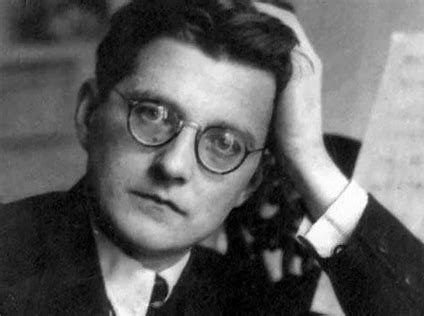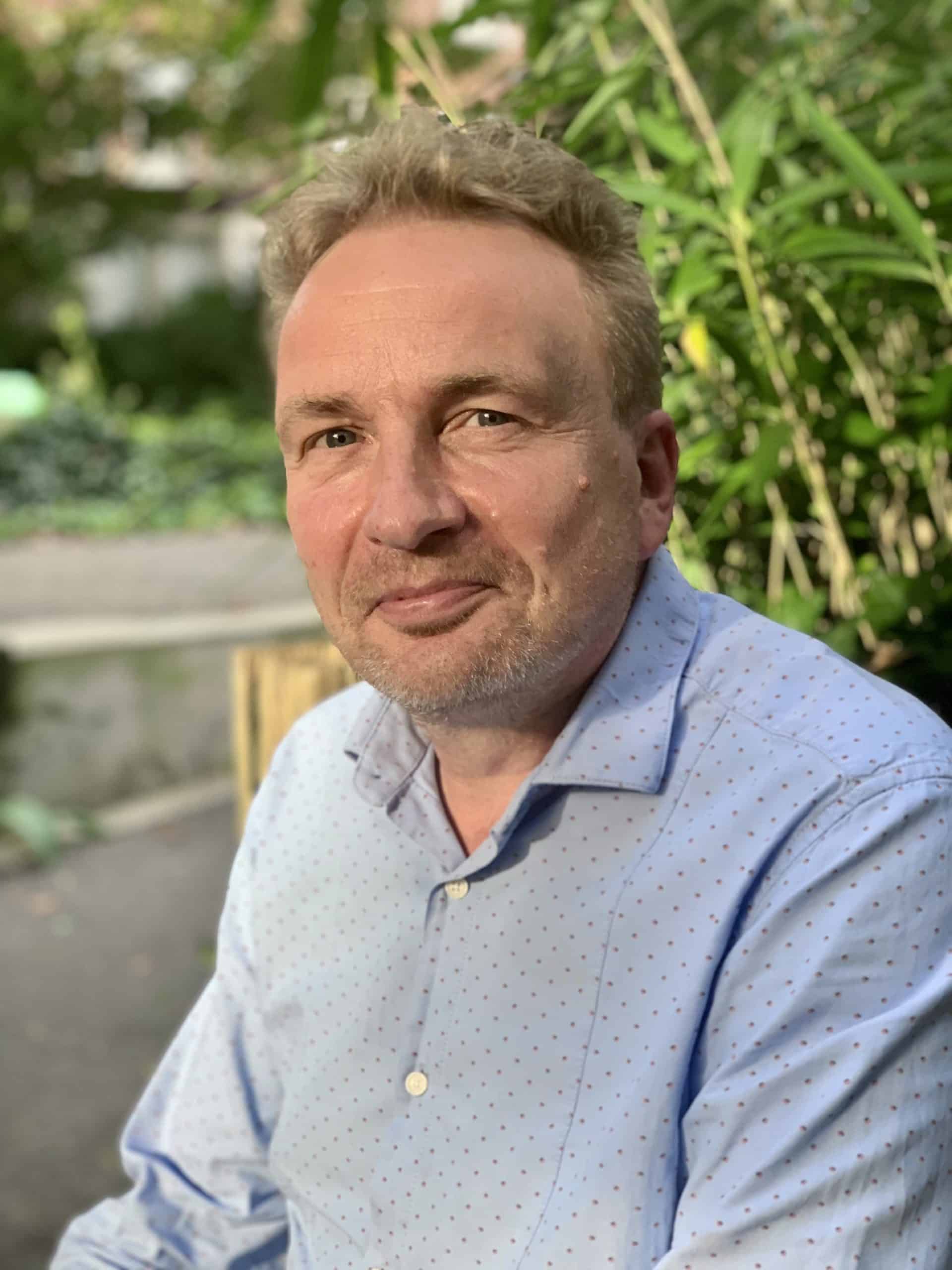
Dmitri Shostakovich (1906 – 1975) is a richly layered, fascinating composer. He lived and worked in structural uncertainty, struggled with mixed and unpredictable reactions from audiences and authorities, but remained in Russia against all odds. And above all, he was a people person with a warm family and inspiring friendships. Festival 20·21, which starts on Monday 27 September in Leuven, dedicates a themed day to the friendship between Shostakovich and his British colleague Benjamin Britten, who understood each other only in the language of music. A conversation with Pieter Bergé (54), artistic director of the festival.
Bergé: "Shostakovich is fascinating in several ways. The first way actually has little to do with his music. He was an artist who lived and survived in extremely ungrateful circumstances, namely the communist regime in the Soviet Union. That guaranteed total uncertainty about where your artworks would take you, towards fame or towards ruin. That tension between the artistic, political and social dimension is very fascinating. Moreover, there is of course the very charged reception history of Shostakovich as a person. Until his death in 1975, he was regarded worldwide as an adherent of the communist regime. Then in 1979 there was the famous book by Solomon Volkov, Testimony, in which that image is completely turned around and in which Shostakovich suddenly appears as the great secret dissident of the communist regime. What is particularly disturbing is the discussion that followed, a textbook example of polarization. On the one hand, a group of musicologists advocated a revisionist view ("Shostakovich was a dissident"), but others on the other hand fiercely defended an anti-revisionist view ("Shostakovich was indeed an adherent of communism"). Remarkable, and also rather disturbing, is that this entire polemics consists of an improbable mixture of arguments and emotions. There are so many errors, lies, false rhetoric, false arguments and so on in it that you cannot remain indifferent to it. The historical discipline as such is shaken to its very foundations here.
And then of course there is the music itself. My appreciation of Shostakovich's music is itself also very polarized. Some works, such as the last symphonies and chamber music, I find truly incomparable; others, such as the opening section of the famous Leningrad Symphony, I find utterly unbearable. There are few composers for whom I myself experience such a wide range in personal appreciation."
It remains striking that Shostakovich chose to stay in the Soviet Union at all costs, while many of his colleagues emigrated. What consequences did that decision have for his compositional career?
"It cannot be denied that within twentieth-century Russian culture there was no composer who had as great an impact as Shostakovich. He is also one of the few Russian composers who chose to spend his entire career in the Soviet Union, which in itself is intriguing. Because why would someone want to stay in a culture that frequently discredited and endangered him? Where does that attachment come from? In itself it is also remarkable that Shostakovich managed to develop so enormously as a composer within all those constraints. To make that possible, Shostakovich did make continuous efforts to stay as much as possible under the radar, although that was not always possible. For an artist it was also particularly difficult to assess what was allowed and what was not. There was not always an easy line to draw in what the regime approved or disapproved of. There was a kind of arbitrariness in it. But that arbitrariness is of course an enormous instrument of power; as long as you don't know what you're doing wrong, it's difficult to be creative. An element that plays into that context, and is also very fascinating, is Shostakovich's use of irony and quotations. I personally enjoy that very much, especially when that irony is refined. That quiet, sneaky but oh so painful little laugh."
In your view, is Shostakovich now a martyr or a pragmatist who tried to make the best of it?
"The last thing I want to do is join in that polarization. Polarization rarely leads to nuanced insights. What the whole controversy in my view also fails to take sufficiently into account is the elementary humanity of a figure like Shostakovich. He was a man who did not put himself on a pedestal at all, a family man, concerned about his children, concerned about his family, not at all keen on great success. He was actually shy of the public. That is that human aspect, in which that artistic element nestles. That same artistic element that of course stems from certain moral values that were considerably abused in the Soviet Union in which he lived. And then it is always that balancing act of: how can you defend your values? Through music, certainly also through the use of text, in a way that actually transcends the concrete situation. So that you can still be somewhat protected from the suspicion that you are criticizing the regime itself. Because let's not be naive about this: explicit criticism of the regime at that time was suicide. It actually takes a lot of courage to give indirect criticism. That criticism is certainly there, and sometimes Shostakovich goes remarkably far in it, especially in the works in which text is used."
That is also addressed in your festival essay 'The Lies and the Cackle'. Does the true Shostakovich only emerge when the decree on the assessment of composers is abolished in 1958?
"In that regard, I find the quote with which I conclude my essay tremendously moving. When that decree is proclaimed, Shostakovich invites the Rostropovich couple for a hearty drink to celebrate the recovered cultural freedom. Galina Vishnevskaya, Rostropovich's wife, describes in her autobiography how the composer nervously paced around the whole time, occasionally sitting down at the piano and then beginning to sing the dogmas of Stalinist cultural policy to some silly melody. She describes Shostakovich as a closed volcano that could erupt at any moment. From this and many other testimonies, his continuous sadness also becomes apparent, a weariness and even a certain reluctance to live life to the end."
The theme day on October 10 focuses on late Shostakovich. Why?
"There are two elements. The first element is that I really love those later works because they often have an emaciated character. He shows an enormous ability to go very deep with few notes. The late string quartets are perhaps the most extreme examples of this, with all those slow movements, few notes, long tones. I find that very moving and stilling. A second element is that I wanted to zoom in on this theme to focus on the friendship between Shostakovich and Benjamin Britten. That friendship only begins to develop in the 1960s, so you're talking about the late work of both Britten and Shostakovich anyway. I find that friendship intriguing. Perhaps it has to do with certain affinities. Both composers spent their entire lives searching for a musical language in which they could maintain contact with the public and yet be innovative. In the twentieth century, with its sometimes scorching modernism, that was not always self-evident. These two composers kept searching for a musical language that was original on the one hand, but not alienating on the other."
The friendship between Beethoven and Haydn is often regarded as opportunistic. What does the friendship between Shostakovich and Britten stand for?
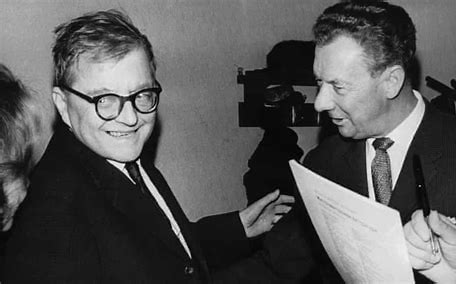
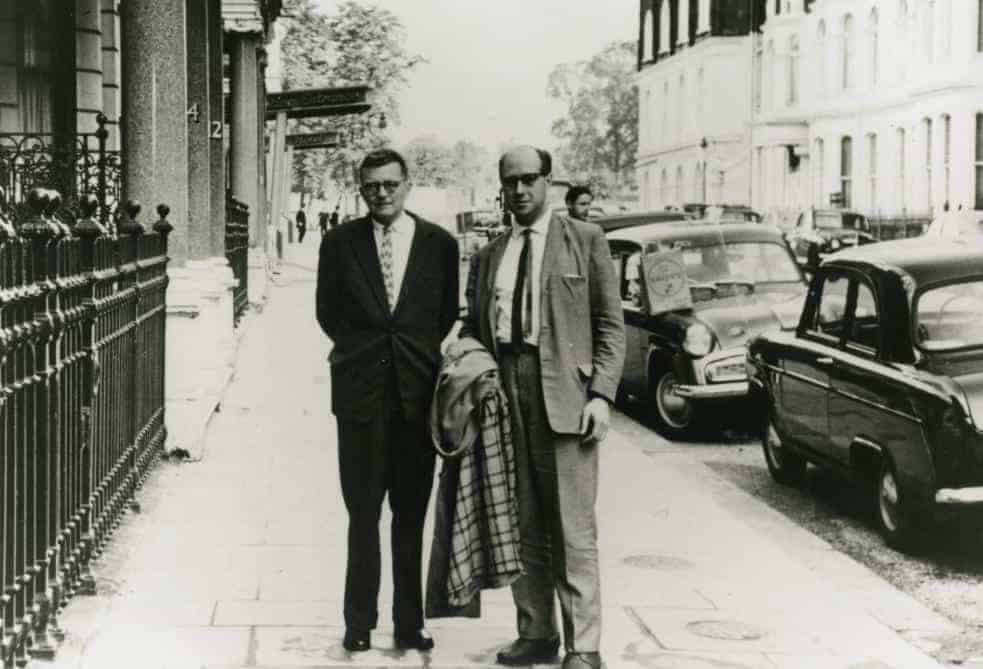
"Britten spoke no Russian and Shostakovich knew not a word of English. So they couldn't converse with each other. Hence the title of the theme day: friendship without words. The friendship must have been a kind of intuitive friendship, thus through music. A beautiful role is played here by the artist couple Rostropovich-Vishnevskaya, the cellist, pianist, conductor and the great soprano, who, unlike Shostakovich, had a great international career, also in the West. They served as interpreters between Britten and Shostakovich. But still it was mainly about the music. For example, Shostakovich greatly admired Britten's War Requiem. That work haunted him to the end of his life and clearly also inspired him for the Fourteenth Symphony. That symphony (which is actually more of a song cycle) is a cross-pollination between Das Lied von der Erde, the War Requiem and Shostakovich himself. Death is the central theme and the work is dedicated to Britten. That does mean something."
I'm looking forward to the Eighth String Quartet. Why is that quartet called autobiographical?
"The Eighth String Quartet is included in the program in a concert that actually revolves around the Third String Quartet by Schnittke, also a Russian who is often seen as a kind of heir to Shostakovich. That third quartet begins with a threefold quotation: one from Stabat Mater by Lassus, one from the Grosse Fuge by Beethoven and finally the famous D-S-C-H motif (the letters represent note names) that Shostakovich used frequently but nowhere as exhaustively as in his eighth quartet. In that concert (on October 20) we first present those three pieces and then Schnittke. This way we present to the audience the material with which Schnittke subsequently works in his own piece. The fact that Schnittke uses that D-S-C-H motif is of course no accident. He places himself in a tradition thereby. But it is indeed true that Shostakovich's Eighth String Quartet is known as autobiographical. Shostakovich himself gave reason for this. He wrote the piece during a period when he was crushed under the pressure to join the communist party, which resulted in him falling into a deplorable psychological state. According to some sources, he seriously considered ending his life at that time. In that context, that string quartet came about. Friends suggest that he said he had written an in memoriam for himself, since he assumed that no one else would do it for him. But officially the quartet is dedicated to the victims of fascism and war. In a sense, he was one himself, of course."
In your essay you call 'Rayok' a farce. Should we take it seriously anyway?
"As a work of art, you have to put that piece in perspective, of course. It is not great music and it is certainly not a great text. And it does come across as a farce. It is at times even almost amateurish. But the reason I have paid so much attention to it is because it is one of the few documents in which Shostakovich himself explicitly speaks about his vision of Soviet cultural policy. I actually don't understand why the work isn't better known, not so much as a musical piece but as an egodocument. He spent a total of 20 years working on it, with long breaks of course. So the work haunted him in one way or another. If it was a regurgitation, it was at least a recurring one. Even though the tone of the work is of course very light, the implications of writing such a work at that time and risking that it would come to light were gigantic, especially in 1948. The difficulty with performing that work lies in the great distance we have from that specific period and that context. Au fond, Rajok is a thoroughly tragic piece. The tragedy lies in the impossibility of a composer to be who he as a composer would want to be, coupled with the refusal to escape that situation. Shostakovich had multiple opportunities to leave the Soviet Union. He chose, as it were, a 'voluntary' captivity and ways to survive in it without being completely silenced. That makes that music, in all its humor and lightness, ultimately very tragic."
Now regarding the organization of the festival. What limitations did you have to take into account?
"The main limitation we face is the absence of decent concert halls. That causes a lot of complications, but also excludes certain repertoires, especially for large ensembles. The fact that we can now bring Shostakovich's Fourteenth Symphony has everything to do with the fact that Shostakovich only uses strings and percussion in it. That limitation also stimulates creativity, of course. In recent years, for example, we have paid a great deal of attention to the culture of arrangements in the classical music tradition. Arrangements have existed for a long time and often aim to enable music for larger ensembles to be performed in more modest contexts. This year, for example, the Alban Berg Ensemble Wien will play arrangements of major works by Mahler, Strauss and Schönberg. And Liebrecht Vanbeckevoort and Severin von Eckardstein are bringing Honegger's Symphonie Liturgique, in an arrangement for two pianos by ... Shostakovich! But anyway, we don't work from limitation, of course, rather from abundance. For the festival, it is important that year after year we can present twentieth-century music in an incredible diversity. In doing so, we want to continue to challenge the idea that twentieth-century music is by definition difficult, inaccessible and elitist. That is really the driving force: to open up as much music as possible while creating the most favorable context each time for that music to be fully absorbed. That is also why we attach so much importance to the structure and framework of our concerts. On the theme day, for example, each piece is introduced by a very short documentary film that places the work in its original setting and thus takes the listener into the historical and cultural context. That has an enormous, almost always positive impact on the intensity of the listener's experience. In the future, we want to invest even more in this. Festival 20.21 is constantly seeking to deepen. Our first concern is not to have more audience, but to involve our audience even more intensely with that music. I myself also don't believe in the ubiquitous dogma of 'growth'. Growth should not be a starting point, but rather the result of a consistent and rigorous artistic vision. Just like Britten and Shostakovich, Festival 20.21 has an ongoing concern for the audience. That concern is not aimed at confirming the known, but rather at bringing the unknown closer to the audience. We want an audience of discoverers. That is our reason for being."
- WHAT: Festival 20.21
- WHERE: Leuven, 27 September to 28 October in various venues
- TICKETS AND INFO: www.festival2021.be
- THEME DAY: Shostakovich and Britten, Sunday 10 October, Stadsschouwburg/30CC, 11h00-20h00
- ESSAY: Pieter Bergé, The Lies and the Laugh – Shostakovich's Secret Stalin Satire, Sterck & De Vreese, € 19,95 Essay presentation and concert: Tuesday 12 October, 20h30, Campus Lemmens
- PHOTOS: The Guardian, Wynold Verweij