

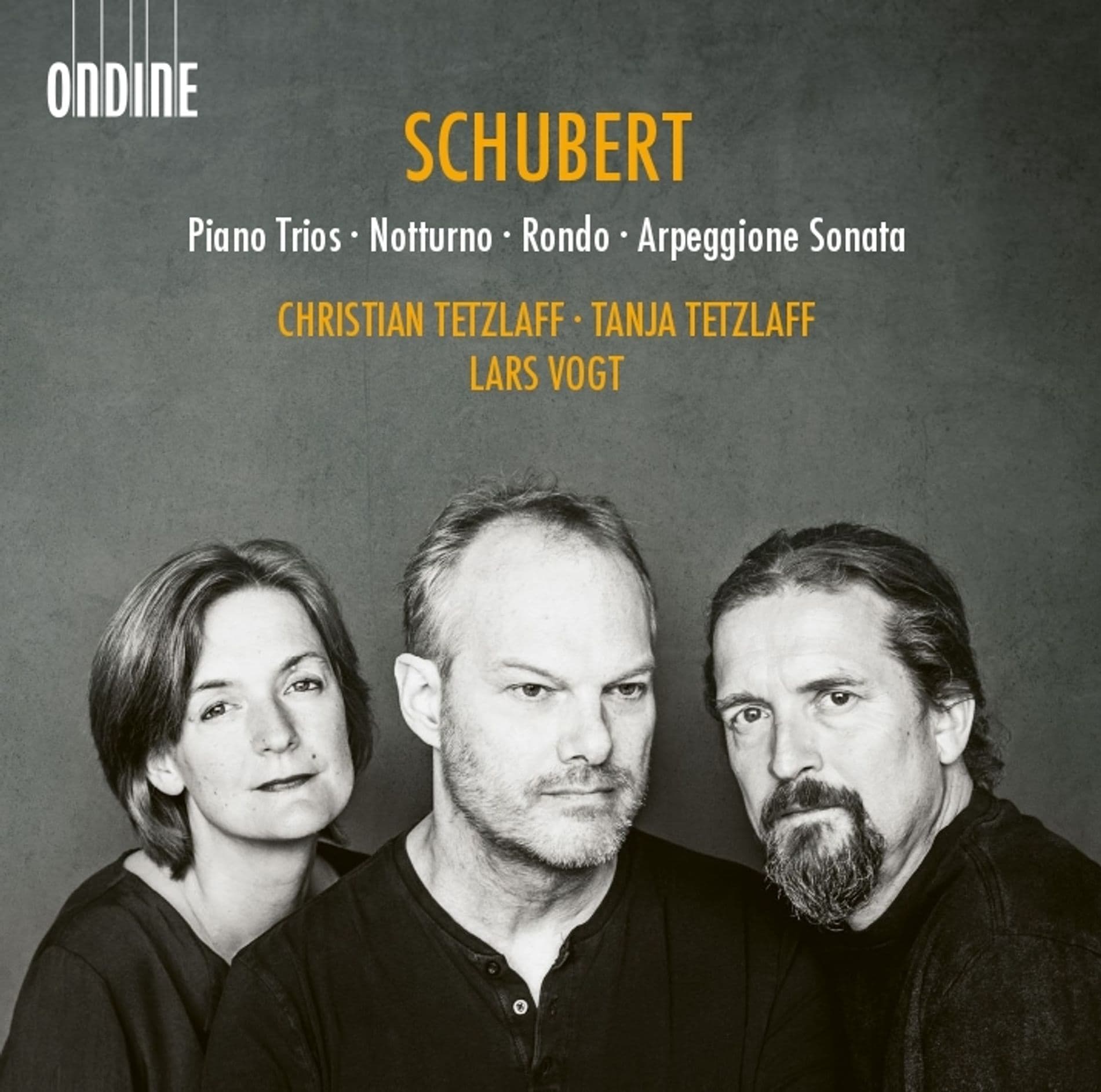
Schubert: Piano Trio No. 1 in B flat, D 898 - No. 2 in E flat, D 929 - Notturno D 897 - Rondo brilliant D 895 - Sonata in A, D 821 (Arpeggione)Lars Vogt (piano), Christian Tetzlaff (violin), Tanja Tetzlaff (cello)
Ondine ODE 1394 • 2.16' • (2 CDs)
Recording: 21-25 Feb. 2021 (Piano Trio No. 2, Notturno, Rondo, Arpeggione); 10-11 June 2021 (Piano Trio No. 1), Sendesaal Bremen
A shock went through the music world when, in early September, the news came that Lars Vogt had died on 5 September 2022, just three days before his fifty-second birthday, in his home town of Erlangen. He had been suffering from cancer for some time, having been diagnosed in early 2020, but nevertheless remained optimistic and continued to perform until shortly before his death, despite undergoing intensive chemotherapy.
His career really took off after winning second prize at the Leeds International Piano Competition in 1990. Twenty-eight years later, he would himself be part of the jury. There was no leading orchestra that didn't want to have him in the years following that prestigious prize: the list is long, from the New York Philharmonic and London Symphony to the Concertgebouworkest and the Wiener Philharmoniker, from the Chicago, San Francisco and Boston Symphony to the Berliner Philharmoniker (where he was the first 'pianist-in-residence' in 2003) and in Leipzig the Gewandhausorchester.
His repertoire was broad, ranging from the Vienna Classics to modern and contemporary works. His great fondness for the music of Brahms took on legendary proportions over time. On
you can find an eloquent example of this.
Lars Vogt in 2013 (photo Thomas Brill)
Lars was not only a celebrated concert pianist, but also a beloved chamber musician. Who wouldn't actually want to work with him? The world's top musicians easily found him in this field as well. Names included Christian and Tanja Tetzlaff (with whom Lars undertook an extensive tour in the U.S.), Daniel Hope, Tabea Zimmermann, Kim Kashkashian, Boris Pergamenschikow, Antje Weithaas, Isabelle Faust, Heinrich Schiff, Sarah Chang, Silke Avenhaus, Antoine Tamestit and Kirill Gerstein.
In 1998, Lars Vogt was at the beginning of Spannungen, with the subtitle Musik im Kraftwerk Heimbach, the annual summer festival focused on chamber music in Heimbach near Cologne, in North Rhine-Westphalia. The concerts take place over a week in a special atmosphere: in a disused hydroelectric power station. The musicians, mostly friends and colleagues of Lars, came at his invitation to Heimbach to make music with him and others. Many concerts were recorded live and broadcast by Deutschlandfunk or later released on CD by the music label Avi.
It was also in Heimbach where Lars performed for the last time in June 2022, here on
, with Brahms' Intermezzo op. 117 No. 1, with in the printed score the first two lines, which he announces himself, of an anonymous Scottish ballad: Schlaf sanft mein Kind, schlaf sanft und schön! Mich dauert's sehr, dich weinen seh'n, taken from 'Lady Anne Bothwell's Lament', translated into German by Johann Gottfried Herder.
Heimbach, June 2022: The last solo performance
But Lars looked beyond the concert stage and the recording studio. In 2005, he founded Rhapsody in School, an extensive education project focused on classical music and jazz, aimed at bringing professional musicians into contact with a young, school-age generation and stimulating them in their musical development and, when talent was evident, supporting them further. The project started under the motto 'Eine künstlerische Gesellschaft ist eine lösungsfähige Gesellschaft'.
His appointment in 2013 as a teacher at the conservatory in Hannover (where he had once studied himself) did not prevent a significant expansion of his musical activities: alongside his many solo performances and concerts, he found sufficient space for what would gradually become an important branch of his musicianship: conducting, as chief conductor (first of Royal Northern Sinfonia, from 2015 to 2020, and from 2020 of the Orchestre de Chambre de Paris, with the appearance in March 2022 of the CD with both piano concertos and Mendelssohn's Capriccio brilliant on the Ondine label), but also as a much sought-after guest conductor.
As recently as May 2022, Lars Vogt performed in the Netherlands, at TivoliVredenburg and the Muziekgebouw in Amsterdam, with, among other things, Beethoven's Hammerklavier Sonata and Janácek's Piano Sonata 1.X.1905.
Now this recording of Schubert's Piano Trios, made in the Sendesaal in Bremen in the period 21-25 February and 10-12 June 2021, about which I can do no better than to let the cellist Tanja (TT) and violist Christian Tetzlaff (CT) speak, recorded in German by Frederike Westerhaus:
Tanja and Christian Tetzlaff in conversation about their close friend and long-time chamber music partner Lars Vogt and about Schubert's music.
Tanja (TT): Lars wrote in our trio chat when he had listened to this recording: "Now I'm diving into the miracle too. It feels a bit like everything, at least in my life, has been building up to this E flat major Trio."
There was always this repeated thing from him: 'Now we've done that, recorded these trios, now I could also leave'. And I find that you can hear in the recording that deep down he already knew that he would most likely not manage to live much longer.
Christian (CT): The recording was shortly before the diagnosis. But after every session he lay on the sofa and his stomach hurt incredibly. And he knew that something catastrophic had happened. When he mentions this piece, it goes without saying that it deals very clearly with farewell and death, quite differently from the B-flat major trio.
TT: But also independently of that – whenever we played music, for him it was always about life and death. Especially with Schubert, he frequently addressed this abyss and the perception that even the beautiful moments are often aware of finitude. That it became so pointed that we happened to play these pieces at this particular time is somehow eerie and intense, but it fits Lars, who was also so melodramatic and extreme in his life. And that's how extremely he went into this last year.
CT: It may sound pathetic, but I always said about the first movement of the E-flat major trio: these are almost all melodies in pianissimo and actually you shouldn't really sing them anymore, but rather hum them to yourself or remember them. Like Hansel and Gretel in the great forest, because the fortissimo outbursts all around are like a huge forest or a mountain range, frightening and terrible. And then the two of them run through there and hum to themselves so they don't get too scared. These are often the two strings together, and that's why it all becomes somewhat too symbolic, but it corresponds to what music has always meant to me. To sing in the face of terror and to imagine beautiful things so that you can accept the whole thing anyway.
TT: And now only Hansel and Gretel are left.
CT: And the forest.
TT: And Lars always emphasized very strongly how it is with Schubert: that even the major or what is actually beautiful is suffused with incredible pain or becomes exaggerated in triple fortissimo and is no longer beautiful. In the E-flat major trio there is hardly anything truly carefree.
CT: The first part of the Scherzo is actually quite friendly. And the theme of the last movement has something worldly about it.
TT: But even if that's the case briefly, it is very quickly put back into perspective with the abyss and the knowledge of finitude.
CT: And in this last movement also with an absurd wildness. We also play the crossed-out part where all the themes of the piece are layered on top of each other. That's like a universe, storm, mountains, forest, everything at once. The ending is extremely affirmative, in triple fortissimo, so you might even think of Shostakovich, who says: 'I must be glad'. The slow movement, the Andante, is in C minor, and there are fortissimo passages in C major that are really dreadful. Triple fortissimo with an eternally long crescendo. You don't find that even in Beethoven. Here things are sawn and smashed, even though it's in major.
TT: That's not singing, but screaming in the greatest pain. With Lars it was also always so crazy that you could rehearse in the most serious way and talk about really terrible things, and five minutes later it was about fooling around, getting excited about a football goal or re-enacting a scene from a comedy. And I find that so fitting for all these Schubert works too: you fall from the most terrible thing and suddenly you're back in 'Oh, there are still very funny and beautiful things', and then it can quickly tip over again.
CT: You also have to keep in mind that Schubert approaches Beethoven in the E-flat major trio. The first movement is in three-four time like Beethoven's "Eroica", the slow movement is a funeral march in C minor. That is clearly the heroic funeral in the "Eroica", and there are quotations from it throughout. The courage of Schubert, that he approaches Beethoven in this way, but creates something quite his own. The slow movement of the E-flat major trio has as its theme a Swedish song about a girl who has been abandoned. And it's not just about heartbreak, but about the loss of everything. The loss of everything is what I feel so often now when I think of Lars. The final, painful loss. And it's remarkable how Schubert has driven this in a piano trio, something one might expect from a requiem.
After these Schubert trios you really consume yourself as a piano trio because of their design, their versatility and what each instrument has to play. The dynamic excess has always played a major role for us three. And Schubert is someone who prescribes to us long diminuendi from ppp and long crescendi to fff. That is something that Lars can do inimitably on the piano, and we also try very hard. And what Lars conjures up in this E-flat major trio purely from a technical point of view, I hadn't experienced from him before. I think he was also proud to see how he had developed as a pianist to be able to execute it. Because most of it is practically impossible to execute in these pieces.
TT: I believe this development in Lars also had to do with the fact that he used to constantly think: 'How do I play this correctly and perfectly'. He said that himself quite often. And that increasingly fades into the background – it's the same for all of us. You can rely on certain things. But whether it's now executed technically perfectly is no longer the question; rather it's about what I want to express with it. That makes such pieces so much easier. I also noticed that with Lars when we played the Arpeggione sonata together. During my studies I was completely preoccupied with how technically difficult it is. And that simply wasn't present anymore. It was really only about the statement. You could play it quite sensationally, but for us together it was a tender narrative. There's a moment where you briefly shudder. That's inimitable from Lars; you get goosebumps. And through this narrative quality, everything also becomes technically much easier to manage. The trios are partly written in a technically ghastly way for all three instruments. But not for a single moment is it about that. It's never superficial. And that's perhaps why we love Schubert so particularly, because it's only about the content.
CT: And even the reverse – it's also part of the expression that there's such a struggle with the instrument and with the material, both into the introspective and into what's carried completely outward. The runs in the last movement of the E-flat major trio are quite hair-raising and precisely through that they become expression.
In this past year we had many concerts where we were practically at dissolution, because we partly anticipated the farewell. Brutally put, it's what composers often share with us – at least the great ones who dare – to encounter these limit situations already in life. With Brahms it's often the element of comfort: 'I know of all this pain, but I want to console you, as a mother consoles you'. As he set it to music in the Requiem. With Schubert the comfort factor is less than the overwhelming, looking things in the eye. But that too is something that's simply important in order to live life more deeply. Closing your eyes won't give you the joy of life that you experience by looking at what you can lose.
TT: And with no one else could you immerse yourself in everything better than with Lars and Christian. That related very much to the musical work and the concerts. I rarely experienced being so shaken myself by what one has just expressed. But that was also the case in real life with the three of us. There were actually no secrets, there were no boundaries to how we could talk about things. We shared everything, all the depths and all the heights. And in that sense, the step of immersing ourselves completely in the music and facing the abyss was quite natural.
CT: And what is a piano trio without a piano... After he had finished listening to the E-flat major trio, Lars wrote in our chat: "I'm near tears. 2nd movement cried through. And the 3rd just as 'bad'. I love you.
We recorded the B-flat major trio later. By then he had already been through several weeks of chemotherapy, and it worked fantastically at first. We thought: 'Hey, he's fighting, and it might come off'. When I say we, that also includes our sound engineer Christoph Franke. He's always the fourth in the group, an essential part. The trust and the freedom to make music this way are also connected to the fact that he's by our side.
TT: And our shared attitude was: 'Now the diagnosis is there, it's serious, but now we'll just keep living'. And Lars did that in an incredible way until the end. He simply lived in the moment, and as long as it was at all possible, always with hope, even though of course he suffered extremely the whole time. Until two weeks before his death, he kept giving all of us this hope over and over again. For me, the 1st movement of the B-flat major trio is something incredibly joyful, positive, bubbling over. And that somehow fit the situation: 'Now let's just make it nice for ourselves for a bit'.
CT: The second movement is actually a lullaby. The last movement is even somewhat coquettish. The two trios emerged in the same period, and Schubert apparently tried to depict two completely different sides. The Notturno, which also emerged at the same time, is structured completely differently because it's absolutely simple. There's a theme up front, a theme in the back, a middle section, but everything is straightforward, homophonic, barely developed. It's like a different composer. The same applies to the Rondo, also from this period. There you have the virtuosic composer. It's – even though it's in B minor – very cheerful and funny, tender in between, but really quite outward-facing, a real rondo brillant. So Schubert serves completely different aspects at the same time in the two trios, the Notturno and the Rondo.
TT: But when I think about the B-flat major trio as a whole, I don't have the feeling that it's cheerful, light-footed music. The second movement already has a distinct melancholy, also because of the dynamics. Or he deliberately writes very long phrases so that you can't really sing them, very fragile and intimate.
CT: And in the theme, often every note under the slur has an accent. That's then something forced, like someone who stammers when singing. So Schubert doesn't make it easy for us.
TT: And then Lars comes with this infinite tenderness in this little piano accompaniment. I already miss that so much. This aspect of incredible tenderness toward people and toward music – that's already incredibly painful.
CT: Of course, that also comes from your familiarity with him, which makes it feel even more like this.
TT: The comfort aspect of such piano accompaniment – it's wonderful that we now have the chance to listen to it again at some point. Right now I don't dare to. And to remember all the incredible moments on stage and in the living room. It's simply wonderful that there was no showing off on the piano in his life. Nothing. I never experienced Lars playing a note to put himself in the foreground or to show: 'I'm great'.
CT: Yet nothing is easier than playing chords and looking at the audience, making the right head movement, and then everyone says: 'Oh, wow, that's Lars Vogt!' That would have made him uncomfortable. It's actually nice to say it so candidly here. He would probably say, 'You must be crazy, what's all this nonsense, cut it out'.
TT: In our chat, Lars wrote after listening to this Franz Schubert album: "If it's not supposed to last much longer, this is a worthy farewell. You two are amazing. And Christoph especially! And Franz. Incredible. Such expression. Such fragility, such love."
The last interview with the always optimistic Lars Vogt took place shortly before his death, on 12 August 2022. You can watch it
________________
The last recording that Lars Vogt worked on, Brahms' piano quartets, will probably be released this autumn, also on the Ondine label.