

Mendelssohn: Symphony No. 1 in c, op. 11 - No. 2 op. 52 (Lobgesang)* - No. 3 in a, op. 56 (Scottish) - No. 4 in A, op. 90 (Italian) - No. 5 in d, op. 107 (Reformation) - Ein Sommernachtstraum op. 61 (sel.)
Chen Reiss*, Marie Henriette Reinhold*, Katharina Konradi, Sophia Burgos (soprano), Patrick Grahl (tenor)
Zürcher Sing-Akademie, Tonhalle-Orchester Zürich
Conductor: Paavo Järvi
Alpha 1004 • 3.50' • (4 cds)
Recording: March & May 2021, Jan. 2023, Tonhalle Maag & Tonhalle Zürich (symph.)
I find Paavo Järvi a wonderful conductor (and he seems to be a very nice person too), but that doesn't mean everything that comes from his hands is a musical nugget of gold. Recently, for instance, I had some reservations about his Bruckner interpretation, but Mendelssohn's symphonic oeuvre seems to be tailor-made for him. So it can work out that way.
Järvi is principal conductor of the Tonhalle-Orchester Zürich and of course you make recordings with that. In this case, not with the Kammerphilharmonie Bremen, although this Mendelssohn cycle would have been a logical continuation of the Schumann, Beethoven and Brahms cycles that Järvi recorded there. Although it does offer the nearly ideal opportunity to look for tonal differences between the two orchestras, quite apart from ensemble size.
Let us first not lose sight of the fact that the Tonhalle orchestra was shaped by David Zinman down to the finest detail in historically informed performance practice. Like no other, he knew how to convey the principles of this to the traditional symphony orchestra with its 'modern' instruments. He was music director from 1995 until the summer of 2014 (his last concert with the orchestra was at the London Proms). As a native of Rotterdam, I also have warm memories of Zinman as music director of the Rotterdam Philharmonic Orchestra; although that tenure lasted only a short time, from 1979 to 1982. And many will certainly also know him from his connection with the Nederlands Kamerorkest, from 1965 to 1977. And perhaps also from his many recordings he made in the US with the Rochester Philharmonic and the Baltimore Symphony.
But in this review, of course, it's primarily about Paavo Järvi, who took over as principal conductor of the Tonhalle orchestra in 2019 and who can now read and write with this orchestra.
The quality of the orchestral playing, as far as this Mendelssohn is concerned, is without question in the highest category, thereby settling the notion that there could be any such thing as an orchestra of 'orchestra of the year'. After all, there are many orchestras that meet such a qualification and the Tonhalle orchestra is one of them. I'm talking about the quality of ensemble and solo playing, balance, articulation, dynamics, rhythm, phrasing, variation in tone color. These qualities of the Tonhalle orchestra place it in the top category.
The historically informed character manifests itself in the modest use of vibrato (truly employed as an added expressive device), the sharpness of the melodic and harmonic profile, the timpanist's sticks and not least the incisive woodwinds. Many times I even wondered who was ultimately responsible: the conductor or the recording technique (or both...), to give the woodwinds such a prominent role in many passages, which reminded me not only in this respect many times of the conducting art of Otto Klemperer with his then (New) Philharmonia Orchestra.
It is always a difficult balancing act, both for the conductor and for the recording team: the detailing, especially when the overall sound is characterized by clarity. How far should you go so that this detailing doesn't have the opposite effect? It's a 'notorious' problem in, for example, Beethoven's Pastoral Symphony. But well, here that has been solved excellently: the detailing is there, but it doesn't come at the expense of integration.
Mendelssohn did not want to provide metronome marks (perhaps he saw the bad example in those of Beethoven, the composer whom he held in highest regard). The performers must therefore make do with the traditional (Italian) tempo markings. With emphasis on stylistic awareness, based on what we know about performance practice in Leipzig around the 1830s. With Mendelssohn as 'Kapellmeister' of the Gewandhausorchester from 1835 to 1843 and from 1845 to 1847 (from 1843 to 1844 it was Ferdinand Hiller). One must work through much correspondence and accounts from contemporaries to get a somewhat reliable picture.
What we know from that time is that there was a gradual increase in subjectivity, new interpretive freedoms emerged that set themselves against the classical 'conservative' model, also prompted by the fact that music by composers such as Schumann and Wagner did not sit well with that convention, particularly the strict tempo convention. This did not necessarily mean that music was played faster across the board. We know from Schumann that he wanted nothing to do with a performance of Beethoven's Ninth Symphony whose tempi he thought were 'unbegreiflich rasch' and 'für mich so beleidigend, dass ich geradezu fortging.'
On the other hand, composers were well aware that (unmotivated) slowing down of the basic tempo had to be avoided equally, as evidenced by the fairly precise tempo markings in their scores. As with Mendelssohn, with markings such as Allegro non tardante, Adagio non lento, Andante espressivo ma non moto or 'Dieses Stück darf durchaus nicht schleppend gespielt werden' (the Andante from the String Quartet No. 4 in e, op. 44 No. 2).
But anyone looking for unambiguity will still be disappointed. Two listeners noted in connection with the performance of his Elias conducted by Mendelssohn, at the aria 'Ist nicht des Herrn Wort wie ein Feuer' that the tempo was so high that it seemed as if the conductor was 'whipping cream'. While on the other hand participants in the same performance later complained about 'dragged' tempi. Who knows may say so.
A glimpse behind the tempo veil is lifted by conductor Hans von Bülow, who was one of Mendelssohn's pupils for a short time: 'Der Meister hielt vor allem auf strenge Taktobservanz. Kategorisch verbot er jedes nicht vorgeschriebene Ritardando und wollte die vorgeschriebenen Verzögerungen auf das allergeringste Mass beschränkt haben.'
Mendelssohn himself provides some insight into how Liszt filled his role as interpreter in Berlin in 1842: 'Liszt hat ein grosses Stück meiner Hochachtung durch die albernen Possen eingebüsst, die er nicht nur mit dem Publikum (das schadet nichts) sondern mit der Musik selbst treibt. Beethovensche, Bachsche, Händelsche und Webersche Sachen hat er hier so erbärmlich mangelhaft, so unrein und so kenntnisslos gespielt, dass ich sie von mittelmässigen Spielern mit weit mehr Vergnügen gehört hätte; da waren 6 Tacte ausgesetzt, dort 7 ausgelassen, hier falsche Harmonieen genommen, und dann später durch andre falsche in's Gleiche gebracht, dort aus den leisesten Stellen ein grässliches fortissimo gemacht, und was weiss ich noch alle den traurigen Unfug.'
Mendelssohn taking Liszt firmly to task. Not surprising, as his conducting – confirmed by eyewitnesses and also in his correspondence itself – was characterized by 'Partiturtreue', by historical and stylistic authenticity. Mendelssohn – Wagner's resistance to Mendelssohn and his 'school' actually confirms it – stood for 'objective' musicmaking, striving for classical clarity and unity, even but flowing (read: lively) tempi. A classical traditionalist, aimed at the ideal of classical forms and the interpretative clarity flowing from them. Perhaps the Toscanini of his time...
Karl Böhm once said that the right tempo determines half of a good performance, but that immediately raises the question of what that tempo actually is. Nikolaus Harnoncourt has treated this subject exhaustively in his writings, particularly aimed at the period of Mozart in Vienna, but it has led to nothing more than modest guidelines for application in orchestral practice.
The (correct or incorrect) right tempo, it is and remains a difficult subject. But at the same time it is so important because tempo is highly decisive for the aesthetic impression we have of the musical work. To return to Mendelssohn as a performing musician in this context: it must have caused considerable conflict at the time, on the one hand due to Mendelssohn's aspired strictness in tempo (others might perhaps wrongly speak of 'tempo coercion') and on the other hand that other important movement that allowed itself romantically-tinted liberties, including also the desire for what seemed like a permanent legato, for the 'unendliche Melodie'.
But back to Järvi who in my opinion predominantly chooses the right tempi in all five symphonies and in Ein Sommernachtstraum, but saddled me with a question mark in the opening section of the First symphony. For what is the case?
Mendelssohn's tempo marking here is Allegro di molto. That is not an Allegro vivace (slower), but nor is it Presto (faster). Yet Järvi chose a basic tempo in 'overdrive', he pushes quite hard, even in the singing theme. It certainly has spectacular aspects, but seems unnecessarily rushed. With Claudio Abbado (only as an example) articulation and accentuation remain better intact despite the high but slightly lower tempo, the discourse thereby also more balanced. Järvi will undoubtedly have thought carefully about this and chosen it deliberately, for already in the subsequent Andante, structured by the composer in 'loose' sonata form, the tempo is perfectly modeled, perhaps a fraction less profound than in Abbado, but is this a disadvantage? The fugally constructed finale is a true highlight in terms of extremely disciplined orchestral playing.
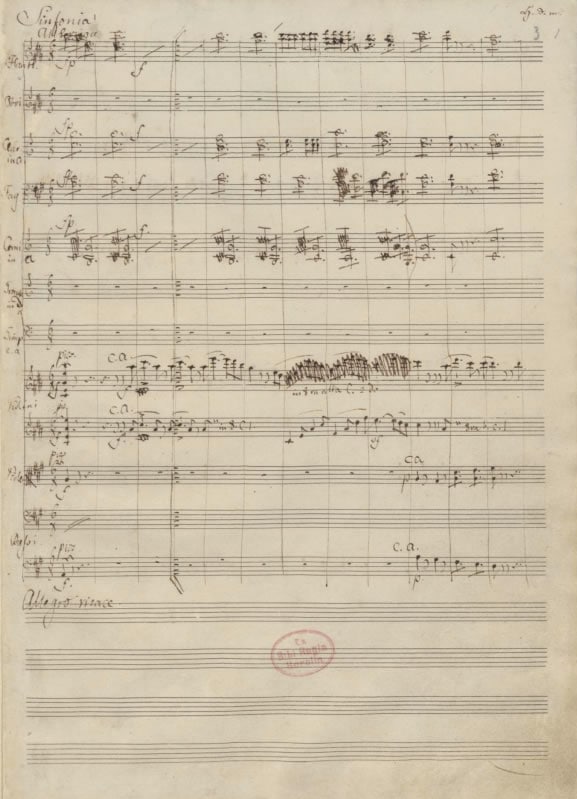
The beginning of the First symphony in the original manuscript
Apart from the one opening section, the performances are exemplary: organic, detailed, clear, not cosmetic, joyful, vital and lyrical, picturesque and without a hint of sentimentality. The tempi are also well chosen and flow within skillfully arched expressive frameworks. The tensions are also well-dosed, as is the expansive power beyond all criticism. The contribution of soloists and choir is as superior as the orchestral playing is.
The 'bonus', a worthy selection from Ein Sommernachtstraum, is also welcome: Järvi and his ensemble present the eight pieces in an extremely colorful manner, again with much attention to detail and which, also thanks to the excellent soloists and the musical ladies' choir, can best be summarized as an event that radiates joie de vivre. The two sopranos Katharina Konradi and Sophia Burgos were replaced by Chen Reiss and Marie Henriette Reinhold in the later recorded Second symphony, which is possibly due to the soloists' schedule. Fortunately, this does not detract from the performances delivered.
Thanks also to the excellent recordings, this is a recommendable set!