

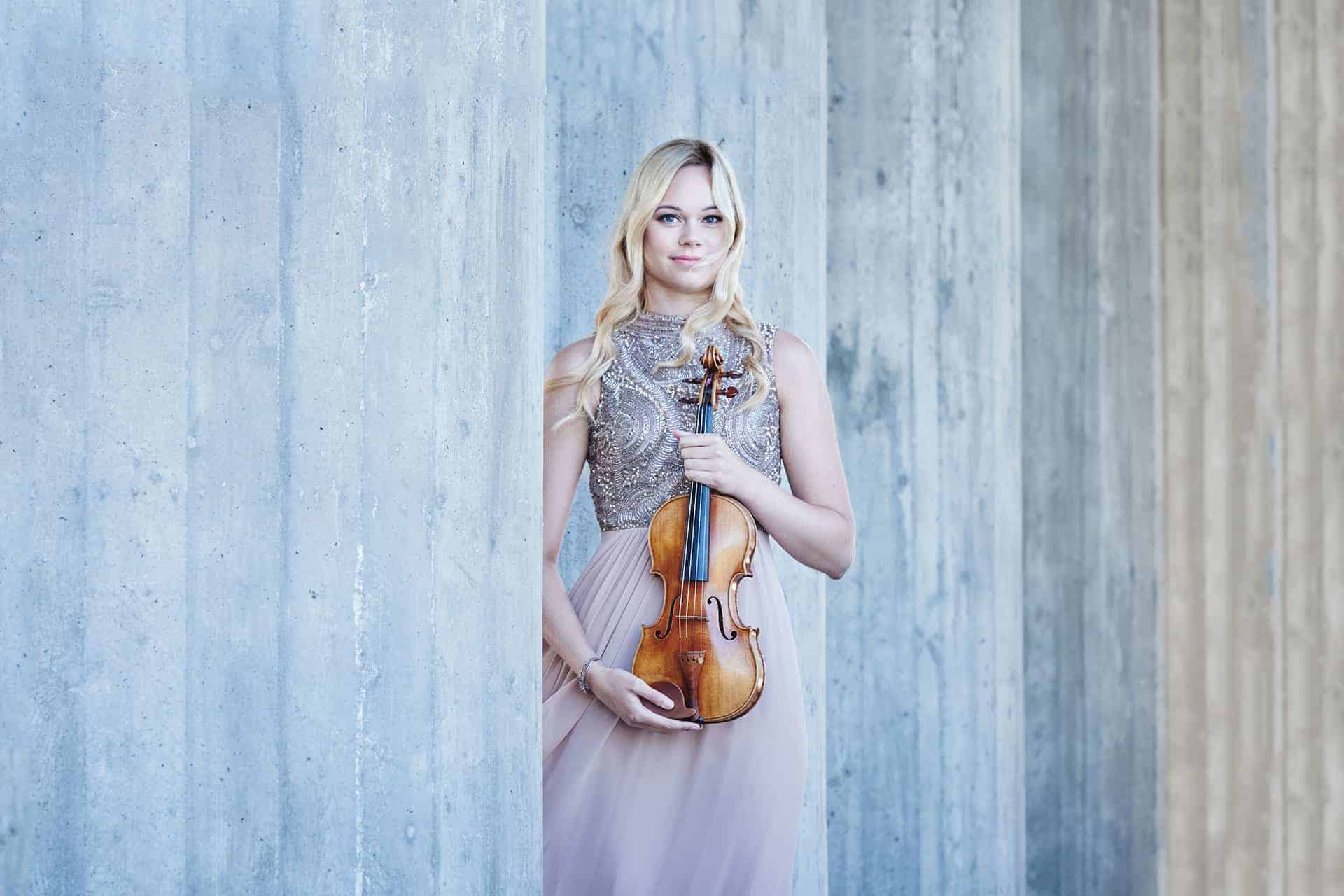
On their new CD Mari and Mihkel Poll guide you through a century of twentieth-century music history in one hour. Neatly chronological from Enescu's third sonata for violin and piano from 1926, via the sonata for violin and piano by Poulenc and Schönberg's Fantasie for violin and piano, both from 1949. To finally end in 1994 with two works by Estonian composer Tüür. A tour de force that would require musicology professors about a semester. Although the duo will not receive the greatest distinction for their attempt.
Let me start with the biggest plus point. Mari and Mihkel Poll present a relatively accessible programme of twentieth-century works for violin and piano. Many music lovers still remain sceptical about works from the past century. A CD like this one seems to me a more than solid introduction. Moreover, the chronology works further in favour of that accessibility. Enescu's sonata is tonally the simplest of the four works. Poulenc's sonata already challenges the listener more. The musical language here is coloured by his impressionist contemporaries and explores the boundaries of tonality more. Schönberg's work breaks through this boundary with his dodecaphonic fantasie, only to finally release that tonal tension with a minimalist work.
Yet this multitude of styles is immediately also the major weakness of this CD. Twentieth-century music is less straightforward than in the preceding centuries. Through the chronological structure, the musicians suggest that this is about an evolution in music history, while the four works, and four styles rather exist side by side. The Slavic school, based on folk music, had Bartók as an important figurehead alongside Enescu for example. Poulenc perhaps did not want to fall under an -ism, but leans more towards his impressionist compatriots Debussy and Ravel. Schönberg's twelve-tone music inspired composers such as Berg and Webern, and Tüür's work is based on American examples by Steve Reich and Philip Glass. Even if you disregard the chronological structure and see this CD as a presentation of twentieth-century music for violin and piano, it remains too much of a motley collection.
Let me be clear: siblings Poll master all styles flawlessly. They particularly excel in the slow sections such as the Moderato malinconico from Enescu's sonata or the Intermezzo from Poulenc's sonata. But they also succeed in displaying their virtuosity in the finales of both sonatas. In the dodecaphonic and minimalist work they are, as it should be, note-perfect. It is clear that Mari and Mihkel Poll can adapt as musical chameleons to very diverse styles. Only this CD has become slightly too eclectic a mess.
- WHO: Mari Poll (Violin) Mihkel Poll (Piano)
- WHAT: Enescu – Sonata for violin and piano No. 3; Poulenc - Sonata for violin and piano; Schönberg - Fantasie for violin and piano; Tüür – Conversio & Köielkõnd
- RELEASE: Dux Recording Producers
- PHOTO: Kaupo Kikkas