

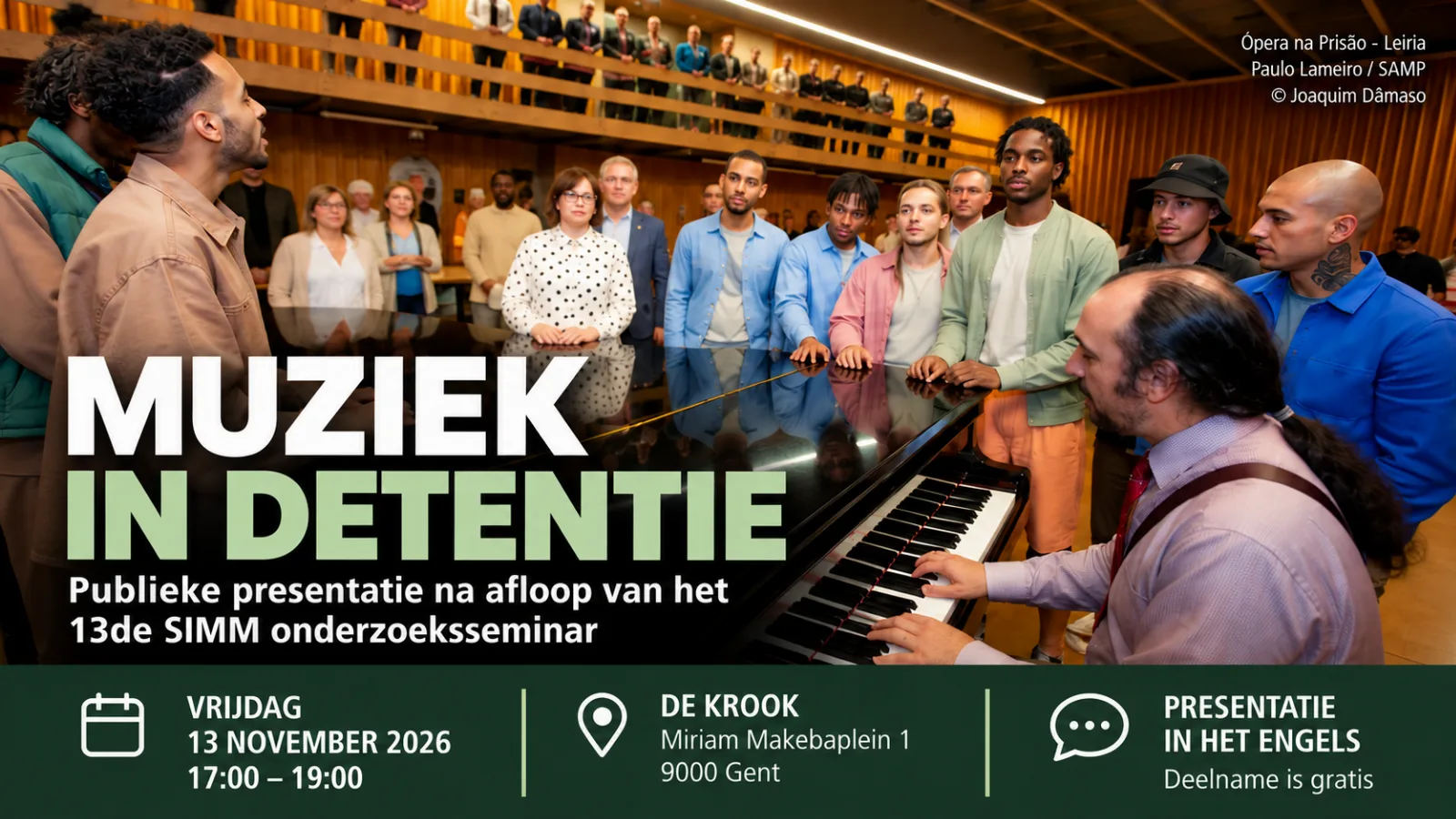
What can making music mean in a prison or detention centre? What kind of space can emerge when people who have lost a large part of their freedom sing, play, compose or make music theatre together? And how can we try to understand what happens there, without overestimating or romanticising the meaning of such practices?
On 12 and 13 November, the research network SIMM brings together in Ghent an international group of researchers who engage with these questions from very different contexts. They come from Spain, the United Kingdom, Brazil, India, Norway, Germany, Australia, Canada, the Netherlands, Italy and Belgium. For two days they will place their research and experiences side by side during the 13th SIMM research seminar, this time organised in collaboration with the Jonet Chair of Ghent University.
What is special about this group is that all participating researchers are themselves involved in music practices in prisons or other detention settings. They therefore do not study these practices solely from the outside. Their research grows in part out of their own involvement in the work and in the people they collaborate with there.
On Friday 13 November from 5 p.m. to 7 p.m. they will present some of the most important questions, insights and tensions that emerged during these two days to a wider audience in De Krook in Ghent. The presentation takes place in English and is freely accessible.
What can we learn from it?
For several years, SIMM has organised small international research seminars around themes that are important for research into the role that music-making can play in social projects. They deliberately differ from classic academic congresses. There are no successive lectures in which researchers present their own work for twenty minutes before making way for the next speaker.
A small group of researchers spends two or three days together. They get to know each other's research and practices, ask each other questions, compare situations and above all try to discover what becomes visible when experiences from very different social and cultural contexts are placed side by side.
For a subject such as music in detention, this seems particularly important. A prison in Belgium is not the same reality as a prison in Brazil, India or Norway. The legal systems differ, the material conditions differ, the place that music and art are given within prisons differs, and social ideas about punishment, repair and reintegration also vary greatly.
Yet people who work with music in these settings often turn out to face similar questions.
What happens, for example, when people make music together in an environment in which their autonomy is by definition strongly limited? Can an artistic practice temporarily enable other relationships between people who, in everyday prison life, mainly stand opposite each other as detainee, guard, therapist, social worker or artist? And what remains of such experiences once a workshop, rehearsal or performance is over?
Researching what you yourself help shape
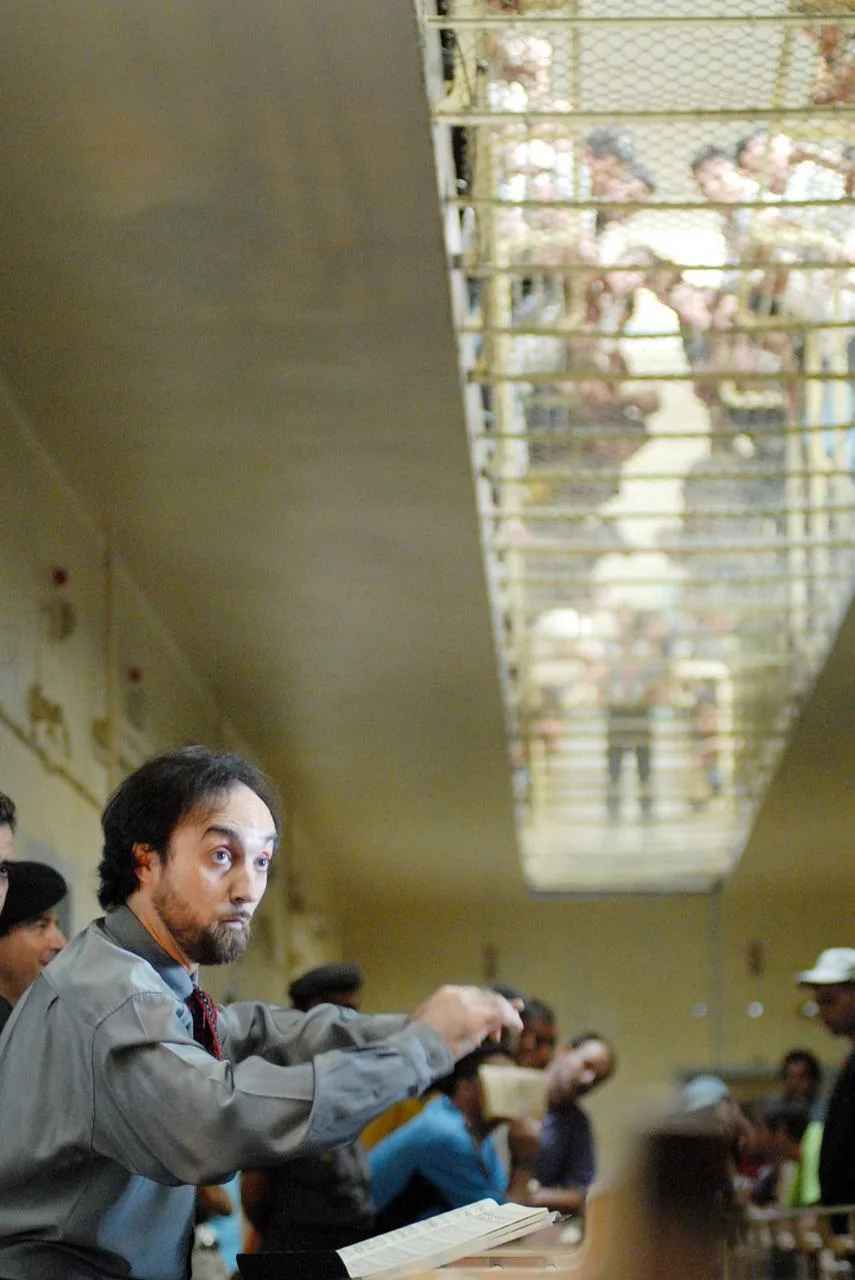 The fact that all researchers taking part in the seminar are also active in these music practices themselves makes the encounter especially interesting. Their position is not that of the detached observer who walks into a prison, gathers data and then leaves again.
They know the daily practice, its possibilities, but also its limitations and frustrations. They know what it means when a planned activity suddenly cannot go ahead, when institutional rules clash with artistic processes, or when building trust takes far more time than a project structure allows.
At the same time, this involvement raises methodological and ethical questions. How do you research a practice of which you yourself are part? Which things become visible precisely because of that involvement? And for which other aspects might you risk becoming blind because you are so closely involved in the process?
That is precisely why comparing researchers from different countries and practices is so valuable. The taken-for-granted assumptions of one context can suddenly be questioned by someone who looks from a very different reality.
Music within a sharply bounded reality
Anyone who speaks about music-making within social projects easily ends up with grand words: connection, inclusion, empowerment, wellbeing, transformation. These are concepts often used when art is assigned a social role.
But a prison may precisely compel us to handle such concepts with more care.
A music project does not lift the reality of detention. It does not simply change the power relations within a prison. Nor does it solve the problems someone faces before or after their detention. And artists or musicians cannot take over responsibilities that lie with the justice system, welfare work or politics.
That does not mean, however, that what happens during such an artistic process is unimportant.
Perhaps we should look for its possible meaning precisely in smaller and more concrete experiences. In the possibility of being heard. In making something you did not know beforehand you could make. In not being addressed, for a moment, exclusively from the fact that you are incarcerated. In working together with others on something shared. Or in experiencing once again a form of initiative in an environment where a great deal is decided for you.
The research tries to understand precisely such processes better, without deciding in advance what music-making should bring about.
How do we know what a music practice brings about?
This leads us to another question that is central during the seminar: how can we actually investigate what happens in such practices?
Who decides, for example, which change is meaningful? The researcher, the artist, the prison management, the organisation funding the project – or primarily the detainees themselves?
And what happens when organisations or funders expect certain results in advance? How do researchers avoid merely confirming what artists, organisations or policymakers would like to hear about the power of art?
The position of the artist also raises questions. Is a musician working in a prison first and foremost an artist, or is a social or even therapeutic role simultaneously expected of him or her? How does artistic quality relate to participation? Who determines what artistic quality means in such a context? And what does artistic freedom mean within an institution where security, control and regulations are constantly present?
These are questions for which no simple, and certainly no universal, answers exist. That is precisely why it can be meaningful to confront experiences from very different parts of the world with one another.
SIMM: investigating music-making within social projects
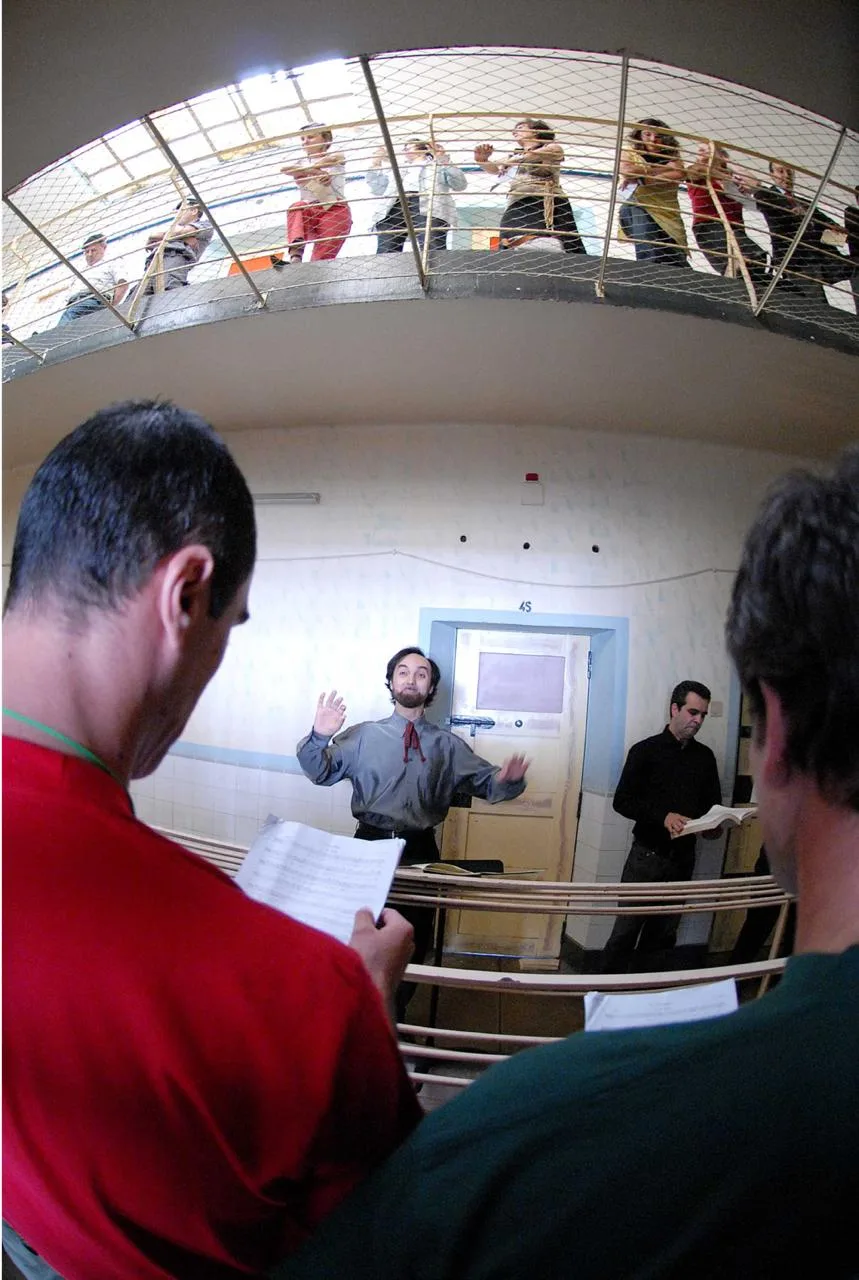 SIMM began its activities in 2015 in Ghent, and in 2017 developed into an international research network around the question of what role music-making can play within social projects.
The starting point is not that music by definition has a positive social impact. More interesting is to investigate what actually happens when music-making is given a place within complex social situations: under which conditions can meaningful processes arise, for whom are they meaningful, and where are the limitations and contradictions?
For this purpose SIMM brings together researchers from different disciplines and countries and explicitly seeks dialogue with artistic practice. In addition to a podcast, publications and international SIMM symposia, the network regularly organises small-scale research seminars in which a limited number of researchers work intensively on one theme over several days.
The seminar in Ghent is the thirteenth in this series and the second entirely devoted to music-making in prisons and other detention environments.
Collaboration with the Jonet Chair
This research seminar is organised in collaboration with the Jonet Chair (www.cesamm.eu) at Ghent University. Within this chair, too, the relationship between artistic practice, research and social context is central.
The Jonet Chair aims to stimulate research into the ways in which music and other artistic practices can play a role in social and societal contexts. In doing so, it seeks to keep the distance between academic research and concrete practice as small as possible: artists and organisations themselves possess knowledge that easily remains out of view in a purely academic approach.
The structural collaboration between SIMM and the Jonet Chair makes it possible at the same time to connect international research experiences with developments in Flanders and Belgium. Here too, various music and art projects exist in prisons and detention contexts. The international comparison can help to look at these own practices differently.
From closed seminar to public conversation
After two days of intensive exchange, they therefore want to open the doors.
The public gathering on Friday evening 13 November will not be a sequence of presentations of individual research projects. Together with Silke Marynissen, researcher at the Vrije Universiteit Brussel and herself active in artistic practices in detention, a number of the most important questions, insights and areas of tension from the discussions will be brought forward in a short presentation.
What did researchers from these different contexts recognise in one another? Where do their experiences turn out to differ strongly? Which assumptions about what music-making can mean within a prison were confirmed or, on the contrary, called into question? And which questions deserve further research?
Afterwards they especially want to engage in conversation with the audience.
The initiators therefore hope to welcome not only researchers, but also artists and musicians who work in prisons themselves, staff of cultural and social organisations, people from the worlds of justice and welfare, students, and anyone interested in what art can mean within an environment in which freedom is so fundamentally restricted.
Perhaps the value of such an international encounter ultimately lies not in finding a single answer to the question of what music can mean in detention. More interesting is that people who work daily in these practices bring their experiences and research side by side and thereby help us to ask better questions: about what artists do there, about what participants experience, about what research can make visible – and also about what we should not expect from making music.
Practical information
Music in detention – public presentation following the 13th SIMM research seminar
Friday 13 November 2026, 5 pm–7 pm
De Krook, Miriam Makebaplein 1, 9000 Ghent
Presentation: Silke Marynissen (Vrije Universiteit Brussel) and Lukas Pairon (SIMM & Leerstoel Jonet)
The presentation will be given in English.
Admission is free.