

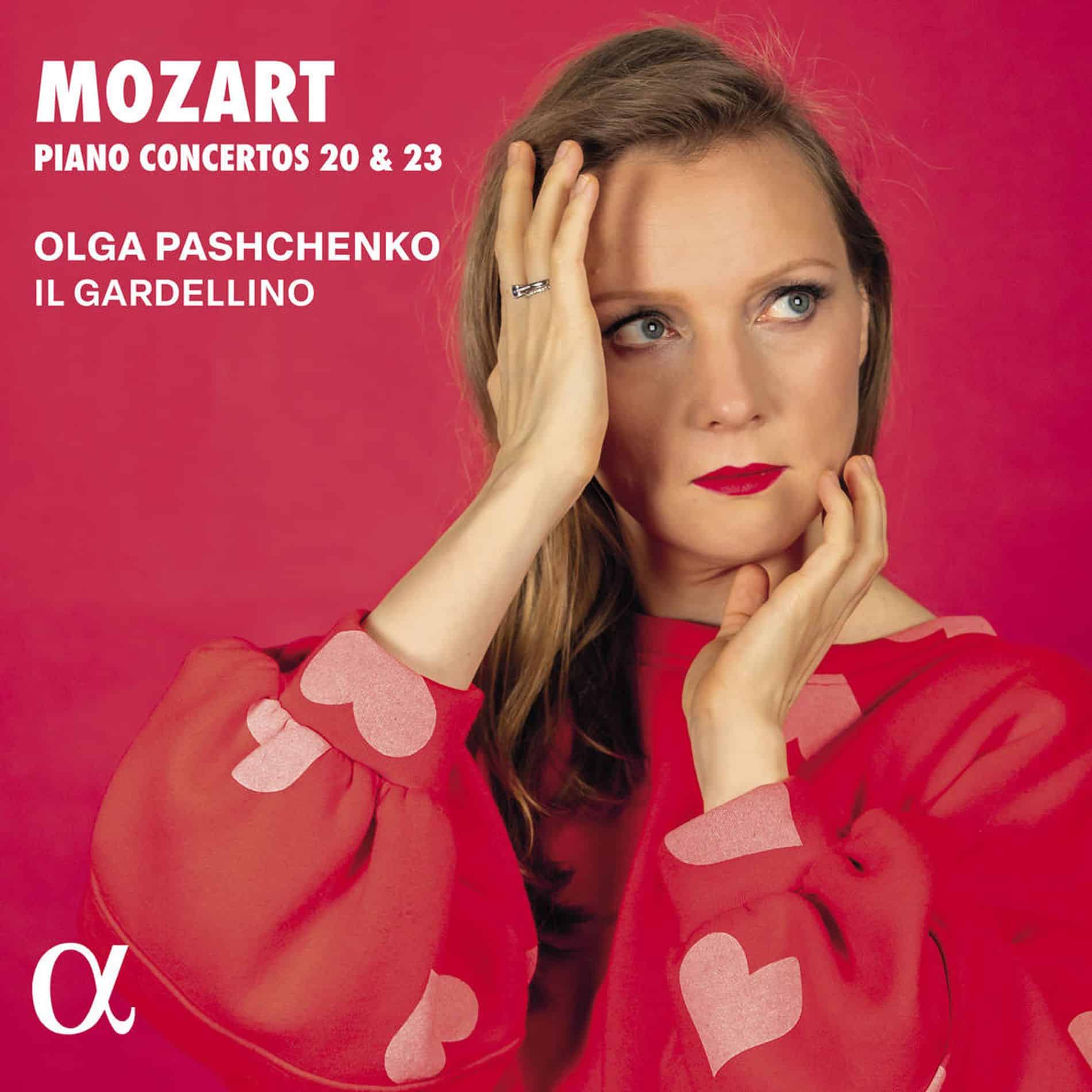
Mozart: Piano Concerto No. 20 in D minor, KV 466 - No. 23 in A, KV 488
Olga Pashchenko (fortepiano), Il Gardellino conducted by the soloist
Exactly two years ago I discussed here Olga Pashchenko's interpretation of Mozart's piano concertos KV 271 and KV 453. Now then this new album with the frequently tested combination of KV 466 and KV 488.
On her previous album she made use of two different fortepianos: in KV 271 a replica by Paul McNulty based on a model by J.A. Stein from 1788, and in KV 453 a copy based on an Anton Walter from 1792, also by McNulty.
For KV 466 and KV 488, Pashchenko again chose an instrument by McNulty and, unlike in the preceding piano concertos, she herself composed the cadenzas for KV 466, following in line with famous predecessors such as Beethoven, Hummel, Alkan, Brahms, Busoni and Clara Schumann. On the other hand, for KV 488 - I quote from the booklet - Pashchenko could not resist the temptation to play Mozart's (fully written out) cadenza.
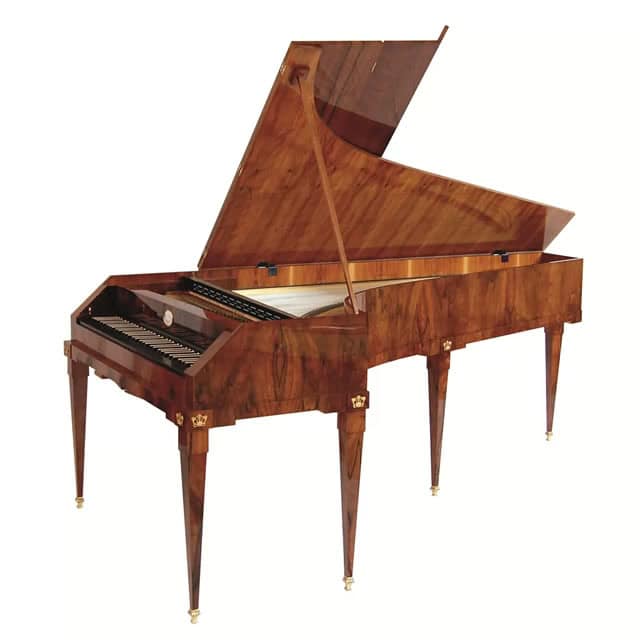 Copy of a fortepiano by Anton Walter (1792) made by Paul McNulty
Pashchenko (*1986) studied at the Tchaikovsky Conservatory in Moscow with Alexei Lubimov (piano), Olga Martinova (harpsichord and fortepiano) and Alexei Smit (organ). Elsewhere she pursued numerous master classes with, among others, Trevor Pinnock, Malcolm Bilson, Bob van Asperen, Bart van Oort and Andreas Staier. In 2011 she took lessons at the Amsterdam Conservatorium with Richard Egarr. From March 2017 she taught there herself, as a fortepiano instructor.
Is the fortepiano in general the most suitable instrument for the performance of Mozart's piano concertos? From the perspective of historically informed performance practice, it certainly is, and then the aforementioned McNulty replicas almost naturally satisfy this image.
To begin with Anton Walter (1752-1826): he was undoubtedly the most famous and most respected builder of fortepianos in Vienna, this 'Kays. Königl. Hof Orgel und Instrumentenbauer'. Walter brought about many innovations and his mechanisms were even regarded as a standard for a long time. This included the flawless catching of the hammer upon descent (which prevented, especially with forceful strikes, unintended bouncing back). As far as is known, some seven hundred instruments left his workshop. One was purchased by Mozart in 1782 (Beethoven was extremely interested in it in 1802, but ultimately refrained from buying it at the last moment.) According to Carl Thomas Mozart (1784-1858), his father had a preference for the wing-shaped fortepiano. The instrument was not only set up in his (Viennese) study, but Mozart also insisted that only such an instrument by Walter should be used in his concerts, no matter where they took place: palace halls, theaters, casinos, courthouses, and so forth.
Regarding Mozart's appreciation, the knee levers certainly played a role, the predecessors of the pedals as we know them: the right lever functioned to sustain the sound, the left as a moderator (a felt layer that was mechanically inserted between hammer and string to dampen the sound). As early as October 17, 1777, Mozart wrote enthusiastically from Augsburg to his father Leopold about such a mechanism:
'This time I shall begin at once with Stein's fortepianos. Before I had seen one of his making, Spath's pianos were always my favorites. But now I much prefer those of Stein because they even dampen much better than the Regensburg instruments. […] This apparatus, which you operate with your knee, works better on Stein's than on other instruments. I only need to touch it and it works: when you shift your knee even a fraction, you don't hear the slightest reverberation.'
 Part of the letter from October 17, 1777
In an impressive video on YouTube (click
) the South African fortepianist Kristian Bezuidenhout explains the special significance of the fortepiano in relation to Mozart's music, while also discussing the Steinway concert grand.KV 466 (scored for flute, two oboes, two bassoons, two horns, two trumpets, timpani and strings) was completed in Vienna on February 10, 1785 and performed almost immediately thereafter, at the Mehlgrube Casino, with Mozart as soloist and conductor. On this occasion, father Leopold wrote to his daughter Nannerl that the copyist was still working on the orchestral parts until the last moment and the composer therefore had no time even to rehearse the Rondo with the orchestra: he preferred to give priority to checking the work delivered by the copyist.
Mozart completed KV 488 on March 2, 1786, two months before the premiere of Le nozze di Figaro. It is, despite the optimistic A major, a work full of contrasts, scored for only flute, two clarinets, two bassoons, two horns and strings. The interplay of light and dark is shaped as phenomenally as the melodic and harmonic inventiveness driven by ingenious motifs. Moreover, the balance between colorful virtuosity and lyrical expression again testifies to great mastery, as does the orchestration, despite its modest means, exemplary.
Unlike what is sometimes assumed, KV 466 is not a 'dark labyrinth' but a pivot point characterized by strict clarity that combines superior tension building with seemingly boundless subtlety, with both soloist and orchestra under virtually continuous high tension. Even the lyrically spun-out Romance does not escape this in its furious middle section.
That there is a clearly identifiable correlation between these two concertos and Mozart's operatic world has been convincingly demonstrated by many musicologists before. Pashchenko also recalls this in her (brief) commentary:
'Thinking about these concertos as operas, where all the instruments are non-verbal heroes, strenghtened our idea of performing them without a conductor for a great chamber music-like interaction between all the personaggi. Altogether we wanted to create a play, a dialogue, such that both concerti would tell their own special story. [...] In KV 466 the cadenzas are fantasized by your humble servant and one might hear the shadow of Il Commendatore and the Requiem touching us with its ominous wing.'
It is crystal clear: this has been the most important starting point for Pashchenko's interpretations, that inimitable connection between these two piano concertos and the opera, but without imposed theatricality. The expressive power that lies hidden in her fascinating discourse expresses itself primarily in the sublimely drawn tone colors that are synonymous with rhetorically shifting emotions, emanating from fear to warm lyricism, from passionate intensity to exuberant joy. The Flemish Il Gardellino proves itself once again as the ideal, extremely supple-responding ensemble that is driven with great élan by Pashchenko conducting decisively from the keyboard - of course in collaboration with concertmaster Evgeny Sviridov. It works perfectly without a conductor, as great predecessors of Pashchenko have irrefutably demonstrated, including Andsnes, Barenboim and Uchida.
The interpreter passes, the genius remains. Pashchenko is of course aware of this, and so modesty is fitting. The knowledge too that no single musician can illuminate every aspect of these exceptionally rich scores. She goes far in this, in this highly driven playing, free of any routine, the deep exploration of the inner and outer, the—even if only suggestion—intuitive quality that also characterizes her playing, alongside the almost etching-like relief, thanks also to the fortepiano excelling in this regard with its naturally parallel-strung strings.
To dwell on this last point for a moment: until 1835 the strings ran parallel to each other. It was Johann Heinrich Pape who had the idea of stringing the bass strings diagonally in the piano, crossing the treble strings. This allowed him to build a piano with a reasonably forceful tone, with a maximum string length of 133 cm and a height of no more than about 100 cm.
Around 1870 Steinway came out with a cross-strung grand piano. The advantage of this was a much more forceful tone with string tension of as much as 25,000 kg (which could be neatly distributed thanks to the triangular shape). It proved to be a successful concept that was soon followed by more piano builders. The inevitable consequence was the standardization and thus uniformity of piano sound. But with the rise of historically informed performance practice in the sixties of the last century, the search for greater diversity and clarity of sound also began. The Belgian harpsichord, piano, and grand piano builder Chris Maene brought a grand piano with parallel-strung strings to market not so long ago. As a compromise between the fortepiano and the traditional concert grand.
In the concert hall, the fortepiano must generally concede in volume to the orchestra. The only solution then is to thin out the orchestral parts, which in itself cannot raise any objections because in the eighteenth and partly nineteenth century such a modest instrumentation was not only customary, but was often also played in smaller spaces.
Pashchenko's sparkling and flashing playing is extremely detailed and sonorously recorded, as is also the case for the many tone colors and the equally flawless balance between fortepiano and ensemble (which without recording technical tricks rarely succeeds). I have already praised the inspired musicians of Il Gardellino who form the ideal partners for Pashchenko (and vice versa, no doubt).