About Opera, Sound and a Special History
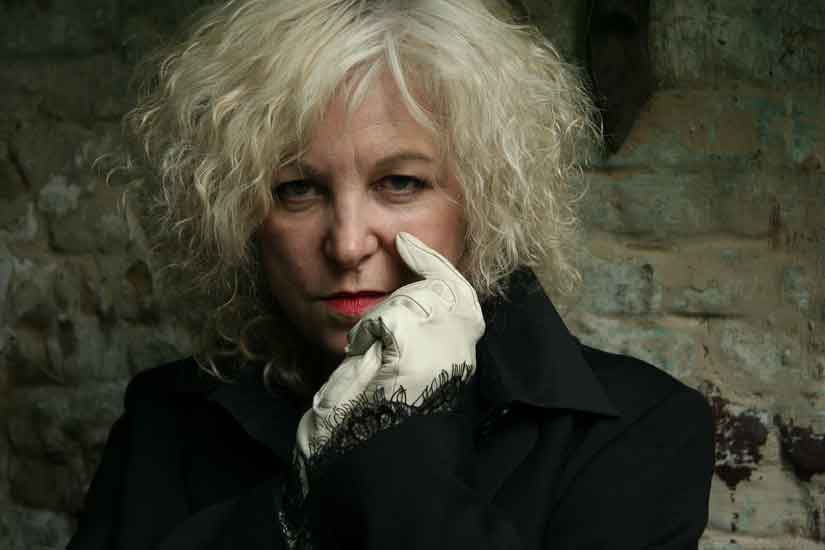
The opera Dialogues des Carmélites by F. Poulenc produced by De Munt at the end of 2017 receives from Klassiek Centraal the Golden Label Opera (see the review by Veerle Deknopper) for the 2017/18 season. Soprano Mireille Capelle, who in December of that year played the role of Mère Jeanne de l'Enfant in that production at De Munt under the musical direction of Alain Altinoglu in a production by Olivier Py.
As part of the festival Passages, organized by the renowned Goeyvaerts Trio, I interview one or more singers or musicians. This time it is Mireille Cappel. For Passages V, the diva presented together with soprano Esther Elisabeth Rispens a surprising and sparkling original creation[1]. The following text could already be read in the thick illustrated festival program booklet – at least if you were there.
That Saturday in Antwerp
The soprano switches between French and Dutch, giving her stories a special character. I pick her up at her house in Antwerp. Actually, she would have liked to take me to the studio of the HERMES ensemble in Wijnegem, but she grabbed the wrong keys in Brussels. She is staying there for the occasion of the De Munt production Dialogues des Carmélites by Francis Poulenc (1899-1963) and Georges Bernanos (1888–1948). The bistro around the corner is packed. Mireille suggests driving to Wijnegem anyway because of the location and the bakery. In the car we talk like old friends even though we just met. In Wijnegem we settle at the long table in the dining room of the French bakery. We get coffee, tea and fresh croissants like you rarely find in Belgium. Mireille Capelle tells me the story of the bread and its Parisian baker who opened a branch here last year. At the bakery it is a constant coming and going. I place my mobile between us. Now that I listen to it again, I realize that I recorded a conversation, not an interview.
Les Carmélites[2]
The evening before I enjoyed the De Munt production in which she sang. Mireille asks. So I tell her about the two things that struck me: the fragility of Blanche and the relativity of 'freedom'.
The naturally fearful Blanche de la Force enters the order of the Carmelites at the beginning of the French Revolution. Although the strict monastic rule gives her a sense of security, her existential fears remain even within the convent, especially after she witnesses the severe death struggle of the prioress. When the monastic order is dissolved during the Revolution, the sisters swear they want to die as martyrs for their faith. In the turmoil, Blanche flees home, but her father has meanwhile become a victim of the Terror and died on the guillotine. When she learns that her fellow sisters have been sentenced to death, Blanche overcomes her fear of death: at the moment of their execution, she voluntarily steps out of the crowd, joins her sisters and enters the scaffold last. (De Munt)
The De Munt production holds up a mirror to us. Liberté, painted on one of the walls, takes on its own meaning. It becomes 'Liberé' (en dieu) with an erased 't'. Indeed, in the name of our freedom and our rights, we do strange things. In Poulenc's opera, almost everyone dies. The father marquis de la Force (libre en soi), the Carmelite sisters (liberté en dieu), the brother and the priest on the run (libre en fuite) and the novice Blanche de la Force frees herself from her fears and dies for the love of God. Finally – as history teaches us – the revolution itself died some time later. Freedom is nothing more than the free choice to bind oneself.
Binding oneself to another (a person or a good cause) as liberation shone through the production. The image of Blanche's psychological fragility also stood out. Today she would probably cut herself or starve herself. Concerned parents would take her to a psychologist to hopefully cure her or at least give a name to her behavior. Perhaps today psychiatry brings relief. Monasteries lost their magic just as so much meaning-making did. De Munt presented a rather accurate image of the fragile Blanche without the voyeurism of contemporary reality TV.
Mireille points out to me the risk that Patricia Petibon took in singing the role of Blanche: she chose beyond classical 19th-century bravura and public expectation to also give voice to the fragility of the character. The stylized beauty of the production contrasted with the human struggle for freedom and the pain of the girl tasted bittersweet. Bravo!
About opera, De Munt and its director
When you step into the skin of a character and share a situation with others, you get a mixture between real life and the world of theater. The portrayed Blanche, as just mentioned, with the feeling and insight of Poulenc and Bernanos. It is as if you step into real life, but it happens in the theater.
The management of the house is very important. Peter de Caluwe needs a deep, 'profound' interpretation. Perhaps part of the audience experiences the director's style as extreme or provocative. Peter de Caluwe seeks the essence: what do we tell and how do we tell it? He wants people to enjoy the music, the beauty and the whole event of an opera. He also sends the audience home with a question, an inquiry into something. Then you can still say whether you like it or not. It gives the opera more level, just a bit more than simply 'beautiful'.
When we meet, at the first reading of a libretto, he invites everyone: the director, the conductor, the singer but also the technicians, the costumiers. You know that we are working towards something together. That creates mutual respect.
For every singer, the first meeting is always somewhat nerve-wracking. You don't know what your colleagues feel or think of you. If you have a large role, you have a large responsibility. If you have a small role, you think about the place you can take here. The small roles support the progression, the development of the piece. Actually, we are all insecure but we laugh and act grandly: "Hello! Ca va? Ah, I come from Rome…" [Mireille plays out a jovial meeting]
Peter de Caluwe comes in and with one word he makes us set aside our egos. "I am so happy that you are all here together. We try to do a reading of Poulenc together."
He has a nice word of introduction for each singer: "Mireille I know from Amsterdam. She has also sung Poulenc there". He knows such a story about everyone. It brings us together, c'est extraordinaire!
He has known that world since he was a young assistant to Gerard Mortier. He has calm and knows his craft. He goes for his goal but remains spontaneous and fun. I once sang Offenbach with him.
In any case: opera has a soul that you don't find elsewhere. Everyone transcends themselves: the composer, the librettist, the management, the performers. I think you experience this, even as a listener.
From Monteverdi to Strauss
You experience music; it is a different understanding. One of my grandchildren, five years old, changes when he hears classical music or singing: he sits differently. He listens as if someone is telling him something. He doesn't understand the text but he feels that. Incredible, isn't it.
Much music is nothing more than beautiful, but then the essence is missing. Then I prefer the rough and honest of Metal or punk. That is also a form of contemporary art with expression and feeling - extrêmement intéressant. It's worth the effort! Often Heavy Metal is rhythmically very interesting. And what energy! I am sure that Mozart in our time would have played with it too. The fierce expression seems to me also part of who we sometimes are. Think of anger or powerlessness.
Over the years I have evolved. I discovered Baroque music through Jos van Immerseel. He was my mentor and Monteverdi my idol. I sang lamentos and traveled the world with them.
Subsequently, my repertoire expanded. I sang a lot of Romantic music: Kundry from Wagner's Parsifal and Salomé from the opera of the same name by Richard Strauss. They are all characters who 'tear': roles that also stretch you emotionally as a singer; a fantastic world I found that.
In between, I performed the classics with, among others, Mozart. Usually I gave shape to the more comic characters. That was fun but after a while I noticed that this aesthetics imposes limitations. It is either Baroque or Romantic. You must sing within a certain technique and use your voice that way. As a singer you must obey it, although you can color freely with expression within it. The vibrato in Mozart resonates differently than in Monteverdi. In Romanticism, on the other hand, you open everything up and let yourself go in the sound. You close your mind as it were to let the sound resonate in your body, as pure emotion.
Meeting Contemporary Music
After 30 years I asked myself how I sound and how sound fits together. I remember the meeting with John Cage (1912-1992). He told me that I fitted well into what he investigated and felt. He wanted to move away from the music that was squeezed into a 'straitjacket' of the script. He wanted to give responsibility to those who interpret the composition. So he composed a minimum so that the performer can do something with it that makes sense for him or her: that is my idea in your version. Listen to what sounds between the notes.
I began to listen to music from all over the world. How do the indigenous people sing? What does a Persian song sound like? That's how I met composers from our Western tradition who also listened beyond this tradition. One of the most important was the recently deceased Klaus Huber (1924 - October 2, 2017). I owe him a lot. He taught me a lot.
"Mireille", he began, "If you want to go beyond the straitjacket of what we see as classical music, in our time and language, then you must understand that pitch distance, for example between do and re, is merely a concept." "If you listen to Arabic music then you hear that the tone [tibetitpetie…. Mireille sings while her voice slides downward] consists of thousands of small shifts. We don't hear that, Mireille", he explained, "because we cannot recognize that. But they, the people from the Arabic tradition, hear that. Just like we recognize do and re. So they hear if a semitone or quartertone is sung too high or too low. For us that sounds unusual or even false. You have to learn that."
When I worked with him for hours, he was already an old man. But what a vision! He wrote music with two commas above the semitone; a quarter tone became a quarter tone plus 1 or a half tone plus 1, plus 2, plus three… And I had to sing that… Reading and interpreting such a score was hard labor. I lost myself in it. I felt the distances between the tones, the expression and the color. That freed me from my musical education.
For me, the world of the voice and vibration no longer colored only Western but 'human'. Partly because of that, I became interested in sonic architecture. Not only music fascinates me but also the sounds of rain, a thing, a voice, a mass,.. you name it. If you listen, it moves you emotionally.
Karel Goeyvaerts (1923-1993) I met as a young singer. He was extraordinary and had an astounding vision. Goeyvaerts asked me to come to his center and then he worked with my voice spectrally - avant la lettre – worked. Unfortunately, I never found the recording again but it's probably in the recording library
And now, through my 'sound obsession', I encounter not only musicians but also physicists, engineers and philosophers. I read constantly and love metaphysics and numbers. The engineers and their electronics implement your idea. You can't do it yourself. Pierre Boulez (1925-2016) didn't try it himself either. A computer can "metamorphose" that sound, change it. It can open it, stretch it or visualize the vibrations and let me hear and see what's in it. The computer lets me hear everything my two-dimensional ears cannot perceive.
My new cd[3] is such a collaboration where the end result belongs to all of us. By searching together with musicians from different traditions and engineers, a new sound world is created. That music form is currently still embryonic but I am certain that in 50 years everyone will understand this language. That goes even further than my first liberation.
Many years later, at the French baker, soprano Mireille Capelle thought of that long-forgotten afternoon, when her father took her to meet the note.[4]
Before I could write, I learned to read music… That's also a very beautiful story.
I don't know where the idea came from to learn music. When I was 5 years old, I told my dad: 'I want to go to music school'. "It's too early", said dad, "you're still too young". I kept pestering because I really wanted to do this. He took me to the academy where the director said to me: "Girl, you're way too small. You have to, as you know, first learn music theory to learn an instrument. That's still too difficult for you. You can't read yet. First you have to learn to read." I cried so much that the director decided: "Let her come anyway. After two, three lessons she'll understand that it's too difficult."
But that's not how it went; I understood the music. I found solfège magical. I could learn the notes I heard and enjoyed the abstraction of the theory. Later the director took me to his office to listen to Beethoven. The symphonies passed by one by one. I cried and wanted to listen again! He told me who that was. You know, in those days Beethoven was THE composer.
Actually, music became a salvation for me. It became a way to survive in a world that wasn't always friendly. I come from a half Italian, half Belgian family, déportés in Charleroi - there are many of them in the working-class circles. My mother migrated to Belgium because of the war. She came from Veneto, between Verona and Venice. My father, a Namurois, studied with the Jesuits and was to become a priest. But bitten by socialism, like so many intellectuals of that time, things turned out differently. His idealism to help improve the lamentable conditions of the workers brought him to Charleroi. We lived in a gray neighborhood near the Metallurgy in a house with a beautiful sunny and colorful garden.
My grandfather was a gifted musician, an organist. He had traveled the whole world. Because we lived next to the factory, we experienced a lot. I can still see how the gendarmes charged against the workers – all those horses. And I still remember that night when my father had to go to the factory because a man had lost his legs: caught in a machine. Another time we had to leave our homes in the middle of the night. There was fear of an explosion at the metallurgy. Je me souviens les bras de ma mère, my mother's arms that carried me when we stood outside waiting. Tu vois, I still feel the special thing about that moment. All those Italian families, the neighborhoods of Charleroi were part of my family. Also the underground, the mine, was a long tragedy.
We had a piano and many guitars at home. Every evening my grandfather insisted that we wash ourselves. We had no shower. We dressed nicely before we came to the table and then: music. My uncles all played guitar and my dad played piano. That way our family thought we were rich and that everything was going well. We would have a beautiful life. Et moi, j'ai senti ça très très très fort: I understood it as if I was really rich and beautiful and I had everything. I was allowed to dance on the table after dinner! I imagined myself a princess. As a teenager I got a big blow. Suddenly I saw through the situation. We were poor and had nothing. I realized that everyone around me was so much prettier… Enfin, I had that feeling.
When I was small, there were cafés for the Italians. At the others hung a sign "interdit aux Italiens". In that one café where my grandfather and I always walked past, hung a very large crystal chandelier. One day I asked to go inside but he said: "No, no, no!" I wanted to have something so beautiful someday. I tell you that because it is a form of longing. Yet I felt that my wealth was much greater than that through that family: the warmth, the music, the faith, the large garden with chickens in it... The world of opera is a bit like that chandelier of the forbidden café. And in that chandelier we then place the spirit of Poulenc: that is genius. You can bring those two collections together: the greatest display, the panache and the intimate fragility of a girl like Blanche.
Career begins at the conservatory
I also experienced my working-class background at the conservatory. They accepted me because I had talent but I constantly had to hear: "Ah, venant du milieu que tu viens." "If you come from such an environment, your chances are very small. How are we going to extract the essence from you? Your nature bothers us. You will never be able to be a great character in theater or opera."
You have to put yourself back in the 1960s. At the conservatory there were only rich people. You didn't qualify if you came from Charleroi, from a vulgar environment 'comme ça'. "Comment enlever ta vulgarité? That can never work". Je t'assure!
I was also lucky. During my first important concert at the conservatory, a critic was in the audience. He wrote about who was good, had talent or would never get far. I also sang my piece. Later in the newspaper one read about the one who was good or not but... someone sang who blew us out of our seats: Mireille Capelle. From that moment on, the professors began to believe in me.
I answered the dreams of my family. That Italian family of workers where one sang better than the other and who all knew the operas by heart. Et tu vois, from that evolution a need for freedom arose.
When I am in the opera like now, I enjoy it and I love them all. But I am also very happy that I also find my language in that other world that is my research and expression.
It is something of mine, it is an idea, an inspiration that they give to each other.
You don't quite know what you are giving to each other but you do it.
Like love, I say.
Yes! You say it perfectly; that is it.
Post Scriptum
Autumn and winter meanwhile shed into an early warm summer. The presentation of the golden labels will soon take place in Geel. Hopefully the opera production Dialogues des Carmélites receives the deserved label there and respectively a retrospective.
Hopefully one continues to think about the story and the way it was told, performed. Having placed ourselves on our own freedom, we sometimes forget what we so gladly bind ourselves to…
Mireille, thank you for the interview and your lovely impromptu at Passages.
"The sound will unfold like a lotus…", you said when I asked you what you would bring. The (re-)sound of your story and the mint production too.
Tu vois...
- WHO: Mireille Capelle; De Munt; Passages V festival organized by Goeyvaerts Strijktrio and CC Sint-Niklaas
- WHAT: interview
- WHERE: Wijnegem, Brussels De Munt, Sint-Niklaas STEM
- WHEN: interview December 16, 2017; Dialogues des Carmélites December 2018; Passages V February 18, 2018
[1] Previous years: tenor Guy de Mey (2017, to read on Klassiek Centraal), saxophonist Robin Verheyen (2017), Mezzo-soprano Euredike De Beul (2016), countertenor Leandro Marziotte (2015) and pianist Thomas Nobels (2015).
[2]DIALOGUES DES CARMÉLITES by Francis Poulenc, Opera in 3 acts and 12 tableaux, text by Georges Bernanos, based on a novella by Gertrude von le Fort; scenario by Philippe Agostini and RP Brückberger.
This De Munt production was conducted by Alain Altinoglu in a production by Olivier Py, with Patricia Petibon as Blanche de la Force; Guy De Mey as L'Áumônier and Mireille Capelle as Mère Jeanne de l'Enfant Jésus.
From the press release: Mezzo-soprano Mireille Capelle has sung countless roles at De Munt. From her debut as Clorinda (La Cenerentola) through her interpretation of Rychtarcka (Jenúfa) to her recent appearance as Pani Páskova in Foxie! The Cunning Little Fox: Mireille Capelle gives each of her characters an unmistakable authenticity that also suits her interpretation of Mère Jeanne de l'Enfant.
[3]Mireille Capelle with HERMESensemble – DO'UN ضوء ; AudioMER. – audioMER.019.CD; 2017
[4]From the opening sentence of One Hundred Years of Solitude (1967) by Gabriel Garcia Márquez.