

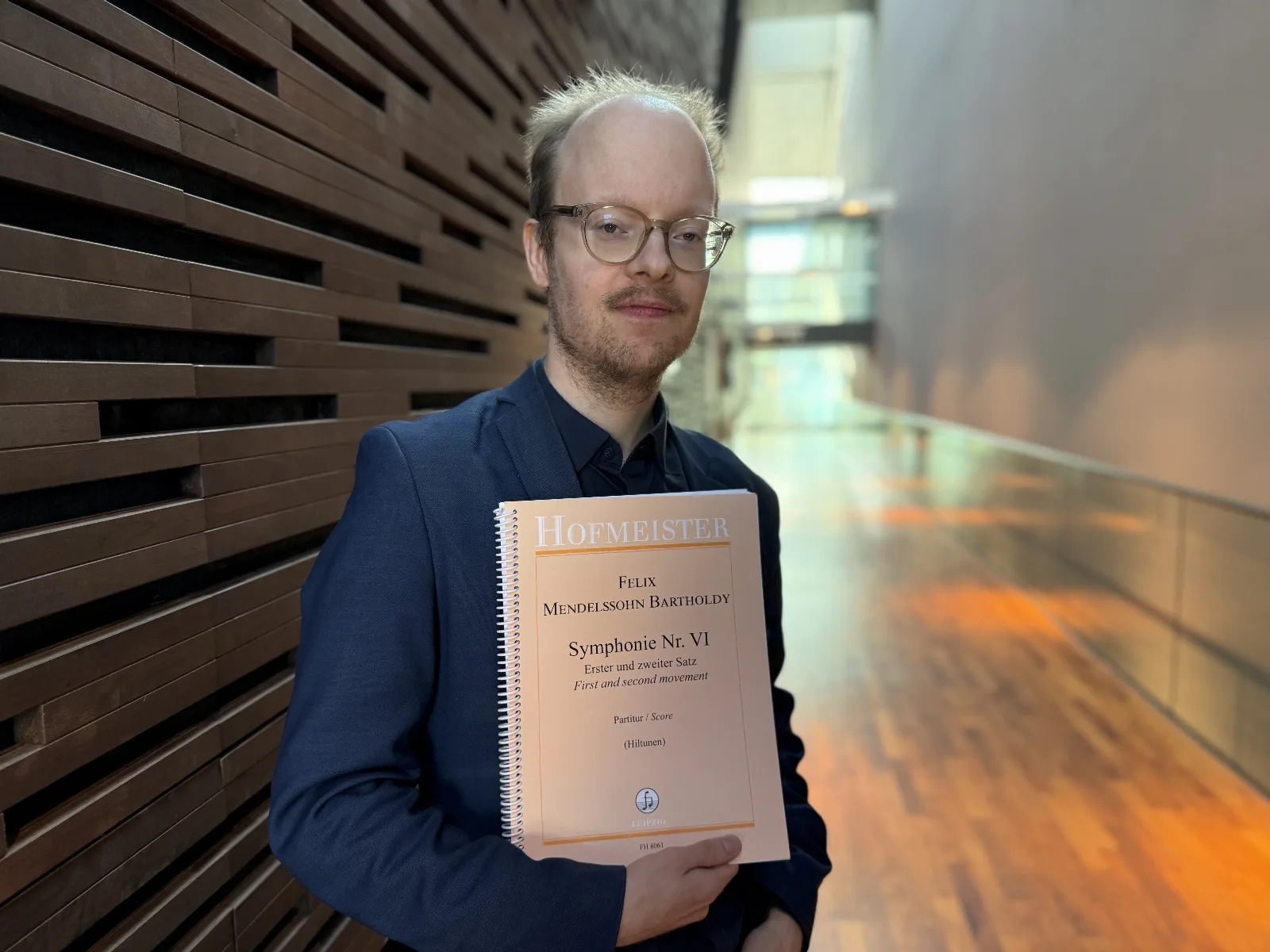
Whoever reads this title probably thinks: isn't this a mistake? Felix Mendelssohn (1809-1847) only wrote five symphonies. That's what I thought too, when I was browsing through the Gewandhausorchester Leipzig brochure in mid-April. As a great Mendelssohn enthusiast, I immediately began investigating and found myself speaking with Luukas Hiltunen, who was happy to discuss it.
When the Gewandhausorchester performs Mendelssohn's Sixth Symphony on 5 November, I will be there, because music that existed only in sketch form for more than a century and a half will be heard. The reconstruction is the work of Finnish composer, arranger and musicologist Luukas Hiltunen, who transformed the fragmentary manuscripts from the Bodleian Libraries in Oxford into a two-movement symphony. For Klassiek Centraal, he looks back on a project that began with a childhood fascination for Mendelssohn and culminates in a world premiere with the orchestra that the composer himself once conducted.
The composer behind the reconstruction
Hiltunen calls himself largely self-taught, although he also received formal training: professional music education, further studies at the Lahti Conservatory and a composition teaching degree from Tampere University of Applied Sciences. He calls his own musical language neoromantic. He hardly sketches – he prefers to listen to what emerges from within. He feels most affinity with the Austro-German tradition and with the folk music of his native Finland, while Gregorian chant and twentieth-century minimal music have also left their mark. Bach, Tchaikovsky, Sibelius, Shostakovich and Mendelssohn are what he calls his five main influences – all present in what he describes as "the compositional process that takes place within me."
Mendelssohn was part of Hiltunen's world early on: at four or five years old, he became familiar with, among other works, the Violin Concerto in E minor, the Overture and Incidental Music to A Midsummer Night's Dream, and the "Italian" and "Reformation" symphonies. That lyrical, expressive music moved him deeply, and working on the Sixth Symphony has only made that bond more personal.
Composing, arranging and musicological research are not separate worlds for him. "Even when I arrange or do research, I am essentially still a composer," he says. His interest in musicology stems from that same creative instinct: curiosity about how a work might have sounded if the composer had finished it himself.
The discovery of the unfinished Sixth Symphony
The starting point was September 2020, when Hiltunen read the chapter on "Mendelssohn's Unfinished Symphony" in Mendelssohn Essays by musicologist R. Larry Todd. Todd describes the manuscripts held in the Bodleian Libraries in Oxford. But the seed was planted much earlier: as a child, Hiltunen harbored a vague conviction that he would one day do something special with Mendelssohn's music.
When he first heard a computer transcription of the manuscripts in June 2022, he calls that moment unforgettable – music that had existed only in Mendelssohn's mind for a century and a half suddenly came alive. After studying digital copies of the manuscripts, he realized that there was enough material to make a structurally coherent two-movement reconstruction possible. The material initially seemed confusing and fragmentary, but upon closer inspection proved to be remarkably coherent – especially for the Allegro ma non troppo. Mendelssohn clearly had a clear concept in mind, Hiltunen believes, but lacked the time and perhaps the opportunity to work it out satisfactorily on paper.
That the work was originally conceived in C major – the same key as Schubert's "Great" Symphony, which Mendelssohn himself premiered with the Gewandhausorchester in 1839 – played a role mainly on a general level, according to Hiltunen. It is evident above all in the rich, changing tonality of the development section, a section for which little of Mendelssohn's material survived. Yet he emphasizes the difference from Schubert: between the two works lie nearly twenty years, and while Schubert's symphony still belongs to late classicism, Mendelssohn's Sixth is thoroughly romantic in character.
Reconstruction versus composition
Where does Mendelssohn end and Hiltunen begin? "Anyone who doesn't know the score and hasn't seen the manuscript can't possibly deduce from the music itself which passages are by my hand and which are by Mendelssohn," says Hiltunen. That immediately raises a question about authorship: who is actually the composer of this work? He draws the line where Mendelssohn's own material ends and his own, posthumously completed compositional work begins – virtually the entire development and coda of the Allegro ma non troppo, and the complete B section with codetta of the Andante. For these passages there was no surviving material; Hiltunen had to derive content and structure from Mendelssohn's other completed orchestral works and his characteristic, warm musical language.
For the reconstruction, Hiltunen listened to virtually Mendelssohn's entire oeuvre, with particular attention to the period 1842–1846, in which the Sixth Symphony was created. He also immersed himself intensively in Mendelssohn's correspondence, which not only gave him insight into the compositional process, but also brought him mentally closer to the composer. His own working method followed that of Mendelssohn: from sketch, via score for two to six staves, to complete orchestral score. He ultimately describes the process as less analytical than intuitive: "the music seemed to unfold by itself, one solution led to the next before I could have consciously thought about it."
One moment stood out for him: the B section of the Andante, which had to be completely newly composed. The melancholic opening theme for oboe in e minor, derived from the clarinet's main theme, came easily. But the restless Animato section that followed took two weeks to arrive. Only when he had the clarinet introduce a fragment of the oboe theme, answered by the first violins with a wistful sixteenth-note motif, did everything fall into place – and with that breakthrough, the form of the complete two-part symphony immediately took shape. "Those two weeks of silence were like a conversation with Mendelssohn," says Hiltunen: "The decision felt less like a conscious choice than like something that arose from within."
The two transmitted movements
The Andante is even more fragmentary than the first movement: only the opening stands as a sketch, the rest Hiltunen had to fill in himself. Paradoxically, he experienced this as liberating rather than intimidating. He found a natural reference point in the second movement, Andante, of Mendelssohn's Violin Concerto in e minor – likewise an instrumental "song without words" with ABA form and a short codetta, whose B section also introduces darker, more dramatic tones. The manuscript of the violin concerto dates from 16 September 1844, precisely in the period when Mendelssohn was working most intensively on the Sixth Symphony.
Particularly striking is the biographical layer that Hiltunen attaches to the Andante: he connects the oboe with Fanny Hensel, Mendelssohn's sister. Had Mendelssohn lived longer and been able to complete his symphony, then according to Hiltunen it is very likely that the work would have processed her death on 14 May 1847 – a loss that found its reflection elsewhere in String Quartet No. 6 in f minor, Mendelssohn's last completed major work. Where chamber music offered space for a very personal mourning process, a symphony could have connected that experience with the broader, universal tragedy of human existence. The interplay between main theme and subordinate theme at the beginning of the Andante creates, according to Hiltunen, an atmosphere of vulnerable, ethereal beauty – and it is precisely in that slow movement, he suggests, where such a biographical resonance is most obvious. Thus the Andante becomes for him a musical portrait of the imperishable bond between sister and brother.
A deliberate boundary, and what it reveals about Mendelssohn
Hiltunen deliberately chose not to invent a Scherzo and Finale – a decision he calls primarily ethical, because "there would have been nothing of Mendelssohn in those movements, and thus no way to attribute them to him, however convincing and Mendelssohnian the style might sound." Had there been material from Mendelssohn for those movements, he would certainly have incorporated it. Thus the Sixth Symphony remains a two-part torso, structurally incomplete – yet it also achieves, in that form, the full symphonic proportions of its time. For Hiltunen, the result is not merely one possible continuation of Mendelssohn's ideas, but the reconstruction as he presumably would have completed the work: "This is as close as we can get to how the Sixth Symphony would have sounded."
The intensive work with the manuscripts has unmistakably changed Hiltunen's image of Mendelssohn. He hears in the Sixth Symphony a composer at the height of his powers, who after five preceding symphonies developed a Romantic language within the tradition, yet remained critical of the quality of his own work. The work builds on the Scottish Symphony, whose favorable reception in Paris prompted Mendelssohn in February 1845 to compose the Sixth. Simultaneously, he was working on the oratorio Elias, which shows a comparable evolution toward full Romantic expressivity.
Whether the Sixth Symphony will really adjust our image of Mendelssohn as a symphonist is still too early for Hiltunen to say with certainty, but he is convinced that the potential is there. Had the work reached its intended scope of approximately one hour, it would, according to him, have ranked among the most important symphonies of the first half of the nineteenth century, with a heroic character reminiscent of Beethoven's Eroica and Egmont Overture, and a dramatic, almost operatic development suggestive of Wagner's Der fliegende Holländer, an opera that Mendelssohn himself attended in January 1843 in Dresden. The intimate Andante, in turn, evokes both Schubert's "Great" Symphony and Beethoven's Pastoral, while Mendelssohn's own innovation translates into distinctive orchestral discoveries, such as the pizzicato trills for the violins.
Leipzig and the Gewandhaus Orchestra
Following the world premiere in October 2024 in the Finnish Vaasa, with a regional orchestra, the German premiere by the Gewandhausorchester itself means for Hiltunen "actually the only natural way to present the work to an international audience." Had Mendelssohn completed his symphony, he would most likely have conducted the premiere himself in Leipzig with that same orchestra. "What is happening now is in a sense just a very late realization of what should have happened anyway – with Mendelssohn now present in spirit," says Hiltunen. The version heard in Leipzig differs slightly from that in Vaasa: the definitive edition published by Hofmeister contains some minor revisions, including to the bowing, which will be barely perceptible in performance.
That the performance under Andris Nelsons is being recorded for Deutsche Grammophon, Hiltunen sees as an important step for the future of the work: the recording should make the symphony known to a broader audience and confirm its place as a recognized part of Mendelssohn's oeuvre. Together with the commission from the Gewandhausorchester and the premieres in Leipzig, he also calls it a milestone in his own career. "I feel deep gratitude and honor that I have been able to contribute to Mendelssohn's musical legacy," he concludes.