

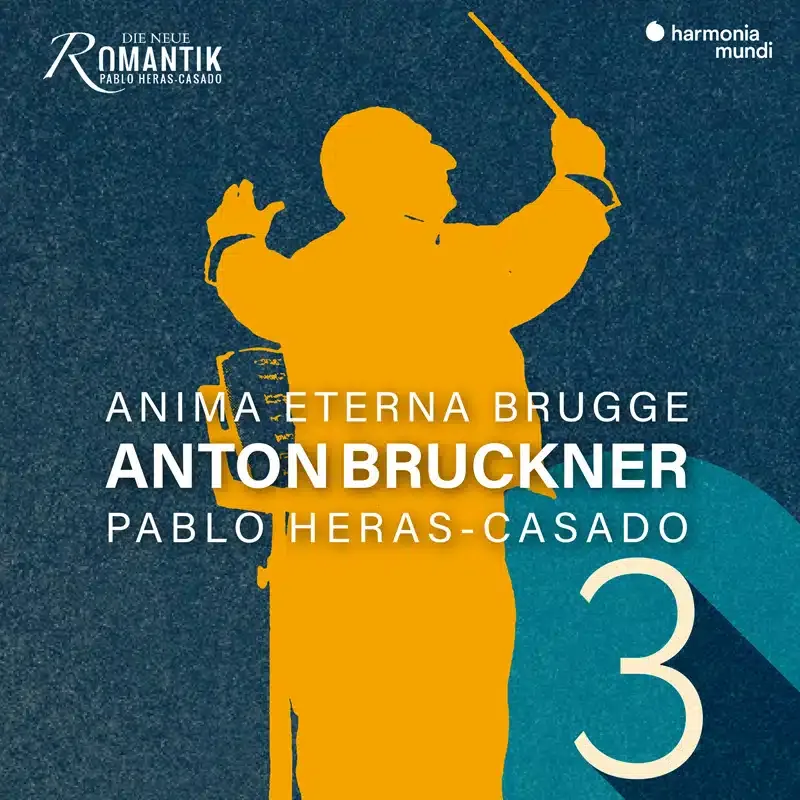
The music of Anton Bruckner (1824-1896) can be overwhelming, but it doesn't have to sound heavy for that. This new recording of his Third Symphony by Anima Eterna Brugge and Pablo Heras-Casado proves that from the opening bars. The choice was made for the original score from 1873 – the version that the composer himself never got to hear in the concert hall and which only sounded for the first time in 1946.
Bruckner completed the symphony at the end of 1873 and immediately traveled to Bayreuth to offer Wagner, his great model, the dedication of the new symphony. The broad, almost deferential devotion on the title page is aptly described in the CD booklet as "a verbal genuflection of the most subservient kind", but in the music itself that deference is nowhere to be heard: in this first version, Bruckner has already found his own way of building arcs of tension and working from small gestures towards monumental climaxes.
For precisely that reason, I don't regard the later revisions of 1877 and 1889 – and many other, well-intentioned arrangements by the Schalk brothers, but also by Peter-Jan Marthe and Joseph Kanz – simply as improvements. They polish away too much, in my view, of what is still tumultuous and sometimes surprising in its juxtaposition here. What can easily be considered a collection of not quite fully developed ideas in a first version sounds remarkably logical in Heras-Casado's hands: the many episodes, contrasts and highlights each get their place without the whole falling apart.
This approach has an impressive effect from the start of the first movement. The symphony sets in with incredible urgency and Heras-Casado leads the music directly towards the famous trumpet fanfare. The effect is tremendous: as a listener you are immediately drawn into Bruckner's narrative. After that, the music remains in constant motion, but without the tension being pushed towards one unbroken climax. There is room for unexpected slowing down and lyrical moments, after which the energy is picked up again each time. Especially the question-and-answer play between the different musical ideas works particularly convincingly: everything seems to follow one another naturally, so that the many entries and contrasts do not sound like loose fragments, but as parts of one larger musical movement.
Wagner is continuously present in the background of this score, with vague, skillfully woven reminiscences of his music – not by chance, for Wagner himself was allowed to choose which symphony Bruckner would dedicate to him, and he chose this Third. In the Adagio, however, this presence becomes very concrete: the Sehnsuchtsmotiv from Tristan und Isolde opens the movement almost literally, followed by the Schlafmotiv from Die Walküre in the mysterious passage afterwards. Yet you soon hear that Bruckner, despite his admiration, is no epigone: in this performance, the Wagnerian allusions are given full space without Bruckner's own, religiously infused voice being overwhelmed by them – a duality that gives the Adagio precisely that extra relief.
This movement also receives a flowing tempo from Heras-Casado. Usually I like Bruckner's slow movements somewhat broader, but here it works surprisingly well: there is still room for slowing down and quieting, the music can withdraw only to start moving again, without the arc of tension breaking. The orchestral solos don't get bogged down anywhere, but get the chance to unfold. The movement breathes and continues to speak, so that ultimately the tempo preoccupies me less than the naturalness with which everything meshes.
What distinguishes this recording especially from common discography is the sound world itself. Anima Eterna Brugge plays on historical instruments from the second half of the nineteenth century: Viennese horns by Leopold Uhlmann, trumpets in F after Ferdinand Roth, valve trombones from Linz and Viennese timpani with goatskin heads. It produces a more transparent, drier and at times deliberately angular sound – far from the luxurious velvet we usually associate with Bruckner, and closer to the sound world that a nineteenth-century audience might have known.
The woodwinds sound clear, the strings have a fresh suppleness, the brass gets brilliance and at times a pleasantly rough bite, and the timpani give the rhythmic drive a dry directness. However, this instrumentation is not an end in itself: it ensures above all a clear relationship between the orchestral groups and makes the internal workings of the score more audible.
The Scherzo perhaps benefits most from that sound world, with a dancing, lightly rough energy that doesn't obscure the folk roots of the music. Here Bruckner sounds not like the revered symphonic giant, but as a composer who takes pleasure in rhythm and movement. In the Finale, Heras-Casado keeps the tempo quite tight, without forcing the music. Here too, a remarkable number of details remain audible: the music gains momentum without losing articulation, and the many entries, accents and mood changes together form a convincing musical flow.
Perhaps that is ultimately what makes this recording so special: everything comes in organically and effortlessly. More than once you have the feeling of listening to a live performance, not because there are coincidences or imperfections to be heard, but because the music seems to unfold so naturally. The beauty of it is moreover that this performance does not present the Urfassung as a curiosity, but simply lets it sound – and then it strikes you how much this version already contains: the freshness of a composer who is not constantly putting his own ideas into question with himself.
Heras-Casado en Anima Eterna Brugge form after this extremely successful Third and the previously released, equally highly appreciated Fourth gradually a dream team for Bruckner. Hopefully the other symphonies will follow in the coming years – including the less frequently recorded Nos. 0 and 00. And why not also Bruckner's sacred works? This recording certainly leaves you wanting much more.
As a Bruckner enthusiast I have countless recordings of his symphonies in my collection. Yet this Third ranks at the top for me. I listened to it several times before I started this review and each time it held me captive. Perhaps that is ultimately the best measure: not that a recording tells you how you should listen to Bruckner, but that it makes you want to listen to it again immediately.
