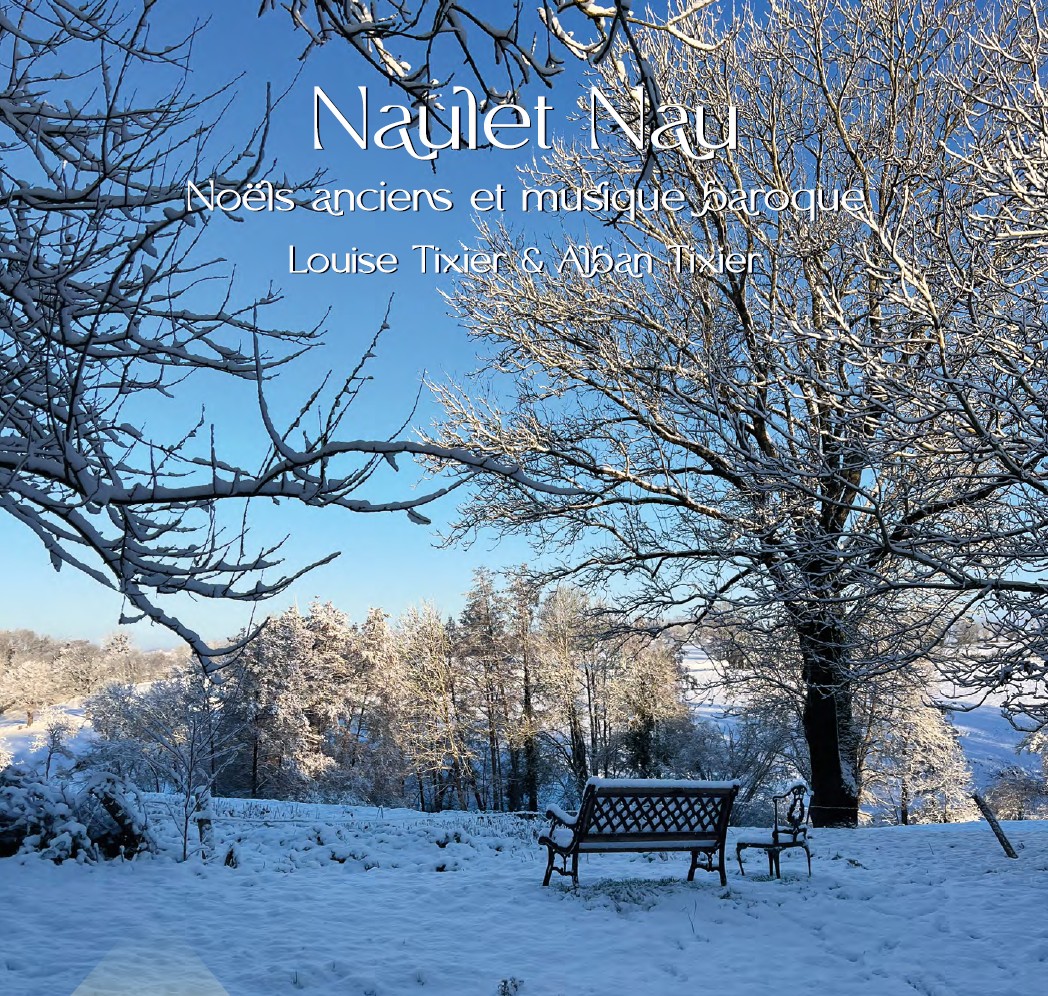
What a lovely Christmas CD! Naulet Nau is a very atypical appearance among this year's Christmas releases. Siblings Alban (24) and Louise (21) Tixier have succeeded in delivering a particularly atmospheric CD, full of beautiful and, for many, probably new melodies. It is a musical discovery that immediately charms me.
The music finds its origin in the rich tradition of the Grande Vendée, a region that comprises the present-day Vendée, parts of Deux-Sèvres, Anjou and Loire-Atlantique. For their repertoire, Alban and Louise have drawn both from the oral folk tradition and from historical musical sources. An important source of inspiration is the collection Trente Noëls Poitevins du XVe au XVIIIe siècle, a compilation of old Christmas songs that was reissued in 1908. In addition, they made use of the Vieux Noëls collections by Jérôme Bujeaud, who in the nineteenth century transcribed songs and melodies from the oral tradition. For the instrumental music, they found inspiration in, among others, the publications of the Société Française du Luth.
The result is a particularly engaging programme in which traditional Christmas songs, often in the old Poitevin dialect, alternate with instrumental works from the sixteenth and seventeenth centuries. Renaissance and Baroque meet here in a very natural way. It is music from a transitional period between the Renaissance and the Grand Siècle, yet at the same time music that does not feel like a historical document at all.
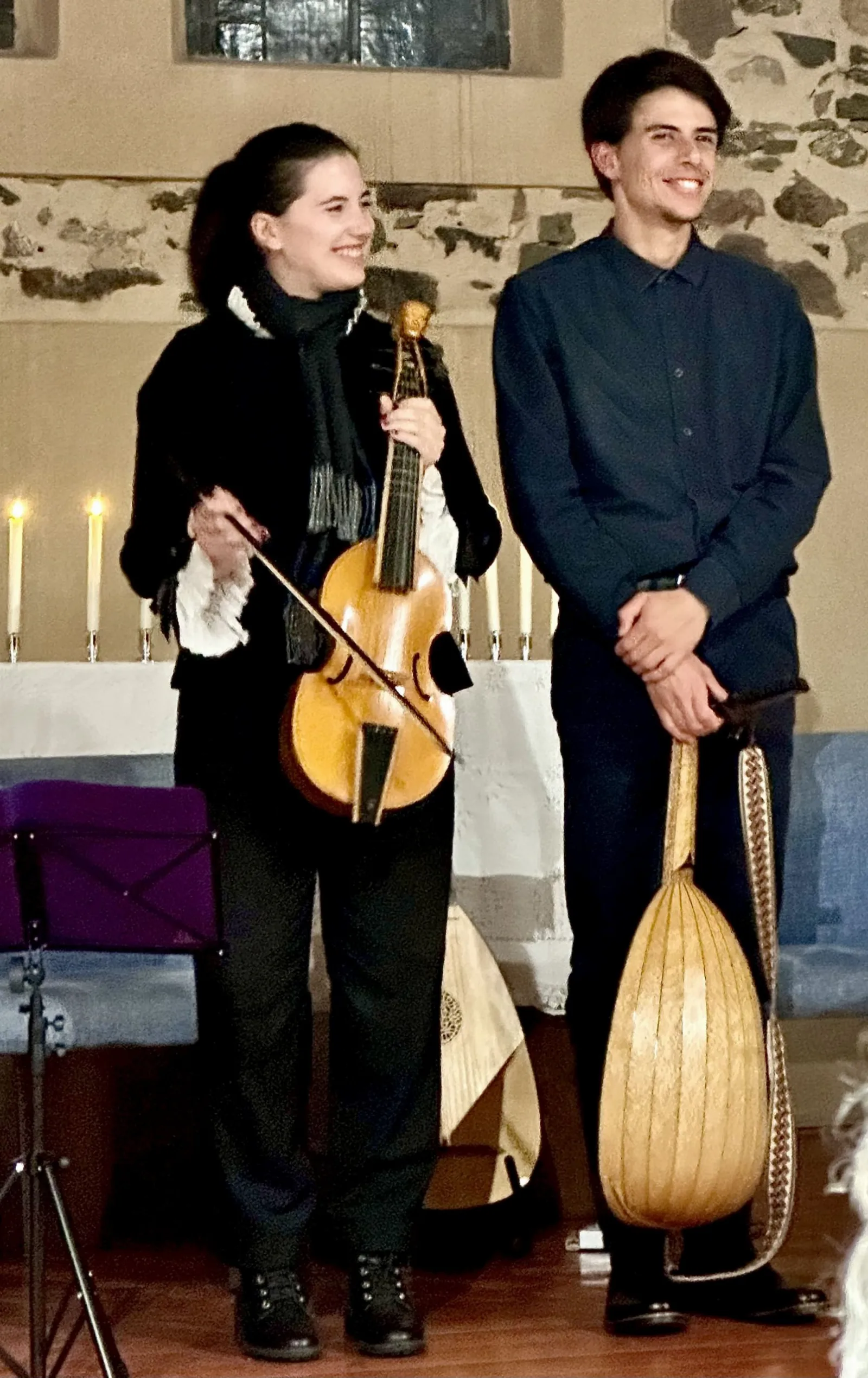 When you read in the booklet about the background of these two young musicians, you immediately understand why I dare to say that this music is in their blood. They grew up in an artistic family, in which music, theatre, dance and the visual arts are a natural part of daily life. Moreover, they live together with their family in the fifteenth-century Fief de la Maison Neuve in the Vendée. The historical setting and the artistic upbringing together form a particularly natural breeding ground for this repertoire. Alban and Louise, by the way, have been performing on stage since the age of five and have played together for many years. That familiarity can be heard in everything.
Alban and Louise master their historical instruments superbly. The lute, the guitar and the theorbo, complemented by the viola da gamba, create a particularly warm and authentic sound world. Louise's voice also deserves special mention. She has a very personal, individual vocal timbre, far removed from the classically trained singing voices we usually associate with early music. And it is precisely there that much of the charm lies.
The recording is moreover beautiful: very close, warm and intimate. Louise sings as if she were simply sitting by the fireside, together with her family, on Christmas Eve or on another winter evening. Outside it is freezing hard enough to crack, inside a wide circle of family and friends has gathered. There is singing, playing and listening. If a CD succeeds in evoking that image of a warm blanket for you, then for me that is already a particularly great achievement.
The individual songs also offer many discoveries and interesting historical references. Take, for example, Une jeune fillette. In the version by Jehan Chardavoine, it tells of a young maiden who, during her prayer, is visited by an angel and learns of the mystery of Christ's birth. The song refers to the Immaculate Conception and had been particularly popular since the early Renaissance. It was arranged by various composers in the centuries that followed. The booklet even mentions Eustache du Caurroy as a possible candidate for authorship. A beautiful example of how a melody finds its way through the centuries and is repeatedly reinterpreted.
Another lovely discovery is Noël Maraichin. This traditional song from the Vendée tells of the birth of Jesus during an icy-cold winter. Mary and Joseph find shelter in a simple stable, where the wind blows in and the conditions are anything but comfortable. As Mary lays the child in the manger, the angels sing of the peace that Jesus is bringing to earth. The precise origin of the song can no longer be traced. Through oral transmission, the melody has evolved over time and its original dating has remained uncertain. That is precisely what makes it so special: we hear here a piece of living folk culture, passed down from generation to generation.
And then there is La Dame Blanche, the final track of the CD. This song is a contemporary composition by Laurent Tixier, the father of Alban and Louise. At first sight, it is about the barn owl, which in popular speech is also called the white lady and appears at night above rural roads and villages. But as the booklet rightly indicates, one may just as well see in that white lady a reference to Our Lady, to the purity of her white mantle and the hope she brings in the darkness.
The commentary on the song goes a step further and refers to the words of Christ: man must bring to life the divine that is present within himself. And precisely therein lies, in my view, the great power of this music and of this CD. It is not only about preserving and performing old music. It is also about what that music can still mean today. Christ challenges us to bring out the divine, the good within ourselves, every day anew. In times when spirituality and connectedness seem to receive less and less room and are sometimes even ridiculed, that is a message that remains particularly relevant.
Naulet Nau is thus much more than a musical document about the music from the transitional period between the Renaissance and the Grand Siècle. It is a CD that you should keep in your CD collection as a kind of household item. One you regularly reach for, not necessarily to discover something new, but simply to let that specific atmosphere resonate through the house once again. And each time, you will notice how special it is.
As you can see, I am quite enthusiastic about this discovery! This is absolutely a CD that belongs in the company of the other remarkable Christmas CDs.
So get it into your home, settle into your armchair or favourite chair, take the time to let time stand still, and listen to the beautiful playing and the warm singing of brother and sister Tixier. You will not regret it!