

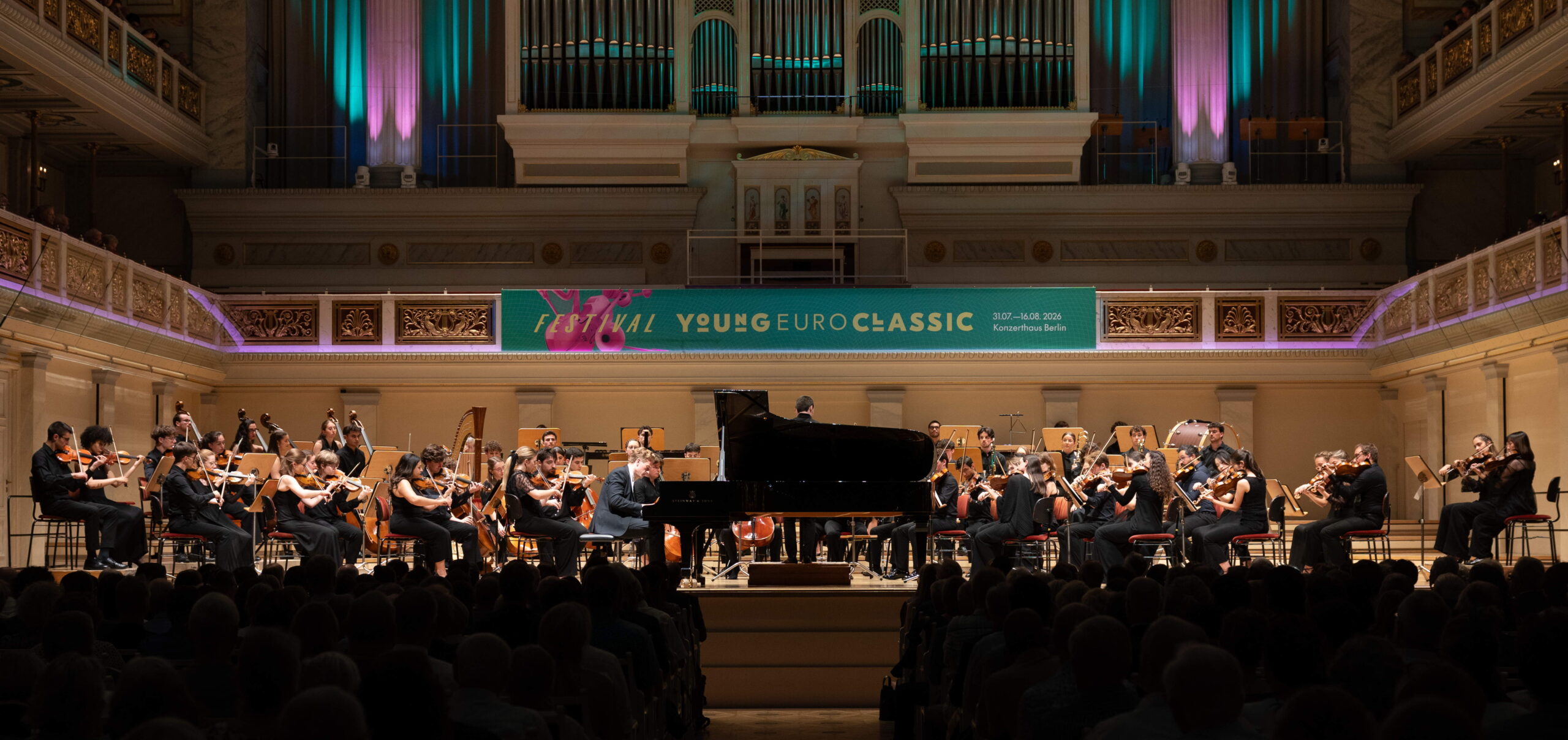
It is a warm summer evening in Berlin when the Orchestre National des Jeunes du Luxembourg performs for the first time during Young Euro Classic on Sunday, August 2. It is a pity that the hall of the Konzerthaus at the Gendarmenmarkt is not completely filled, because this young orchestra clearly has something to say. Fortunately, there are noticeably many young people and children among the audience.
The ensemble, barely five years old, brings together fifty to seventy young musicians between thirteen and thirty years old per project and reflects the international diversity of Luxembourg, with talents from more than twenty-five nationalities. Under the direction of Pit Brosius, an atmosphere of trust and musical pleasure is created immediately.
The evening begins with the festival hymn by Iván Fischer (°1951), a playful, somewhat Kurt Weill-like opener, after which two orchestra members greet the audience first in Luxembourgish and then in German. The witty reference to the elephant that will make its appearance literally and figuratively later in the evening immediately creates a relaxed atmosphere – professional, but without losing the spontaneity of young musicians.
Music as inner space
Next comes If the bell rings, why should we run? by the young Luxembourgish composer Hy-Khang Dang (°1996), who studied composition in Brussels, Paris and at the Guildhall School of Music and Drama. The work experiences its German premiere in Berlin.
 The title is a quotation from Henry David Thoreau's Walden, in which the writer retreats to a cabin to think about what is truly essential. The festival program links the evening around the idea of the musical retreat, from Thoreau's cabin to Rachmaninoff's villa Senar. Dang describes his composition as an inner space in which thoughts, voices and aphorisms from Thoreau's text move about – an idea that becomes particularly convincingly perceptible in the music.
Dang builds his composition from sound clouds from which individual voices gradually emerge. The result is intriguing music, brought with iron strength and dedication by the young Luxembourgish musicians. Particularly surprising are the moments when orchestra members declaim passages from Walden, sometimes alone, sometimes in chorus – a variation that both surprises and works. The literary element feels nowhere like an afterthought, but becomes an organic part of the musical event. If the bell rings, why should we run? Why should we let ourselves be rushed? It is a question that also enters the concert hall.
The strength of this performance is that the work does not receive polite applause. This is a composition that makes you curious and that you want to hear again, precisely because there still seems to be so much undiscovered on a first listening.
When Rachmaninoff begins to breathe
After Thoreau's contemplative world comes Sergei Rachmaninoff (1873-1943), and with it a completely different musical language. His Rhapsody on a Theme of Paganini forms a masterful synthesis of virtuosity, lyricism and dramatic tension. This work easily tempts a display of pianistic bravura, but pianist Joseph Moog plays each variation with dedication rather than mere showmanship. His technique seems self-evident, but it is especially his ability to maintain a large dramatic arc across the twenty-four variations that impresses. Rachmaninoff also incorporates the medieval Dies irae, which runs as a dark undercurrent through the work from the seventh variation onwards.
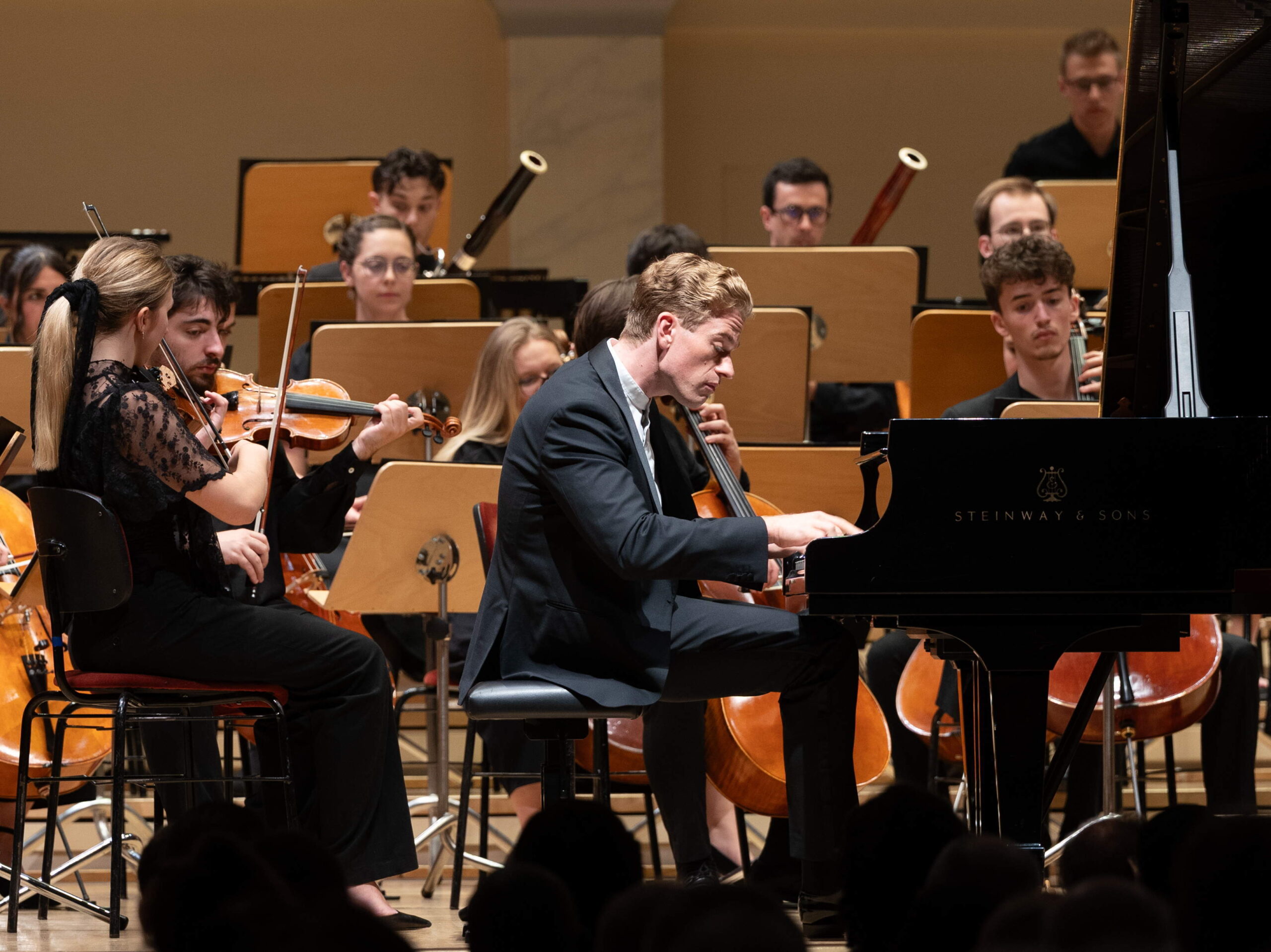 The orchestra initially builds carefully on the rich sound world, but from the Dies irae onwards the performance gains increasingly more glow and dramatic power. Moog remains fully immersed in the musical story. The famous eighteenth variation receives an exceptionally lyrical character and slowly blooms into a truly goosebump moment. When the final fireworks burst, the exuberance feels almost like liberation after the dark Dies irae thought. The orchestra shows its full power: sharp, energetic, with a remarkable sense for the big picture. The interplay between Moog and the orchestra is one of the great strengths of the performance: not a soloist floating above an accompanying orchestra, but truly making music together.
As an encore follows Gershwin's 'S Wonderful – Moog visibly enjoyed working with these young musicians, to the great enthusiasm of the audience. He closes the first half with a melancholic, idyllic Canon, op. 65, by Alkan.
Elephant in the china shop
After the intermission, restraint is over. Igor Stravinsky's (1882-1971) Circus Polka, originally written for an elephant number at Barnum & Bailey circus, sounds magnificent and accurate, full of humor, sharp dissonances and rhythmic surprises. The young musicians visibly enjoy the unexpected accents, while Brosius with his light, flexible conducting style gives the playfulness full room.
The Firebird flies
With the suite from L'Oiseau de feu, the concert reaches its artistic climax. Stravinsky was only 29 when he broke through with this ballet in Paris. The dark opening in the double basses is impressive and immediately striking; from that dark sonic world, a musical fairy tale unfolds slowly, in which each orchestra section gets its own colour. That every solo passage convinces is by no means a given for a youth orchestra – and yet here every soloist seizes his moment with precision.
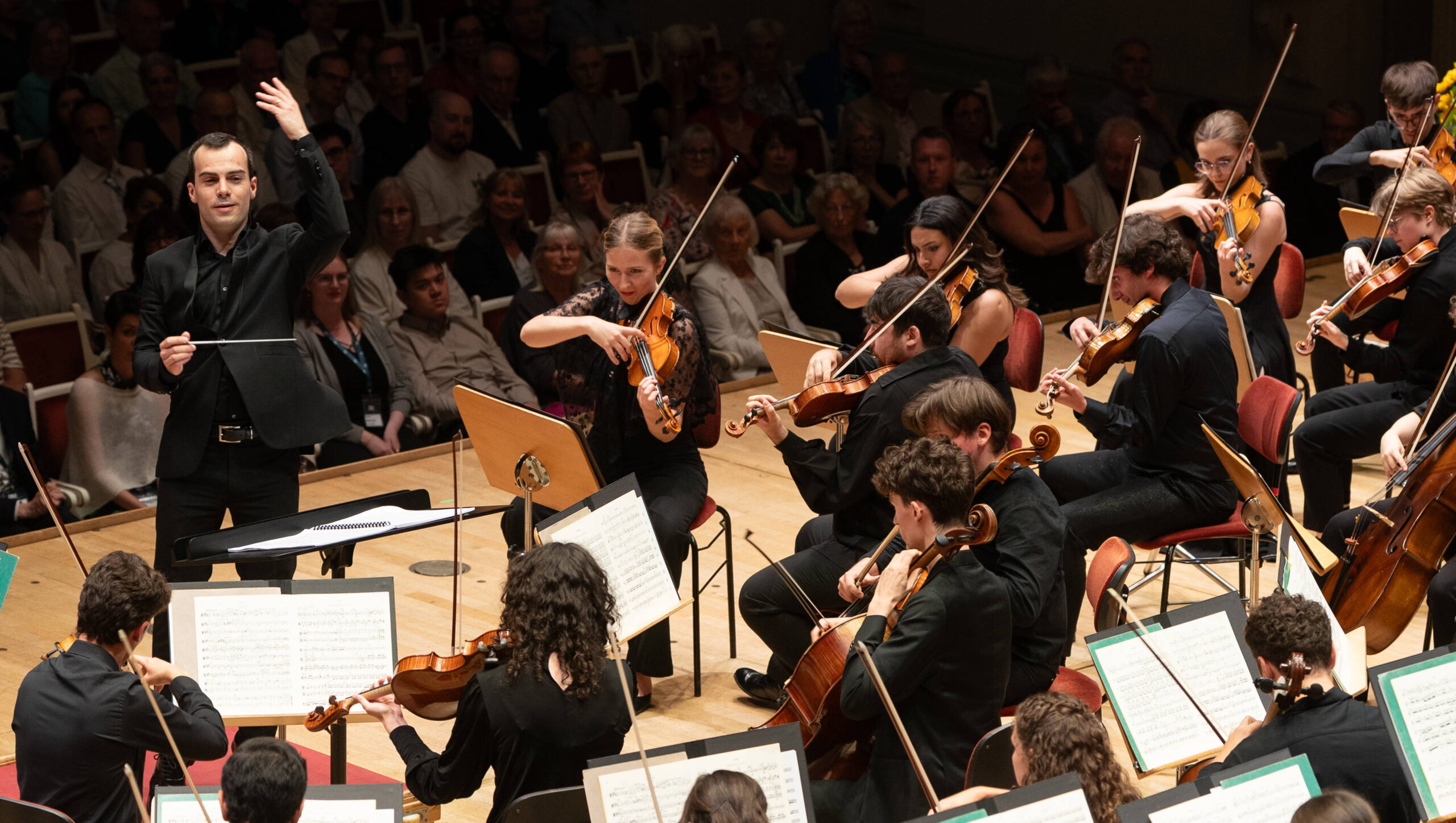 The orchestral passages are intense, with beautifully calibrated brightness, but nowhere is strength confused with volume. Brosius builds tension without forcing the music, so that the Danse infernale ultimately bursts forth as an orgy of sound: precision, energy, daring and enormous commitment. The climax towards the end is also phenomenal. The orchestra sounds here like a tight-knit musical community that knows how to find each other blindly. The young musicians don't just play the notes; they tell a story together.
When the final sounds fade away, applause erupts in the Konzerthaus – a sincere recognition of an exceptional evening.
An orchestra that stands out
Much credit goes to Pit Brosius, who founded the orchestra in 2021 and built an ensemble that performs with confidence in a short time. His conducting style is accurate and clear, but never authoritarian: he knows exactly what he wants, without limiting the musicians.
The Berlin debut of the Orchestre National des Jeunes du Luxembourg was much more than a promising introduction: this is an ensemble that claims its place. Joseph Moog confirmed his reputation as a pianist of international class, while the young musicians themselves provided the strongest proof of what is possible. An ensemble that you would also like to hear with us after such an evening.
Young Luxembourg shines, and it would be a shame if we were to see its light too little.