Through the eyes of death, man beholds his own reflection — and discovers only what he himself has given.
Under the expansive sky of the Weimarhallenpark, on Sunday, August 17, 2025, no ordinary performance unfolded, but an inspired journey: Jedermann, the timeless morality play by Hugo von Hofmannsthal (1874-1929), was reborn in a form that rarely reaches the horizon of theater. Director Nicolai Tegeler chose restraint over spectacle, depth over external splendor, and created a performance that did not impress through display, but clung to inner authenticity. It became a meditation on mortality, loss, and reconciliation, in which language, breathing, silence — and the night itself — inhabited the stage.
An existential journey between heaven and earth
Hofmannsthal's Jedermann, rooted in the medieval Everyman and written in 1911, during the suffocating prelude to the Great War, is steeped in an almost sacred language. The story of the wealthy Jedermann, who at the height of his power meets Death, poses the eternal question: what remains when everything disappears? His wealth, friends, and loved ones turn away from him; only faith, good deeds, and conscience remain in his final hours.
"Was hilft mir Reichtum, wenn ich sterben soll?"
"What good is wealth to me if I must die?"
In Weimar, the city that breathed Goethe and Schiller, this centuries-old text gained new vitality. Nature was no mere backdrop, but an engaged co-player: the whisper of the trees, the gathering darkness, the starlit sky as the vault of transience — everything breathed together with the play, everything contributed to the power of the message.
Julian Weigend: vulnerability in its deepest form
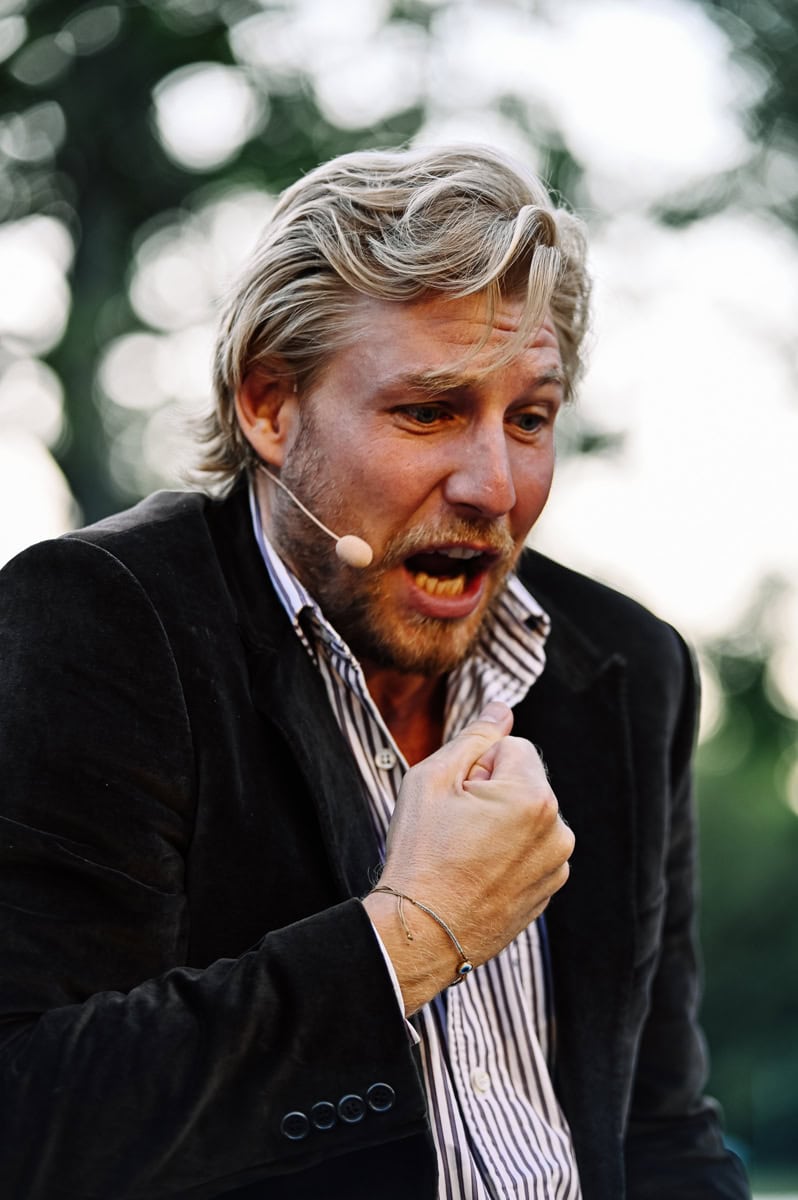
Julian Weigend was the beating heart of the performance. He sketched no stereotypical wealthy man, but a human in crisis. His loneliness and fear were palpable, his vulnerability awakened deep empathy in the audience.
In the opening scene, we saw him as a self-assured, almost indifferent man, surrounded by revelers. His posture was arrogant, his words powerful, but beneath that façade lurked doubt. The confrontation revealed an inner conflict: the desire for pleasure clashed with aversion — a tension that Weigend subtly played out, both through his physical expression and through variations in his voice's tone and volume.
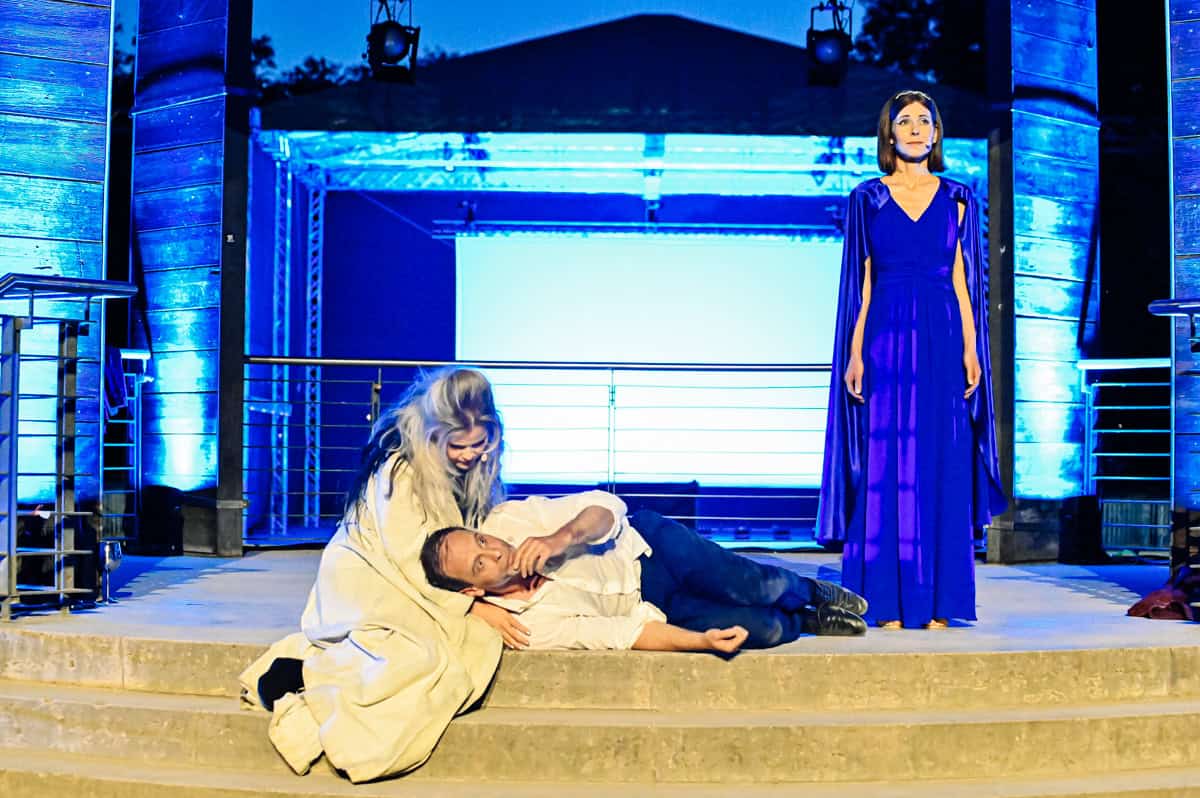
When Death appeared, Weigend's façade completely crumbled. His powerful bearing gave way to smallness, to the vulnerability of a man confronting his own mortality. With a trembling voice, he spoke his surrender: "Wie du mich hast zurückgekauft, so wahre jetzt der Seele mein." "As you have redeemed me, so now preserve my soul."
The silence that followed was almost tangible; his breathing determined the rhythm of the moment, the audience was drawn into the weight of the event. Here Weigend showed with minimal means maximum emotion.
In his encounter with Gute Werke, his inner struggle between guilt and hope became beautifully visible: initially skeptical and rejecting, he ultimately seeks support and forgiveness. His restrained gestures and embarrassed gaze testified to profound control.
Weigend made of Jedermann an archetype of human vulnerability, a search for meaning at the end of life — a human who completely exposed himself to his mortality, his body and voice as instruments of his inner struggle.
Thomas Thieme: Death as calm, inevitable presence
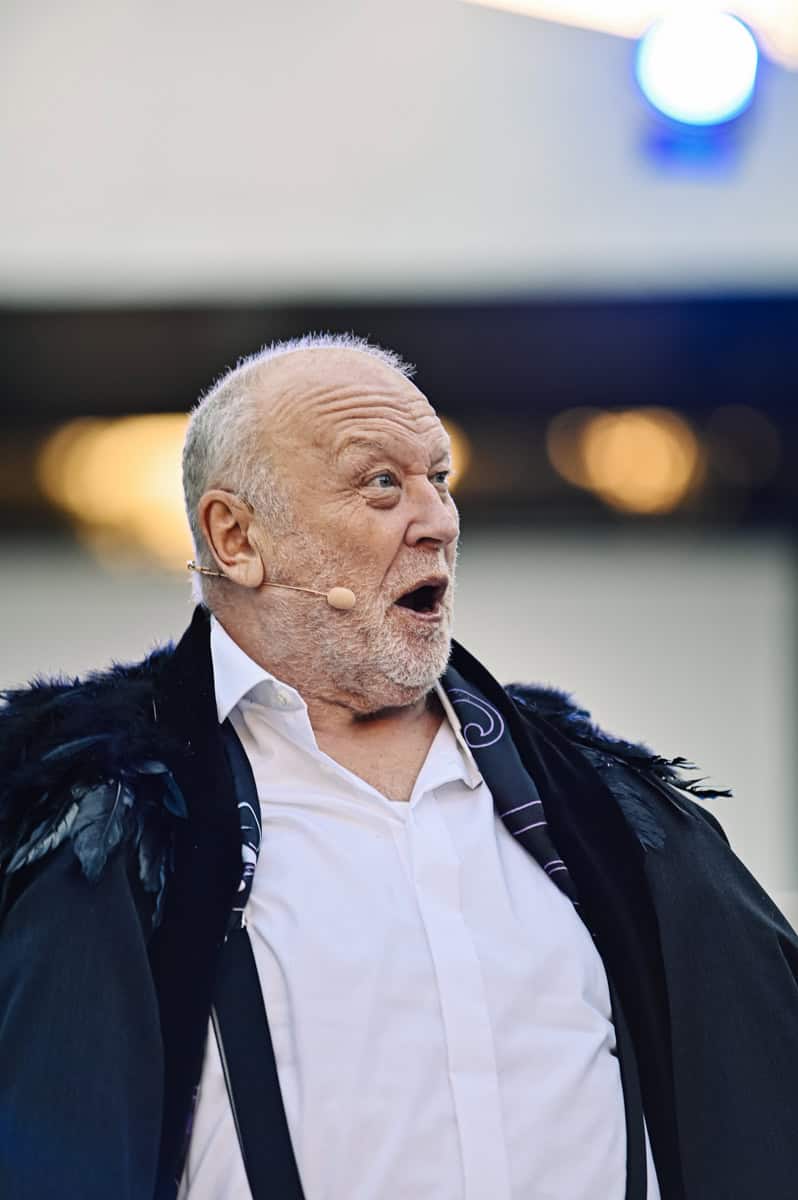
At 75 years old, Thieme brought Death that seemed not of this world, stern and ancient, yet without hostility. His voice was heavy as stone, every sentence irrevocable. No theatrical grin, no terrifying specter, but a calm, inexorable truth that reflected the inevitable. His voice, deep and somehow soothing, bore the words as an inescapable pronouncement: "Ich bin der Tod, der niemand verschont." "I am Death, who spares no one."
With monastic sobriety, a slow gait, and complete control, Thieme transcended the human and became Death an almost philosophical, serene presence that radiated nothing but peace.
An ensemble as moral mosaic
Where Weigend was the beating heart, the ensemble wove the soul around him. It was a hall of mirrors, in which Jedermann lost his masks, layer by layer. Each character stood not only for itself, but for an aspect of the human condition: sin, vanity, loyalty, faith, temptation, loss, conscience. The strength of this cast lay in its harmony: each brought something unique, yet together they sounded like an ethical chorus.
-
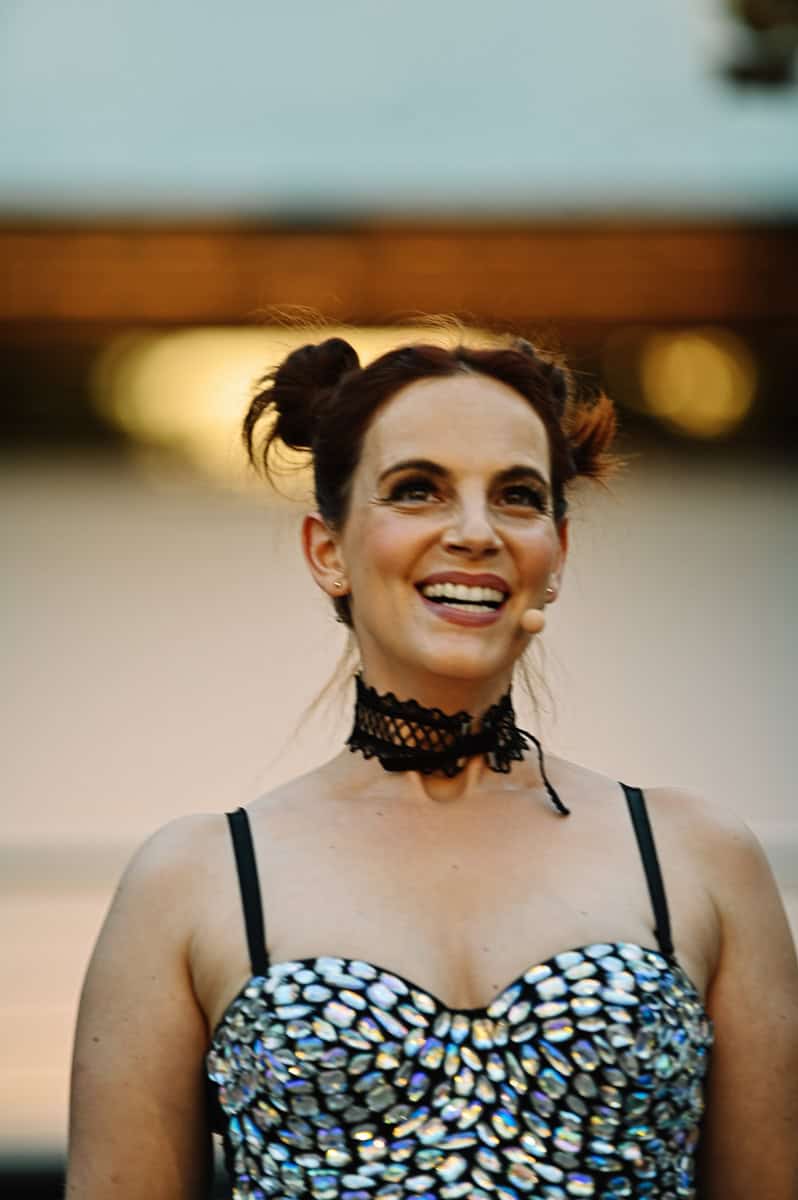
Susanne Bormann – Die Buhlschaft (Beloved) "Ich bin kein Weib fürs Sterben, nur fürs Leben." "I am no woman for dying, only for living."
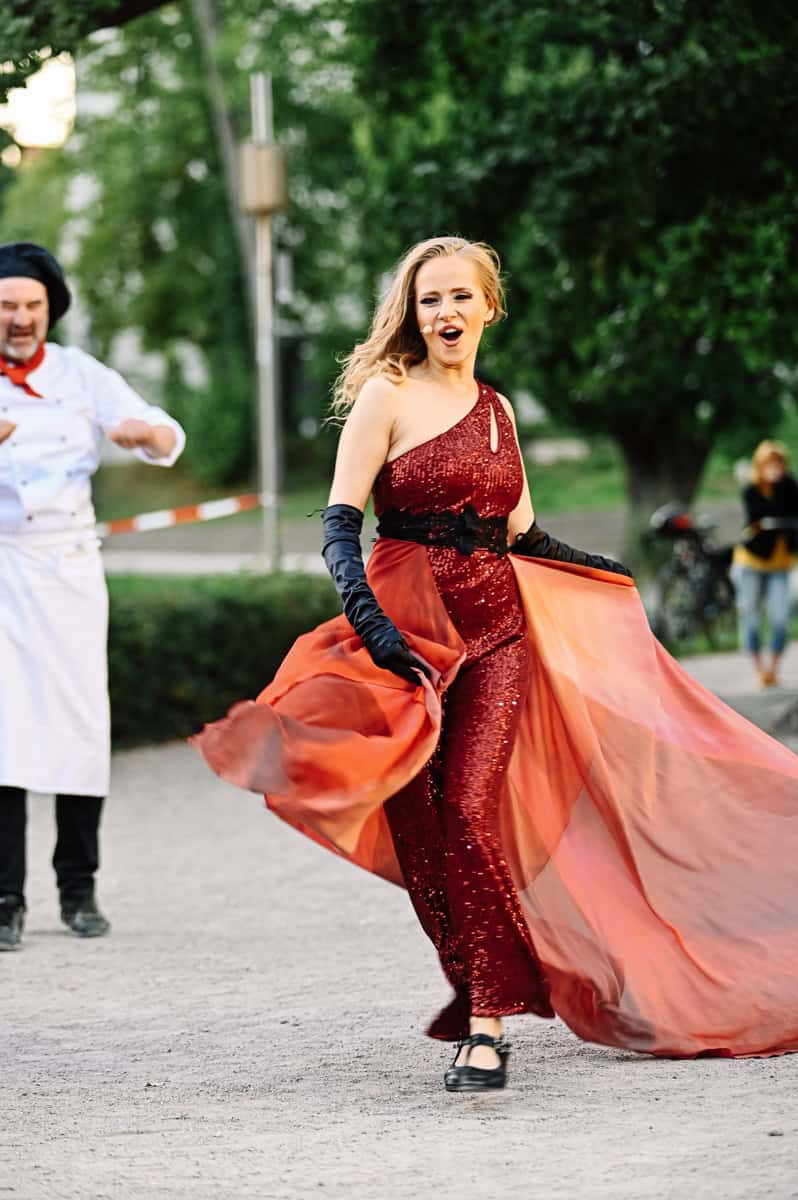
Bormann played not a beloved woman, but an icon of desire: radiant, graceful, yet inwardly empty. Her presence was palpable, her gaze icy cold. She breathed physicality, but without intimacy — a vision of possession that tolerated no closeness. In her confrontation with dying Jedermann, she showed no compassion, only the pragmatism of worldly love. Her posture, slightly turned away, her words — flat, yet sharply spoken — made clear: she resolutely chose life, not loyalty.
-
Ralph Morgenstern – Mammon "Du hast mich nicht geliebt – nur gebraucht." "You did not love me – only used me."
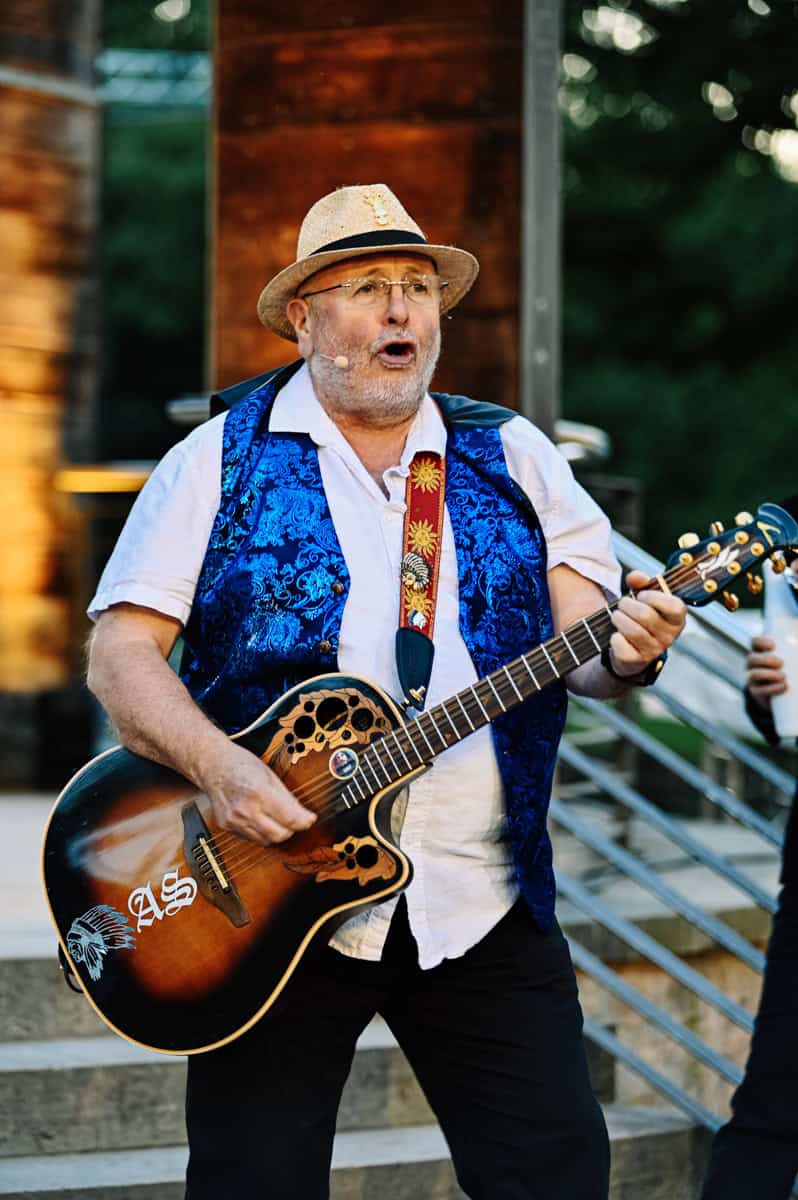
Morgenstern embodied money itself — brilliant, glittering, but with an undertone of icy mockery. Clad in gold and eccentric clothing, he played seduction with flamboyant flair, but beneath the glitter lurked moral emptiness. He was amusing, until he lowered his mask and let the truth – also for the spectators – fall like a cold coin.
-
Tine Wittler – Base "Wenn der Mensch kommt, dann gilt das Wort." "When the human comes, the word holds true."
Wittler brought lightness and irony, but no complacency. Her Base was sober, worldly-wise, someone who did not deny death, but neither made it more dramatic than necessary. With a sharp eye and a spark of humor, she balanced between mockery and seriousness.
-
Michaela Schaffrath – Gute Werke (Good Deeds) "Was ich getan, das bleibt." "What I have done remains."
Schaffrath brought Good Deeds as something that grew slowly, from fragile to powerful. Her voice was soft, yet firm; her gestures small, yet charged. When Jedermann finally allowed her near, the energy shifted: here rang the return of hope. Her physical proximity became comfort, not duty.
-
Alma Rehberg – Der Glaube (Faith) "Ich bin bei dir gewesen, doch hast du mich nicht erkannt." "I was with you, but you did not recognize me."
Rehberg radiated a quiet, resolute presence. Her faith was not a dogmatic voice, but a whisper that became audible only in silence. Her performance was subtle: soft hand gestures, a soothing gaze, and a voice that sounded like the conscience you could not ignore, no matter how hard you tried.
-
Bernhard Bettermann – Der Teufel (The Devil) "Was recht ist, muß Recht bleiben: er gehört mir!" "What is right must remain right: he belongs to me!"
Bettermann played the devil without theatrical grimace. No fiery demon, but a calculating player. His evil was businesslike, his wrath based on justice, not revenge. He too eventually departed.
-
Reiner Schöne – Die Stimme Gottes (God's Voice) "Jedermann, du musst Rechenschaft geben!" "Jedermann, you must give account!"
Schöne was no physical presence, but his voice filled the Weimarhallenpark with thunderous majesty. Not comforting, but absolute. A voice that left no room for doubt or negotiation.
Together, this ensemble formed a living moral tapestry. Each character was a facet of the human condition: greed, temptation, vanity, goodness, faith, guilt, fear, hope. They never stood apart from Jedermann, but mirrored, enriched, and questioned him — and thereby us. In their interplay, no chaos emerged, but clarity: a hall of mirrors in which humans saw themselves, naked and true.
Direction as meditative sculpture
Nicolai Tegeler chose a sober, contemplative approach in which text and nature played the lead role. No bombast, but a refined staging in which light, sound, and silence were deployed surgically. Nature breathed along: the rustling of leaves, the wind moving through the trees, the falling evening — everything created a poetic space that invited reflection. Stillness, breathing, waiting, gazes: moments in which the unspoken came to life. Tegeler showed theater as an inner journey, a listening sculptural work that challenged the audience to reflect.
Music as conscience whisper
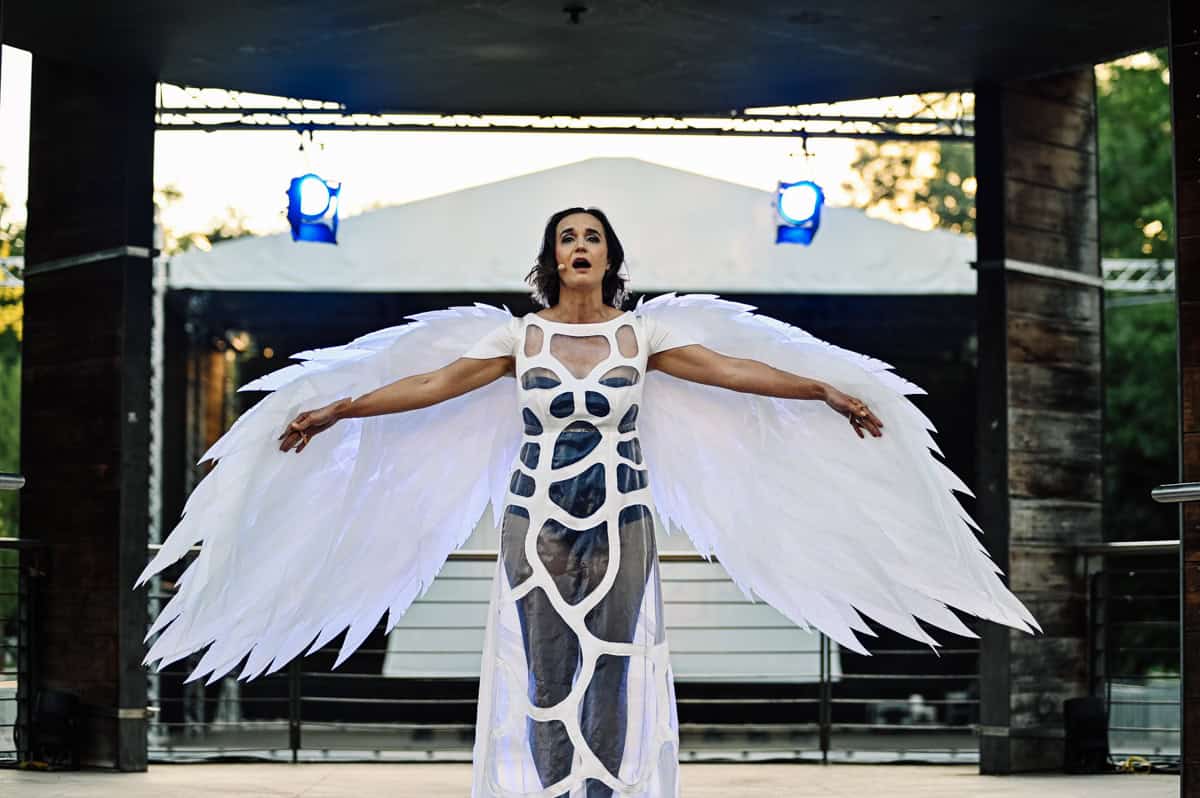
The musical interludes by Maya Forster, dressed as an angel with wings, added depth. Her voice was not an ornament, but an inner echo of Jedermann's struggle — a whisper of hope, connection, and forgiveness that created space beyond language.
Hopefully Jedermann returns to Weimar
Tegeler has found the key to the living heart of Jedermann. Hopefully he will succeed in bringing this work to Weimar again next year, a city steeped in culture and history. Here the piece finds its true meaning as a mirror for the soul, as an invitation to self-reflection. From the first minute you are drawn into the story, and before you know it, two hours have passed, during which you have traveled the path of mortality with Jedermann.
More than theater: an incantation
This Weimar edition of Jedermann was no extravagant spectacle, but a quiet call to reflection, a whisper from the past that found its meaning in the silence of the moment. It did not ask for dramatic answers, but invited the audience to ask the question themselves: what remains when everything falls away?
Tegeler proved that classical repertoire need not be a frozen relic, but a living organism, a conversation between past and present. This Jedermann was not a scream, but a soft breath, inviting the spectator to rediscover the depth of human experience. In the silence of the evening, where everything faded, the question itself became the most intimate answer. Jedermann reminded us of the essence of our existence — an invitation to find, in the emptiness of the moment, something that endures…