

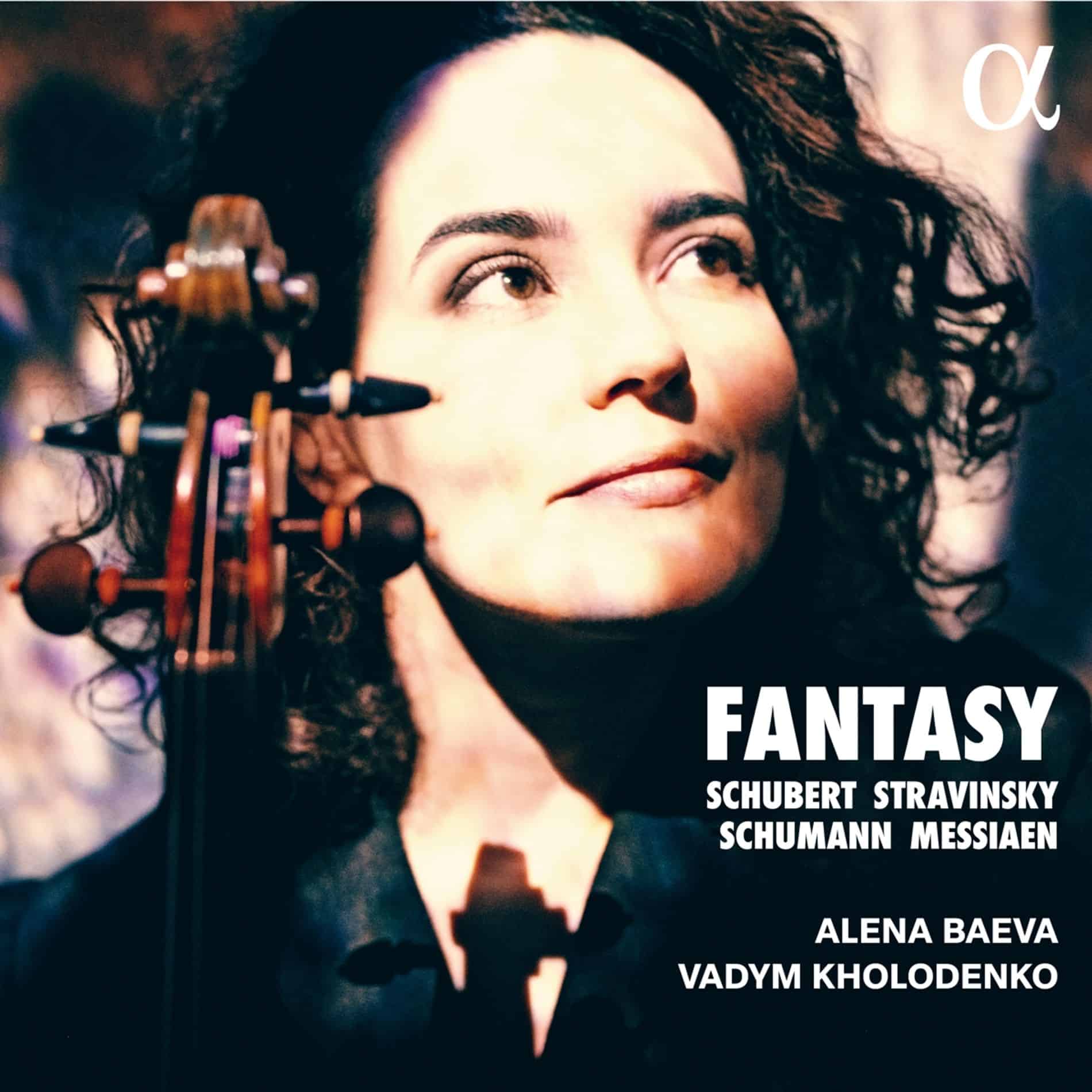
Fantasy - Schubert | Stravinsky | Schumann | Messiaen Schubert: Fantasie in C, D 934 Stravinsky/Dushkin: Divertimento Schumann: Märchenbilder op. 113 Messiaen: Fantaisie
I am pleased with this album because, apart from Schubert's Fantasie D 934, it does not concern repertoire that has been exhaustively recorded, a problem (if it may indeed be called that) that manifests itself increasingly strongly as time progresses and thus the 'stock' that has been assembled grows. What should we do with the umpteenth Eroica, even if it is – as I have discussed before – performed by the Budapest Festival Orchestra under Iván Fischer? It is an arbitrary example on this 'overgrown path'. A breath of fresh air then when we get to hear Messiaen's Fantaisie from 1933, admittedly an early work, but in which we can already hear the harbinger of the Quatuor pour la fin du temps. He wrote it during his stay in the camp Stalag VIII-A, in the German Görlitz, where it, amidst 400 prisoners and guards, was premiered on 15 January 1941 by four fellow prisoners on partly borrowed instruments (the composer certainly exaggerated when he claimed that 5000 people listened to it then). Also interesting is Stravinsky's Divertimento, a suite compiled from the ballet music for Le baiser de la fée, created in virtually the same year (1934) as Messiaen's Fantaisie. Both the Divertimento and Le baiser are still treated as step-children in the music business. Good then that the Divertimento (here for violin and piano in the arrangement by Samuel Dushkin and thus not in the much richer orchestral version, which does not detract from its importance) is included on this cd. Then Robert Schumann's Märchenbilder, four extraordinarily beautiful mood pictures filled with musical poetry, of which in particular the final section (langsam, mit melancholischen Ausdruck) is of a deeply moving quality. We hear this piece here not for viola and piano, but for violin and piano, although the 'bronze' character of the viola would admittedly suit this work somewhat better. Schubert's Fantasie was still classified during the interwar period as casual chamber music, like so many works by this Viennese 'biedermeier' (in this context rather a disqualification than a compliment). What was overlooked then and in some circles is still overlooked is that 'der Schwammerl' (as he was called by his friends, namely a large mushroom in Austrian dialect), commonly portrayed as a 'little burgher', managed to make the giant leap in barely ten years from musically wandering adolescent to the great works such as the 'Unvollendete' and the 'Große C-Dur' symphony, the monumental last three piano sonatas D 958, 959 and 960 and the phenomenal, deeply felt String Quintet, alongside of course the song cycle Winterreise and the unimaginable depth of the last individual songs, brought together by the music publisher as a cycle under the title he devised Schwanengesang, published only after the death of the impoverished composer. Schubert completed the Fantasie in December 1827, less than a year before his death (he died on 19 November 1828). It is also his last composition for violin and piano, whose first performance he was able to witness, in January 1828, in the Landhaussaal in Vienna, by violinist Josef Slavik and pianist Carl Maria von Bocklet. How it went there we do not know, but we do know that it is technically a particularly difficult work for both instrumentalists and also does not lend itself easily to realization in terms of interpretation. According to pianist Nikolai Lugansky it even belongs among the most difficult music ever composed for the piano. The duo Baeva-Kholodenko does not shy away from it, however. Alena Baeva, born in 1985 in Kyrgyzstan (or Kirghistan), then still under Soviet rule, studied at the Tchaikovsky State Conservatory in Moscow and then took lessons in France with Mstislav Rostropovitch. Finally she studied in Switzerland with Seiji Ozawa and in Israel with Shlomo Mintz. Talent and intensive study soon bore fruit. She won the Henryk Wieniawski Concours in 2001 and the Niccolò Paganini Concours in 2004. As her career developed successfully, more and more orchestras and ensembles came into view. She maintains a special and warm artistic bond with Paavo Järvi. She has performed with a large number of orchestras and ensembles and also maintains a warm artistic bond: the conductor regularly invites her to perform with the Estonian Festival Orchestra and the NHK Symphony Orchestra in Tokyo. Unlike many of her colleagues (who, as world travelers, get through the year with only a few solo concerts), Baeva has no fewer than over forty solo concerts in her repertoire, including many modern and contemporary works. With Ukrainian pianist Vadym Kholodenko she forms – as can also be heard on this cd – a duo of great artistic stature. In addition, she plays chamber music with, among others, Martha Argerich, Steven Isserlis, Misha Maisky and Lawrence Power. In her home country we know her from her performances with the philharmonie zuid (now Philzuid) and the Orkest van de Achttiende Eeuw. She has also made a number of cd recordings (they can be found, among other places, on Spotify). Alena Baeva plays the 'ex-William Kroll' Guarneri del Gesù from 1738. The career of Vadym Kholodenko (Kiev, 1986) accelerated after winning the Van Cliburn Concours in 2013, until on 17 March 2016 a great personal tragedy announced itself in the loss of both his daughters, Michela (1) and Nika (5). Both children were killed at home in Benbrook (he had exchanged his native country for American Texas in 2014). Wife Sofia Tsigankova was arrested almost immediately thereafter on suspicion of murder. Not long afterwards, media reports appeared suggesting that her unstable mental state had led to this tragedy. On 16 July of the same year came the news that Tsigankova, after extensive examination of her mental condition, had been declared not responsible for her actions. During the memorial service preceding the funeral of his two children, Kholodenko played the Andante from Brahms' Third Piano Quartet, together with three members of the Fort Worth Symphony Orchestra with whom he – with a record contract from Harmonia Mundi in his pocket – had already made a number of recordings. Kholodenko and Tsigankova had been married for five years when in the summer of 2015 the divorce announced itself. From August on, the couple had already been separated from board and bed. It can be called a miracle that Kholodenko ultimately managed to pick up the thread of normal life again, accepting engagements again. The interpretation of the four works on this album show much character. We hear a beautifully coordinated couple that pairs a fervent tone with effortless technique. The full, rich tone of Baeva blends perfectly with the sonorous and crystal-clear keyboard sound in a journey in which the evocative aspects are given expression as much as the layered voice-leading. Without exception, these are disarming performances that sound fresh and spontaneous, often even intuitive in the underlying tensions and the carefully and refinedly applied tempo changes. In short, this is a recital that really matters and thus may be regarded as an important discographic acquisition.