

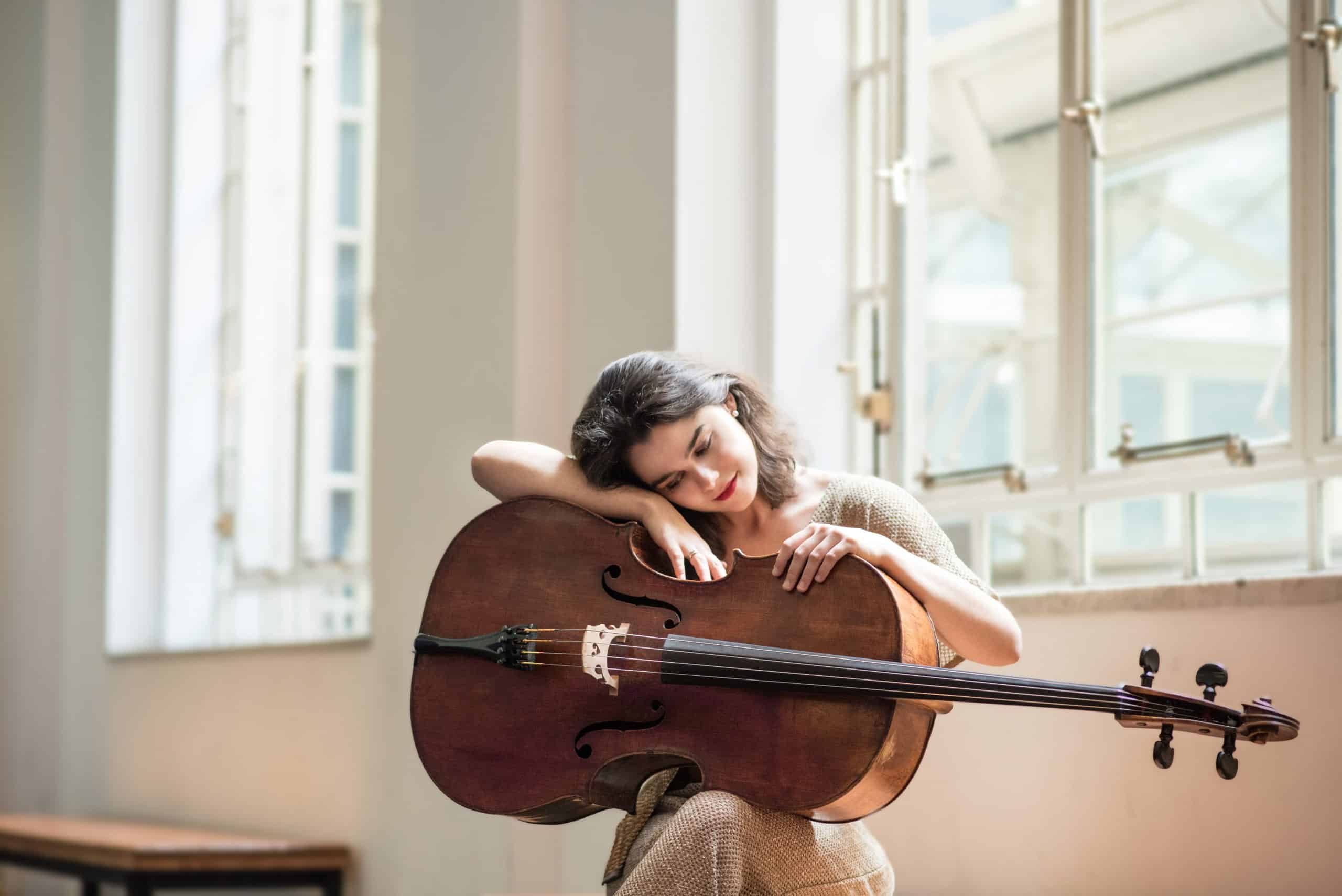
Swiss cellist Estelle Revaz has become an engaged activist for cultural policy in recent years, drawing attention to the situation of creative artists in the difficult circumstances created by the pandemic. Her artistic productivity remained unimpeded despite everything. The duo recording Inspiration Populaire with French-Argentine pianist Anaïs Crestin was a challenging undertaking in times of lockdowns and closed borders, as Estelle Revaz lives in Switzerland and Anaïs Crestin in France.
Inspiration Populaire presents the work of five composers, each of whom drew inspiration from the folk music of their native country. The album demonstrates how enriching such appropriations can be. Sensual rhythms and melodies in a modal structure permeate Manuel de Falla's (1876-1946) Canciones populares Españolas (1914). Leoš Janáček's (1854-1928) three-part Pohádka (1924 version) is spiced with a touch of Slavic melancholy. Robert Schumann's (1810-1856) Fünf stücke im volkston op. 102 (1849) favour the intimate Lied or song form.
The highlight of this album is marked by Alberto Ginastera's (1916-1983) Sonata for Cello and Piano op. 49 (1979). Born in 1916 in Buenos Aires, he later emigrated to Switzerland and lived, just as cellist Estelle Revaz does now, in Geneva. In this technically demanding composition with its dissonant idiom, elements of traditional South American music come to life. The final piece offers a stunning romantic contrast: terpsichorean and down-to-earth, David Popper's (1843-1913) Hungarian Rhapsody op. 68 (1893) brings an air of rustic jamboree. When Estelle Revaz and Anaïs Crestin first met at the International Festival in Mendoza, an immediate human and artistic bond formed between them. Since then, they have regularly toured throughout Europe and South America. Their enthusiasm for different cultures is reflected in their repertoire.


How did you experience the pandemic restrictions in your role as a musician?
The first lockdown was a real shock, I felt almost numb. Fortunately, a few months later I had a major recording project with three cello concertos as part of my residency with the Chamber Orchestra in Geneva. That project really helped me carry on and stick to my regular practice, as it was an inspiring goal. But already then I had to start fighting for protective measures so that the recording of Journey to Geneva could take place under acceptable conditions. The recording became a great success. During the second lockdown I was living in Germany. My last concert before the lockdown was extremely moving. I played as if it was the last concert of my life. The audience was also moved to tears. It was an unforgettable moment. The fact that everything fell apart again was very difficult to process. I began to wonder what role the artist actually plays in society.
Fortunately, a new recording project was on the horizon, titled Inspiration Populaire. To make this project succeed, I had to navigate between all kinds of restrictions... especially because the pianist lived in France and I was back in Switzerland. It was very complicated, but with a lot of creativity we managed it. After that, a fatigue set in, coupled with a kind of resilience. Music is and remains the captain of my life.
When did you decide it was time to raise your voice and fight for the survival of the cultural industry?
Shortly before the second lockdown, it was still legal in Switzerland to give concerts with one musician and nine audience members, for example in churches. I wanted to fight to the bitter end and so I organized 42 pocket concerts in different cities within a few days. All concerts were "sold out" within hours. I also managed to raise enough funds to pay the approximately 30 participating artists. Unfortunately, the Bundesrat banned all cultural activities on the day of the opening concert. In concrete terms, this meant that in a basilica with 800 seats, a mass with fifty people was allowed, but it was illegal to hold a concert for nine people in the same basilica. It also became clear to me that there was no legal precedent for the compensation of independent artists or part-time artists. So I had the choice between giving in to frustration or using my survival instinct to throw myself into the political struggle.
Was it difficult to be heard?
At first, I knew nothing about politics. So I simply went ahead and used my intuition. With my collective Kulturkollektiv, we wrote a manifesto that was strongly supported by the cultural scene. Then I decided to contact the members of parliament working in the responsible committees one by one, to personally sensitize them to the dramatic situation in the cultural sector and in particular that of independent, self-employed and part-time workers in the cultural sector. Across all political parties, I was received with openness and respect. Everyone was open-minded and eager to find solutions. We all worked together to change the Covid laws and cultural regulations. I really met fantastic people who are brave, passionate and persistent. The friendships that resulted from this were the most valuable thing that has helped me continue this struggle, which has been incredibly difficult and still is.
What demands did you make? Did you succeed?
In Switzerland, almost 50% of creatives and artists had already given up by March 2021 and were forced to reorient themselves and seek work in other industries. That was unprecedented. Financial support came late, but we were able to support approximately 50% of people in the industry. If we had done nothing, we would have lost even more. We were able to improve emergency aid by reviewing the eligibility criteria and restructuring the system. This way, we managed to introduce non-repayable emergency aid of 1500 Swiss francs per month for all artists. Artists were also allowed to give certain concerts without losing their right to emergency aid. We also enabled independent artists to be reimbursed retrospectively up to 80% of their financial losses before November 1, 2020.
And we succeeded in extending this right to intermittent artists, who previously had no right to emergency aid at all. This was a surprising victory, because to succeed we had to create majorities in seven parliamentary committees and in both parliamentary plenary sessions, we had to convince different ministries and cantons, and win the support of the Bundesrat. In November 2021, it was crucial to consolidate our achievements, which were at risk from the popular referendum on Covid legislation. I was personally heavily involved in this campaign, which was tough. I was a victim of slander and threats, which required police protection. After the legal basis was saved, we had to fight for the extension of this emergency aid until the end of 2022. Fortunately, that succeeded.
What's next on the agenda?
The cultural sector is devastated. It will need help to recover. The government must truly realize how great the damage is that the regulations of the past two years have caused. The government must propose concrete measures to reverse this trend and make a new start for the cultural sector possible.


Inspiration populaire
- WHO: Estelle Revaz [cello], Anaïs Crestin [piano]
- RELEASE: Alpha 796
- ORDER: JPC