

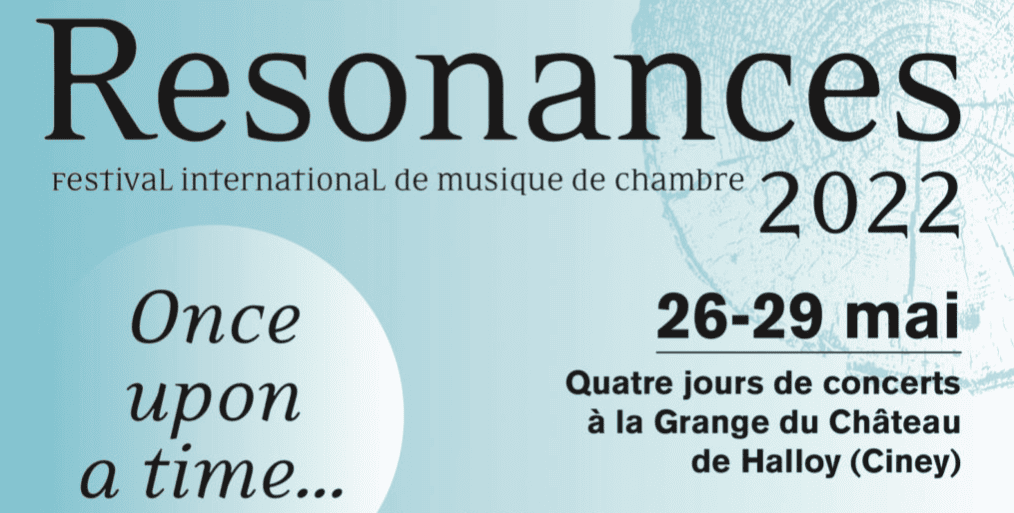
For two years, silence reigned in the barn of Kasteel van Halloy: Festival Resonances also fell victim to a persistent virus. But the enthusiasm for spending a week making chamber music with an international group of musicians is more intact than ever, as artistic director Amy Norrington and her husband Martijn Vink confirm in unison. "Many musicians are yearning to do this kind of festivals again."
It is a longing they apparently share with the music-loving public. Because just under two months before the start of the festival, on Ascension Day, May 26, more tickets have never been sold, Norrington adds. "And then the publicity campaign still has to get going properly," says the British cellist hopefully on this last day of March. After the 2020 and 2021 editions fell through, it promises to be a spectacular four-day event. "Once upon a time…", the baseline steeped in childlike nostalgia of Resonances 2022, sharpens the approach: the international festival wants to revive the pre-corona era – when the tenth anniversary was celebrated – with fairy-tale chamber music. To this end, Norrington, as before, brings together a fine selection of about twenty musicians from both home and abroad in Halloy: a hamlet of Ciney, nevertheless the capital of the Condroz in Namen, where the barn of the local castle is transformed into a charming concert hall. Veterans like the Scottish pianist Alasdair Beatson or her own husband, Dutch cellist Martijn Vink, share the stage with homegrown talent – violinist Alice Van Leuven – and world top performers like Alina Ibragimova. The British-Russian string player opens Festival Resonances at the end of this month together with, among others, Sini Simonen, the leader of the Castalian String Quartet, and alto Timothy Ridout, a twenty-something already with an impressive track record. As the title of that concert announces, it will undoubtedly be "a joyful reunion with the great masters", in particular thanks to what the organizing couple calls a "very interesting reduction" for string sextet of Mozart's celebrated Sinfonia concertante (KV 364)!

Besides this overture, there are six other concerts and a children's concert on the program this year. Which of these concerts would you recommend as a must-hear?
Martijn Vink: If you come to one of the first concerts, you'll automatically feel like staying (laughs). In that sense, I would invite everyone to be present from the beginning. There is certainly a magnificent opening concert on the program on Thursday, May 26. But if I really have to choose, I would like to mention Adieu 'Fairest Isle': the second concert the next day with rarely played but beautiful English pieces by Purcell, Adès, Bridge and Williams. Almost all the musicians present play in this 'Brexit concert'. That will certainly be a unique moment.
Amy Norrington: The Piano Quintet by the relatively unknown Ralph Vaughan Williams (1872-1958) is really a work to discover, also for the performers by the way. I myself played it for the first time only about three years ago. The same applies to the impressive first Piano Quintet by Grażyna Bacewicz (1909-1969) on Saturday, which I came across six years ago in Germany during a festival with only female composers. For our festival theme, I was inspired by music from Jörg Widmann (°1973): "Es war einmal…", a trio for clarinet, viola and piano, which is also programmed on the third day. It's difficult to give tips anyway, because the "timeless" closing concert is also something to look forward to. Besides a late quartet by Beethoven (his opus 131, ed.) I also expect a lot from the Fantasy for Piano Four Hands by Schubert (D940) with Alasdair Beatson and Cédric Tiberghien.
Vink: Not all concerts relate to the festival theme, but there is quite a bit of imagination on the program. For example, the third concert pairs the Fantasiestücke by Schumann (opus 88) with Schubert's fantastic Fantasy for Violin and Piano (D934). And with music by, among others, Sibelius and Szymanowski, we explore the world of myths and legends during the penultimate concert.
Norrington: Of course, it's nice to work around a theme, but usually I always invite the musicians first. With their names in mind, the ideas for the various programs develop. The contours of a theme only emerge at a later stage and are therefore not the starting point. What is more important is creating exciting encounters and a good connection between the performers. Actually, for this 'fairy tale edition', it began with the incredible piece by Widmann, which violist Lilli Maijala was extremely enthusiastic about and which she had already worked very hard on before with Beatson and clarinetist Matthew Hunt. So hard that she wanted to play it again with the same people. Resonances will make this possible soon!

"Never waste a good crisis": has the festival somehow benefited from corona in some way? Or was it just trouble and strife?
Vink: At the beginning of the pandemic and shortly after, it still felt pleasant: finally taking a break after twenty years of non-stop chamber music playing. I was also extraordinarily naive; thought it would be over after a month. But during the year that changed. Things you had looked forward to couldn't happen after all. And with the second and third lockdown, you naturally got fed up completely. For the festival, the cancellation in 2020 was a real pity, especially because we were almost on the verge of flying into it. On the other hand, after ten years the organizational stress suddenly fell away. It felt like a kind of sabbatical. But then it became an even longer, forced break and so today we are incredibly happy to feel that excitement again: the enthusiasm that the festival can finally take place again! That is the biggest gain: it feels as if we are doing everything for the very first time.
Norrington: You also notice it in the positive reactions from the audience, which I find truly heartwarming. It will certainly be moving to see all those people in Halloy again. Because the festival also attracts quite a lot of foreign visitors, while you don't know if they will take the risk again to buy entrance and travel tickets and book a house for something that might ultimately not happen.
The first corona year was a good moment for me to look back at things, to return to basics. I studied and discovered new repertoire. With the Valo Quartet a new group also emerged from it. Playing cello is and remains our greatest happiness. Or perhaps an addiction, if you like (laughs). But the second corona year I got tired of the situation quite quickly. For the second time in a row we had to cancel the festival in 2021. That was very sad. Then I decided to bring some musicians together in the salon anyway, so that at least one concert could take place and be recorded.
Are there musicians coming for the first time this year and who you are particularly looking forward to?
Norrington: Certainly. The young violist Tim(othy) Ridout is a rising world star. I know him because during a course in England he was one of the students I still taught (laughs). It is the first time he is coming to Festival Resonances, so that is very nice. The same goes for the fantastic Swedish cellist Jakob Koranyi. (Vink whispers the name of Sini Simonen, ed.) The Finnish violinist is leader of the Castalian Quartet and will indeed be present for the first time. But I have played with her several times before during the International Musicians Seminar, Prussia Cove. That is a traditional festival in west-Cornwall, which is as paradisiacal as it is remote, where delay and deepening are central and many of us have been there at some point. French pianist Cédric Tiberghien will also be there, but I don't actually know him. He is roughly the long-standing musical partner of Alina Ibragimova. Although she has been to Resonances once before, Alina is someone exceptional. Not to be missed, we think!
Vink: It's wonderful that she wants to come back, because she is an incredibly inspiring violinist. Sharing the stage with Alina is always an absolute celebration. She has such a natural command of the instrument that it is very easy to play with her. She carries everyone along, without having to make great effort for it. I play with her Phantasy for piano quartet (H. 94) by Frank Bridge (1879-1941). Something to look forward to already!
The programming of Festival Resonances is also based on the character of the players and how these characters fit together and with a specific piece. Which concert is a good example of that?
Norrington: An interesting example is the Lament for two violas by Bridge (H. 101). That is rare repertoire because a recital with two violists is almost never programmed. But for a festival, this combination naturally offers attractive possibilities. And then I thought of Ridout because he has a very natural, singing tone that perfectly suits this piece. I'm curious to see how the symbiosis with his Belgian colleague Vincent Hepp will sound.
Vink: The people Amy has invited form a wonderful group that carries all sorts of possibilities within it. These musicians do not play together in a fixed ensemble, and so the number of combinations that can inspire each other is almost too much to mention. Each of the concerts is intended as a special encounter. Because of this, all participants are always on the edge of their seats to get the best out of themselves and their fellow musicians.
Norrington: It is always exciting when musicians meet for the first time. That will be the case this year, for example, between pianist Julien Libeer and both Sini Simonen (in Szymanowski's Mythen, opus 30, ed.) and Alina Ibragimova (in the already mentioned work for piano quartet by Bridge, ed.).

Before that happens, the Resonances Chamber Music Academy first takes place in Halloy. What is going to happen during that week of April 4-10? Or to put it differently: what do new generations of chamber musicians need to have a say in the chapter?
Norrington: The chamber music academy came for the first time in 2018 and actually uses a concept similar to the festival. The impetus was the growing demand from young students who had come into contact with Festival Resonances through the popular masterclasses that we could only organize for a few groups at most. The applications for the academy really come from everywhere, which is why the level is very high. During the first edition, the Karski Quartet was formed. Instead of receiving lessons, it is important for these young string players to work on a piece of music together with the professors or with people with more experience. That way, you learn to find your own voice in a group, you also build confidence, and you learn to deal with other opinions that throw you off balance. It's also easier for me to be generous if I play along myself. To be able to participate from within, rather than giving instructions from the outside. We don't shy away from the major repertoire – Schubert's quintet or Beethoven's late quartets, for example – because those are the pieces you want to play at that age too, but which are often labeled as 'food for later' at the conservatory. Yet those works – often a world unto themselves – also remain an eternal quest for us and thus a lesson in humility.
Vink: The participants we attract often have the right attitude and background, which makes the concept work really well. Without consciously aiming for it, this new initiative got a lot of resonance from the very beginning through social media. And this year, just one announcement from Amy on Facebook was enough to receive registrations from all over Europe and even from Canada. That put us in a fortunate situation: we had to work with waiting lists and started selecting purposefully. It's become a wonderful group, with works by Haydn and Mozart alongside Beethoven, Brahms, Janáček, Ravel and Schönberg, for example. Each of the four teachers (besides Norrington and Vink themselves, also violinists Philippe Graffin and Michael Gurevich, ed.) supervises an equal number of groups. The students play in three different pieces. These are covered anew every day. In larger formations, such as a quintet or sextet, they get the first and most difficult score. It is therefore important to be really well prepared. Because we always get involved ourselves, the way of teaching is different. The hierarchy disappears. It's actually more like rehearsing together.
Norrington: This is also a very special year because a very talented Bulgarian violinist from London had to cancel at the last minute due to a hand injury. When this girl unfortunately dropped out, I asked the Brussels conservatory for a replacement. This 17-year-old Ukrainian violinist is someone who has just fled his homeland with his mother and sister. We will play Beethoven together. I'm curious to see how that will go, but it feels right anyway to be able to give him this opportunity. And to see young individuals gradually blossom during that one week, so that they dare to express their own ideas and feelings in the music that is being played.
Vink: Because you come into contact with a younger generation that is already amazingly advanced, it also becomes enjoyable and enriching for us to work with them. They are sponges that want to absorb everything, but they also give an awful lot back. They play with considerable energy and often also with different ideas, which makes the communication and dynamics so fascinating. At the end of the week, each group has to play something in the salon. These are sometimes marathon concerts, which take place for a limited audience of festival friends.
Norrington: After the academy ends, I normally invite one or even two outstanding musicians to the actual festival. This year Alice Van Leuven is joining us, and in previous years we also had Diede Verpoest and the other members of the Karski Quartet as guests. That's also a nice reward for them, of course.

Our conversation two years ago began with a passage from the artistic director's opening remarks: "As always, a group of wonderful artists will inhabit Kasteel van Halloy to participate in musical interactions, to discuss and admire, to be challenged and to challenge others, to inspire and be inspired." In an individual's musical life, festivals provide oxygen and can play a particularly stimulating role. Can you give examples of how Festival Resonances has done exactly what is described here over the past ten years?
Norrington: In the festival's first year, I programmed the duo by Zoltán Kodály (1882-1967), with Finnish violinist
and Belgian cellist . It was certainly a very beautiful performance of the work, but for me it was especially a very special way to bring together my two worlds, and two musicians I particularly value. I met Pekka at chamber music festivals in England, while I studied with Roel. From my own experience as a musician, I must recall the festival last year, when I had the opportunity to perform together with violinist Antje Weithaas.Vink: The quote describes very well what the festival does. We don't invite groups, but rather individuals. I myself was a full member of permanent ensembles like Het Collectief and Oxalys for fifteen years. So you often play with the same people and in the same constellation. Together we had already covered quite a journey, during which you also build certain habits and patterns. Festival Resonances is a place for me where Amy invites all sorts of people who, in a parallel universe, in another country, have walked the same path, but where you suddenly perform together.
You feel that someone has just as much or even more experience as you do. You're taken out of your comfort zone, yet you also make direct contact immediately and suddenly create that dialogue. Those encounters have been incredibly liberating and enriching for me. It's wonderful to have a permanent group, and I still cherish that. But as a musician, it's also very inspiring, and sometimes destabilizing, to suddenly perform in a different constellation and with different colleagues. You become more vulnerable, but at the same time more open to everything that happens.
Norrington: The circumstances during the festival also release a special kind of energy and provide space to take risks. It's rare for musicians to step out of the rat race they're usually in. To withdraw themselves 'in the middle of nowhere' for a week and have the conversation revolve around music all day long. In that way it also provides inspiration to people after the festival ends. To return to Pekka: after the first edition of Resonances, he decided to start a string quartet, which later became the (now defunct, ed.) quartet-lab with great musical personalities like Patricia Kopatchinskaja and Pieter Wispelwey.
Speaking of great personalities, which player has left an admirable or inspiring impression over the years?
Vink: Someone who has been present at the festival almost every year from the beginning is Scottish pianist Alasdair Beatson. Alasdair is a very special player, extraordinarily free-spirited: anything goes, everything is possible. Certain things are agreed upon during rehearsal, but he still provokes during a concert by doing something slightly differently. To see if you've noticed. Everything is discussed, but immediately called into question again, so you always have to keep listening carefully and responding. That surprising way of engaging with the music means you never quite know what's going to happen. Something like that adds an extra dimension and brings you to a different level. It pushes you to open all your senses and to do better by responding cleverly to what the other person presents to you. To every turn you don't necessarily expect.
Norrington: James Boyd is also such a wonderful musician; a viola player who sadly doesn't play much anymore. He has also been present at Festival Resonances more than once. What I find so fantastic about both Alasdair and James is that it seems like they're composing all the time. Their playing testifies to such an genuine understanding of the music: it's as if they have a direct link to it, without you being aware that there's an instrument in between. Their playing is very lively and spontaneous, yet at the same time it possesses so much depth and integrity. I trust them 100%.

How did the Finnish Institute Benelux become involved en cours de route with Festival Resonances, and how important is external support to make the entire event financially viable?
Norrington: Finland is a country that really strongly supports its culture, and the Finnish Cultural Institute for the Benelux is a fine example of that. It was through Pekka that I came into contact with Aleksi Malmberg, the former director of the institute. If a Finnish musician comes to the festival since then, like Lilli Maijala for example, they will always cover at least the travel costs. A few years ago Lilli was seriously ill. A week before the festival she called me with the message that we might as well arrange a plan B. She knew someone who still had a whole week free. The institute then immediately stepped in to book a last-minute and therefore expensive plane ticket. That was very quick on the ball. The institute also made an exhibition about Sibelius once, which we set up in the castle. These kinds of relationships and support are very important for us to make the accounts balance and to ensure that the musicians not only have beautiful memories but also benefit financially from the festival.
Vink: The first editions of the festival were financed by a single patron. But due to personal circumstances, that woman withdrew and suddenly there was no money left. Then Amy informed the musicians about it: there was no budget to pay them. And yet they all came! That was very moving. And also the year after we were able to organize Resonances in this way. At that point, the friends of the festival organized themselves and took action. They established a foundation that was recognized by the King Baudouin Foundation. Because donations through that channel are tax-deductible, people give more easily and we are assured of a certain amount each year. That's still not enough, but in that way we've already come a long way. Yet it remains a fact to this day that the musicians don't come to Halloy for the money: every participant receives the same fee, and there is no negotiation with agencies. And this while we do ask them for a week-long engagement. Fortunately it is the case that if you're doing the right things, you feel rich anyway. Whereby the real wealth ultimately lies in the depth of the chamber music itself.
Norrington: We also managed to get in touch with the cultural center of Ciney. We've been receiving limited material support from them for several years, but since the last elections, a new alderman for Culture has taken office. This lady came to the festival before she even held that position, which set quite a bit in motion. She is now organizing a walk on the first day of this edition, which ends on the estate and is followed by a drink and the opening concert. In this way we hope to find more connection with the people from the area, who because of the location might think that it's all very chic and therefore not for them. Another way to get in touch with the local population of Ciney is by doing a school project this year again with the wonderful teacher Vinciane Hanquet with two or three classes from two different schools. Those students will come to their children's concert on Friday, May 27. These are the kinds of small things that can really make me happy. The idea is also to showcase the low threshold and accessibility of the festival to parents in that way. Because those characteristics are very important to me.
The festival audience is growing and tickets are flying off the shelves... Is the setup bursting at the seams, or how and where do you see the future of Resonances?
Vink: Amy and I thought about where we wanted to take the festival, and the ambition is not necessarily to make the whole thing bigger or to do more. The only expansion there has been was the chamber music academy. Large venues, BOZAR and Flagey for example, have made the proposal to host the event. But what makes Resonances so special is precisely that natural demarcation. The moment you expand the number of musicians or have the setup take place elsewhere, you also create a completely different atmosphere and dynamic. So we decided to remain faithful to the concept and philosophy of the festival, by keeping it as it has become now: a series of concerts in a beautiful place in the middle of a magnificent park, supplemented with good food and drink. We also always try to plan the festival so that it falls in a long weekend, so people can make a trip of it. And if the weather cooperates, which of course it always does (laughs), you just have a wonderful time!
WHAT & WHO: Interview with cellists Amy Norrington and Martijn Vink on the occasion of Festival Resonances. It ultimately became a conversation in two halves, before and after the coronavirus pandemic, on March 2, 2020 and March 31, 2022.
WHERE & WHEN: The 11th edition of this international chamber music festival takes place from Thursday, May 26 to Sunday, May 29 at the Castle of Halloy in Ciney.
WEBSITE: https://www.festival-resonances.be/nl/programma/
PHOTOS: © Sophie Williams (@shot.intime), Dan Welldon Photography, Marta CSoult
VIDEO: https://www.facebook.com/121682664512497/videos/664231351338652
© Dan Welldon Photography
© Marta CSoult
© Marta CSoult
Martijn Vink | © Sophie Williams
Amy Norrington | © Sophie Williams

