

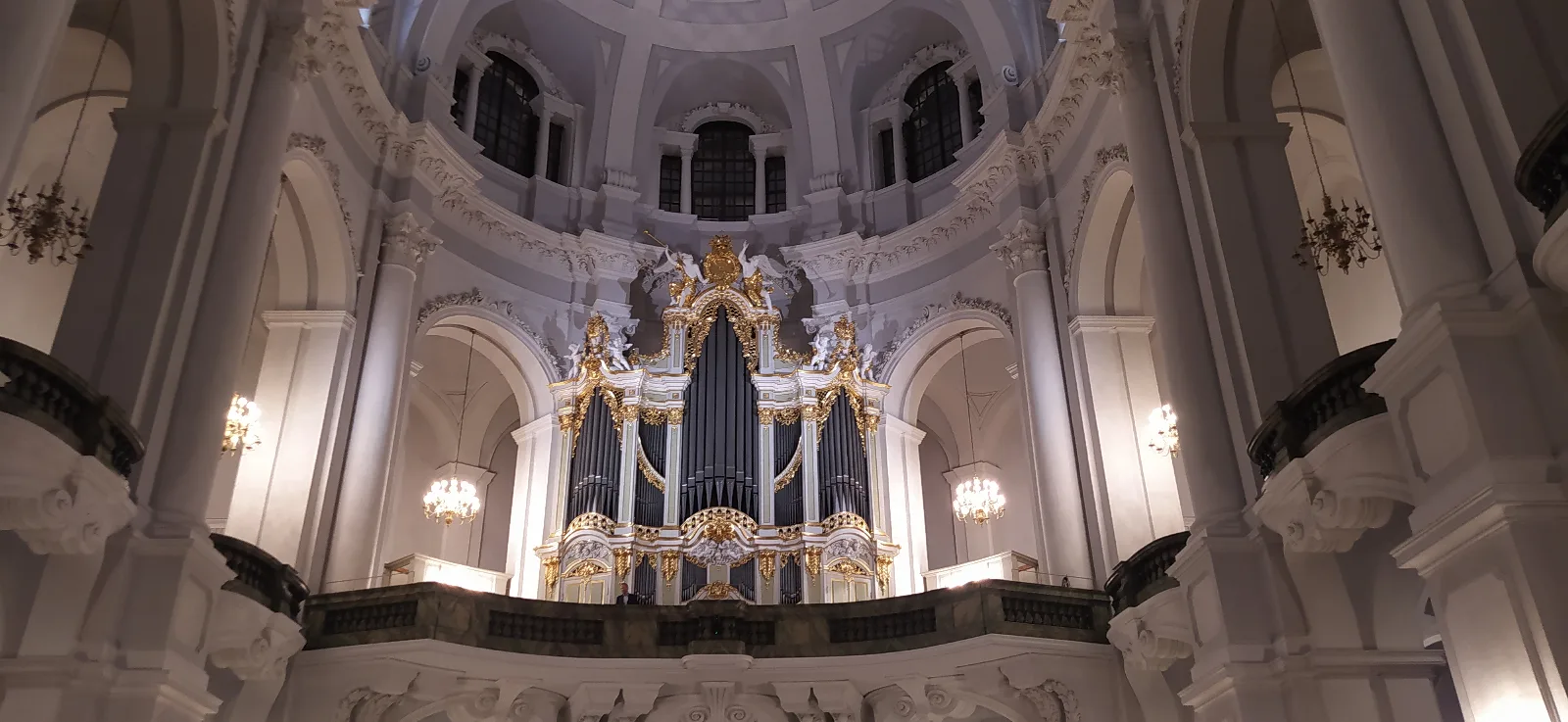
An organ concert in the Dresden Cathedral is also an encounter with history. The church, the former Catholic Hofkirche, houses an instrument of exceptional significance: the organ that Gottfried Silbermann (1683–1753) built at the end of his life. It was his last and largest instrument, with 47 stops, three manuals and pedal, and roughly three thousand pipes. The inauguration took place in 1755, two years after the organ builder's death.
During the destruction of Dresden in February 1945, the pipework could be saved, but the original organ case was lost. It was later reconstructed. After a thorough restoration, completed in 2002, the instrument regained as much as possible of its original tonal character. Whenever I am in Dresden, I always try to attend an organ concert in the cathedral. The combination of the instrument and the church space continues to fascinate me: the organ seems to form a natural part of the architecture. The sound fills the space and at the same time enters into dialogue with it. You experience how instrument and church reinforce each other.
For this edition of the Dresdner Orgelzyklus, Marcell Fladerer-Armbrecht took his place at the keyboards. He studied church music and organ in Detmold and Berlin, and since May 2024 has been city and cathedral organist in Brandenburg. For his programme he chose a thoughtful structure, in which two compositions on the same religious theme or the same chorale melody were always placed side by side. This allowed you to hear how composers from different periods approached the same musical starting point in their own way. The programme brought together music from over two centuries, from the late sixteenth to the early nineteenth century.
From Spanish splendour to German chorale art
The evening opened with Ave Maris Stella by José Lidón (1748–1827). The powerful, monumental opening made an immediate impression. From that first burst, the composition built towards a festive, almost jubilant whole. Especially the alternation between full and lighter registers appealed to me. The sound was at once rich and refined: deep registers gave the work an impressive foundation, while the higher voices sometimes sounded almost tender and fragile. It was a composition that revealed the possibilities of the Silbermann organ and carried me along from the first notes.
This was followed by Salve Regina by Sebastián Aguilera de Heredia (1561–1627), a composer who lived about two centuries earlier. The contrast could hardly have been greater. After the exuberant splendour of Lidón, the transition to this much stricter and more austere music took some getting used to. The registration remained largely uniform and the musical language sounded more restrained, although the work was richly ornamented. Precisely because of this sharp contrast, it became clear how strongly organ music changed over time.
The next two compositions were based on the chorale Vater unser im Himmelreich. Johann Ulrich Steigleder (1593–1635) and Georg Böhm (1661–1733) each gave their own interpretation of the same melody. Steigleder's Fantasia oder Fugen Manier über „Vater unser im Himmelreich“ initially convinced with its clear, sober character. Gradually, however, the contrapuntal working-out began to become somewhat uniform. The general austerity made the work rather long-winded over time, despite the organist's attempts to bring some variety to his playing. With Böhm, a very different freshness entered the programme. His approach sounded lighter and had an almost ethereal quality. It was a welcome change after Steigleder's more restrained composition and showed how differently two composers could treat the same chorale melody.
From Zachow and Buxtehude to Bach
Wie schön leuchtet der Morgenstern also served as the starting point for two very different works. Friedrich Wilhelm Zachow (1663–1712) kept his arrangement relatively short, but with a clear presentation of the melody he made an immediate strong impression. The sound had something nasal and folk-like, with a faint association with a bagpipe. This gave the work a very distinct tonal colour.
With Dieterich Buxtehude (1637–1707), the same chorale melody was treated at much greater length. His composition was more richly ornamented and showed more variety in registration. As a result, some tonal combinations took on something mysterious and strange. The shifting tonal colours and musical figures created surprising moments, but they did not hold my attention constantly. The composition as a whole felt too long to me: the ornaments and figures sometimes continued for a long time, and there were too few moments in which the music could come to rest.
With Johann Gottfried Walther (1684–1748) and Johann Sebastian Bach (1685–1750), the chorale Wachet auf, ruft uns die Stimme came next. Walther, a distant relative of Bach and a friend from his Weimar period, wrote an accessible and clear arrangement. The composition convinced without grand gestures.
Bach's chorale prelude Wachet auf BWV 645 then sounded somewhat faster than I am used to. As a result, some passages were given less room. The tempo remained consistent, however, and I found that more important than speed in itself. In Meine Seele erhebt den Herrn, BWV 648, the emphasis lay above all on the soft, intimate sound world that Fladerer-Armbrecht evoked. The various voices were woven together clearly, while the registration ensured a restrained and coherent whole.
The highlight of the evening came with Bach's Toccata and Fugue in D minor, BWV 565. It is a work performed so often that you think you know it through and through. Yet Fladerer-Armbrecht managed to give it a very personal interpretation. From the very beginning, the freer, less predictable phrasing stood out. He would sometimes unexpectedly ease off the tempo, allow silences, and give certain moments more space than one usually hears. That combination of virtuosity and stillness meant that I listened to this familiar work once again with full attention. It sounded different from what I expected, without losing its recognizability. Moreover, the music seemed completely at home on this instrument and in this church space. It was a convincing and personal conclusion.
An instrument that continues to amaze
Throughout the concert, Marcell Fladerer-Armbrecht proved to be a thoughtful organist, with a good sense of registration and of the possibilities of the Silbermann organ. The works by Lidón and Bach in particular stayed with me: the monumental, festive sound world of Ave Maris Stella, and the personal interpretation of a work I had already heard so many times.
The sound of the Silbermann organ remains fascinating, but it is above all the way this historic instrument comes to life in this space that moves me again and again. An organ concert in the Dresdner Kathedrale is always an encounter with an instrument and a sound world that cannot be experienced in quite the same way anywhere else.