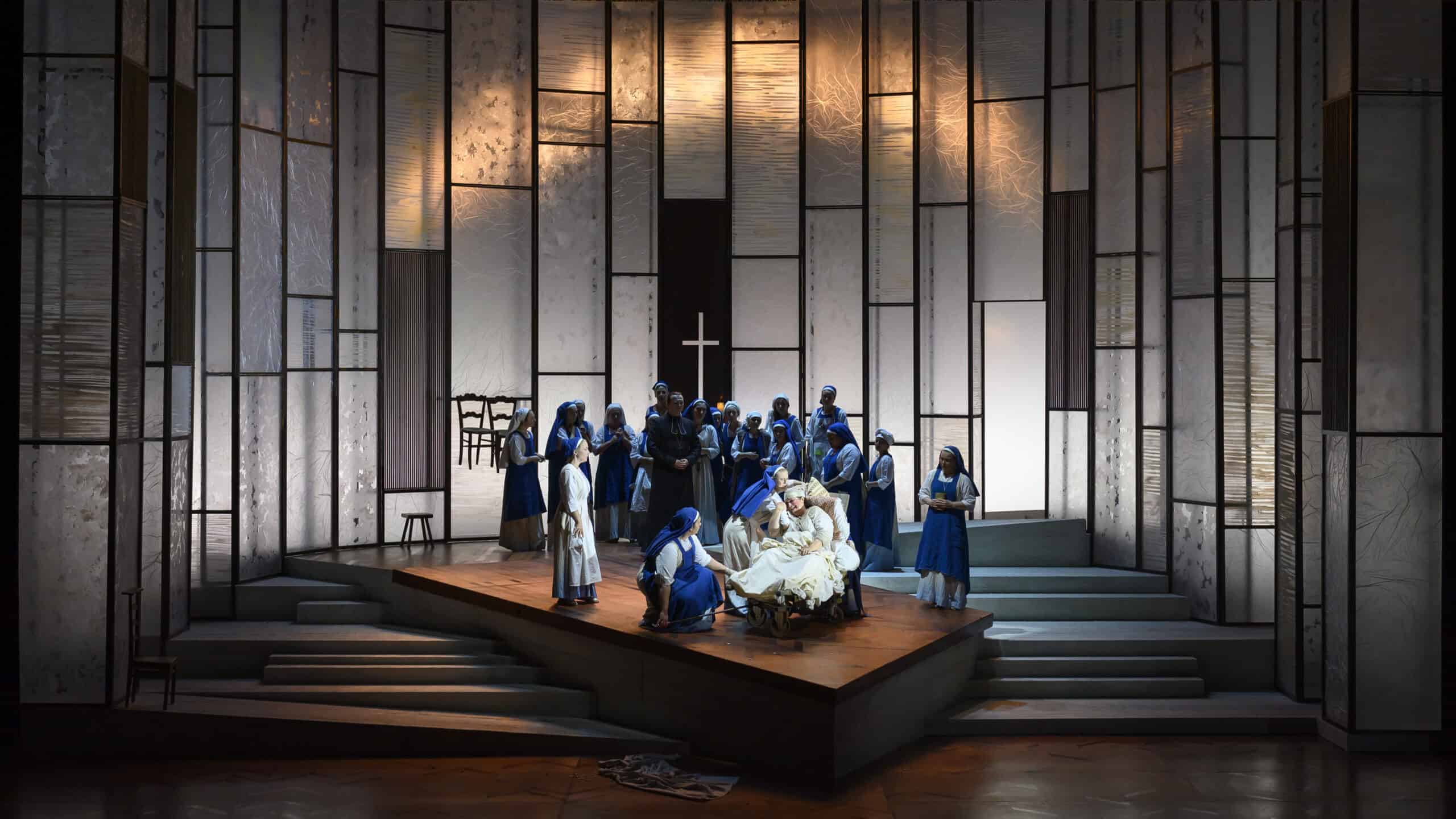
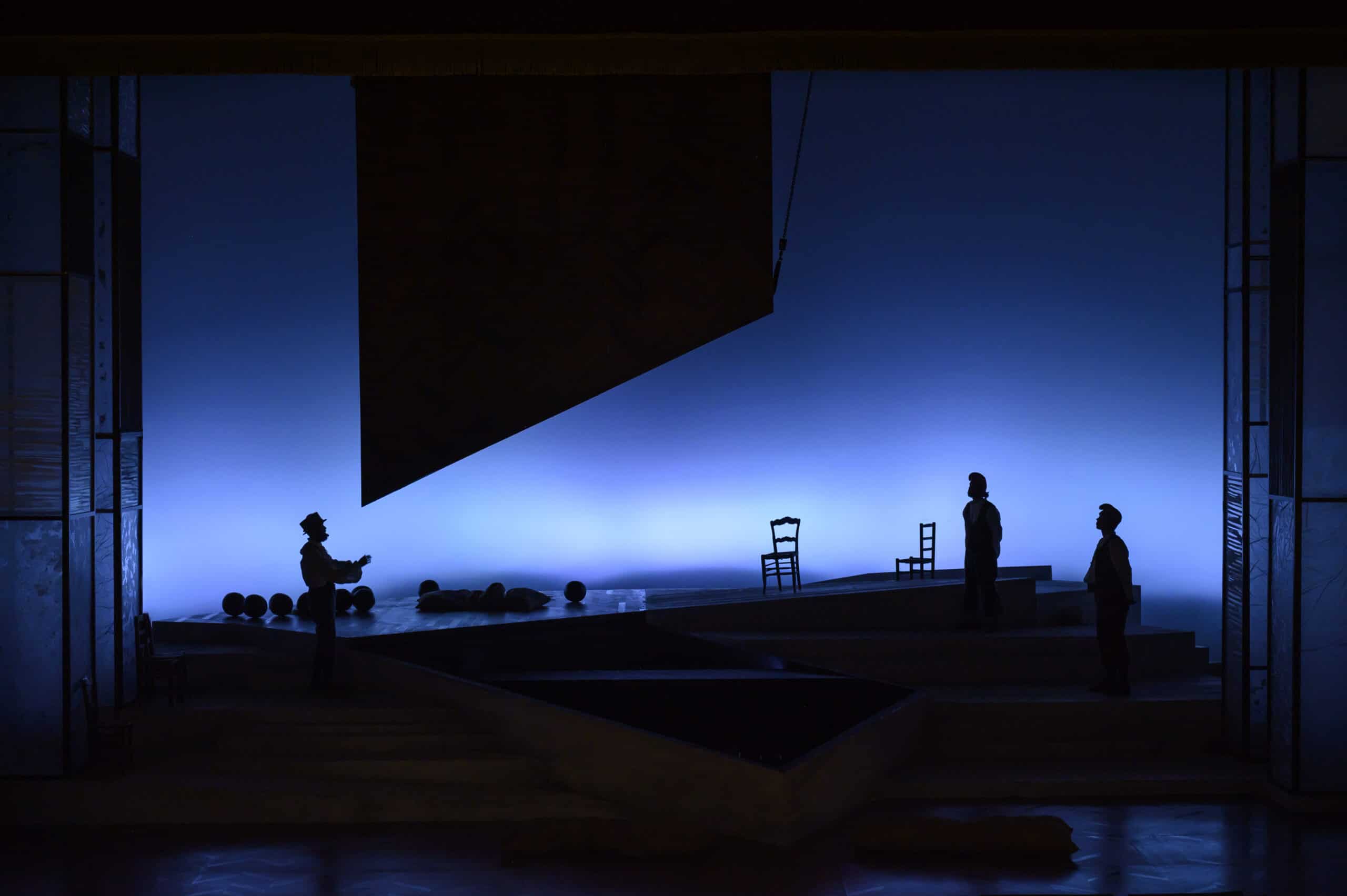
The Opéra Royal de Wallonie closed the season with one of the most gripping operas of the twentieth-century repertoire: Dialogues des Carmélites by Francis Poulenc. The opera premiered in 1957 at the Scala in Milan, but the story about the terror of the French Revolution that sends a small community of Carmelite nuns in Paris to the guillotine is still chilling, as demonstrated by the Opéra Royal de Wallonie's powerful production.
Francis Poulenc composed the opera during a period when he himself wrestled with existential questions about his relationship and was going through an inner crisis. In the play Dialogues des Carmélites by Georges Bernanos, he discovers the spiritual journey of Blanche that leads from acceptance of her shortcomings through detachment and inner peace to the choice of martyrdom. This becomes the core of his opera. Bernanos had based his play on a novella by Gertrud von le Fort, in which Blanche experiences human, existential fear, intensified by an apocalyptic time – in le Fort's case a clear metaphor for the advancing Nazism. The inspiration from le Fort gives Poulenc the idea to give Blanche the surname "de la Force". Poulenc found in Blanche's fear a dramatic translation of his own despair in the period after World War II.
The story
During the French Revolution, Blanche de la Force, a girl of noble birth, tries to overcome her fear of the world by entering the Carmelite convent community. The Prioress quickly makes it clear to her that the convent is not a refuge, not a place to solve personal problems or to lead a heroic life. Blanche must reconcile her existential fear with her religious calling. As a young novice, she witnesses the death throes of the old prioress. The sisters are expelled from the convent by supporters of the French Revolution and during the exodus, Blanche drops a small statue of baby Jesus, which burdens her with guilt and reawakens her sense of fear. She escapes the convent and returns to the house of her father, who has since been executed. When she learns that the sisters are condemned to the scaffold, she feels the exaltation of faith again and, freed from fear, she joins the sisters as they one by one ascend the scaffold and the guillotine falls upon them.
Modernity and devotion
It is the strength of Francis Poulenc that he manages to write a work that is modern yet deliberately remains tonal. The vocal line is melodious without traditional virtuosity, the recitatives are simple. The story unfolds in short scenes without grand arias but with a few recurring motifs that characterize the characters. (Blanche, Mère Marie, or the motif of death). The choral parts often resemble church hymns and prayers and are particularly impressive in the final section Salve Regina, with one voice dropping out each time. The orchestration is subtle and spare, supporting the dramaturgy with, of course, the climax in the final scene, which is breathtaking through the combination of music with the fall of the guillotine and the successive silencing of each voice.
[caption id="attachment_50505" align="aligncenter" width="2560"]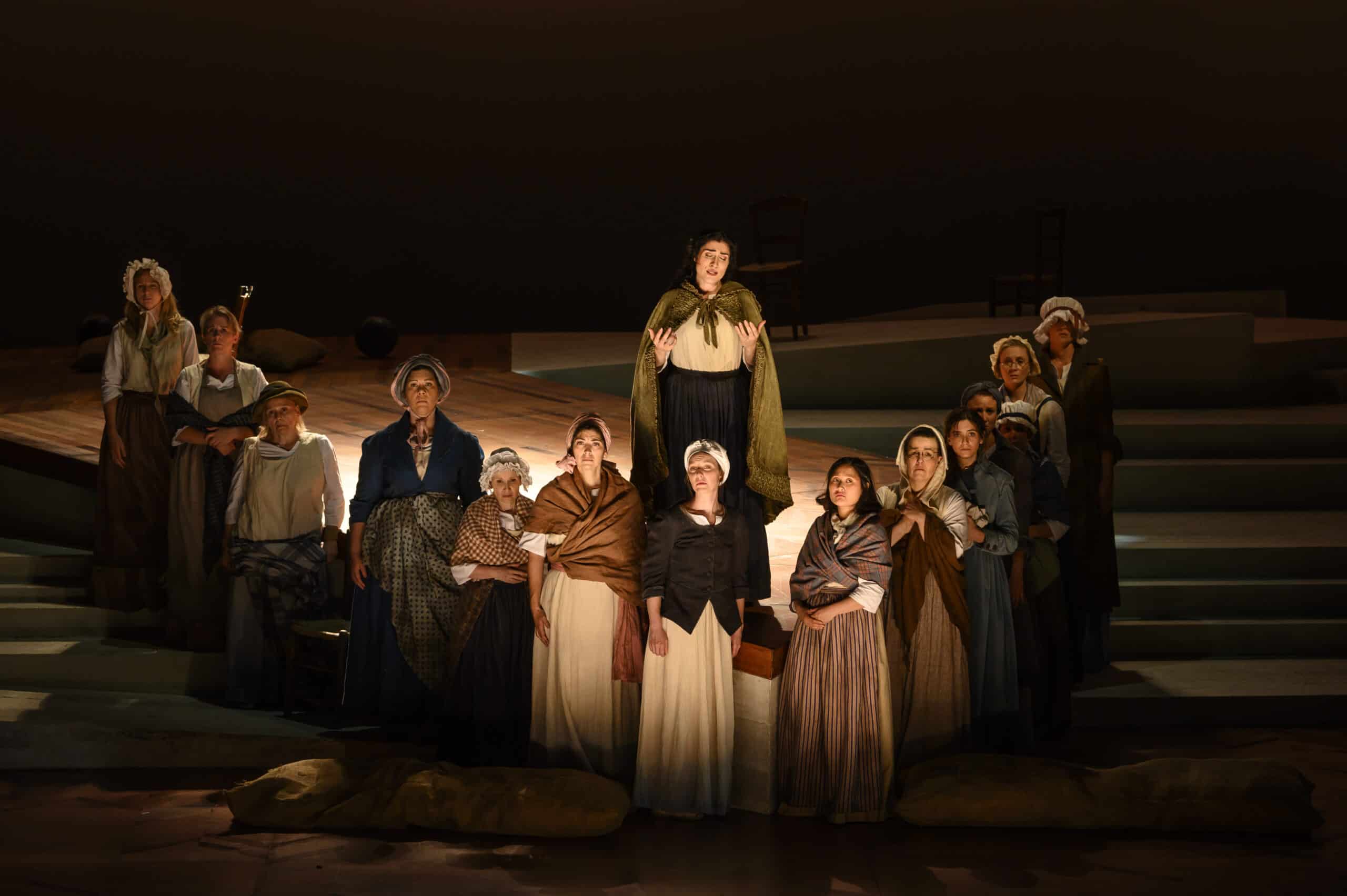 © J. Berger[/caption]
Authentic sobriety
This production is yet another illustration that ORW manages to present the essence of an opera in an efficient and, above all, sober manner. The direction by Marie Lambert-Le Bihan presents the convent community as a close-knit group of women in their daily religious activities and small interpersonal concerns and relationships. The nuns are believable women, earthy and primitive, frivolous or neurotic.
After the opening scene with the domestic tableau in the library of the de la Force family, the set is a stylized space with glass walls and refined lighting as a suggestion of the convent, within which the sisters lead their lives. They are dressed in simple white and blue. The behavior of each nun is consistent with who she is according to her text and role in the opera. Thus, Blanche is unmistakably tormented by fear and doubt, the other novice is naive, the new prioress is stern. The most moving scene is of course the death of the old prioress. As a physically damaged but inwardly still strong woman, she lies centrally on a platform on the stage so that she fixes the gaze of the spectator upon herself, as it were. In the third act, the tension builds with the appearance of the officers as clear representatives of the revolution. The decision to choose martyrdom is already a foreshadowing of the chilling final scene in which the sisters fall victim to the guillotine one by one. The central platform of the stage is raised as a set element and forms a massive guillotine above the heads of the row of sisters who fall one by one. Blanche rejoins her community at the last moment, as the culmination of her inner drama and spiritual quest.
[caption id="attachment_50504" align="aligncenter" width="2560"]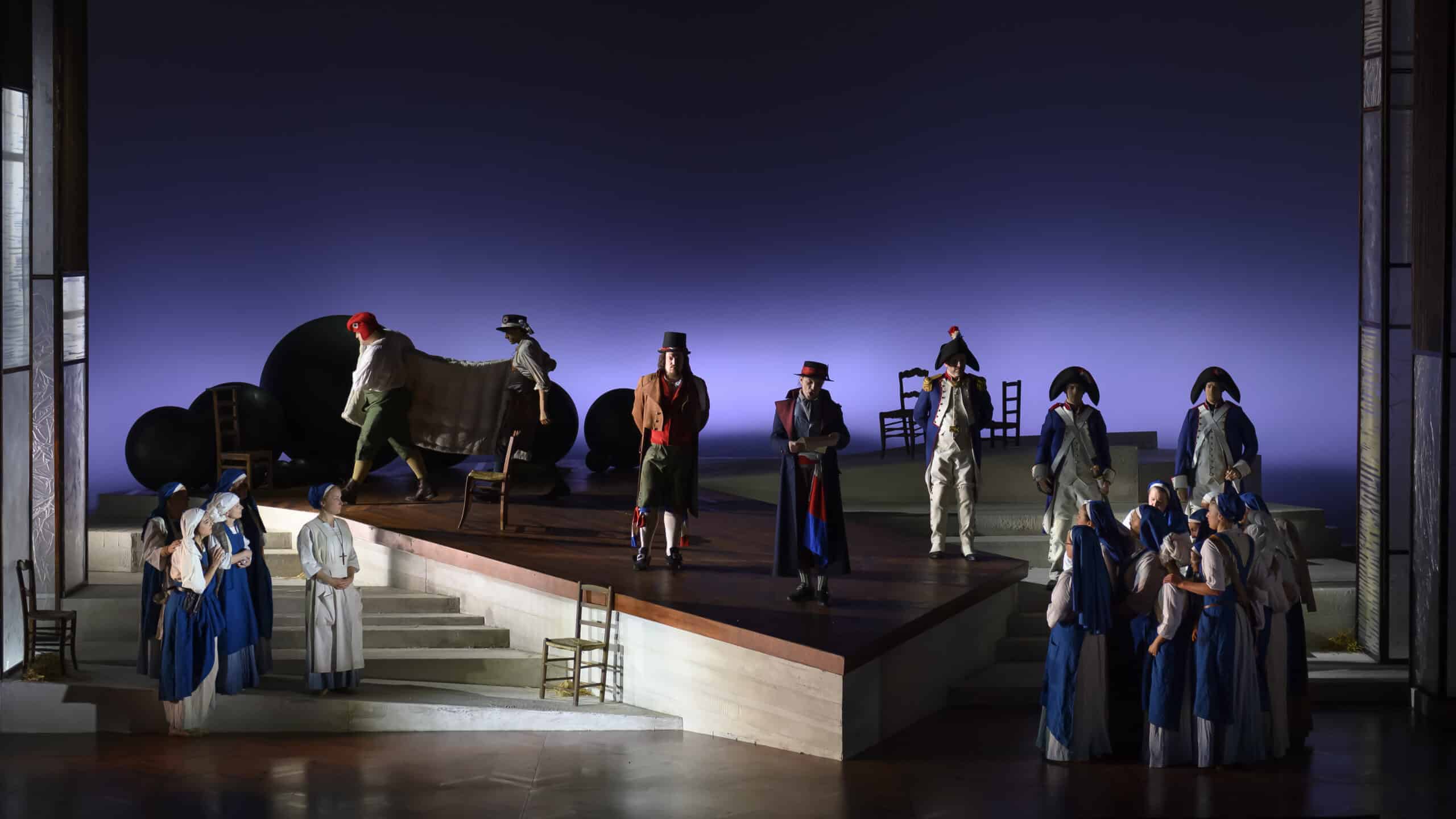 © J. Berger[/caption]
Musical intensity
The singers immerse themselves completely in the unique experience of a convent community. The role of Blanche was sung by the somewhat sharp-sounding soprano Alexandra Marcellier who nonetheless conveyed her part very convincingly. Julie Pasturaud was the impressive old prioress. With confident mezzo she drew the spectator into her painful struggle face to face with death.
Speranza Scappucci lets the music of Poulenc speak/sing so powerfully through orchestra, choir and soloists, that you experience the religious impact and feel the pain of the unjust and cruel demise of the sisters who have devoted themselves to something higher. The laudate Dominum that the young novice Soeur Constance strikes up when ascending the scaffold gives goosebumps, which become increasingly severe as the sisters sing with one voice fewer. The crash of the guillotine is stark but no spectacle: thus Scappucci knows how to find the right dosage and follows with precision and concentration the episodes of the gripping story. She also gives the interludes their value each time as a kind of meditation resting points. It was both for the audience and certainly also for the orchestra a joyful reunion with the conductor. The orchestra made that heard with the spontaneous rendition of "until we meet again" at the end of this final performance of the season.
Dialogues des Carmélites takes a unique place in the opera repertoire; it is the crowning achievement of the religious oeuvre of the believer Poulenc. Even though a proper understanding of the opera requires openness to spiritual thinking, the score with its warm humanity and its sometimes Puccinian emotionality leaves no one unmoved. This production by Opéra Royal de Wallonie proved this unequivocally. An intense conclusion to the opera season in Liège.
WHAT: Francis Poulenc Dialogues des Carmélites
WHO: Marie Lambert-Le Bihan [direction], Speranza Scappucci [conductor]
With: Alexandra Marcellier, Julie Pasturaud et al. Orchestra, Choirs Opéra Royal de Wallonie-Liège
WHERE: Opéra Royal de Wallonie-Liège
WHEN: 29-6-2023 (final performance)