The Royal Opera House Covent Garden in London closed the season with a rather
unusual world premiere: the very first performance of "L'Ange de Nisida", the opera by Donizetti
that was never performed but whose score was partially "reused" in "La
Favorite"
"L'Ange de Nisida" was to have been one of the first works Donizetti wrote specifically for Paris, where he had settled in 1838. It was a commission from the Théâtre de la Renaissance, where a production of his "Lucie de Lammermoor" had been a triumph in August 1839. The composition of "L'Ange de Nisida" was completed in December 1839 and preparations for the premiere began, but the date was repeatedly postponed. In May 1840 the Théâtre de la Renaissance went bankrupt and "L'Ange de Nisida", the opera specifically intended for this theater, was lost in the process.
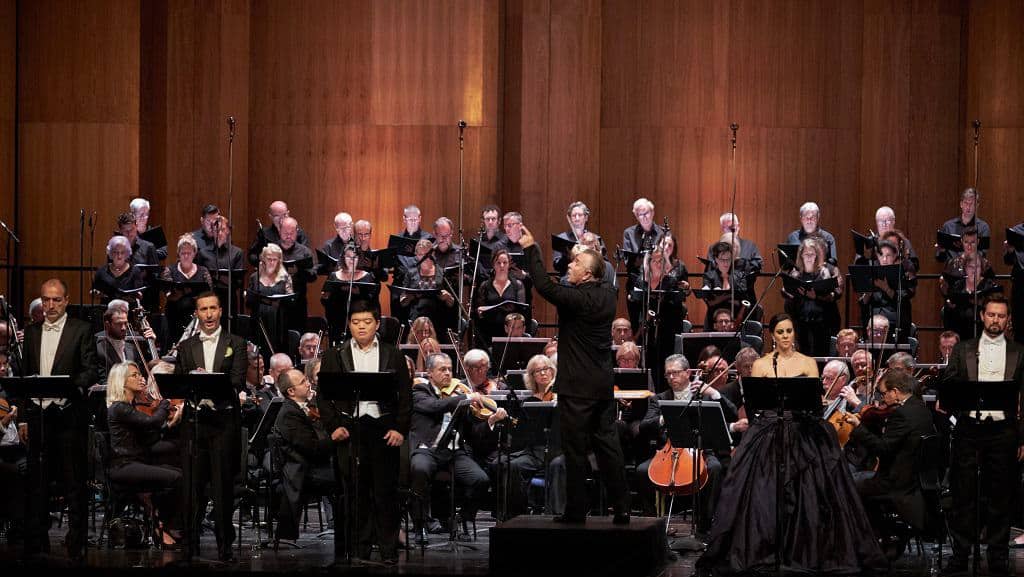
Donizetti did attempt to interest other theaters in the work and adapt it, but without success. Eventually he recycled quite a few pages of the score of "L'Ange de Nisida" in "La Favorite", adapting the text as well as the vocal parts and orchestration to use these fragments in a different dramatic context. The rest of the "L'Ange de Nisida" score, a rather incoherent collection of approximately 500 manuscript pages, was preserved in the Bibliothèque Nationale de France in Paris. Under the direction of Dr. Candida Mantica, musicologists succeeded over the course of about ten years in reconstructing the score of "L'Ange de Nisida" as Donizetti had intended it. This is the version that has now been presented in concert form at Covent Garden and recorded by "Opera Rara", the organization that specializes in rediscovering 19th-century repertoire. The CD edition, with extensive commentary, is scheduled for release next year.
The libretto by Alphonse Royer and Gustave Vaëz bears a strong resemblance to that of "La Favorite": Sylvia, the angel of Nisida (a small island near Naples), is the king's mistress who is forced to leave him. He has her marry Leone, a man who secretly loves her but does not know who she really is. When Leone discovers this to his shame, he seeks refuge in a monastery. Sylvia finds him there to ask forgiveness and to die. But unlike "La Favorite", "L'Ange de Nisida" is a "opera semiseria" with a character, Don Gaspar, the king's chamberlain, who provides a rather disturbing, inappropriate comic note and certainly does not give the libretto greater dramatic power. But once the first act and Don Gaspar's interventions are over, the score of "L'Ange de Nisida" offers many fine passages (often indeed borrowed from "La Favorite") with a splendid quartet and
great ensembles.
At the head of the Royal Opera orchestra, Mark Elder brought life, color and brilliance to Donizetti's score and led and inspired the ensembles with a firm hand. Arranged for the requirements of the recording and the placement of microphones, the singers did not have many opportunities to give this concert version much dramatic interaction. The one with the most opportunities was Laurent Naouri, the only Francophone singer in the cast, who with his sonorous voice and exemplary text projection presented a picturesque and irritating Don
Gaspar. The role of Sylvia does not offer the singer the same dramatic possibilities as that of Leonore in "La Favorite". Joyce El-Khoury gave her character nobility and emotion, but lacked somewhat in conviction and her soprano could have used more color and warmth. David Junghoon Kim (Leone) sang his arias elegantly with a nice bel canto style but little dramatic interpretation. Vito Priante gave the King vocal allure and Evgeny Stavinsky displayed a beautiful bass voice in the role of the Abbot. The choirs of the Royal Opera did well.
A belly laugh as farewell!
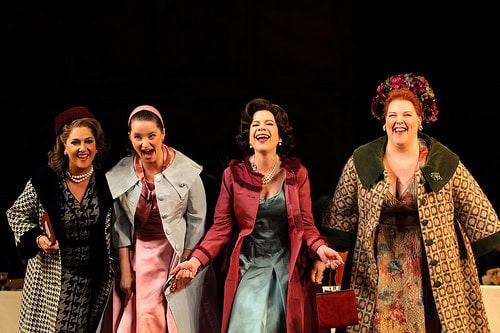
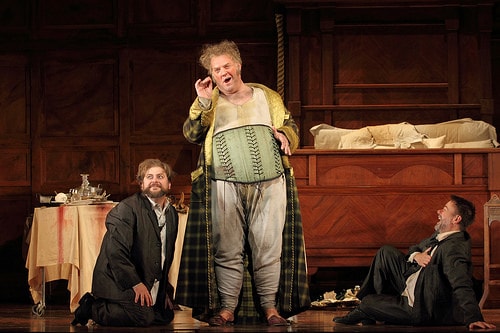
To round off the season with a laugh, the Royal Opera presented a revival of Verdi's Falstaff in the staging by Robert Carsen, seen for the first time at Covent Garden in the 2011-12 season. The Canadian director, well known to us thanks to his productions for Opera Vlaanderen and now internationally in demand, situates the action around 1950 but betrays neither Shakespeare nor Verdi. In a suggestive set by Paul Steinberg, he accentuates the contrast between the often impoverished English nobility (Falstaff) and the "nouveaux riches" of the middle class (Ford and the merry wives of Windsor) and makes hunting, so beloved in England, an important theme. This production has lost none of its elan, its contagious good humor and its touch of melancholy and once again you could admire the excellent direction of the characters and the choirs with the attention to detail that characterizes Robert Carsen's stagings.
The performance was interpreted with verve by a homogeneous ensemble under the musical direction of Nicola Luisotti, who made Verdi's masterly score shine and kept the performance engaging from the first to the last note.
Of course, in the first place, there was Bryn Terfel's Falstaff, a "grand seigneur" even in his rather humble circumstances who detailed the text and musical phrases with care, excellent text projection and his expressive, sonorous voice, creating a character full of humor and humanity. Marie-Nicole Lemieux repeated her memorable Mistress Quickly, so vital and amusing and sung with her ample, warm voice. She was well surrounded by Ana Maria Martinez (an elegant Alice), Marie McLaughlin (Meg) and Anna Prohaska (a fine Nannetta). Her admirer Fenton had the youth and supple voice of Frédéric Antoun. Simon Keenlyside was not as convincing as Ford, little presence and weak voice). Peter Hoare gave temperament to Dr. Caius and Michael Colvin and Craig Colclough (recently heard as Falstaff in Opera Vlaanderen) gave life and color to Bardolfo and Pistola. A performance that you leave with a good feeling and a smile!
- WHAT: L'Ange de Nisida, Falstaff
- WHO: Gaetano Donizetti, Mark Elder, Laurent Naouri, Joyce El-Khoury, David Junghoon Kim, Vito Priante, Evgeny Stravinsky, Giuseppe Verdi, William Shakespeare, Robert Carsen, Paul Steinberg, Nicola Luisotti, Bryn Terfel, Marie-Nicole Lemieux, Ana Maria Martinez, Marie McLaughlin, Anna Prohaska, Frédéric Antoun, Simon Keenlyside, Peter Hoare, Michael Colvin, Craig Colclough
- WHERE & WHEN: London Royal Opera House Covent Garden, 18-21 July 2018 (L'Ange de Nisida), 7-21 July 2018 (Falstaff)
- PHOTOS: Russell Duncan, Catherine Ashmore (The Royal Opera © 2018)